
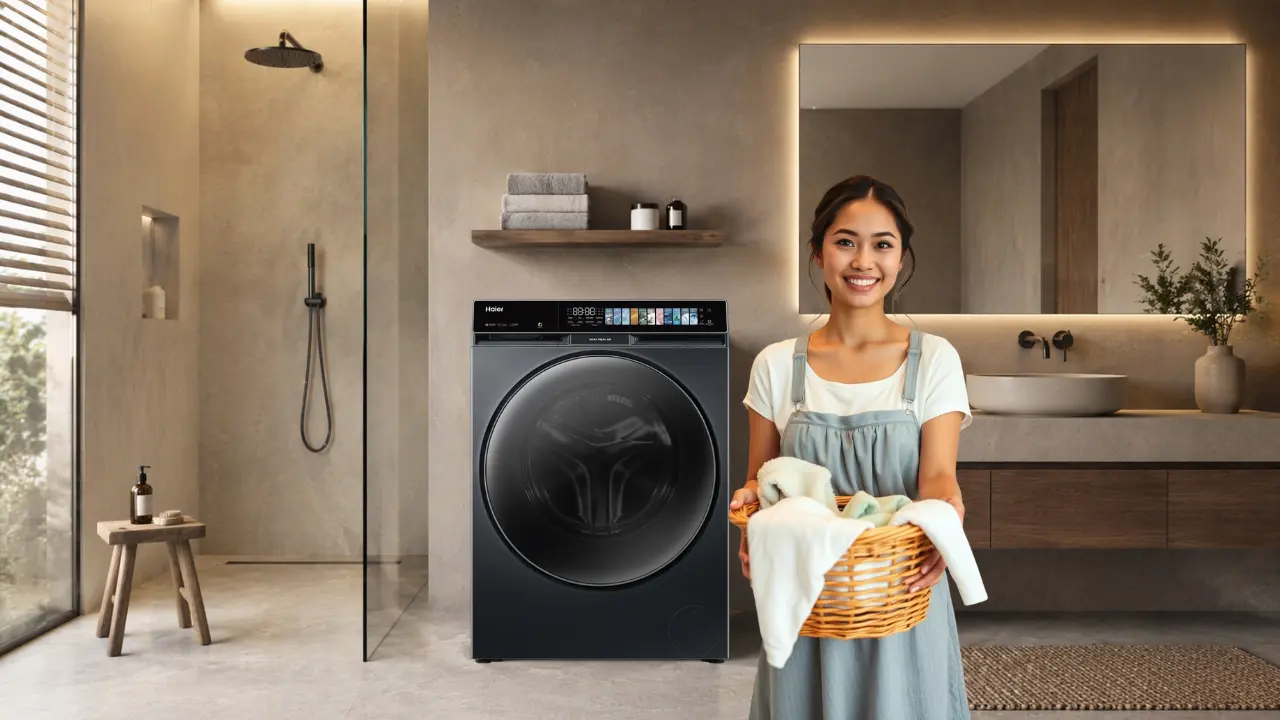

Haier improves laundry efficiency by turning washing into a self-optimising system. It senses load, fabric, and dirt level, then adjusts water, time, and energy automatically.
The result is simple. Cleaner clothes, lower effort, and fewer resources used in every cycle.
Laundry is not about washing. It is about managing chaos.
It is Sunday evening.
A pile of clothes sits on the chair. Gym wear from the week. Office shirts. Kids’ uniforms. A sari worn once at a function.
Each piece asks for something different.
But the washing machine? It usually gets one command.
Start.
That is where inefficiency begins.
Laundry is not a single task. It is a system of decisions.
- What to wash together
- How much detergent to use
- Which cycle to choose
- When to run the machine
Most homes manage this system manually. And manual systems always leak time, energy, and effort.
Efficiency, then, is not about speed. It is about removing decisions.
Why traditional laundry systems quietly fail
Most washing machines still expect you to think like a technician.
Select fabric type. Adjust spin speed. Estimate load. Guess water level.
It sounds simple. It rarely is.
Here is what usually happens:
Three hidden inefficiencies in everyday laundry
- Overwashing
- Clothes run longer cycles than needed
- Leads to higher electricity and water usage
- Under-optimised loads
- Half-loads consume almost the same energy
- Poor sorting leads to ineffective cleaning
- Manual errors
- Wrong settings damage fabrics
- Excess detergent causes residue
According to energy efficiency studies, modern front-load washing machines already use up to 40 percent less water than traditional top-load models. But the real savings come from how intelligently they operate.
That is the gap Haier focuses on.
Not just machines.
But decisions.
Efficiency begins when the machine starts thinking
The shift is subtle.
Instead of asking the user to decide everything, the system observes first.
That is the logic behind features like One-Touch AI Wash in models such as the
It works like this:
What the machine does automatically
- Detects fabric type
- Measures load weight
- Analyses dirt level
- Adjusts water, time, and spin speed
All in one touch.
No trial and error. No second guessing.
A good system removes effort. A great system removes uncertainty.
The efficiency equation: time, water, energy
Every laundry cycle is a balance between three resources:
| Resource | Traditional Approach | Smart Approach |
| Time | Fixed cycles | Adaptive cycles |
| Water | Pre-set levels | Load-based adjustment |
| Energy | Uniform usage | Optimised consumption |
Haier’s Smart Wash systems actively balance all three.
That matters more than it sounds.
Because most machines optimize one variable.
Efficient systems optimize all three together.
Capacity is not about size. It is about flow
Think about a typical Indian household during festival season.
More clothes. More guests. More washing cycles.
Here, capacity becomes a bottleneck.
Machines like the 12 Kg front load models are not just bigger. They change how laundry flows through the week.
Two ways to think about capacity
- Small capacity approach
- More frequent cycles
- Higher cumulative energy use
- More time spent managing loads
- High capacity approach
- Fewer cycles
- Better batch processing
- Lower overall effort
The Super Drum design increases drum diameter to improve washing efficiency and reduce tangling, improving wash quality by up to 25 percent.
Efficiency is not about doing things faster. It is about doing fewer cycles.
What happens when friction disappears
Laundry feels tiring because of interruptions.
Noise. Timing. Manual monitoring.
This is where small features quietly change behaviour.
Examples that reshape daily use
- Night Wash mode
- Runs silently
- Fits into off-peak hours
- Reduces schedule pressure
- WiFi-enabled control
- Start or monitor remotely
- Get notifications when done
- Removes the need to “wait around”
- iRefresh steam care (in 10 Kg models)
- Refreshes lightly worn clothes
- Reduces full wash cycles
- Saves time and water
Each feature solves a small problem.
Together, they redesign the experience.
Convenience is not a feature. It is the absence of friction.
Hygiene is an efficiency multiplier
Most people separate hygiene and efficiency.
They should not.
Cleaner machines reduce rework.
Rewashing clothes wastes time, water, and energy.
How Haier addresses hygiene efficiently
- Dual Spray technology
- Cleans lint and residue from drum and gasket
- Prevents contamination between cycles
- Reduces need for maintenance washes
- Allergy care and high-temperature programs
- Remove bacteria and allergens
- Reduce repeated washing
- Self-clean cycles
- Maintain machine health automatically
Every time you avoid a second wash, you double efficiency.
The silent system behind efficiency: the motor
Most users never think about the motor.
They should.
Because it determines energy use, noise, and durability.
Haier uses Direct Motion Motors that connect directly to the drum.
Why this matters
- Fewer moving parts
- Less vibration
- Lower energy consumption
- Longer lifespan
Benefits like reduced noise, energy saving, and precise control.
This is not visible.
But it shapes every cycle.
Good engineering is invisible. Great engineering is felt.
Three ways to approach laundry efficiency at home
Most households fall into one of these patterns.
1. The reactive approach
You wash when the pile becomes too big.
- Cost: Time pressure, inefficient cycles
- Benefit: Minimal planning
2. The scheduled approach
You assign fixed laundry days.
- Cost: Less flexibility
- Benefit: Predictable routine
3. The system-driven approach
You let the machine optimize cycles based on load and usage.
- Cost: Initial setup and learning
- Benefit: Maximum efficiency with minimal effort
Haier designs for the third.
Because systems scale. Habits don’t.
What this means for modern Indian homes
Laundry used to be a chore.
Now it is a background process.
Think about how other appliances evolved.
- Refrigerators manage temperature automatically
- ACs adjust cooling based on room conditions
- TVs recommend what to watch
Laundry is catching up.
Machines are becoming decision-makers.
Not just executors.
The real shift: from control to trust
People used to trust their judgement more than machines.
That is changing.
Because machines now observe more variables than we can.
Fabric type. Load weight. Water level. Dirt intensity.
All at once.
Efficiency grows when control shifts to intelligence.
A simple takeaway most people miss
Laundry efficiency is not about doing laundry better.
It is about thinking about laundry less.
That is the real upgrade.
Less time deciding.
Less effort managing.
Less energy wasted.
The broader implication
Every home runs on invisible systems.
Cooking. Cooling. Cleaning. Washing.
When these systems become intelligent, life becomes lighter.
Not dramatically.
But consistently.
And that consistency compounds.
Because small efficiencies, repeated daily, shape how a home feels over time.
A well-designed home is not one that looks good. It is one that works quietly in your favour.
Frequently Asked Questions
Why do I feel mentally tired just thinking about doing laundry every week?
Because laundry isn’t one task it’s dozens of micro-decisions (sorting, timing, detergent, cycles). Systems like those from Haier India reduce that decision load by automating choices.
Do I really need to decide fabric type, water level, and cycle every time I wash clothes?
Not anymore. AI-driven washing systems can detect these automatically, removing the need for manual guesswork.
I always delay laundry until it piles up. Am I doing it wrong?
Not wrong, just inefficient. Reactive laundry leads to rushed decisions and suboptimal loads. A system-driven approach spreads effort and optimizes each cycle.
How can I make laundry feel like a background task instead of a chore?
Use machines that automate decisions (load sensing, AI wash, scheduling). The less you decide, the lighter it feels.
I left my laundry in the washer overnight. Do I need to rewash it?
Often yes, especially in humid conditions. Bacteria and odor can develop quickly. Machines with hygiene cycles reduce this risk.
Why do my clothes sometimes smell even after washing?
Likely causes: detergent residue, overloaded drum, or dirty machine interiors. Features like Dual Spray or self-clean cycles help prevent this.
How does an AI washing machine actually decide what to do?
It uses sensors to detect load weight, fabric type, and dirt level, then adjusts water, time, and energy automatically.
What does “One-Touch AI Wash” really mean for me?
You press start once. The machine handles everything else, no manual configuration needed.
Can I control my washing machine remotely?
Yes, WiFi-enabled models let you start, pause, or monitor cycles from your phone no need to stay nearby.
Is a bigger washing machine always better?
Not always but higher capacity reduces the number of cycles, improving overall efficiency for families.
What’s the real benefit of features like Night Wash mode?
It reduces noise and lets you run laundry during off-peak hours, freeing up your day.