
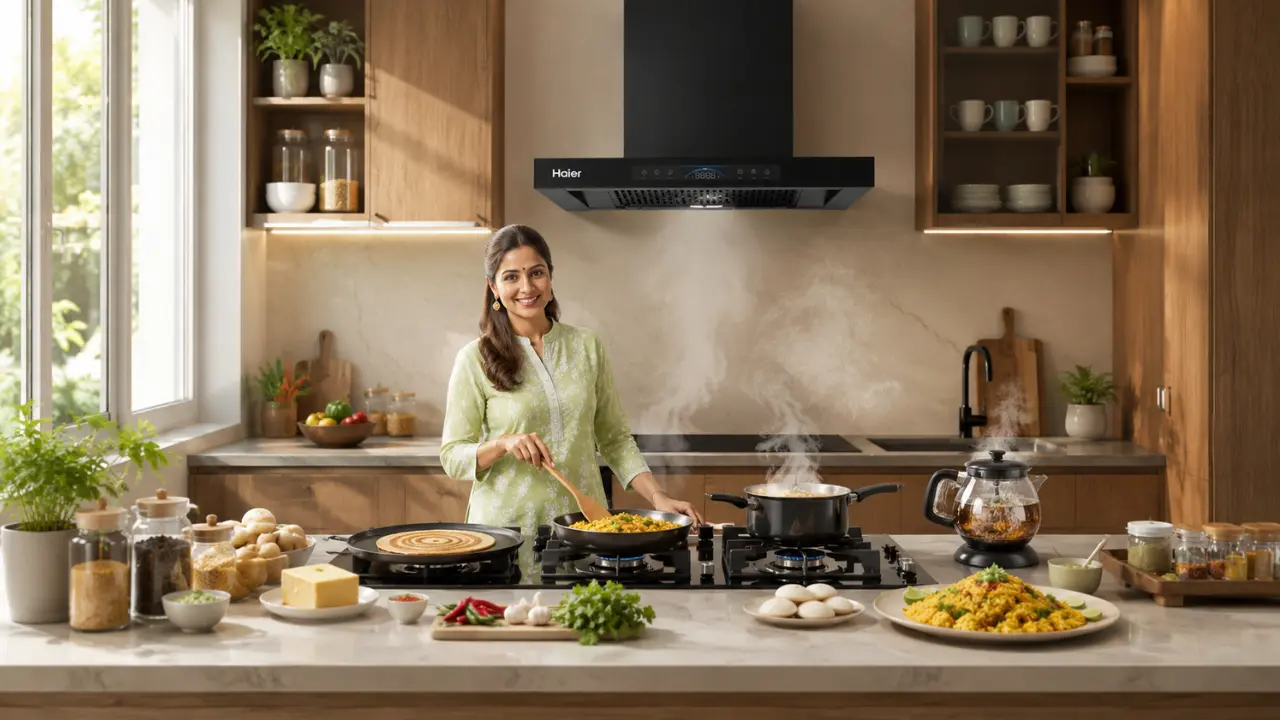

A kitchen chimney is no longer a luxury in Indian homes. It is becoming infrastructure.
Daily Indian cooking creates a very specific kind of kitchen environment.
Hot oil. Tempering smoke. Masala vapours. Steam from pressure cookers. The sharp smell of garlic tadka that quietly travels from the kitchen into curtains, cushions, and wardrobes.
Most people notice the problem slowly.
First, the walls lose freshness. Then cabinets feel sticky. Then the kitchen starts holding yesterday’s cooking long after dinner is over.
A good kitchen chimney changes that system entirely.
Not because it looks modern. Because it changes how the kitchen behaves every day.
And that matters more than most people realise.
Indian kitchens are built differently from global kitchens
A lot of appliance conversations borrow ideas from Western homes.
Minimal cooking.
Light grilling.
Occasional baking.
That is not how most Indian homes function.
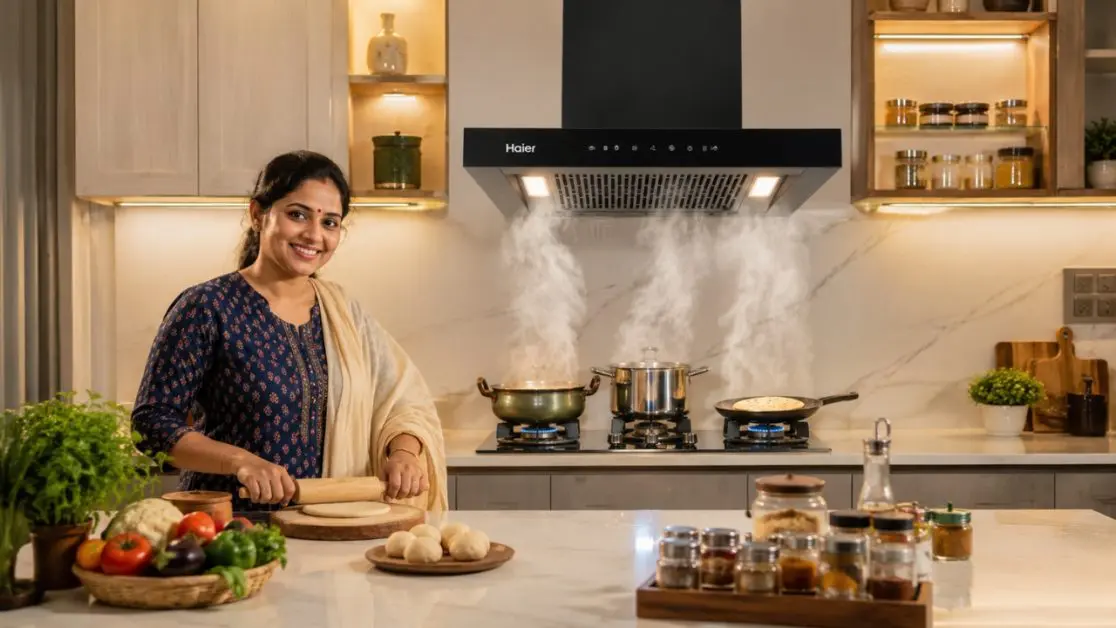
Indian cooking is intense by design.
A regular weekday can involve:
- Deep frying
- Tadka
- High-flame cooking
- Multiple dishes together
- Long simmering gravies
- Rotis running continuously during dinner
Now add monsoon humidity, compact apartment layouts, and open kitchens.
The air has nowhere to go.
That is why chimney performance matters more in India than in many other markets.
A chimney is not just removing smoke. It is managing air behaviour inside the home.
And once you see it that way, buying decisions become clearer.
The hidden cost of not using a kitchen chimney
Most people calculate appliance costs incorrectly.
They look at the purchase price.
Rarely the cumulative friction.
But homes operate like systems.
When smoke and grease circulate daily, the costs show up elsewhere:
One cost is cleaning fatigue
Oil particles settle everywhere.
- Kitchen cabinets
- Tiles
- Glass surfaces
- Ceiling corners
- Dining spaces near open kitchens
The cleaning load quietly increases every week.
The second cost is trapped odour
A kitchen without airflow becomes memory foam for smells.
Fish fry from lunch stays until bedtime.
Weekend tadka lingers into Monday morning meetings.
The third cost is heat
Indian cooking already generates enough thermal discomfort.
Without proper suction, kitchens become exhausting during summers.
Especially in apartments.
A comfortable kitchen changes how willingly people cook.
That insight matters.
Why suction power matters more than fancy marketing terms
People often get distracted by aesthetics first.
Black glass finish.
Touch panels.
Curved designs.
Those matter. But they are secondary.
The real question is simple:
Can the chimney handle daily Indian cooking intensity?
That is where suction power becomes important.
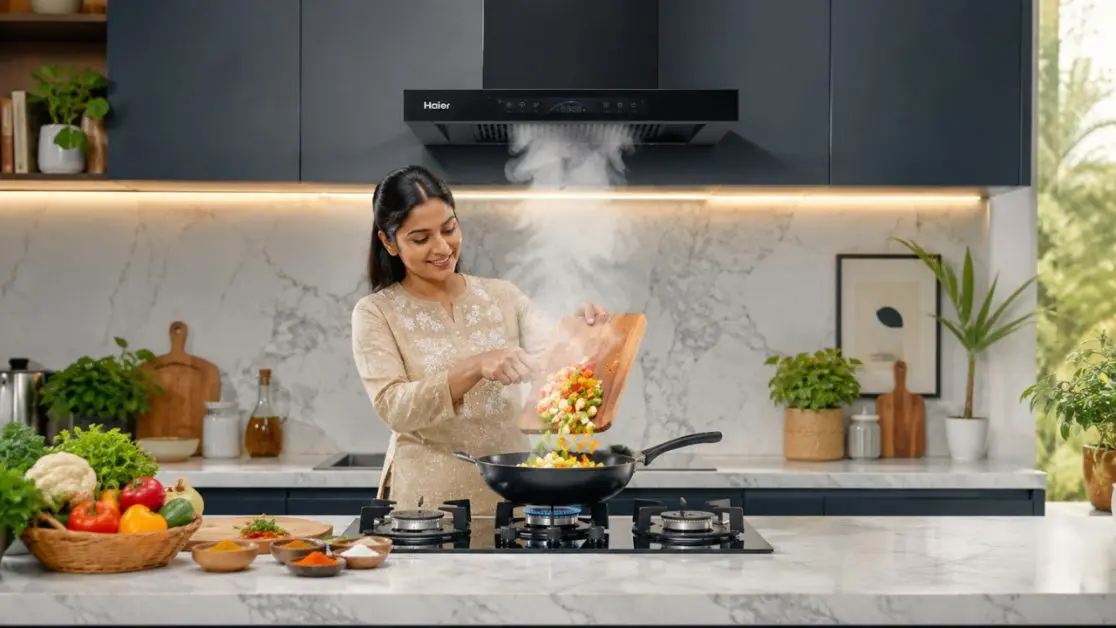
For example, several Haier kitchen chimney models focus heavily on high suction capacity ranging from 1500 m³/h to 1600 m³/h for Indian cooking conditions.
That specification sounds technical until you translate it into lived experience.
Higher suction generally means:
- Faster smoke removal
- Better grease capture
- Lower lingering odour
- More comfort during high-flame cooking
In practical terms, it means your kitchen recovers faster after cooking.
That recovery time matters more than people think.
The best kitchen technology is the kind you stop noticing
Good appliances disappear into routine.
Bad appliances constantly demand attention.
This is where modern kitchen chimney design has evolved quietly.
One shift is gesture control
Think about actual cooking conditions.
Hands covered in atta.
Oil splatter.
Wet fingers while handling utensils.
Touchless controls suddenly become practical instead of futuristic.
Some Haier chimneys now include Touch & Gesture controls for hands-free operation during cooking.
Not because gestures are flashy.
Because kitchens are messy environments.
Technology works best when it respects reality.
The second shift is filterless systems
Traditional filter cleaning is one reason many people stop using chimneys consistently.
Maintenance becomes friction.
Friction becomes avoidance.
Filterless chimney systems reduce that burden significantly.
Several Haier chimney models highlighted in the product sheets use filterless designs combined with Heat Auto Clean technology.
That matters because Indian cooking produces heavy grease.
A system that manages grease buildup automatically changes long-term usability.
And usability determines whether appliances become habits or decoration.
Heat Auto Clean is solving a very Indian problem
There is a reason this feature keeps appearing across modern chimneys.
Grease accumulation.
Not visible on Day 1.
Very visible after eight months.
Heat Auto Clean systems melt accumulated grease internally and direct it toward oil collectors for easier maintenance.
That sounds small.
It is not.
Because the most expensive appliance is the one people stop maintaining.
And maintenance failure usually begins with tasks that feel annoying, repetitive, or difficult.
The smartest appliance companies understand this:
Convenience is not a luxury. Convenience is retention.
Noise changes kitchen psychology more than people admit
Many households tolerate noisy appliances for years.
Then one quieter appliance enters the house and suddenly the old standard feels unbearable.
Kitchen chimneys are similar.
A loud chimney changes the emotional feel of cooking.
Conversations become difficult.
Phone calls get interrupted.
The kitchen feels aggressive.
Some newer BLDC motor-based chimney systems now focus on lower noise alongside efficiency improvements. Certain Haier models mention noise levels below 48 dB with BLDC motors.
That changes the atmosphere significantly.
Because homes are emotional environments before they are functional environments.
Choosing the right chimney depends on how your kitchen actually behaves
There is no universal “best” chimney.
There is only contextual fit.
One option is compact kitchens
Smaller homes with moderate cooking intensity often prioritise:
- Space efficiency
- Easier maintenance
- Moderate width sizes like 60 cm
- Balanced suction
Models like the Haier HIH-T1600-IN or HIH-T1600-BLDC-IN are positioned around these kinds of use cases with 60 cm formats and strong suction capacity.
The second option is heavy daily cooking households
Larger families often need:
- Higher suction
- Wider coverage
- Faster smoke handling
- Extended cooking endurance
This becomes especially relevant during festivals, dinner gatherings, or multi-dish cooking.
Models with 90 cm size formats and 1600 m³/h suction are often better suited here.
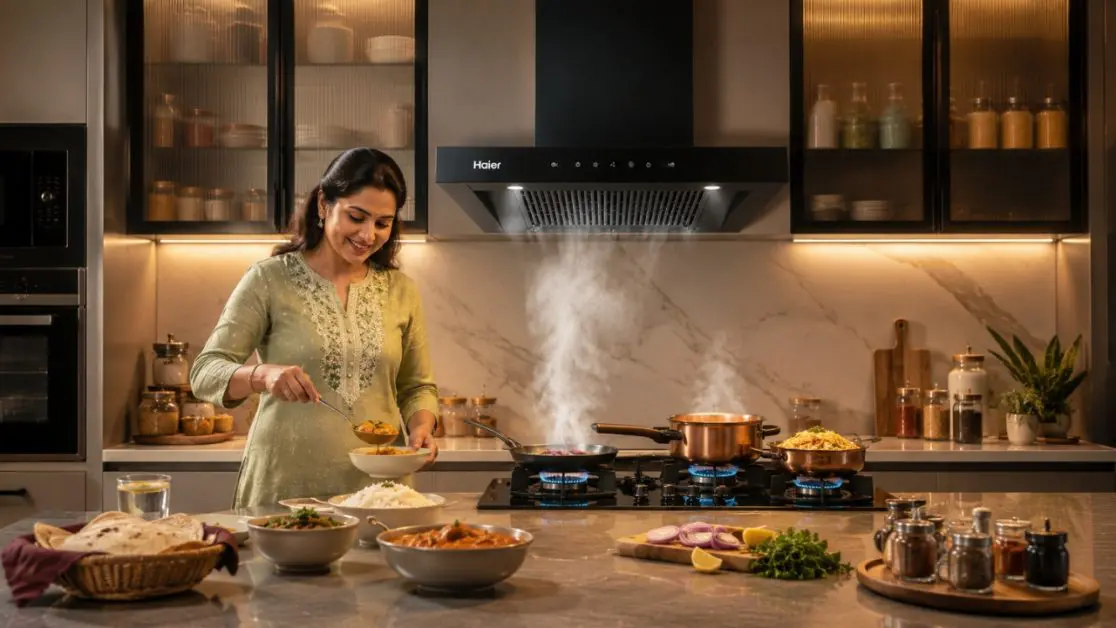
The third option is open kitchen homes
Open kitchens create a different airflow challenge.
Smoke travels directly into living spaces.
Here, aesthetics and low-noise operation become equally important alongside suction.
Because the chimney becomes visually part of the living room environment.
And modern Indian homes increasingly blur those boundaries.
Modern kitchens are becoming emotional spaces, not utility zones
This is the larger shift happening quietly.
Earlier kitchens were hidden spaces.
Now they are social spaces.
People cook while talking.
Friends stand around islands during house parties.
Parents help children with homework while dinner gets prepared nearby.
The kitchen is no longer isolated from the rest of the house.
Which means smoke, odour, heat, and noise now affect the entire home experience.
That changes appliance expectations completely.
A chimney today is not just protecting walls.
It is protecting the atmosphere.
Small systems create big lifestyle shifts
Most people expect life upgrades to arrive dramatically.
They rarely do.
Usually, they arrive through smaller frictions disappearing consistently.
The kitchen feels less exhausting.
The house smells fresher.
Cabinets stay cleaner longer.
Cooking feels lighter during summers.
That accumulation changes behaviour over time.
And this is where brands like Haier are finding relevance in modern Indian homes.
Not by selling complexity.
But by quietly improving the systems people live inside every day through features like Heat Auto Clean, gesture control, filterless technology, and high suction performance designed specifically for Indian cooking conditions.
Because the future of appliances is not about showing technology.
It is about reducing invisible friction.
And perhaps that is the real insight here:
A well-designed kitchen chimney does not merely clean the air. It changes the emotional temperature of the home.
Frequently Asked Questions
Do I really need a kitchen chimney if I cook Indian food every day?
If your cooking regularly involves tadka, frying, gravies, pressure cooking, or high-flame cooking, a chimney can significantly reduce smoke, grease buildup, cooking odours, and kitchen heat.
My kitchen already has a window. Is a chimney still worth it?
Windows help with ventilation, but they usually cannot remove grease particles and cooking fumes as efficiently as a chimney designed for continuous smoke extraction.
Should I prioritize suction power or design?
Suction power should come first. A beautiful chimney that struggles with smoke removal will create frustration over time. Design matters, but performance affects daily life.
How much suction power do I need for Indian cooking?
For regular Indian cooking, higher suction capacities (around 1500–1600 m³/h) are often preferred because they can handle smoke, steam, and grease more effectively.
Is a 60 cm chimney enough for my kitchen?
A 60 cm chimney usually works well for smaller cooktops and compact kitchens. Larger cooking areas often benefit from 90 cm models.
I cook for a family of six. Should I buy a larger chimney?
Yes. Larger families often cook multiple dishes simultaneously, generating more smoke and heat. A wider chimney with stronger suction is usually a better fit.