
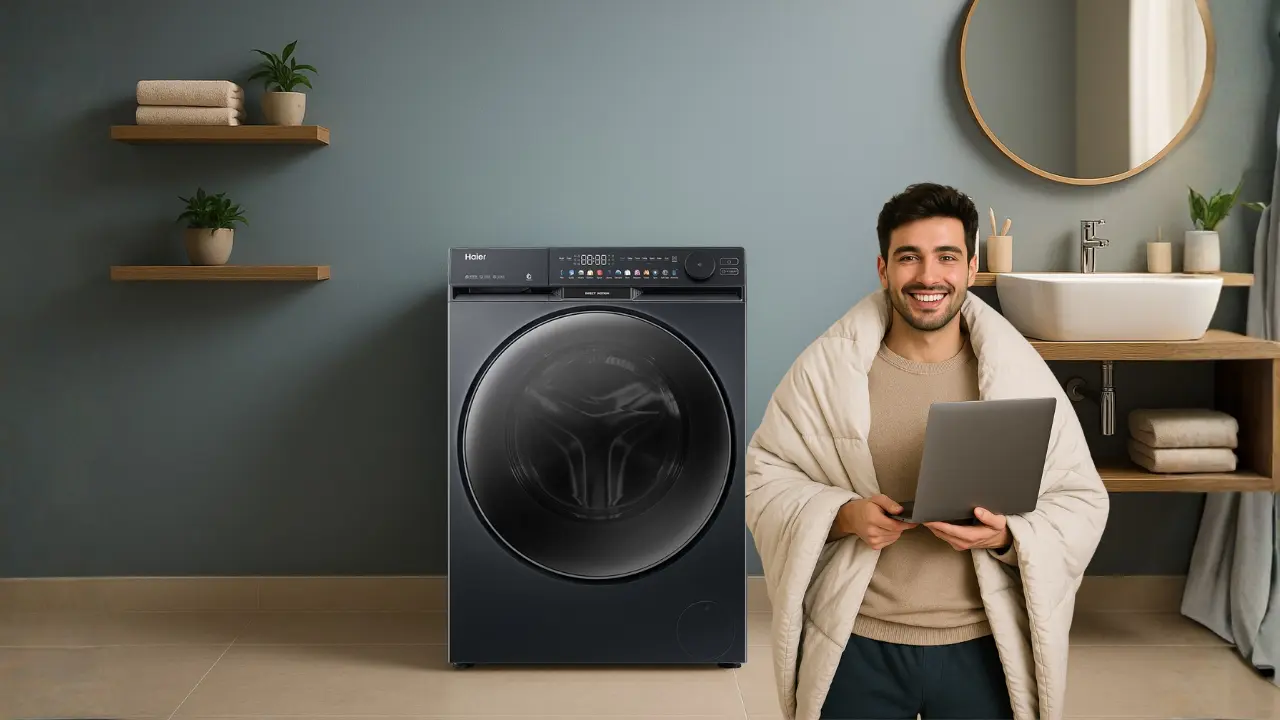

Modern Indian men are redefining care by sharing household responsibilities with confidence and consistency.
This shift blends partnership, practicality, and presence. In this new rhythm, smart home appliances quietly support the flow of everyday life.
From intuitive washing cycles to silent night modes, technology helps modern men balance work, family, and personal time with more ease.
The quiet revolution happening inside Indian homes

Walk into any home on a typical weekday and you will see it.
A young parent loading laundry before heading to the office.
A partner prepping lunch while a quick wash is running.
A working professional living solo planning cleaning tasks between Zoom calls.
This rhythm is no longer unusual.
It is the new design of modern Indian life.
Men across cities are embracing roles that feel more human, more collaborative, and more intentional. And the question that rises naturally is this.
What does care look like when everyone participates without hesitation?
Care works best when it becomes a system
Care is no longer a favour.
It is a framework.
Three cultural shifts explain this transformation.
1. The rise of shared routines
With dual-career households becoming the norm, chores get distributed more evenly. Routines are set by practicality rather than tradition.
2. The celebration of modern masculinity
International Men’s Day highlights positive role models and community well-being, reinforcing what many homes already feel: participation is a strength worth celebrating.
3. Technology that simplifies the repetitive
Automation removes guesswork.
AI washes clothes.
Temperature sensors protect fabrics.
Silent cycles keep evenings peaceful.
Care becomes a shared system instead of a personal load.
The spin cycle as a mirror of modern life

Life rotates through work tasks, school pick-ups, grocery runs, weekend plans, and personal time.
Laundry sits at the center of this rotation.
Modern men are navigating this cycle with clarity. They choose gentle cycles for baby clothes, set timers for late-night washes, and trust machines to handle precision automatically.
This is where thoughtful innovation matters.
Machines like the Haier 12 Kg F9 model bring three essential supports into everyday care:
- AI Colour Panel for intuitive control
- One Touch AI Wash that selects the right settings automatically
- Direct Motion Motor that keeps noise low and efficiency high
Care becomes smoother because the tools are smarter.
What shared care looks like in real routines
Morning rhythms
- One partner loads a quick cycle while the other arranges tiffins.
- Solo professionals use One Touch AI Wash before leaving for the office.
- A father sets a rinse cycle for uniforms during breakfast prep.
Evening routines
- Night Wash keeps the home peaceful after long workdays.
- Parents finish laundry without disrupting children’s sleep.
Weekend resets
- Bedding goes into high temperature washes.
- Gym wear cycles run back to back using stain focused programs.
- Busy renters rely on Delay functions to align laundry with outings.
These examples are not exceptions.
They are the blueprint of modern Indian homes.
Features that support the spin cycle of modern care
Haier’s design philosophy blends intuition with everyday living. The F9 Front Load model reflects that idea with features that simplify decisions instead of adding steps.
Key Features That Support Shared Care
- AI Colour Panel that is easy for everyone to understand at a glance
- One Touch AI Wash that senses load, fabric, and dirt level automatically
- Direct Motion Motor designed for quiet, stable performance
- Night Wash for minimal disturbance
- 14 specialised programs including Baby Care, Allergy Care, Quick 15, and Bedding
- High strength welded drum built for durability
- Smart functions like Delay, Memory, and Child Lock
- 5 star efficiency that reduces energy load for the entire home
These features support participation.
Participation supports harmony.
Harmony builds homes that feel balanced.
Why this matters for the future of Indian households
1. Shared responsibility creates lighter homes
The emotional load shrinks when chores are not assigned to one person.
Teamwork strengthens trust.
2. Equality builds stronger partnerships
Care becomes a habit instead of a negotiation.
3. Technology enlarges available time
When machines handle the complex parts of laundry, evenings open up for rest and connection.
4. Children learn from what they see
A son watching his father fold clothes or run cycles learns that care is a life skill, not a label.
Three choices every home faces

Every household designs its own approach to care.
One option is division
Clear task lists.
Predictable, but limited.
The second option is rotation
Alternate days or chores.
Balanced, but scheduled.
The third option is integration
Everyone contributes based on the moment.
Fluid, natural, and increasingly common in tech enabled homes.
Most modern households prefer integration because life rarely follows perfect plans.
A table that captures the shift
| Household Style | Strength | Limitation | Best For |
| Division | Predictable | Can feel mechanical | Busy work driven couples |
| Rotation | Fair distribution | Needs coordination | Families with structured routines |
| Integration | Natural flow | Needs mutual trust | Modern, tech supported homes |
The right choice is the one that reduces friction and increases connection.
The hidden system underneath the spin cycle
Homes run smoothly when the environment supports shared action.
Tools influence behaviour.
Simple steps change big patterns.
A machine that analyzes fabrics and dirt levels encourages consistent participation.
A silent motor encourages late evening chores.
A clear AI panel encourages anyone to start a cycle without confusion.
Convenience becomes culture.
Culture becomes care.
The larger insight: Indian masculinity is evolving through small daily actions
Not through slogans.
Through practice.
By prepping meals between calls.
By choosing Allergy Care for children’s clothes.
By folding laundry after late dinners.
By building homes where everyone contributes.
This is masculinity shaped by empathy.
Not pressure.
Presence.
A closing truth worth remembering
The real measure of care is not who does more.
It is how smoothly a home runs when everyone participates.
Modern Indian men are showing something powerful.
Care is not weight.
Care is leadership.
And when technology lifts the repetitive parts, people can focus on connection, family, and rest.This is the true spin cycle of care.
Not a task.
A transformation.