
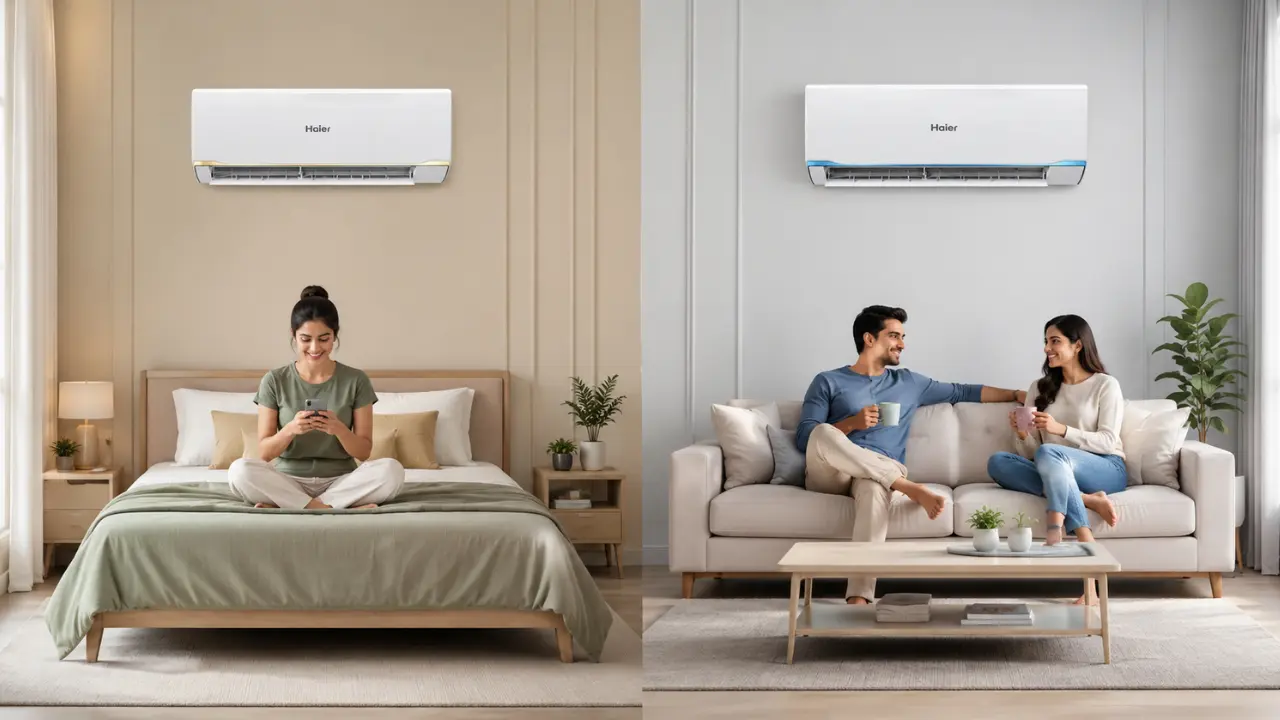

Room size and AC tonnage are directly connected, but square footage alone never tells the full story. A 1 Ton AC may work perfectly in one 120 sq. ft. room and struggle badly in another. Sunlight, ceiling height, occupancy, insulation, and usage patterns change everything. Cooling is not just about room size. It is about how the room behaves.
There is a hidden reason why so many Indian homes feel “almost comfortable” but never fully cool.
The AC is running.
The electricity bill is rising.
The room still feels uneven.
One corner feels cold. Another feels humid.
Someone lowers the temperature to 18°C hoping the machine will “work harder.”
But the real issue often starts much earlier.
Wrong tonnage.
And most people misunderstand what tonnage actually means.
What AC tonnage actually means

“Tonnage” sounds mechanical. Heavy. Industrial.
But in air conditioning, tonnage simply measures cooling capacity.
Not weight.
A 1 Ton AC removes roughly 12,000 BTUs of heat per hour. A 1.5 Ton AC removes around 18,000 BTUs. A 2 Ton AC handles even more heat load.
That word matters.
Heat load.
Because air conditioners do not create cold air. They remove heat from a space.
Which means the real question is not:
“How big is the room?”
The real question is:
How much heat does this room generate and retain every day?
That changes the entire buying decision.
Room size gives you the starting point. Not the final answer.
Most tonnage charts online look clean and simple.
- Up to 120 sq. ft. = 1 Ton
- 120–180 sq. ft. = 1.5 Ton
- 180–260 sq. ft. = 2 Ton
Useful?
Yes.
Complete?
Not even close.
A top-floor bedroom in Jaipur behaves differently from a shaded guest room in Bengaluru.
Same dimensions.
Different cooling reality.
That is the hidden system behind AC tonnage conversion.
A practical AC tonnage guide for Indian homes
Here is the baseline most households can start with:
| Room Size | Recommended AC Capacity |
| Up to 120 sq. ft. | 1 Ton |
| 120–180 sq. ft. | 1.5 Ton |
| 180–260 sq. ft. | 2 Ton |
But then the modifiers begin.
And modifiers change outcomes.
The five factors that quietly change tonnage requirements

1. Sunlight exposure changes everything
A west-facing room absorbs heat differently.
Especially during Indian summers.
If your room receives strong afternoon sunlight, increase cooling consideration by 10–15%.
That is why some bedrooms feel hotter at 7 PM than at 2 PM.
Walls store heat.
Homes behave like batteries during summer.
2. Ceiling height matters more than people realize
Most tonnage calculations assume standard ceiling heights.
But modern apartments increasingly use taller ceilings for aesthetics.
It looks beautiful.
Changes cooling dynamics completely.
Higher ceilings mean more air volume.
More air volume means more cooling demand.
A room is not just a floor area. It is air volume.
3. Number of people affects heat generation
Humans generate heat constantly.
One person working quietly is different from five people watching an IPL match in a closed living room.
That is why living rooms often need higher tonnage than similarly sized bedrooms.
Not because of size.
Because of activity density.
4. Electronics create invisible heat
TVs.
Gaming consoles.
Laptops.
Kitchen appliances.
Modern homes produce far more internal heat than older homes.
A work-from-home setup can quietly raise cooling demand throughout the day.
Especially in compact apartments.
5. Ventilation and insulation shape cooling efficiency
Poor insulation leaks cooling.
Bad window sealing invites heat back in.
An oversized AC in a poorly insulated room still wastes electricity.
This is important because many people think bigger tonnage automatically means better cooling.
It does not.
Oversized systems create a different problem.
Why buying a bigger AC is not always smarter
This is one of the biggest myths in appliance buying.
“Better to buy a bigger AC for extra cooling.”
Sounds logical.
Often expensive.
An oversized AC cools too quickly without properly removing humidity.
The room feels cold but sticky.
That uncomfortable “clammy” feeling?
Usually poor humidity management.
Especially during monsoon months.
There is another problem too.
Frequent compressor cycling.
The AC switches on and off repeatedly instead of running efficiently. That increases wear and energy usage over time.
Cooling is not about force.
It is about balance.
Undersized ACs fail differently
An undersized AC struggles constantly.
It runs longer.
Consumes more power.
Still fails to cool properly.
And this creates a hidden psychological loop inside homes.
People keep lowering the temperature.
24°C becomes 20°C.
20°C becomes 18°C.
But temperature settings cannot compensate for insufficient cooling capacity.
The machine is already overloaded.
A properly sized AC at 24°C often feels more comfortable than an undersized AC struggling at 18°C.
That surprises people.
Until they experience it.
Bedrooms, living rooms, and studio apartments all behave differently
Bedroom cooling is about consistency
Bedrooms need stable temperatures and quieter operation.
Most Indian bedrooms between 100–140 sq. ft. work well with a 1 Ton or 1.5 Ton inverter AC depending on sunlight exposure.
Cooling at night is different from cooling during the day.
The body notices sound more during sleep.
That changes what “comfort” means.
Living rooms demand airflow strength
Living rooms have movement.
Doors opening.
People gather.
Televisions running.
Warm air is constantly entering.
This is why many living rooms benefit from 1.5 Ton or 2 Ton systems even when the room dimensions seem moderate.
Cooling large social spaces requires airflow distribution, not just low temperatures.
Studio apartments create hybrid cooling challenges
Studios combine sleeping, cooking, and working into one environment.
That creates fluctuating heat loads throughout the day.
Especially in urban apartments.
In these cases, inverter technology becomes important because cooling demand changes constantly.
This is where smart cooling systems start making practical sense.
Not because they sound futuristic.
Because they adapt better.
Why inverter ACs changed the tonnage conversation
Older AC systems worked like light switches.
Full power.
Then off.
Modern inverter ACs behave more like cruise control.
They adjust dynamically.
That changes efficiency dramatically.
A properly sized inverter AC maintains temperature more steadily while consuming less electricity over time.
This matters because Indian summers are no longer short bursts.
In many cities, AC usage stretches across multiple seasons now.
Cooling systems have shifted from luxury appliances to everyday infrastructure.
Like refrigerators.
Like Wi-Fi.
The expectations changed.
So the buying logic must change too.
What smart buyers calculate before choosing AC tonnage
Most informed buyers now evaluate cooling using five practical filters:
- Actual room dimensions
- Sunlight intensity
- Daily room usage
- Occupancy patterns
- Long-term electricity efficiency
Not just discounts.
Not just star ratings.
Because a cheap wrong-sized AC becomes expensive every month after purchase.
That is how appliance economics actually work.
How modern Haier ACs fit into real Indian homes
One reason many modern Indian households now explore inverter-based systems like the Haier 1.7 Ton 5 Star Desert Rose Air Conditioner or the Haier 1.7 Ton 5 Star Gold Desert Rose Air Conditioner is because cooling expectations have evolved beyond basic temperature control.
People now care about:
- Faster cooling during peak summer afternoons
- Better energy efficiency across long usage hours
- Stable night-time comfort
- Smart airflow management
- Aesthetic integration into modern interiors
The interesting shift is this:
Air conditioners are no longer judged only when they work.
They are judged when people stop noticing them entirely.
That is what good cooling feels like.
Quiet.
Balanced.
Predictable.
The best appliances quietly remove friction from daily life.
A simple room-size-to-tonnage decision framework
If you want a practical way to think about tonnage, use this framework:
Choose 1 Ton when:
- The room is under 120 sq. ft.
- Limited sunlight exposure
- Mostly bedroom usage
- Low occupancy
Choose 1.5 Ton when:
- The room is 120–180 sq. ft.
- Moderate sunlight
- Regular family usage
- TV or work setup present
Choose 2 Ton when:
- The room exceeds 180 sq. ft.
- Heavy sunlight exposure
- Large living spaces
- Multiple occupants regularly
Simple frameworks reduce bad decisions.
That is true in business.
And surprisingly true in cooling systems too.
The real insight most people miss
People think AC buying is about temperature.
It is actually about rhythm.
How your room gathers heat.
How your family uses space.
How summers behave in your city.
How long the machine runs every day.
The right AC tonnage does not feel dramatic.
It feels invisible.
The room cools evenly.
The electricity bill feels manageable.
Sleep improves quietly.
Arguments over the remote reduce.
And suddenly the appliance disappears into daily life.
That is usually the sign you chose correctly.
Not maximum cooling.
Balanced cooling.
Because comfort is rarely about extremes.
It is usually about systems working exactly as they should.
Frequently Asked Questions
My room is 120 sq. ft. Should I buy a 1 Ton or 1.5 Ton AC?
Start with 1 Ton as the baseline, but consider upgrading to 1.5 Ton if the room gets strong afternoon sunlight, has multiple occupants, or contains heat-generating electronics.
Why does my friend’s 1 Ton AC cool better than mine even though our rooms are the same size?
Room size is only one factor. Sun exposure, insulation, ceiling height, occupancy, and airflow can dramatically change cooling performance.
Is it safer to buy a bigger AC “just in case”?
Not always. Oversized ACs may cool too quickly without removing enough humidity, making the room feel cold but uncomfortable.
How do I know if my AC tonnage is wrong for my room?
Signs include uneven cooling, excessive runtime, high electricity bills, frequent temperature adjustments, or persistent humidity.
Should I focus more on room size or room conditions when choosing AC tonnage?
Room size gives a starting estimate, but room conditions often determine the final recommendation.