

Rotisserie cooking in a microwave is a method where food is slowly rotated on a motorized rod inside the oven, allowing it to cook evenly from all sides using heat and grill functions.
This continuous rotation ensures uniform browning, better texture, and juicy interiors without constant manual flipping.
Why does rotisserie cooking feel like a restaurant experience at home?
It is 8:45 pm.
You open your kitchen fridge. There is marinated chicken from the afternoon. You think about frying it. Too oily. You think about pan grilling. Too much effort.
So you leave it.
This is where most home cooking decisions quietly collapse. Not because of lack of skill. But because of friction.
Rotisserie cooking removes that friction.
It turns cooking into a system that manages itself.
Food rotates. Heat circulates. You step back.
Good cooking is not about effort. It is about control.
How does rotisserie cooking in a microwave actually work?
At its core, rotisserie cooking is simple.
A rod holds the food. A motor rotates it. Heat surrounds it.
But the system underneath is what makes it powerful.
The three layers that make rotisserie work
1. Rotation
- Food rotates continuously
- Ensures every side gets equal exposure to heat
- Prevents burning on one side and undercooking on another
2. Grill or convection heat
- Heat comes from multiple directions
- Helps create that crisp, golden exterior
- Locks in moisture inside
3. Controlled environment
- Microwave cavity traps heat efficiently
- Maintains consistent temperature
- Reduces cooking time compared to open grilling
In models like the Haier 30L Convection Microwave with In-Built Air Fryer (HIL3001ARSB), the motorized rotisserie feature automatically rotates food for uniform grilling .
That one detail changes everything.
Because consistency is what most home kitchens struggle with.
What makes rotisserie cooking different from regular microwave cooking?
Most people assume all microwave cooking is the same.
It is not.
A simple comparison
| Cooking Method | What Happens | Result |
| Microwave mode | Heats food internally using waves | Fast but uneven browning |
| Grill mode | Direct heat from top | Crispy surface, uneven inside |
| Rotisserie mode | Rotates food + grill/convection heat | Even cooking, crispy outside, juicy inside |
Insight: Movement creates balance. Stillness creates hotspots.
Rotisserie cooking introduces movement into heat.
And that is the difference.
What can you actually cook using rotisserie in a microwave?
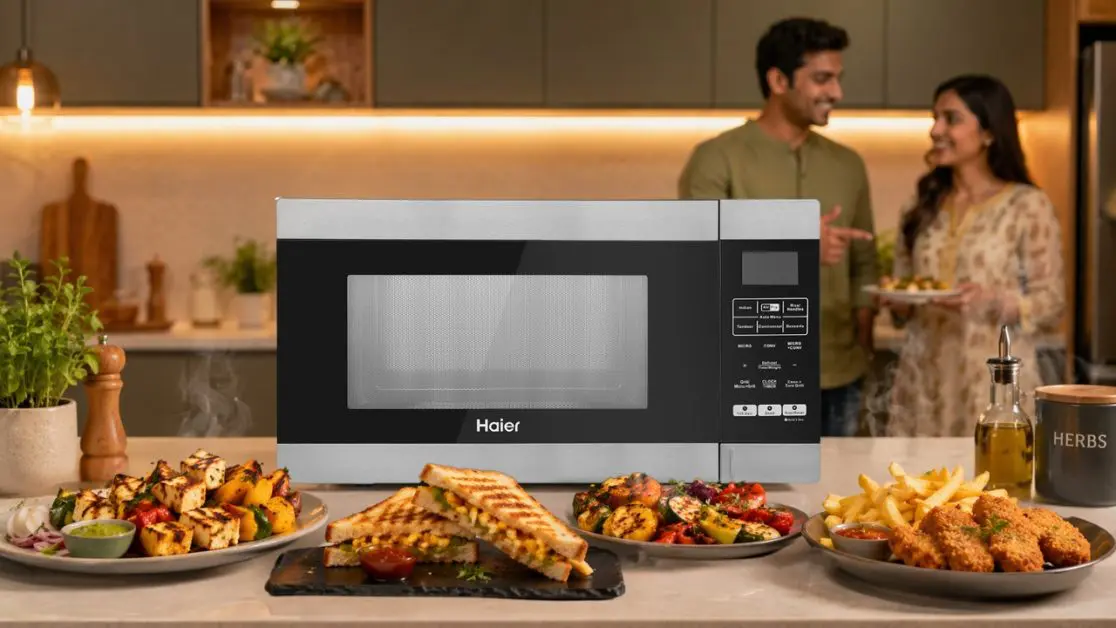
This is where it becomes practical.
Because features only matter when they fit into real life.
Everyday Indian kitchen use cases
- Whole chicken for weekend dinners
- Paneer tikka for house parties
- Kebabs for quick evening snacks
- Grilled vegetables for healthier meals
- Seekh kebabs for festive cooking
Now zoom out.
These are not just recipes. They are moments.
Sunday lunch. IPL night. Family gathering. Late-night cravings.
Rotisserie cooking fits into these moments because it reduces effort without reducing experience.
Three ways people approach grilling at home
Not everyone cooks the same way. And that matters.
One option is manual cooking
You use a pan or tawa.
- Cost: Low
- Effort: High
- Result: Inconsistent
You stand there. Flip. Adjust heat. Watch constantly.
The second option is basic grill mode
You use a microwave grill.
- Cost: Moderate
- Effort: Medium
- Result: Surface-level crisp
Better than manual. Still requires intervention.
The third option is rotisserie cooking
You use a rotating system.
- Cost: Slightly higher appliance investment
- Effort: Minimal
- Result: Even, professional-style cooking
You set it once. The system takes over.
Aphorism: The best systems remove the need for supervision.
Why does rotisserie cooking give better texture and taste?
Because it solves a hidden problem.
Heat imbalance.
When food stays still, one side cooks faster. Moisture escapes unevenly. Texture breaks.
Rotation fixes that.
What changes when food rotates
- Juices redistribute evenly
- Surface crisps without burning
- Inner layers cook gradually
- No need to flip manually
This is why rotisserie chicken tastes different.
Not just better. More balanced.
Even paneer or vegetables come out with a uniform texture.
And in a microwave with convection support, the results are closer to oven-style cooking.
How modern microwaves make rotisserie cooking easier
The real shift is not the feature.
It is the integration.
Earlier, rotisserie meant separate ovens or outdoor grills.
Now it is part of a system.
Take the Haier 30L Convection Microwave with In-Built Air Fryer.
What changes with this kind of setup
- Motorized rotisserie rod for automatic rotation
- 305 auto cook menus for preset cooking combinations
- 5 power levels for controlled cooking
- Combination cooking modes that blend grill, convection, and microwave
This is not feature stacking.
This is system design.
Everything works together so you do not have to manage each variable manually.
Is rotisserie cooking healthier?
Short answer. Yes, in most cases.
But not for the reason people think.
It is not just about oil.
It is about control over cooking conditions.
Why it tends to be healthier
- Requires less oil than frying
- Fat drips off during rotation
- Even cooking reduces overburning
- Preserves nutrients better than high-heat frying
Combine this with air fryer functionality in the same appliance, and you start seeing a pattern.
Less oil. More consistency. Better results.
Common mistakes people make with rotisserie cooking
Technology simplifies cooking.
But only when used correctly.
Avoid these errors
- Overloading the rod with too much weight
- Not securing food properly on the rod
- Skipping preheating in convection mode
- Using incorrect temperature settings
- Not balancing food evenly
Insight: Systems fail when inputs are careless, not when design is weak.
How to think about rotisserie cooking when buying a microwave
Do not think feature-first.
Think system-first.
Ask these questions
- Do I cook grilled food regularly?
- Do I want consistency without effort?
- Do I prefer healthier alternatives to frying?
- Do I cook for my family or just myself?
If the answer is yes to most, rotisserie is not a luxury.
It is a time-saving system.
What does this mean for modern Indian kitchens?
Kitchens are changing.
Not in size. But in expectation.
People want speed. But also quality. Convenience. But also control.
Rotisserie cooking sits at that intersection.
It removes effort without removing experience.
It turns cooking into something closer to assembly than struggle.
And that is the real shift.
The bigger insight most people miss
Rotisserie cooking is not about grilling.
It is about automation of precision.
Think about it.
Every great dish depends on timing, heat, and balance.
Rotisserie handles all three.
Quietly.
Consistently.
Without asking for your attention every two minutes.
Aphorism: The future of cooking is not more skill. It is a better system.
Final thought
The question is not whether you need rotisserie cooking.
The question is this:
Do you want to cook, or do you want the system to cook with you?
Because once that shifts, everything else follows.
Frequently Asked Questions
How is rotisserie different from normal microwave cooking?
Regular microwave mode mainly heats food internally using microwave waves. It is fast, but often uneven when cooking larger foods.
Rotisserie mode adds:
Continuous rotation
Grill or convection heat
Controlled airflow
The result is closer to restaurant-style grilling than reheating.
Why does rotisserie cooking feel more professional?
Because it automates consistency.
In traditional cooking:
You flip food manually
Heat distribution changes constantly
One side may burn while another stays undercooked
Rotisserie systems remove much of that supervision. The microwave handles:
Rotation
Heat exposure
Timing balance
That creates a more reliable texture and taste.
Do all microwaves support rotisserie cooking?
No.
You usually need:
A convection microwave
Built-in rotisserie rod
Motorized rotation system
Basic solo microwaves typically do not support rotisserie cooking.
Is rotisserie worth paying extra for in a microwave?
It depends on your cooking habits.
It is useful if you:
Grill often
Cook for family gatherings
Prefer low-oil cooking
Want less manual supervision
Enjoy kebabs or roasted dishes
If grilling is a regular part of your routine, the feature can save significant effort over time.
Do I need to flip food during rotisserie cooking?
Usually no.
The entire purpose of rotation is to expose all sides evenly to heat automatically.
That is one of the main conveniences of the feature.