


Yes, you can wash white clothes after Holi without yellowing.
Rinse immediately in cold water. Avoid heat on fresh stains. Use the right wash cycle and the correct detergent quantity. Most yellowing happens when colour, sweat, detergent residue, and heat react together. Control that reaction, and your whites stay white.
That is the short answer.
Now let us talk about what actually happens in Indian homes the morning after Holi.
The real reason whites turn yellow after Holi.
It is 10:15 am.
Your balcony looks like a textile exhibition. White kurtas, T-shirts, dupattas. All washed. All hopeful.
By evening, the bright pink is gone.
But a dull yellow patch sits quietly on the sleeve.
Why?
Because Holi colour does not act alone.
- Powder pigments cling to fabric fibres.
- Sweat and skin oils bind those pigments deeper.
- Detergent residue traps minerals from water.
- Heat locks everything in place.
Yellowing is not random.
It is a chain reaction.
Heat sets stains. Time deepens them. Residue discolours them.
Break the chain early, and the fabric recovers.
Ignore it, and the stain evolves.
Step One: Stop the Stain Before It Settles

Cold Water Is Your First Move
The first wash decision determines the outcome.
Cold water slows down colour bonding.
Hot water accelerates it.
So the sequence is simple:
- Shake off dry colour outdoors.
- Rinse under running cold water from the back of the stain.
- Avoid harsh scrubbing.
Scrubbing spreads pigment sideways.
Rinsing pushes it out.
Small difference. Big impact.
In real homes, this is the five-minute step that saves the garment.
Step Two: Choose the Right Wash Cycle, Not the Fastest One
After Holi, white clothes are not regular laundry.
They need deliberate cleaning.
One Option Is: Quick Wash
- Fast.
- Economical.
- Good for light surface stains.
Cost: Less time.
Benefit: Works if colour exposure was minimal.
Risk: Deep pigments may remain.
The Second Option Is: Cotton or Intensive Wash
- Longer cycle.
- Stronger agitation.
- Better for heavy stains.
Cost: Slightly more water and time.
Benefit: Deeper stain removal.
The Third Option Is: AI-Optimised Wash
Modern front-load machines such as the Haier 10 Kg Fully Automatic Front Load Washing Machine come with One Touch AI Wash. It detects fabric type, load weight, and dirt level automatically, then adjusts water and spin speed.
Cost: No manual guesswork.
Benefit: Balanced cleaning without over-washing.
If your Holi celebration involves cousins, neighbours, and two extra buckets of colour, a larger capacity like the Haier 12 Kg F9P Front Load Washing Machine handles bulk loads comfortably.
More capacity means fewer cycles.
Fewer cycles mean less fabric stress.
Detergent Quantity: The Silent Culprit
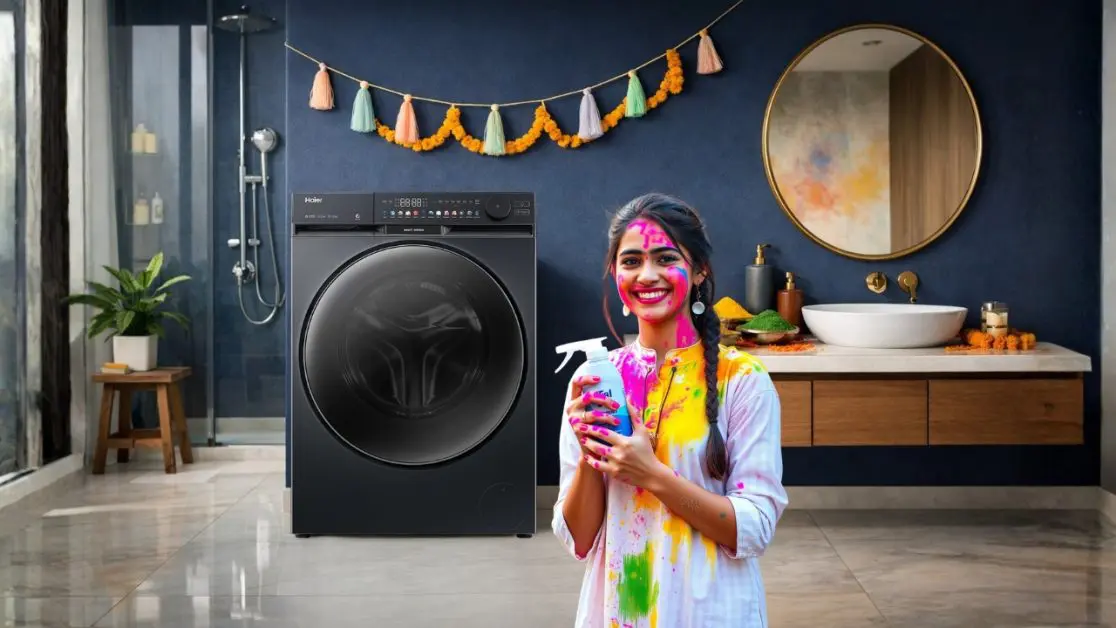
After Holi, most people double the detergent.
It feels logical.
More colour. More soap.
But excess detergent creates residue. Residue traps dirt. Dirt dulls fabric.
And dullness looks like yellowing.
Use measured detergent.
Let the machine rinse properly.
If needed, add an extra rinse cycle instead of extra detergent.
Clean is about precision, not power.
Water Quality Changes the Game
Hard water leaves invisible deposits on white fabric.
Over time, those deposits build up.
After Holi, they combine with leftover pigment and create uneven yellow patches.
What works?
- Avoid overloading the drum.
- Use the correct detergent dose.
- Choose machines that adjust water level automatically.
Features like Eco Wash match water quantity to load size, reducing residue build-up.
The less leftover detergent, the brighter the white.
Steam and Refresh: Not Every Garment Needs Aggression
Sometimes the colour is faint, but the smell lingers.
Not every white kurta needs a heavy wash.
Steam-based refresh programs reduce odour and wrinkles between washes.
Cost: Minimal water use.
Benefit: Extends fabric life.
Think of it like airing out a bookshelf.
Not every book needs deep cleaning.
Some need gentle care.
Temperature Is a Strategic Decision

Many machines offer high-temperature washes up to 90°C.
But temperature is a tool.
Not a default.
- Use cold water for fresh stains.
- Move to warm settings only after pigment is removed.
- Avoid high heat during the first wash.
Heat is powerful.
Use it at the wrong stage, and it locks colour in permanently.
Drum Design Affects Whiteness
You do not see it.
But the drum decides how fabric moves.
The pillow-shaped drum design in Haier front-load models improves water flow while reducing fabric stress.
After Holi, cotton fibres are already stressed from colour and friction.
Gentler tumbling protects fibre structure.
Healthy fibres reflect light better.
Better reflection equals brighter whites.
Whiteness is not only about cleaning.
It is about fibre integrity.
Late-Night Laundry Is Part of Real Life
Holi rarely ends early.
Guests linger. Kids nap late. Laundry happens at midnight.
Night Wash features allow quieter cycles, so washing white clothes after Holi does not disturb the house.
Cost: None.
Benefit: Laundry fits your schedule.
Smart homes adapt to life.
They do not demand rearrangement.
A Practical Post-Holi White Care Framework
Do This
- Rinse immediately in cold water.
- Separate whites strictly.
- Use measured detergent.
- Select cotton or AI wash mode.
- Dry in shade to avoid uneven oxidation.
Avoid This
- Hot water on first wash.
- Excess detergent.
- Overloading the drum.
- Leaving clothes damp for hours.
These are not complicated rules.
They are disciplined ones.
Capacity Is Not About Size. It Is About Rhythm
After Holi, laundry volume spikes.
Joint families easily create 10 to 12 kg loads.
Machines with 10 kg or 12 kg capacity handle this efficiently.
Cost: Higher upfront investment.
Benefit: Fewer cycles. Less time. Lower per-garment stress.
Direct Motion motors in these models reduce vibration and noise while improving efficiency.
Less vibration means less fabric wear.
Less wear means longer-lasting whites.
The Bigger Insight: Stains Reveal Systems
Holi stains are emotional.
But the solution is mechanical.
When people panic, they overcorrect.
Too much soap. Too much heat. Too much scrubbing.
And overcorrection creates yellowing.
Laundry teaches restraint.
Understand the sequence.
Cold first.
Calibrated wash next.
Heat later.
Let intelligent features handle adjustment.
Because the real goal is not just removing colour.
It is restoring confidence.
When Monday morning arrives and your white kurta looks fresh again, you are not just holding clean fabric.
You are holding proof that chaos can be managed.
Festive colour included.
And that is what a well-designed home quietly delivers.
Frequently Asked Questions
I just came back from Holi and my white kurta is covered in colour. What should I do in the first 5 minutes?
Shake off dry powder outdoors. Then rinse the garment under running cold water, preferably from the back of the stain. Do not scrub. Do not soak in hot water. The first rinse determines whether the stain fades or sets.
I’m confused. Should I soak, scrub, or put it directly in the washing machine?
Rinse first. If colour is heavy, soak briefly in cold water (15–20 minutes max). Then wash using a cotton or intensive cycle. Avoid aggressive scrubbing because it spreads pigment deeper into fibres.
I’m tired after Holi. Can I just throw everything into one load?
No. Strictly separate whites. Even light pastel pieces can bleed and create uneven yellow patches when mixed. After Holi, segregation is not optional.
I’m scared of ruining my favourite white outfit. What’s the safest wash setting?
Choose a cotton or AI-optimised wash cycle with cold water. These provide stronger agitation without unnecessary heat. Avoid quick wash if colours are heavy.
Should I use more detergent since there’s more colour?
No. Overusing detergent causes residue build-up, which traps minerals and dulls whites. Measure properly. If needed, add an extra rinse cycle not extra detergent.
I left my white clothes in a bucket for hours after Holi. Is it too late?
Not necessarily. Rinse thoroughly in cold water to remove loosened pigments. Then wash using a longer cycle. Avoid hot water during the first wash. Acting now still helps prevent yellowing.
I left my laundry in the washer overnight. Do I need to rewash it?
Yes, especially if it smells damp. Moisture plus detergent residue can cause dullness or mild yellowing. Run a quick rinse or refresh cycle to prevent fabric damage.
Why does my white shirt look yellow even after the pink stain disappeared?
Yellowing happens when colour, sweat, detergent residue, minerals, and heat react together. Even if visible colour fades, the chemical reaction may remain. It’s usually a residue issue not leftover colour.
My clothes smell clean but still look dull. What went wrong?
Likely detergent build-up or hard water deposits. Whites lose brightness when residue accumulates. Use the correct detergent quantity and avoid overloading.