
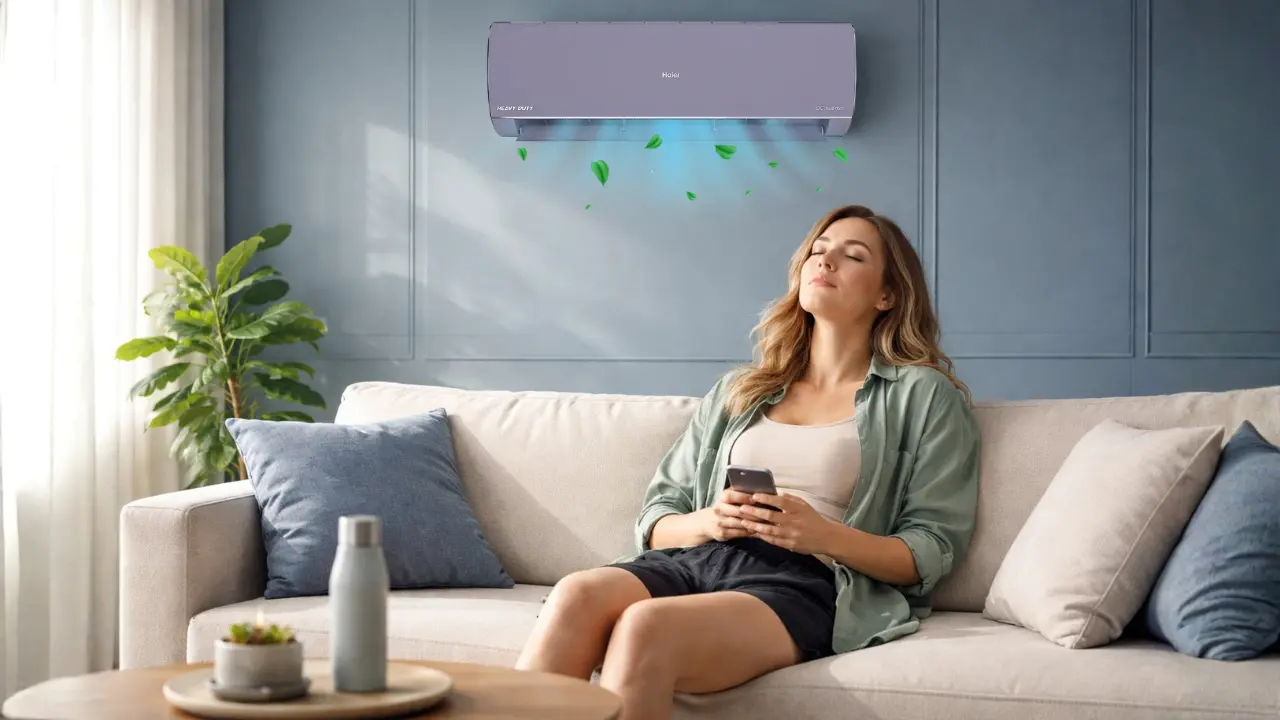

What Is Intelligent Cooling That Adjusts During Power Peaks?
Intelligent cooling during power peaks means your air conditioner automatically reduces, balances, or optimises energy consumption when electricity demand rises, without compromising comfort.
It senses temperature gaps, occupancy, and usage patterns, then adapts in real time so your room stays comfortable while your power bill stays controlled.
That is the short answer.
The longer answer lives inside Indian homes.
The 8:30 PM problem nobody talks about.
Picture this.
It is 8:30 PM in May. Dinner is cooking. The washing machine is running. Two fans are on. The TV is streaming a match. The AC is set at 22°C because the day was brutal.
This is not excess.
This is normal life.
Across Indian cities, peak electricity demand spikes sharply between 6 PM and 10 PM during summer. According to India’s Central Electricity Authority, peak power demand has crossed 240 GW in recent summers. Residential ACs contribute significantly to this surge.
When everyone cools at once, the grid feels it.
And so does your bill.
Power peaks are invisible traffic jams. You do not see them. You just pay for them.
Why Traditional Cooling Struggles During Power Peaks
Most conventional air conditioners follow one simple rule.
Cool until the set temperature is reached.
They do not ask:
- Is the temperature gap too large?
- Is the room empty?
- Is the outside temperature dropping?
- Is peak demand happening right now?
They simply run.
That creates three problems:
- Overcooling
The room becomes colder than needed. - Energy spikes
The compressor runs at full capacity longer than necessary. - Manual dependence
Someone has to adjust settings constantly.
technologies that rely on memory fail when life gets busy.
Intelligent Cooling Is About Dynamic Decisions
The shift is not about making ACs more powerful.
It is about making them more aware.
Intelligent cooling technologies use a combination of environmental sensing, usage tracking, and real-time adaptation. Instead of treating cooling as a static instruction, they treat it as a live conversation between the room and the machine.
For example, Haier’s AI Atmox platform, described as an Automated Temperature Monitoring and Optimization Xperience , is built around this principle.
It does not just cool.
It learns, adapts, and cool.
How Intelligent Cooling Adjusts During Power Peaks
1. AI Eco 2.0 Modes That Respond to Temperature Gaps
During peak hours, the biggest waste often comes from large temperature gaps.
When the room-set difference exceeds 3°C, technologies like AI Eco 2.0 shift to a calibrated mode instead of running at maximum load. As seen in AI Eco 2.0 logic, it automatically transitions between L1, L2, and L3 levels based on how close the room is to the set temperature.
That means:
- If the room is much hotter, it cools efficiently.
- As the gap narrows, it reduces load.
- When the difference is minimal, it stabilises instead of overshooting.
This prevents power surges at scale.
Small adjustments prevent large bills.
2. AI Human Detection That Cuts Idle Consumption
One hidden cost during peak hours is cooling empty rooms.
Human detection technologies can switch to energy-saving mode automatically if no movement is detected. In some intelligent models, the technology reduces to Auto L3 after 15 minutes of inactivity and powers off after 30 minutes.
No reminders.
No guilt.
Just automated discipline.
During power peaks, idle load matters. Intelligent cooling removes it.
3. Electricity monitoring 2.0 That Makes Consumption Visible
You cannot manage what you cannot see.
Electricity monitoring 2.0 tools provide graphical views, mode tracking, currency-based consumption display, and adjustable targets.
This changes behaviour.
When families see that running in Eco mode saves measurable units during peak windows, choices become deliberate.
Cooling becomes a strategy, not a habit.
Peak Hours Demand Smarter Cooling, Not Less Comfort
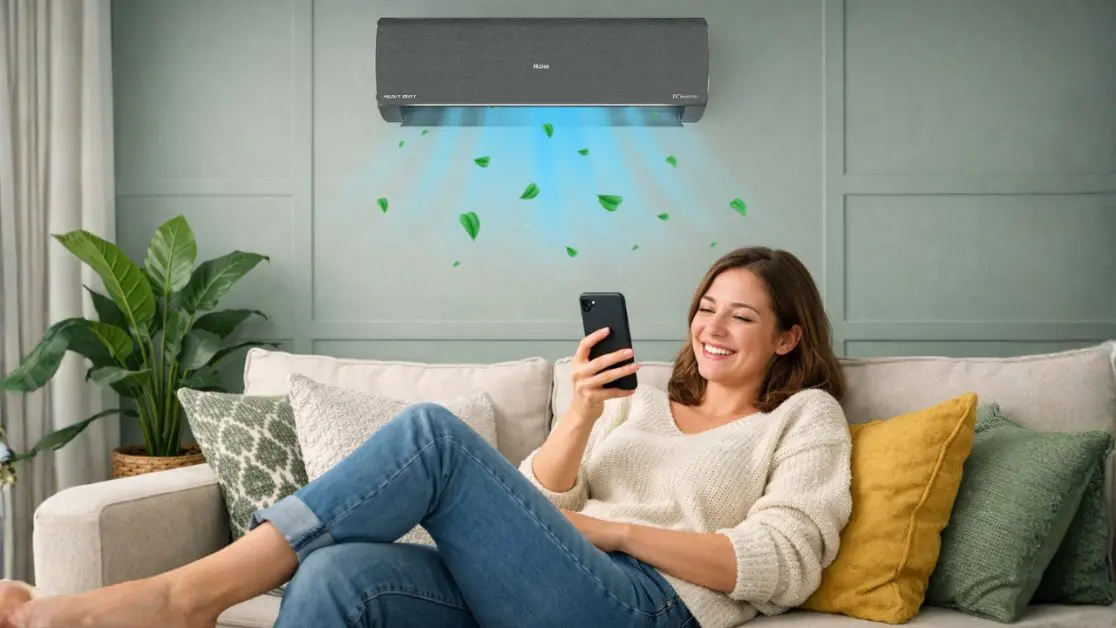
Many assume saving power means compromising comfort.
That is outdated thinking.
Intelligent cooling during power peaks balances three forces:
| Factor | Traditional Cooling | Intelligent Cooling |
| Compressor Load | Fixed response | Dynamic adjustment |
| Occupancy | Manual control | Auto-detection |
| Temperature Gap | Ignored | Real-time modulation |
| User Effort | High | Minimal |
| Peak Hour Efficiency | Poor | Optimised |
The difference is not the louder technology.
It is better judgment.
The Human Experience Inside a Smart Room
Let us slow down.
It is a Saturday afternoon. You step out for groceries. The AC senses no occupancy. It shifts modes. Power is reduced.
You return. Pre-cooling ensures comfort begins before you enter, using predictive logic when you enter a preset zone.
That is not luxury.
That is rhythm.
Homes operate on patterns. Intelligent cooling respects those patterns.
Three Ways Households Handle Power Peaks
Every family chooses one of three paths.
Option One: Ignore the Peak
Set the AC low. Leave it running. Absorb the bill.
Cost:
- High electricity charges.
- Greater load stress.
- Long-term wear.
Benefit:
- Immediate comfort.
Option Two: Manual Micromanagement
Switch modes constantly. Adjust temperature every hour. Turn it off when stepping out.
Cost:
- Mental effort.
- Inconsistent comfort.
- Human error.
Benefit:
- Partial savings.
Option Three: Intelligent Automation
Use technologies that sense, adapt, and self-correct.
Cost:
- Upfront investment in smarter technology.
Benefit:
- Sustained savings.
- Reduced peak load.
- Effortless comfort.
- Lower long-term stress on appliances.
The third option scales.
The Larger technology Behind Intelligent Cooling
Power peaks are not just about households.
They affect:
- Local grid stability.
- Transformer load.
- City-wide outages.
- National demand patterns.
India’s power consumption rises sharply during heatwaves. As cities expand and more homes adopt air conditioning, intelligent technologies become essential infrastructure.
Cooling is no longer a private decision.
It is a shared responsibility.
Why This Matters to Modern Indian Homes
Millennials and Gen Z buyers think differently.
They track expenses. They value sustainability. They want automation without complexity.
An intelligent AC that integrates AI Climate Control, AI Eco 2.0, Human Detection, and Electricity monitoring 2.0 fits this mindset.
It feels less like an appliance.
More like a partner.
Comfort During Power Peaks Is a Leadership Decision
There is a quiet truth about homes and organisations.
Both function on technology.
If a technology depends on constant manual correction, it eventually fails.
If a technology adapts automatically within boundaries, it scales.
Intelligent cooling during power peaks is not about gadgets.
It is about designing environments that self-correct.
A Memorable Insight
Cooling should feel invisible.
Bills should feel predictable.
Effort should feel minimal.
When those three align, technology disappears into life.
The Real Question to Ask
Not:
Can this AC cool my room?
But:
Can it cool intelligently when the city is at its hottest and the grid is under pressure?
Because that is when decisions matter.
The Future of Cooling in Indian Summers
As peak demand continues rising, intelligent cooling will shift from optional to expected.
Features like:
- Real-time energy modulation.
- Predictive pre-cooling.
- Occupancy-based automation.
- Electricity cost tracking.
- Self-clean technologies that maintain efficiency.
These are not luxuries.
They are infrastructure for modern living.
Homes are becoming smarter.
Grids are becoming stressed.
The bridge between the two is intelligent cooling.
And perhaps the most important insight of all:
The smartest technologies do not work harder.
They work wiser.
That is what makes comfort sustainable.
Frequently Asked Questions
If I leave my AC running while I step out for groceries, does it waste a lot of electricity?
Yes. Cooling an empty room consumes energy unnecessarily. Intelligent ACs with human detection can reduce cooling levels or switch to energy-saving modes automatically.
My family keeps changing the AC temperature. Is that bad for energy efficiency?
Frequent changes force the compressor to adjust repeatedly, which can increase energy usage. Intelligent cooling systems stabilize temperature automatically.
Does intelligent cooling make the room less comfortable when it saves energy?
No. These systems prioritise comfort while reducing excess cooling by adjusting compressor load gradually rather than shutting down abruptly.
What happens if my room is already cool but the AC keeps running?
Traditional ACs may overshoot the temperature. Intelligent cooling reduces compressor load as the temperature gap narrows.
What exactly is intelligent cooling in an air conditioner?
Intelligent cooling uses sensors, AI algorithms, and usage patterns to adjust cooling power automatically based on temperature difference, occupancy, and real-time conditions.
How does AI Eco mode save electricity?
It adjusts compressor load in stages depending on how close the room temperature is to the set temperature, avoiding unnecessary high-power operation.
What is human detection in an AC?
Sensors detect movement in the room. If no activity is detected for a set period, the AC reduces power or switches to an energy-saving mode.
What is electricity monitoring in a smart AC?
It tracks energy consumption in real time, often showing daily usage, mode performance, and estimated electricity cost.