
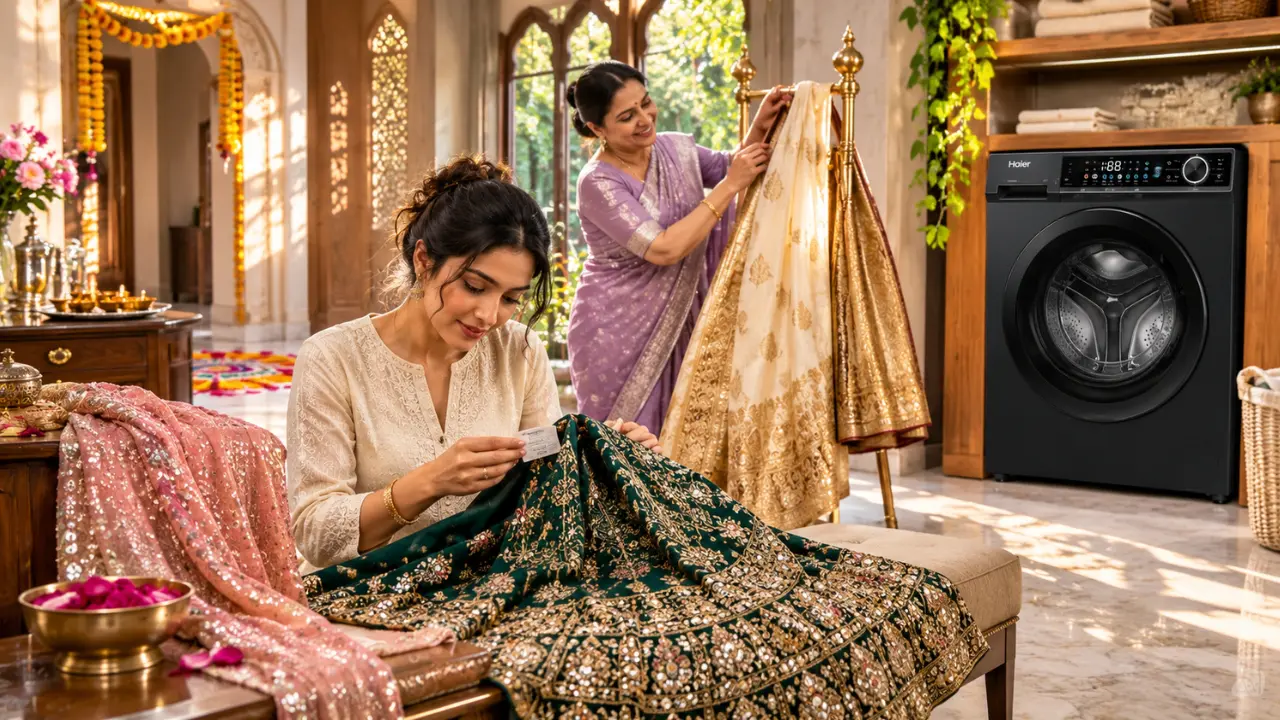

The Diwali festival has ended. Your favourite holiday clothes are ready for cleaning, the decorations are down, and the sweets are gone.
The lovely kurta with all the zari embroidery work? It has a few food stains. The lehenga that was your mirror-work for the family function? Probably requires a spruce-up. The sequined dupatta that was so pretty in pictures now has a hint of perfume and make-up.
Obviously, you would be wondering if these clothes can be put into the washing machine.
There is no simple answer, it is not just yes or no.
Certain decorated clothing may be washed in a washing machine with mild detergent and water. Others, however, will need professional dry cleaning, especially if there is delicate embroidery, metallic threads or glued decorations.
Knowing the difference can save you from needless spending on cleaning your festive wardrobe.
Do sequinned, Zari or Mirror-Work Clothes go in the washing machine?
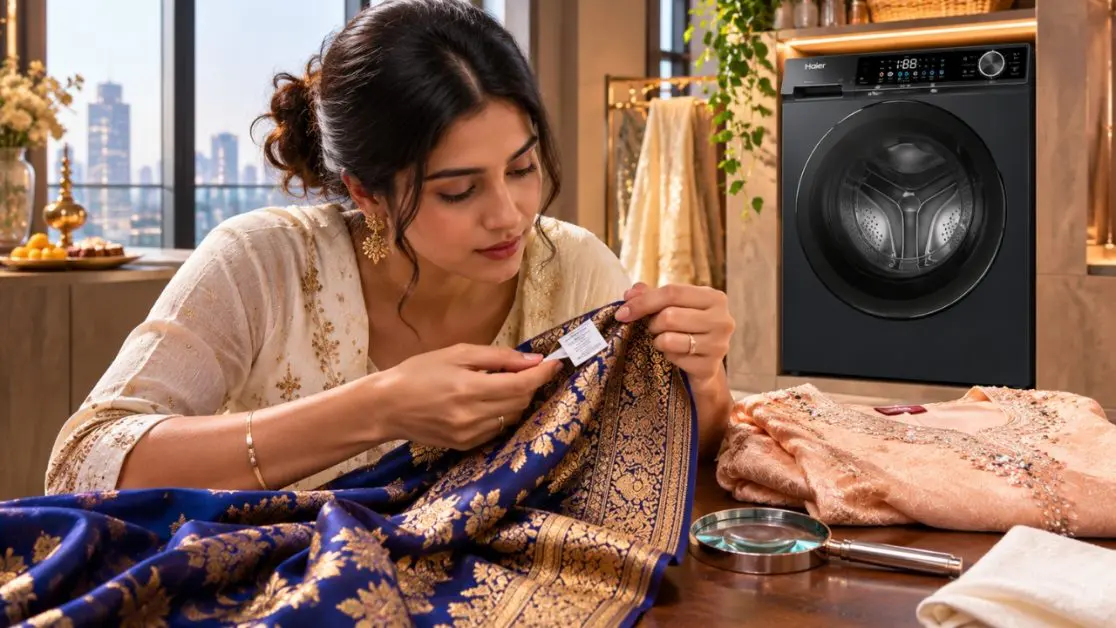
Before deciding how to wash an embellished outfit, check its care label.
Just as the decoration is important, the fabric it is displayed on is also important.
A few well stitched sequins on a cotton kurta is a different thing to a heavily embroidered silk saree. If both the outfits appear to be as light as a feather, the cleaning process can be entirely different.
These are the things you need to think of:
- Fabric composition: Some materials may be able to be washed gently, such as cotton, while others like silk or other delicate fabrics may need special care.
- Embellishment attachment: Stitched decorations are more likely to hold than glued embellishments, but can still work loose.
- Embroidery density: If the embroidery on a garment is too dense, it can be at risk of being pulled and distorted when wet.
- Colour transfer: Festive bright colours may transfer, especially in the first wash.
- Care instructions: If there is a label indicating dry-clean only, this should be used over general washing instructions.
A washing machine that has separate fabric-care programs provides more flexibility. Even a gentle cycle, though, will not render an ill-fitting garment machine washable.
Why are there different washing methods for different Diwali embellishments?
The decoration of the clothes gives festive clothing its character. Unfortunately, the same information can make cleaning difficult.
Sequins: Beautiful, but Vulnerable to Friction
Sequins are typically composed of light, decorative fabrics that are sewn or glued onto a garment or fabric.
They can rub against other clothes in the washing machine or the drum during the washing process.
This can cause:
- Sequins that come loose or fall out.
- Scratches on fine ornamented surfaces.
- Tangled embroidery threads
- Damage to the surrounding fabric.
If the care label says that the garment is machine washable, turn it inside out and put it in a proper mesh laundry bag.
Gentle, low spin cycle.
Do not wash sequined clothes with denims, towels or clothes that have exposed zips.
Zari Work: Metallic Threads Require Extra Attention
Zari embroidery is responsible for the richness of Indian festive clothes.
It can be seen on Banarasi Sarees, lehengas for weddings, kurtas for festivals and traditional Dupatta.
Zari can be made with metallic or metallised threads which do not perform well in damp conditions, detergents or in the event of friction.
Strong cleaning can alter the look of the embroidery and can cause it to become loose.
Generally, it is safer to have the heavily zari-embroidered garments professionally cleaned in line with the care label.
If the base fabric looks washable, it doesn’t necessarily mean the zari is washable.
Mirror Work: Small Decorations, Significant Washing Risks.
Mirror-work is a popular choice for traditional Gujarati outfits and festive ethnic wear.
The mirrors may be attached using embroidery, stitching or adhesive.
Loosely attached mirrors can be damaged or come off a garment that is being washed in a washing machine.
There’s another concern.
A broken or pointed decorative piece may tear or injure other garments and/or components of the appliance.
If the outfit is mirror-work and is very elaborate, it’s generally better to have it professionally cleaned.
When the garment maker specifies that it is machine washable, you should wash it in a protective laundry bag and follow the recommended programme.
What’s the best way to prepare the festive clothes before washing?
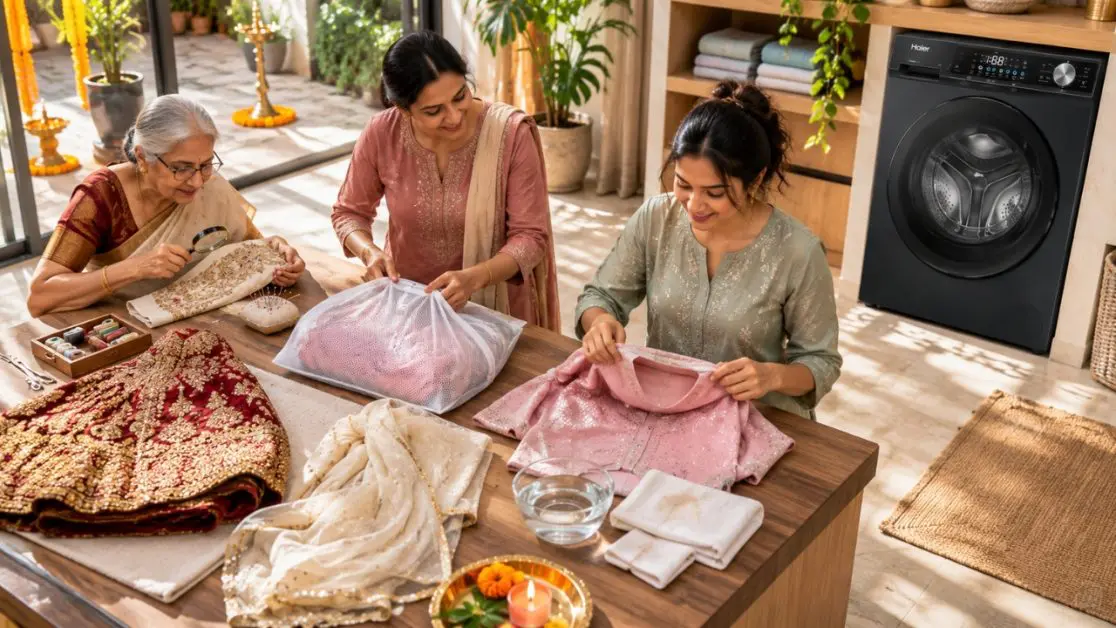
Some simple preparation can minimize possible damage.
It’s no good putting everything into one laundry load because you’re exhausted after Diwali!
First of all, put embellished clothes in a separate category from normal clothes.
Step 1: Inspect the Decorations
Place the article on a clean surface.
Look for loose sequins, mirrors or embroidery.
Take extra care with sleeve edges, necklines and around the waist.
If the stitching shows signs of damage, patch them or have them professionally repaired before washing.
Step 2: Check for Stains
Oil, make up, sweets and food stains are left behind often during festive celebrations.
Each stain is unique and will require a different treatment.
Do not rub or use heavy stain removers on parts that are heavily embroidered or on metallic decorations.
If allowed by the care label, gently blot appropriate stains with a clean cloth and an appropriate cleaning solution.
Professional stain removal is safer than trying at home for expensive and delicate clothes.
Step 3: Turn Suitable Garments Inside Out
Clothes are turned inside out to minimize contact of decorative surfaces with the drum.
Does not fully prevent friction, but it can help to keep embellishments securely attached.
Step 4: Use a Mesh Laundry Bag
A mesh bag will help minimize snagging and will help keep small decorations contained if they fall off.
But it offers no warranty for broken mirrors or failure of the stitch or adhesive.
Use only for garments that are machine washable.
What Washing Machine Settings to Use for Light Christmas Garments?
When washing delicate fabrics, it is important to select the right washing programme.
A stronger mechanical action than an embellished garment can withstand may be used in a regular cotton programme.
If you have clothes that you want to be machine washed for the holiday season, take into account the following settings.
Gentle or Delicate Programme
A delicate programme is one that will use quieter drum beats for delicate fabrics.
This can help to minimize the needless friction.
But the programme should be used only when the instructions for care of the garment allow for machine washing.
Cold Water Washing
Some decorations, adhesives and dyes may be damaged by hot water.
For embellished clothes that need to be washed, cold water is frequently a safer option, as long as it is suitable for the care label and detergent instructions.
Reduced Spin Speed
Decorative stitching might be at risk of being stretched further by high speed spinning.
Use a low spin setting or do not spin the machine when the garment directions say so.
Appropriate Detergent
Use a detergent that is appropriate for the fabric.
Use no bleach unless specifically stated and never use a detergent that is described as gentle on metallic embroidery or glued decorations.
What Role Does Haier F5 Washing Machines Play In Festival Washing?
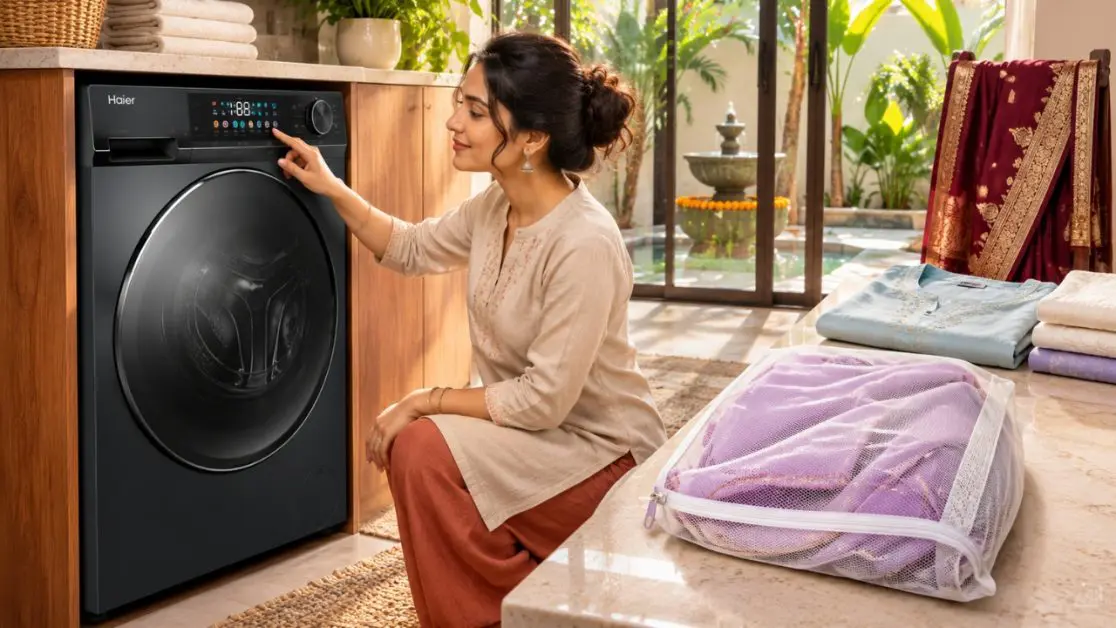
During the festive season Indian households have to come across a lot of fabrics.
A range of washing methods may be required for cotton kurtas, normal ethnic clothes, sarees, and family clothing.
This is where having washing machine programmes that work for specific things comes in handy.
Haier India’s F5 front load washing machine range has two models to consider: Haier F5 9KG Front load Washing Machine HW90-IM14F5BKU1 and Haier F5 10KG Front load Washing Machine HW100-IM14F5BKU1.
Both models include several washing programmes and functions to help with convenient everyday fabric care.
Special Delicate and Saree Wash Programmes were established.
A dedicated Delicate and Saree programme is one of the features that is relevant.
Both the F5 models have 14 washing programmes, such as:
- Delicate
- Saree
- Cotton
- AI Wash
- Hygiene
- Quick
- Refresh
- Eco
In the Delicate programme there is a specific category for appropriate sensitive fabrics.
In the meantime, the Saree programme provides an approved environment for machine-washed sarees.
This is particularly helpful when you have various kinds of traditional Indian clothes in your wardrobe.
Still, however, heavily embellished silk sarees, zari clothes and mirror work clothes ought to be cleaned as indicated by the care direction on the clothes.
AI Wash for Everyday Convenience in laundry
Haier F5 models all have AI Wash.
This technology intelligently optimises the washing cycle to support effective cleaning and efficiency.
Can be helpful when disposing of appropriate everyday clothes after holiday events.
AI Wash should not be a substitute for the instructions for a particular garment.
When wearing a “fragile” outfit, choose the correct fabric-care programme, don’t take anything for granted, since not all decorations are recognized by the automatic setting.
A drum that moves fabric better, 525 mm in diameter.
The Haier F5 series has a large drum with a capacity of 525 mm to accommodate better fabric flow and minimize tangling.
The drum also has a pillow-shaped design.
The machines are attractive for home use where the washing function and care of the garments are desired.
Of course, good loading practices still apply.
Do not overfill the drum, especially when washing delicate items like clothes.
Haier F5 9kg or 10kg: What to choose?
The two washing machines have a similar set of basic features, such as AI Wash, a full colour touch display, Wi-Fi and an inverter motor.
The primary difference is the washing capacity stated.
Haier F5 9KG Front Load Washing Machine
The Haier F5 9KG model (HW90-IM14F5BKU1) comes with a washing capacity of 9kg.
It could be suitable for families who want a front-load washer that can handle their regular family laundry needs and have special programmes for fabric care.
It has many important characteristics such as:
- 9 kg washing capacity
- 14 washing programmes
- AI Wash technology
- 525 mm drum
- Full-colour touch display
- Wi-Fi connectivity
- Inverter motor
- 5-star energy rating
For families that wash their ethnic clothes regularly in the washing machine, it’s worth considering the Delicate programme and Saree programme together.
Haier F5 10KG Front Load Washing Machine
The Haier F5 10KG model (HW100-IM14F5BKU1) is a 10 kg washing machine, which suits the demand of washing more in a household.
It is equipped with the same main washing programmes and intelligent functions.
The extra space can prove beneficial for families who have more than one person who needs to wash their clothes.
But, if the drum is bigger, don’t put heavy loads of delicate clothes in it.
However, there are still sensitive fabrics to be treated with sensitivity and the right programme.
The two models are also adjustable with temperature and spin-speed settings so that the user can choose appropriate settings from the machine’s settings.
What Should You Never Do When Washing Embellished Diwali Clothes?
However, some of the common habits of doing laundry can damage festive clothes even if you use a modern washing machine.
These are some of the most common mistakes to avoid:
- Laundering very decorated clothes without reading the labels.
- Combining fine ethnic clothes with casual attire
- Apply hot water without checking if it is suitable for the fabric.
- Choosing fast spinning for delicate decorations
- Applying bleach directly on the surface of zari or sequins.
- Strongly scrubbing embroidered stains.
- Feeding in clothing with free mirrors into the machine.
One of the biggest misconceptions is that high-priced clothes always require dry cleaning.
The washing method is not based on the price.
The type of embellishment and instructions from the fabric manufacturer are much more important for fabric construction.
What to Do With Your Holiday Clothes: Dry and Store Them?
Washing is just part of the solution.
Delicate festive clothes can be damaged by improper drying and storage.
Drying Embellished Clothing
If the clothes can be washed at home:
- Do not wring or twist fragile embroideries.
- Use a clean towel to gently remove surplus water, when appropriate.
- Dry flat (if directed on care label).
- Avoid placing sensitive colours and embellishments in direct sunlight.
- Do not use the tumble dryer unless stated.
Dense wet clothes tend to stretch when put on hangers, especially when embroidered.
When determining how to dry a garment, always take into account the weight and construction of the item.
After Diwali, how to store clothes.
When dry, carefully store festive garments.
Fold items that are very decorated with appropriate protective material or acid-free tissue between decorated areas.
Store them in a clean dry place.
Don’t fold or stack fragile mirror work under weighty garments.
If it is a zari sari or for a special occasion, adhere to the fabric manufacturer’s recommendations for storage.
Make holiday laundry simple and easy without sacrificing care of the clothes
Diwali clothes require more care than regular clothes.
Depending on the type of embroidery work it has, the lehenga might need professional cleaning services, or a lightly embroidered cotton kurta may be able to be washed in a gentle machine wash.
The distinction is in the fabric, embellishments and the care instructions.
If the Indian household is someone who wants to wash their everyday laundry clothing as well as proper delicate clothing, then Haier India’s front load washing machine is the product that they should look into.
The Haier F5 9KG and 10KG models can be differentiated by the dedicated Delicate programme, Saree programme and a large drum of 525 mm, which caters to different types of household laundry needs.
Visit Haier India to learn more about their F5 washing machine models and select your washing machine according to your family size.
Besides, your preferred holiday attire ought to be prepared for the next holiday season, and not compromised prior to it.
Frequently Asked Questions
Can I machine-wash a saree with zari embroidery?
It depends on the fabric, zari construction and care label. Heavily embroidered zari sarees often require professional cleaning. Do not machine-wash them unless the manufacturer permits it.
Can sequins come off during machine washing?
Yes. Sequins may loosen due to friction, weakened stitching or adhesive failure. Machine-wash only when the garment label allows it, using suitable protective measures.
Is a delicate wash programme safe for mirror-work clothing?
Not necessarily. Even gentle drum movements can damage loosely attached mirrors. Professional cleaning is generally safer for heavily embellished mirror-work garments.
Do Haier F5 washing machines have a saree wash programme?
Yes. Both the Haier F5 9KG and 10KG front-load washing machines include a dedicated Saree programme among their 14 washing programmes.
Should I use hot or cold water for embellished clothes?
Cold water is often preferable for machine-washable embellished garments. However, always follow the garment’s care label, as some fabrics and decorations require specialist cleaning.