
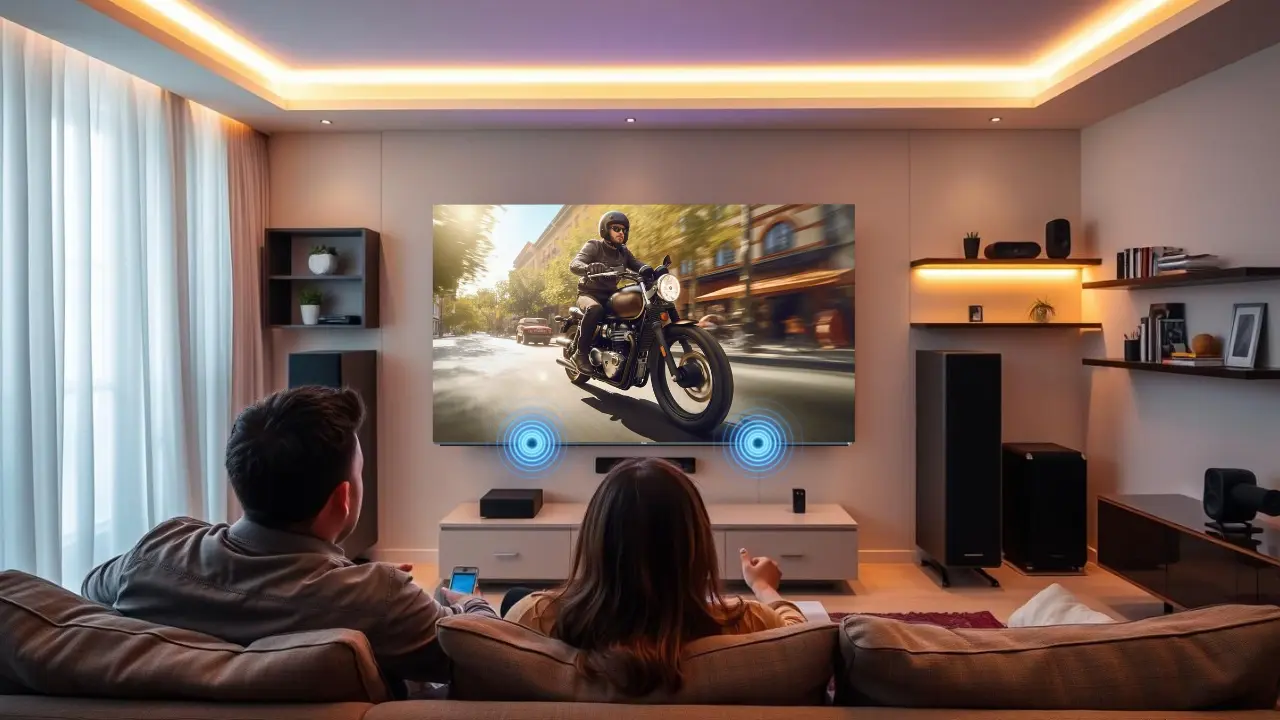

Sound by KEF engineering enhances TV sound by turning flat, front-facing speakers into a layered, room-filling experience.
Through precise speaker design, dedicated woofers, and immersive formats like Dolby Atmos, Sound by KEF focuses on clarity, depth, and balance so dialogue feels closer, bass feels grounded, and sound moves around you instead of staying trapped inside the screen.
That is the short answer.
Now let us talk about what that really means in an Indian living room on a Friday night.
Why does most TV sound feel thin in real homes?
You switch on a cricket match.
The stadium looks massive. The players feel alive. But the crowd noise sounds… small. The comment feels sharp. Background energy disappears.
This is not because the broadcast is weak. It is because most televisions rely on tiny downward-firing speakers. Physics limits them.
A standard TV without a dedicated subwoofer struggles to produce deep bass below 100 Hz. Human hearing spans roughly 20 Hz to 20 kHz. That missing lower band is where impact lives.
No bass. No weight. No immersion.
According to Dolby’s own audio research, spatial sound dramatically improves perceived realism in visual content. The image pulls you in. The sound convinces your brain it is real.
Sound is not an accessory to picture.
Sound is the second half of belief.
And this is where Sound by KEF engineering changes the equation.
What Is Sound by KEF Engineering in a TV Context?
Sound by KEF is a British audio brand with over 60 years of speaker research and acoustic design experience. That matters because speaker design is not guesswork. It is geometry, materials, wave behaviour, and placement science.
When you see Sound by KEF integrated into Haier televisions like the Haier M80F Mini LED 165cm (65) Google TV Sound by KEF (H65M80FUX) , it signals that the sound architecture is not an afterthought.
It is engineered.
In the M80F series:
- 2.1 channel speaker configuration
- 50W total audio output
- Dedicated woofer for bass
- Dolby Atmos integration
These are not decorative specs. They shape how sound travels in a room.
Let us break that down.
The Power of 2.1 Channel Design: Why a Woofer Changes Everything
Most entry televisions use 2.0 channel systems. Two speakers. No dedicated bass.
A 2.1 channel system adds a separate woofer. That single addition shifts the experience.
What 2.1 Channel Means in Practice
- Two stereo speakers handle mids and highs
- One woofer handles bass frequencies
- Total power output improves depth and presence
In the Haier M80F 189cm(75) model (H75M80FUX), the 2.1 stereo speakers and 50W audio output are clearly specified.
Here is the practical difference:
| Feature | 2.0 Channel | 2.1 Channel with Woofer |
| Dialogue clarity | Good | Clear and grounded |
| Bass impact | Limited | Noticeably deeper |
| Movie immersion | Surface-level | Room-filling feel |
| Cricket crowd ambience | Flat | Layered and atmospheric |
Deep bass is not about volume.
It is about weight.
When a door slams in a thriller or a six lands in the stands, your brain expects vibration. The woofer delivers that physical anchor.
Dolby Atmos and Spatial Placement: Sound That Moves

Sound by KEF engineering does not stop at speaker hardware.
It works alongside Dolby Atmos.
Dolby Atmos creates three-dimensional audio by assigning sound objects specific positions in space. Instead of left and right channels alone, sound appears above, around, and behind.
In models like the Haier M80F Mini LED 215cm (85) Google TV Sound by KEF (H85M80FUX), Dolby Atmos works with Sound by KEF audio tuning.
The effect?
- Rain feels like it falls from above
- Helicopters travel across your ceiling
- Stadium sound wraps around your seating area
According to Dolby documentation, object-based audio allows up to 128 simultaneous audio objects in cinema environments. Home systems scale this down intelligently.
But the principle stays.
Sound becomes location-aware.
The picture pulls you forward.
Sound surrounds you.
How Sound by KEF Engineering Focuses on Clarity, Not Just Loudness
There is a common assumption.
Better sound equals louder sound.
Wrong.
Sound by KEF’s approach focuses on precision and balance.
The M96 Series, the audio section highlights Sound by KEF’s legacy of acoustic research and balanced tuning. The focus is on:
- More balanced highs, mids, and lows
- More precise details
- More versatile tuning across genres
That matters for Indian households where content changes constantly.
Morning bhajans.
Afternoon news.
Evening IPL.
Late-night OTT thriller.
Each format stresses different frequency bands.
A well-tuned system prevents:
- Shrill dialogue
- Muddy bass
- Distorted crowd noise
Clarity is a discipline. Not an accident.
Why Larger Screens Demand Better Audio Engineering

As screen sizes grow from 165cm (65) to 189cm(75) to 254cm(100), expectations rise.
The New M96 Series 254cm (100) QD-Mini LED AI Smart Google TV (H100M96FUX) integrates Sound by KEF with advanced audio architecture.
The larger the visual canvas, the more obvious weak sound becomes.
Here is the hidden system at work:
- Bigger screen equals larger visual field
- Larger visual field increases perceived distance
- Increased perceived distance requires deeper, wider sound
Without balanced acoustics, sound feels disconnected from image scale.
That mismatch breaks immersion.
Good engineering keeps scale aligned.
When visuals expand, sound must expand with them.
Three Real-World Scenarios Where Sound by KEF Engineering Matters
Let us ground this in lived experience.
1. Cricket Night with Family
- Crowd roars feel layered
- Commentary remains clear above ambience
- Sixes feel impactful, not hollow
Cost: Higher investment than entry TVs
Benefit: Shared excitement that feels cinematic
2. Solo OTT Binge After Work
- Dialogue stays crisp at moderate volume
- Background score builds tension without distortion
- Dolby Atmos enhances depth in thrillers
Cost: Slightly more complex sound architecture
Benefit: Less listening fatigue over long sessions
3. Festive Movie Marathon
- Music sequences sound fuller
- Bass supports dance numbers
- Surround effects enhance action scenes
Cost: Requires good content format support
Benefit: Living room becomes event space
Sound transforms routine watching into experience.
The Engineering Details That Often Go Unnoticed
On paper, specifications like:
- HDMI 2.1 eARC
- 50W audio output
- 2.1 channel speakers
- Dolby Atmos
look technical.
But they solve real problems.
HDMI eARC ensures high-quality audio signals from connected devices pass cleanly.
Low standby power consumption under 0.5W improves efficiency in daily use.
Energy saving modes balance performance with sustainability.
Engineering shows up in small details.
Small details define long-term satisfaction.
A Bigger Pattern: Why Audio Is Becoming Central Again
For years, TVs competed on pictures alone.
Resolution.
Brightness.
Refresh rate.
But here is the shift.
As streaming platforms improve production quality, audio design becomes richer. Dolby Vision and Dolby Atmos content now dominates premium OTT releases.
According to industry streaming reports, immersive audio formats are increasingly integrated into mainstream releases.
If sound quality lags behind the picture, the gap becomes obvious.
Sound by KEF engineering closes that gap.
It aligns audio capability with modern content demands.
What This Means for Modern Indian Homes
We are not just watching television.
We are:
- Hosting friends for matches
- Playing console games
- Attending virtual events
- Casting from smartphones
- Multitasking between work and streaming
Audio must adapt to all of it.
The M96 Series, with AI Center MAX and advanced picture plus Sound by KEF sound tuning , shows how integrated systems are evolving.
Not louder.
Smarter.
The real decision is not whether you need more volume.
It is whether your screen and sound feel aligned.
The Memorable Insight
The picture attracts attention.
Sound builds belief.
Sound by KEF engineering enhances TV sound because it respects this balance. It treats audio as architecture, not decoration.
And in a world where living rooms double as theatres, stadiums, gaming zones, and quiet retreats, that architectural thinking matters.
When sound feels right, everything else feels effortless.
And effortless is what modern homes quietly seek.
Frequently Asked Questions
I just bought a big TV. Do I really need something like Sound by KEF engineering, or is the built-in sound enough?
Most large TVs still use small internal speakers that struggle with bass and spatial depth. Systems tuned with Sound by KEF engineering include better speaker placement, dedicated woofers, and balanced tuning. This means dialogue is clearer, bass feels fuller, and sound spreads across the room instead of staying inside the screen.
I’m confused between buying a soundbar and choosing a TV with Sound by KEF built in. What should I prioritize?
A TV with Sound by KEF tuning already improves the internal audio architecture with a 2.1 system and dedicated woofer. For many living rooms, that removes the immediate need for a soundbar. If you want an even deeper surround later, you can still add one through HDMI eARC.
My living room is small. Will I actually notice a difference with Sound by KEF-tuned audio?
Yes. Even in small rooms, better tuning improves dialogue clarity and bass balance. You may not need higher volume, but you will notice voices sound closer and background sound feels more natural.
I mainly watch news and YouTube. Does advanced TV sound overkill for me?
Not necessarily. Clear mids and balanced tuning reduce listening fatigue during long viewing sessions. Even simple content like news benefits from cleaner dialogue reproduction.
I’m upgrading from a 140cm (55) to a 189cm (75) TV. Should audio quality matter more now?
Yes. Larger screens increase visual immersion, which makes weak sound more noticeable. Audio systems like Sound by KEF-engineered 2.1 speakers with a woofer help match the scale of the bigger display.