
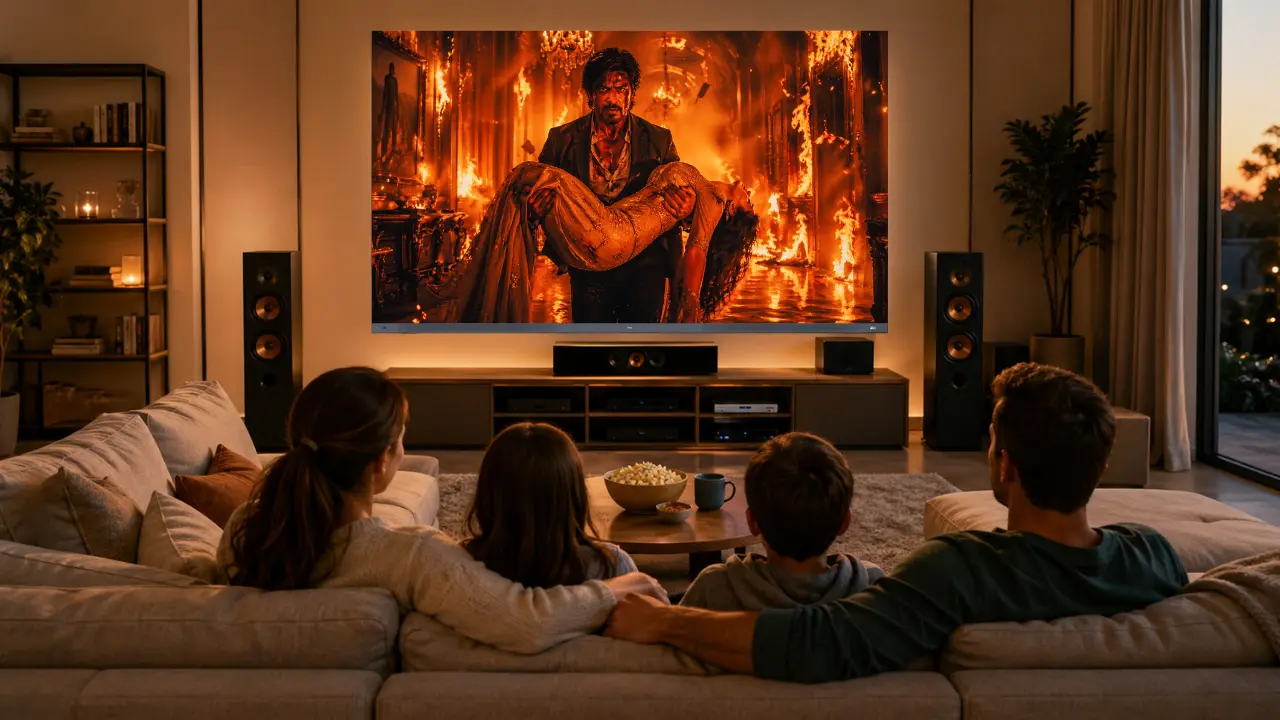

Dolby Atmos is an advanced audio technology that creates three dimensional, immersive sound by placing audio “objects” in a virtual space around you including above your head, instead of limiting sound to fixed channels like traditional surround sound.
Ever noticed how some scenes feel… real?
You are watching a late night cricket match.
The crowd roars.
A helicopter passes overhead in the broadcast intro.
And for a moment, it does not feel like a sound coming from a TV.
It feels like a sound is happening around you.
That shift is not accidental.
It is the difference between hearing sound and experiencing it.
That difference has a name.
Dolby Atmos.
Sound is no longer flat. It has direction, depth, and height
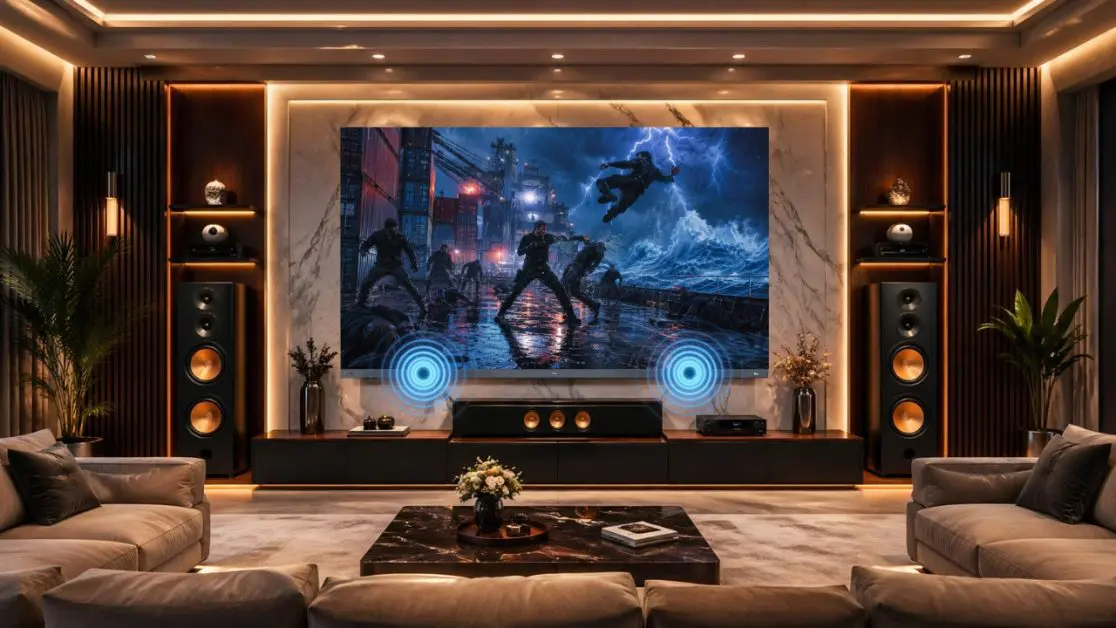
Traditional TV sound works like a stage.
Everything comes from fixed positions. Left. Right. Center.
It is predictable. Controlled. Limited.
Dolby Atmos breaks that system.
Instead of assigning sound to channels, it treats sound as objects.
Think of it like this:
- In old systems, sound is like actors stuck on a stage
- In Dolby Atmos, sound becomes actors moving freely in a 3D space
This is not just a better sound.
This is a different way of thinking about sound.
Sound is no longer played. It is placed.
How Dolby Atmos actually works
Let’s strip the jargon.
At its core, Dolby Atmos does three things:
1. Turns sound into objects
Instead of saying “play this sound from the left speaker,” it says:
Place this sound here in space.
That “here” could be above you. Behind you. Slightly to the right.
This creates freedom.
2. Maps your room virtually
Your TV or sound system calculates how sound should move based on available speakers.
Even with limited hardware, it simulates a full 3D field.
3. Adds height to sound
This is the real game changer.
Older systems only work horizontally.
Dolby Atmos adds verticality.
Rain falls from above. Planes fly overhead. Stadium echoes feel taller.
Simple comparison: Traditional vs Dolby Atmos
| Feature | Traditional Surround Sound | Dolby Atmos |
| Sound Direction | Fixed channels | Dynamic objects |
| Dimension | Horizontal only | 3D including height |
| Immersion Level | Moderate | High |
| Flexibility | Limited | Adaptive to room setup |
| Experience | Watching | Being inside |
Why Dolby Atmos feels so different in real life
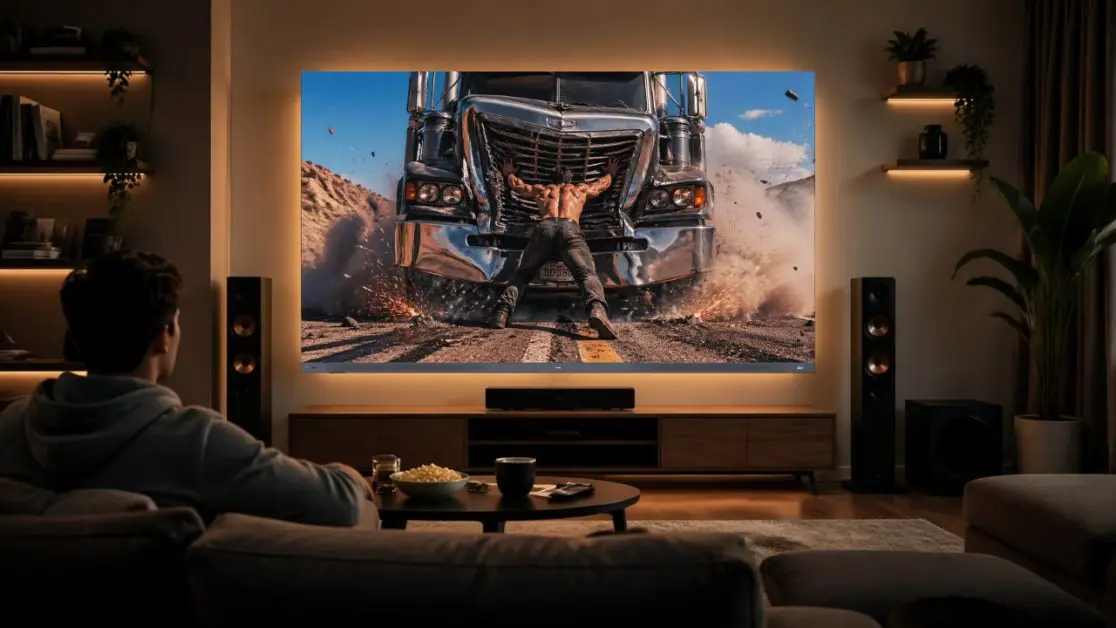
Because it mirrors how we hear in the real world.
In real life, sound does not come from speakers.
It comes from everywhere.
- Traffic noise rises from the street
- Voices bounce off walls
- Thunder rolls above you
Dolby Atmos recreates this behavior.
Not perfectly.
But convincingly enough that your brain fills the gaps.
And that is the trick. Technology does not need to be perfect. It needs to feel believable.
Where you actually notice Dolby Atmos in Indian homes
This is where theory becomes practical.
Dolby Atmos is not about technical specs. It is about moments.
1. Cricket nights with family
You hear crowd chants wrapping around the room.
The commentary feels centered.
The stadium ambience feels alive.
2. Weekend OTT binge
Dialogues stay crisp even during action scenes.
Background scores do not overpower voices.
You notice layers you never noticed before.
3. Gaming sessions
Footsteps have direction.
Gunshots feel spatial.
You react faster because you hear better.
Not all Dolby Atmos experiences are equal
Here is where most people get confused.
Seeing “Dolby Atmos” on a box does not guarantee the same experience.
Why?
Because output depends on three systems working together:
One system is the content
- Netflix, Prime Video, Disney+ Hotstar support Dolby Atmos content
- Without Atmos-enabled content, the experience drops
The second system is the hardware
- TV speakers vs soundbars vs home theatre setups
- More capable systems deliver richer depth
The third system is the processing
- How well your TV interprets and distributes sound
This is why two homes with “Dolby Atmos” can feel completely different.
Three ways to experience Dolby Atmos at home
Not everyone needs a full theatre setup.
The system adapts.
One option is built-in TV speakers
- Clean setup
- No extra devices
- Good for compact spaces
The second option is a soundbar
- Adds depth and bass
- Better separation of sound layers
- Ideal for living rooms
The third option is a full home theatre
- Maximum immersion
- True multi-directional sound
- Higher investment and space requirement
The trade-off is simple:
More equipment equals more realism.
Less equipment equals more convenience.
Where Haier fits into this shift

This is where design meets experience.
Modern TVs are no longer just screens.
They are audio-visual systems.
Take the Haier M80F Mini LED series.
Across sizes like 140cm (55), 165cm (65), 189cm (75), and 215cm (85), these TVs integrate Dolby Atmos with tuned audio systems.
What does that actually mean in real usage?
- 2.1 channel speaker systems with 50W output create deeper bass and clearer dialogue
- Sound by KEF tuning improves clarity and spatial precision
- Dolby Atmos processing adds that third dimension to everyday viewing
The result is not just louder sound.
It is a more organized sound.
And organized sound is what feels immersive.
Why Dolby Atmos matters more today than before
Because how we consume content has changed.
Earlier:
- One TV
- One cable connection
- One type of content
Now:
- Multiple OTT platforms
- Cinema-quality production at home
- Gaming, sports, series, and live streams
The expectation has shifted.
People do not want to just watch content.
They want to feel it.
And sound plays a bigger role than we admit.
Bad sound breaks immersion faster than bad visuals.
A simple way to decide if Dolby Atmos is worth it
Ask one question.
Do you want background noise or designed sound?
Because that is the real difference.
- Background noise fills space
- Designed sound shapes experience
Dolby Atmos belongs to the second category.
The hidden system behind better experiences
Here is the deeper pattern.
Every upgrade in technology follows the same path:
- First, it adds features
- Then, it improves quality
- Finally, it changes perception
Dolby Atmos is in the third stage.
It changes how you perceive content.
Once you experience spatial sound, flat audio feels incomplete.
Not wrong.
Just incomplete.
What this means for your next TV decision
You are not choosing a screen anymore.
You are choosing an experience system.
And that system has layers:
- Visual clarity
- Sound depth
- Smart features
- Ease of use
Ignoring sound is like buying a car for its paint.
It looks good.
But it does not drive well.
The one insight to remember
Sound is invisible, but it shapes everything you feel.
Dolby Atmos works because it understands that.
It does not just play sound louder.
It sounds smarter.
And in modern homes where space is limited but expectations are high, that shift matters more than ever.
So the next time you hear a helicopter on screen
Pause.
Close your eyes.
If you feel it above you, not just in front of you
You are not just watching.
You are inside the moment.
And that is exactly what Dolby Atmos was designed to do.
Frequently Asked Questions
Do I actually need Dolby Atmos for my home TV setup?
If you care about immersion feeling like you’re inside the scene then yes. If you mostly watch casual content or news, regular audio may be enough.
Is Dolby Atmos worth it for a small living room like mine?
Yes, especially with soundbars or Atmos-enabled TVs that simulate 3D sound even in compact spaces.
I already have a decent TV. Will upgrading to Dolby Atmos make a noticeable difference?
Absolutely. The biggest upgrade you’ll feel isn’t volume, it’s direction and depth of sound.
Should I prioritize Dolby Atmos over 4K or picture quality?
Ideally both, but if visuals are already good, upgrading sound can dramatically improve your overall experience.
Is Dolby Atmos just a louder sound?
No. It’s not about loudness, it’s about spatial placement. Sound moves around you, including above.
Why does Dolby Atmos feel more ‘real’?
Because it mimics how we hear in real life sound coming from all directions, not just left/right.
Does every show or movie support Dolby Atmos?
No. Only specific content on platforms like Netflix, Prime Video, and Disney+ Hotstar supports it.
Why does Dolby Atmos sound different in different homes?
Because the experience depends on content, hardware, and processing quality.
How does Dolby Atmos actually work in simple terms?
It turns sounds into “objects” and places them in a 3D space instead of assigning them to fixed speakers.
What does ‘sound objects’ mean?
Instead of “play from the left speaker,” it says “place this sound above and slightly behind you.”
Does Dolby Atmos adapt to my room?
Yes. Your TV or system maps your room and adjusts sound placement accordingly.
What’s special about height in Dolby Atmos?
It adds vertical sound like rain falling from above or helicopters flying overhead.