
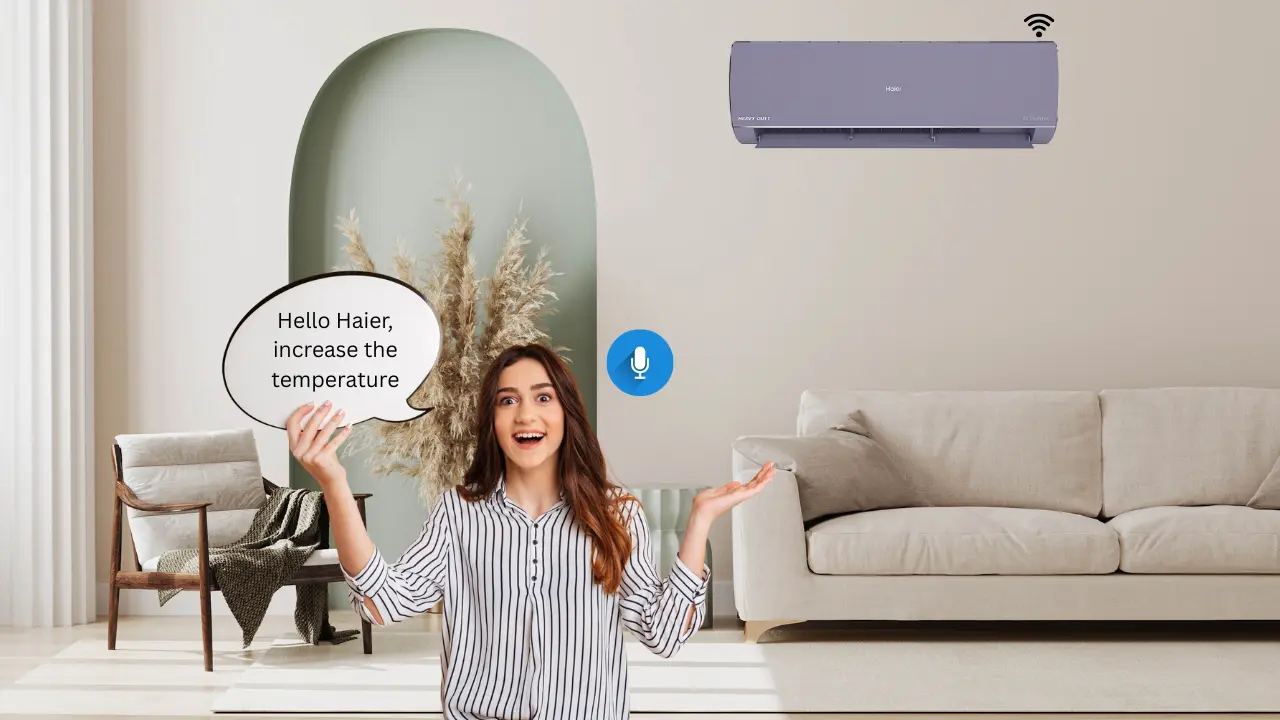

Yes, You Can Change the Room Temperature Just by Talking
Effortless temperature changes through natural speech mean you do not reach for a remote, open an app, or adjust settings manually. You simply speak. The air conditioner understands everyday language and responds instantly, creating comfort without friction.
That is the short answer.
The longer answer lives in how Indian homes actually function.
The Real Problem Is Not Heat. It Is Interruption.
Picture this.
You are on a late evening work call. Laptop open. Headphones on.
The room suddenly feels warmer.
You have three choices.
- Pause the call and search for the remote.
- Unlock your phone and open the AC app.
- Ignore the discomfort and continue.
Each option has a cost.
Time. Focus. Energy.
Small interruptions compound. That is how friction quietly builds inside modern homes.
According to India’s Ministry of Power, residential electricity consumption has grown steadily in urban homes due to increasing appliance usage and climate shifts. Air conditioners now form a large part of household summer energy load. Comfort matters. Efficiency matters more.
But control still feels mechanical.
This is where natural speech changes the system.
Comfort should not interrupt your flow. It should protect it.
What Does Effortless Temperature Control Through Speech Actually Mean?

At its simplest, it means your AC understands normal conversation.
Not commands.
Conversation.
Instead of pressing buttons, you say:
- “It feels a little warm.”
- “Lower the temperature by two degrees.”
- “Switch to Eco mode.”
- “Turn off in 30 minutes.”
In select Haier models powered by AI Atmox, Direct Voice Control works even without WiFi .
That detail matters in India, where internet reliability still fluctuates across cities and towns.
The shift is subtle but powerful.
You are no longer operating a device.
You are interacting with it.
Technology disappears when conversation replaces control panels.
Why Natural Speech Feels Different from Traditional Smart Control
We already have remote controls.
We already have apps.
We already have timers.
So what changes?
1. Remote-Based Control
- Requires physical presence.
- Often misplaced.
- Interrupts activity.
2. App-Based Control
- I need WiFi.
- Requires unlocking and navigation.
- Adds screen time.
3. Natural Speech Control
- Hands-free.
- Screen-free.
- Immediate.
The cost-benefit difference is clear.
| Control Type | Effort Required | Dependency | Speed | Daily Friction |
| Remote | Medium | Physical | Fast | Moderate |
| App | Medium | Internet | Fast | Moderate |
| Voice | Low | Minimal | Instant | Low |
Effortless temperature changes through natural speech reduce micro-decisions.
And micro-decisions are what drain mental energy.
How AI Makes Natural Speech Feel Intelligent, Not Mechanical
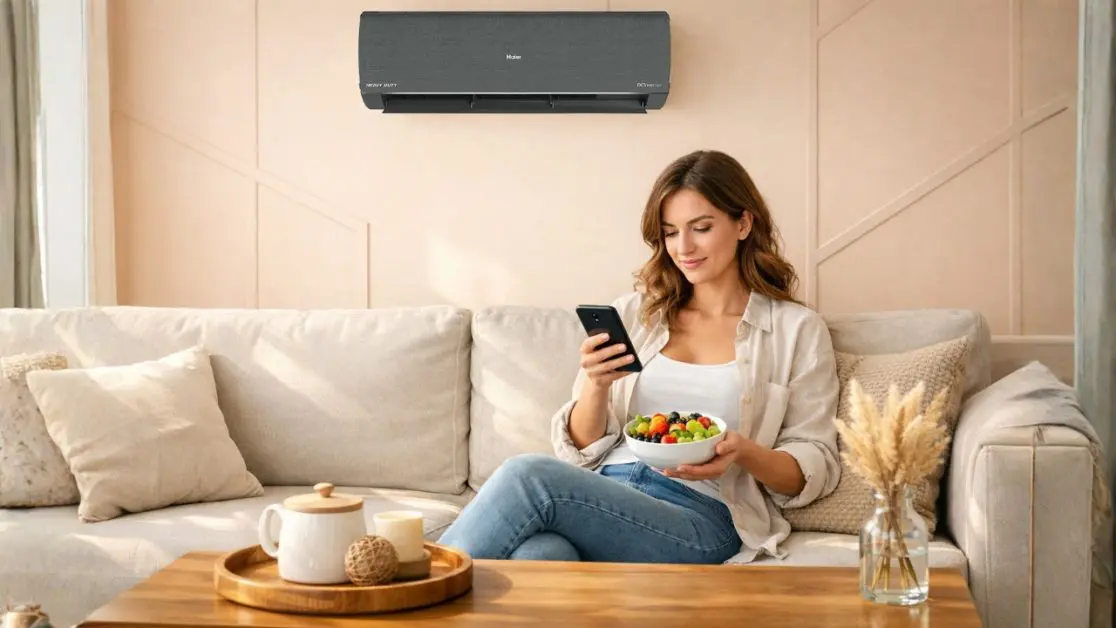
Voice control is only half the story.
What makes it powerful is the intelligence behind it.
The AI Atmox system inside select Haier ACs combines multiple layers :
- AI Climate Control
- AI Pre-Cooling
- AI Target Cooling
- AI Eco 2.0
- AI Human Detection
- Electricity monitoring 2.0
This means when you say, “Make it comfortable,” the AC is not guessing blindly.
It analyzes:
- Current room temperature
- Outdoor climate
- Usage patterns
- Energy mode settings
AI Climate Control automatically analyzes the environment and optimizes cooling to prevent overcooling while saving energy .
The system learns behavior in real time, tracking duration and power data to build a personalized consumption model .
Speech becomes a trigger.
AI becomes the brain.
Comfort without intelligence wastes power.
Intelligence without simplicity feels complicated.
The balance creates effortlessness.
When Natural Speech Changes Everyday Indian Moments
Technology feels real only when it fits culture.
Consider these scenarios.
The Post-Work Entry
You return home from a humid Mumbai commute.
AI Pre-Cooling predicts arrival using a geofence range of 100 meters and cools the room in advance .
You walk in. It is already comfortable.
No button.
No waiting.
Now imagine adding natural speech.
“Switch to sleep mode.”
Done.
The system moves from predictive to responsive in seconds.
The Family TV Night
The living room is packed. Cricket on.
Someone says, “It is too cold near the sofa.”
AI Target Cooling directs airflow to specific seating areas instead of cooling the entire room unnecessarily .
You say, “Focus cooling near the couch.”
It adjusts.
Traditional ACs cool space.
Smart ACs cool people.
The Empty Room Problem
We have all done this.
AC on.
The room is empty.
AI Human Detection automatically optimizes cooling when no activity is detected. It shifts to Auto L3 in 15 minutes and powers off in 30 minutes .
No guilt.
No wasted electricity.
Add speech.
“Turn off when I leave.”
Now intention and automation align.
Energy Savings Become Visible, Not Abstract
One hidden stress in Indian households is the electricity bill.
AI Electricity monitoring 2.0 offers graphical and calendar views of consumption . It even displays consumption in currency for real-time awareness .
This matters.
When savings become visible, behavior changes.
You can:
- Track Eco vs Normal usage duration.
- Set custom energy-saving targets.
- Monitor monthly trends.
Effortless temperature changes through natural speech combine convenience with accountability.
Comfort feels good.
Savings feel smarter.
Why Natural Speech Control Reflects a Bigger Shift in Homes
This is not just about ACs.
It reflects a broader change in how Indian homes evolve.
Earlier, appliances demanded attention.
Now they anticipate it.
Earlier, we adjusted machines.
Now machines adjust to us.
The AI Atmox framework is built around three pillars :
- Comfort
- Savings
- Service
Comfort through adaptive cooling.
Savings through AI Eco 2.0 and power monitoring.
Service through auto-clean technology like AI IDU Frost Self Clean and ODU Cyclone Clean .
Even maintenance reduces friction.
Fifteen seconds after shutdown, the outdoor unit fan reverses to blow away dust, maintaining condenser efficiency .
Cleaner coils mean faster cooling and lower power bills .
Effortlessness is not one feature.
It is a system.
Is Voice Control a Luxury or a Logical Upgrade?
Let us examine this practically.
Cost Considerations
- Slightly higher upfront investment.
- Potential long-term energy savings.
- Reduced maintenance stress.
Daily Benefits
- Faster adjustments.
- Reduced interruptions.
- Better energy awareness.
- Personalized comfort.
In India’s rising temperature cycles, climate control is no longer optional. According to data from the India Meteorological Department, several cities record temperature spikes of over 40°C during peak summers.
The question is not whether you need cooling.
The question is how intelligently you manage it.
Natural speech removes friction.
AI removes waste.
The Hidden System: Decision Fatigue in Modern Homes
Millennial and Gen Z households manage more variables than ever:
- Remote work
- Smart devices
- Rising energy costs
- Compact living spaces
Every manual adjustment adds cognitive load.
Effortless temperature changes through natural speech reduce decision fatigue.
Small relief compounds into mental clarity.
The same logic applies in organizations. technology that removes repetitive decisions free up bandwidth for meaningful work.
Homes operate on similar principles.
The best technology is invisible.
What Should You Actually Look for in Voice-Enabled ACs?
If you are evaluating options, consider three filters:
1. Does Voice Work Without WiFi?
Direct Voice Control in select models operates independently .
2. Is It Backed by AI Climate Intelligence?
Look for technology that analyzes the environment and usage patterns automatically .
3. Does It Integrate Energy Monitoring?
Electricity tracking builds long-term savings awareness .
Convenience without intelligence is novelty.
Intelligence without simplicity is friction.
You want both.
Effortless Temperature Changes Through Natural Speech Are About Control Without Effort
In the end, this is not about speaking to a machine.
It is about removing unnecessary friction from daily life.
You speak.
The room responds.
Energy optimizes.
Comfort stabilizes.
No drama.
No complexity.
Just an ecosystem that learns, adapts, and cools .
And that is the shift.
When appliances understand natural speech, homes feel less mechanical and more human.
The future of comfort is not louder.
It is quieter, smarter, and almost invisible.
Effortless temperature changes through natural speech are not a feature.
They are a design philosophy.
One that makes everyday Indian living feel just a little more sorted.
Frequently Asked Questions
Can I really change my AC temperature just by talking to it?
Yes. Select Haier AC models with Direct Voice Control and AI Atmox that allow you to change temperature, switch modes, and set timers using normal speech without touching a remote or phone.
Do I still need the remote if my AC supports voice control?
No, but the remote remains available. Voice control simply gives you a faster, hands-free option when you’re busy.
Will talking to my AC interrupt what I’m doing?
Not at all. The purpose of natural speech control is to remove interruptions. You can adjust cooling while working, cooking, or relaxing.
Does voice control reduce the number of settings I need to manage?
Yes. Instead of navigating menus or pressing buttons, you can just say things like “lower the temperature by two degrees” or “switch to Eco mode.”
Why does voice control feel easier than using an app?
Because it removes extra steps such as unlocking your phone, opening an app, and navigating settings.
What happens if the AC does not understand my voice command?
You can repeat the instruction more clearly or use the remote/app as a backup.
Does background noise affect voice control accuracy?
Advanced voice recognition is designed to work even with moderate household noise.
Will voice control work in multiple Indian languages?
Many modern systems are expanding multilingual support, though availability may vary by model.
Do voice-enabled ACs require regular maintenance?
Yes, but features like AI IDU Frost Self Clean and ODU Cyclone Clean help automate cleaning processes.