
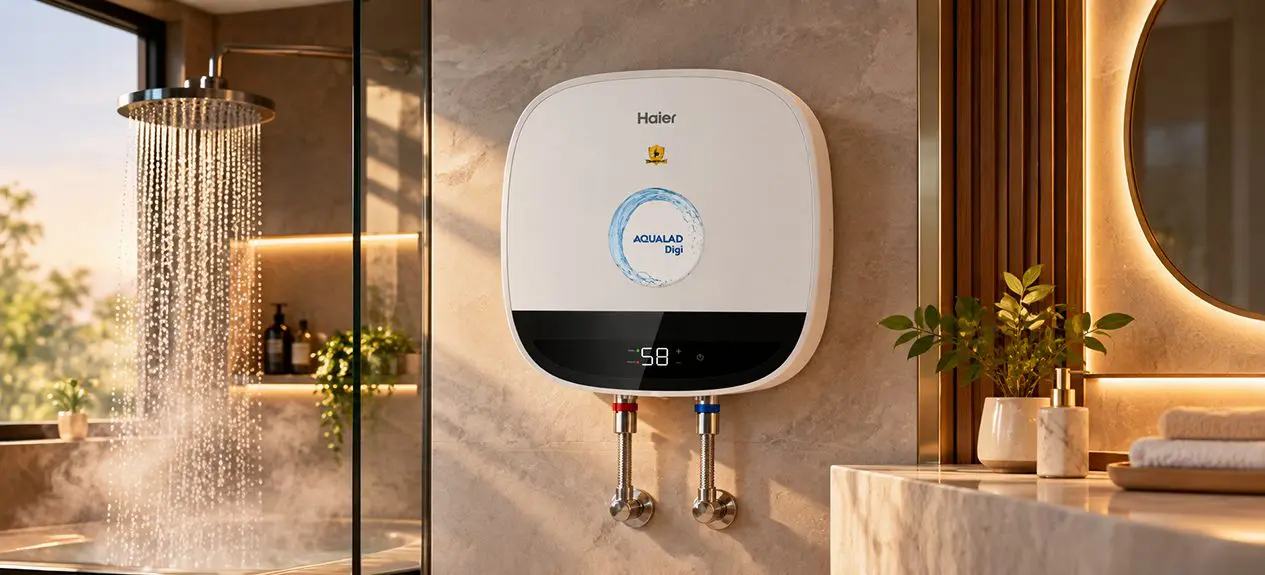

A water heater is used so routinely that its safety rarely gets much attention until something feels unusual. Since it works with heat, water and electricity in the same setup, even small changes in installation, pressure or electrical conditions can affect how confidently it can be used over time.
That is why understanding geyser safety features becomes useful before choosing or installing a water heater. Rather than focusing only on capacity, heating speed or energy use, it also helps to know what safety-related factors should be considered and why they matter in everyday bathroom use.
Before we get into the specific safety systems, it is worth understanding why these protections are important in a water heater in the first place.
Why Do Safety Features Matter in a Water Heater?
Safety features are important because a water heater is expected to perform reliably through frequent heating cycles and regular daily usage. They’re not just there to deal with faults; they also help to make the appliance more predictable and dependable over time.
- They prevent a small problem from becoming a bigger problem. A small fault may grow to be a greater one if it is allowed to go unnoticed. Safety devices are meant to intervene early, helping limit the effect before it puts more stress on the appliance or surrounding installation.
- They make everyday work better controlled. A water heater heats, stops and reheats water repeatedly during its use. Correct safety controls help prevent the appliance from operating unchecked and keep this process within intended limits.
- They boost confidence when used often. In many homes, the geyser may be used a few times a day. In such cases, built-in protection becomes particularly useful, as the appliance is expected to perform consistently without requiring constant attention from the user.
- They can help identify when professional help is needed. Some safety responses, like repeated cut-offs or unusual discharge, may be a sign that something needs to be checked. Early detection of these warning signs can assist users in scheduling service before normal operation is further impacted.
What Does a Water Heater Thermal Cut-Off Actually Do?
The water heater thermal cut-off is a safety control that backs up and functions when the water temperature exceeds the desired temperature. If it gets too hot , it shuts off the power to the heating element so the unit does not keep heating uncontrollably . This is not like a normal thermostat that controls temperature during normal operation. When normal control is no longer sufficient, the thermal cut-off comes into play, providing a further level of protection against overheating.
How Does a Geyser Pressure Release Valve Improve Safety?
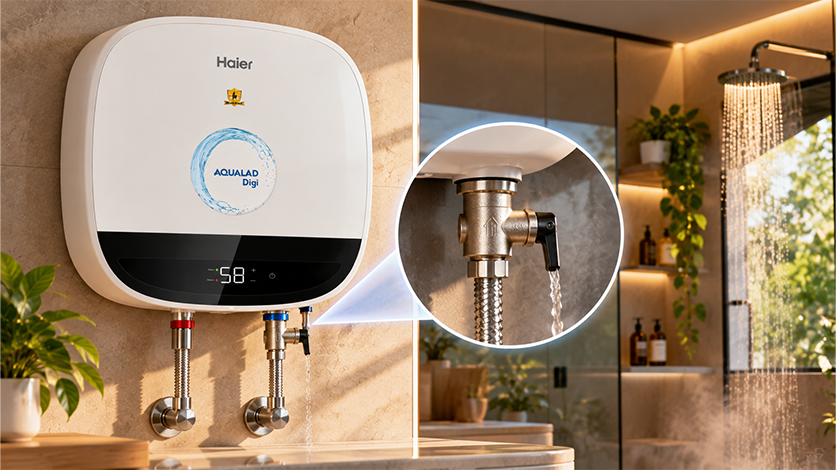
A geyser pressure release valve has one specific function: to keep the pressure within a manageable level while heating. It does not control the temperature or the electricity, but the physical pressure that is created inside the system and helps the water heater to operate more safely from the plumbing perspective.
- It bleeds off pressure before it reaches an unsafe level. As the water heats, in a closed system, its pressure can rise. The valve is a means to vent the pressure when it is above the level it is supposed to handle.
- It protects the attached plumbing fittings. Too much pressure is bad for the tank, too. It can also add additional load on the pipes, fittings and connection points around the heater, so pressure control is important for the wider plumbing set-up as well.
- This reduces the chance of pressure building up in the system. Under certain operating conditions, pressure may be constrained to the heater rather than diffusing naturally. A working valve prevents that pressure from being trapped.
- It makes a safer service and drain system in multi-function designs. Some valves provide pressure relief in conjunction with drainage or backflow prevention. This allows for more controlled maintenance and water movement through the system when the heater needs service.
What Is a Shockproof Geyser and How Does Shock Protection Work?
A shockproof geyser has additional electrical safety features to reduce the risk of current leakage. Such protection is especially relevant as water heaters are usually located in bathrooms, where there is always moisture. This is to reduce the risk of leakage current that could reach the user in case of an electrical fault within the appliance.
Shock protection limits or isolates the effect of electric leakage before it reaches the outer body or water path. It should still be used in conjunction with proper earthing, suitable wiring and professional installation; however, these are still essential parts of safe operation. That is, shock protection is an additional safeguard, but it does not replace basic electrical safety measures.
What Other Geyser Safety Features Are Worth Checking?
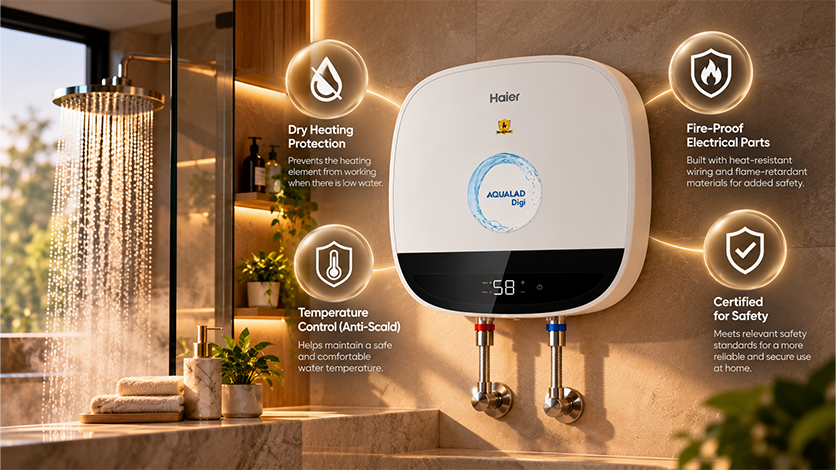
Having considered the main thermal, pressure and electrical protections, some other details are worth looking at. These can be used to judge how well a water heater has been designed for everyday use in the home.
- Protection from dry heating. Some water heaters have a feature to prevent the heating element from turning on when there is not enough water in the unit. This can help to protect the element from damage by heat with no water around it.
- Temperature controls (anti-scald). The ability to choose and program a reasonable temperature for the hot water can minimise the likelihood of the water appearing at an uncomfortable temperature. This can be especially useful in homes with children or older family members.
- All electrical parts are fire-proof. Another useful consideration when assessing the overall construction of a geyser can be heat-resistant wiring, insulated connections and flame-retardant materials around electrical parts.
- Correct product safety certification. Confirm that the water heater meets the appropriate safety standards and is certified for the market in which it is sold. The certification gives buyers another point of reference when they compare the geyser safety features of different models.
Wish to know about advanced safety with our water heater?
Read through Advanced Safety in Haier Geysers: Shockproof Tech and Auto Cut-Off
How Can You Use an Electric Geyser More Safely Every Day?
Safe day-to-day use also relates to how the geyser is operated after it has been installed. Some practical habits can help reduce unnecessary misuse and support better electric geyser safety over time.
- Use the temperature setting smartly. Don’t keep the geyser on the highest setting unless you really need to. For general use in the home, a moderate setting is usually best and it may help to reduce the risk of the water being too hot at the tap.
- Turn off the geyser if it is not being used for a long period of time. If you are not going to use the appliance for a long time, for example when you go on a journey, you can switch it off to prevent it from operating unnecessarily and leaving it on without purpose.
- Do not use the controls with wet hands. Use dry hands to operate the switches and the electrical controls near the geyser, even if the geyser has a protection system built-in. This makes it safer for everyday use, especially in a bathroom.
- No clothes or towels are to be hung on the unit. No clothing or other articles should be placed over or around the geyser. Keeping the outer body and controls clear helps to avoid unnecessary contact with hot or electrical parts.
How Do Haier Water Heaters Approach Thermal, Pressure and Electrical Safety?
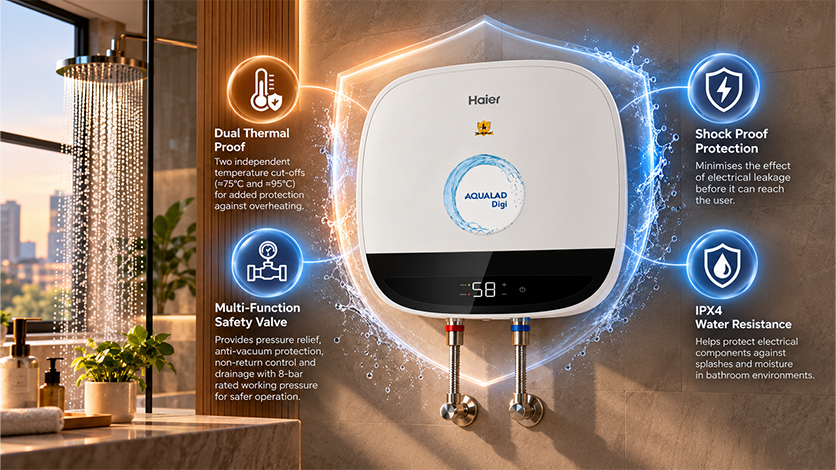
Water-heater safety works best when different risks are controlled by different systems. On selected Haier models, we incorporate thermal protection, pressure control and electrical safeguards so each can respond to a different part of day-to-day operation.
- Dual Thermal Proof provides you with a second level of overheat protection
With our Dual Thermal Proof system, we have two independent temperature cut-offs instead of one control point. The first will turn off heating at around 75 °C, and the second is designed to cut the power if the temperature keeps going up to around 95 °C. This provides us with an additional layer of protection should the primary temperature control fail to operate as intended.
- The Multi-Function Safety Valve helps you to better control pressure
Our Multi-Function Safety Valve provides pressure relief, anti-vacuum protection, non-return control and drainage on selected models. Together with an 8-bar rated working pressure, this enables the water heater to cope more reliably with difficult pressure situations, for example in high-rise homes or properties that use pressure pumps.
- Shock Proof and IPX4 protection help you address electrical and bathroom-related risks
Our Shock Proof technology is designed to minimise the effect of electrical leakage before it can reach the user. We also employ IPX4 water resistance on selected water heaters to help protect electrical components against splashes and moisture that are common in bathroom environments.
- Our range of Digi called AQUALAD combines these protections
We have designed our Haier AQUALAD Digi 25L Square 5 Star Water Heater with Shock Proof protection, over-heat and over-pressure protection, water resistance of IPX4, 8-bar rated working pressure and bi-capillary dual thermostat. Our Haier AQUALAD Digi 15L Square 5 Star Water Heater uses similar safety measures but with a smaller capacity. Therefore, instead of comparing water heaters only by capacity, we suggest checking the exact safety features of the model that fits your household needs.
Conclusion
There is no such thing as a safety feature on a water heater. Thermal cut-offs prevent excessive temperatures. Pressure valves deal with abnormal pressures. And shock-protection systems provide an additional safeguard against electrical leakage.
Together, these protections, proper installation and maintenance give a much better picture of how safely a geyser can fit into everyday bathroom use.
Frequently Asked Questions
Which geyser is more safe?
The multi-layered protection is a safer choice of a geyser. Check for features such as a thermal cut-off, pressure relief valve, electrical leakage protection, proper earthing and a working pressure rating that is suitable for your home.
What safety features should a geyser have?
Key geyser safety features are a thermostat, a thermal cut-off, a pressure relief valve and electrical protection against current leakage. Water-resistant construction and corrosion protection can also contribute to safer long-term use.
Is an electric geyser safe in the bathroom?
Yes, if it is designed for use in the bathroom and installed correctly. Earthing should be proper, and wiring should be suitable. Leakage protection is important. Electrical components should be water-resistant.
Is an LPG / gas geyser safe?
A gas geyser may be safe if installed in a well-ventilated area with the right exhaust system. The installation conditions are very important, as poor ventilation can allow combustion gases to build up.
Can an instant geyser blast?
An instant geyser is safe to use under normal conditions, but overpressure, faulty parts or incorrect installation can prove risky. These situations are handled by a geyser pressure release valve and reliable thermal protection.
What does a thermal cut-off do?
A thermal cut-off in a water heater will cut power to the heating element if the temperature exceeds a set safety limit. It’s an extra safety net if the normal temperature control isn’t working as it should.
Which type of geyser is safe?
Instant and storage geysers can be safe when they have appropriate thermal , pressure and electrical protection . The right choice is more a function of the safety systems, pressure compatibility and quality of installation than the type of geyser itself.