
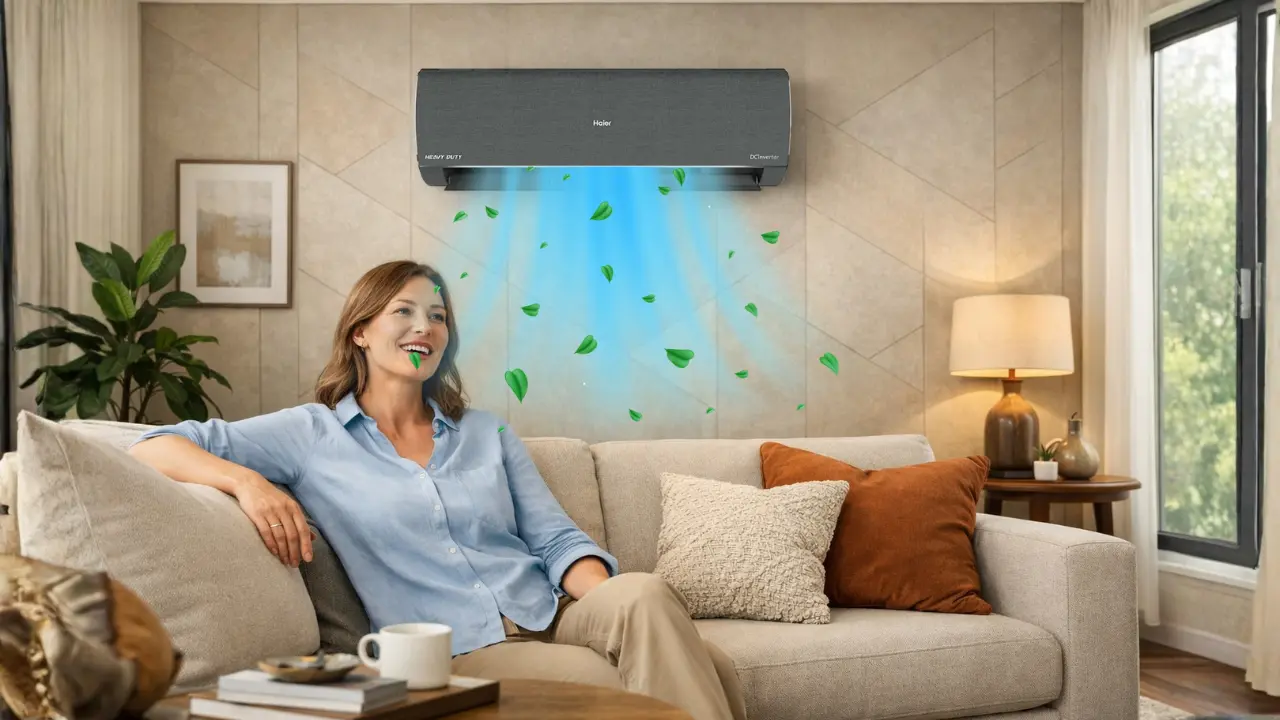

AI climate control automatically adapts air conditioners to changing weather by analyzing temperature, humidity, user habits, and room conditions in real time.
Instead of relying on fixed settings, AI powered ACs learn how a home behaves across seasons and automatically adjust cooling, airflow, and power usage to maintain comfort while reducing electricity consumption.
In simple terms, the machine begins to understand the rhythm of your home.
The weather changes.
The AC adapts.
Comfort becomes automatic.
The Indian weather problem most ACs were never designed for.
Step outside on an Indian summer afternoon.
The heat feels different in April than it does in June.
April heat is dry and sharp.
June heat is humid and heavy.
September evenings feel sticky.
December nights suddenly need warm blankets.
Yet most traditional air conditioners treat every day exactly the same.
Set temperature.
Same airflow.
Same compressor pattern.
But weather is not a fixed system. It is a constantly shifting environment.
And that mismatch creates three common problems inside Indian homes:
| Problem | What Happens | Result |
| Static cooling | AC runs at fixed patterns | Energy waste |
| Poor humidity control | Monsoon air feels sticky | Discomfort |
| Manual adjustments | Users constantly change settings | Inconsistent cooling |
This is the hidden limitation of conventional cooling.
Machines operate like clocks.
Weather behaves like jazz.
AI climate control exists to bridge that gap.
AI Climate Control Turns Your AC Into a Learning System

Think about how smartphones became smarter over time.
They began to learn your habits.
Music recommendations improved.
Maps predicted your commute.
Notifications adjusted to your routine.
AI powered air conditioners follow the same principle.
They collect environmental data, observe user behavior, and adjust performance dynamically.
According to the Haier AI climate control system, advanced AI powered ACs analyze multiple inputs simultaneously such as:
- Current room temperature
- Outdoor weather conditions
- Humidity levels
- User cooling preferences
- Usage patterns across time
- Power consumption behavior
This allows the AC to continuously optimize its performance without manual adjustments.
The result is simple.
The machine stops reacting.
It begins predicting.
Four Ways AI ACs Adapt to Changing Weather
AI climate control works because it solves multiple comfort variables at once.
Not just temperature.
Here are the four systems working quietly inside modern AI powered air conditioners.
1. AI Climate Learning: The AC Understands Your Environment
Weather patterns inside a home change throughout the day.
Morning sunlight heats the living room.
Afternoon humidity increases indoor moisture.
Night cooling needs to feel different from daytime cooling.
AI climate control continuously monitors these variables and adjusts the compressor and airflow accordingly.
The system collects environmental data and uses machine learning to build a personalized cooling model based on user behavior and seasonal changes.
Instead of fixed settings, the AC learns patterns.
Your home becomes its dataset.
2. AI Pre Cooling: The Room Cools Before You Arrive
The most uncomfortable moment with a traditional AC is the first ten minutes.
You enter a hot room.
You switch on the AC.
You wait.
AI powered systems eliminate that waiting.
Using location awareness and behavior prediction, AI powered pre cooling systems anticipate when users are returning home and begin cooling the room in advance.
Some systems trigger cooling when the user enters a preset geofence distance from home.
For example, Haier’s AI pre-cooling technology can automatically start cooling when the user enters a 100 meter radius near home.
The result is subtle but powerful.
The room is already comfortable.
The system thinks ahead.
3. AI Target Cooling: Cooling Only Where It Matters
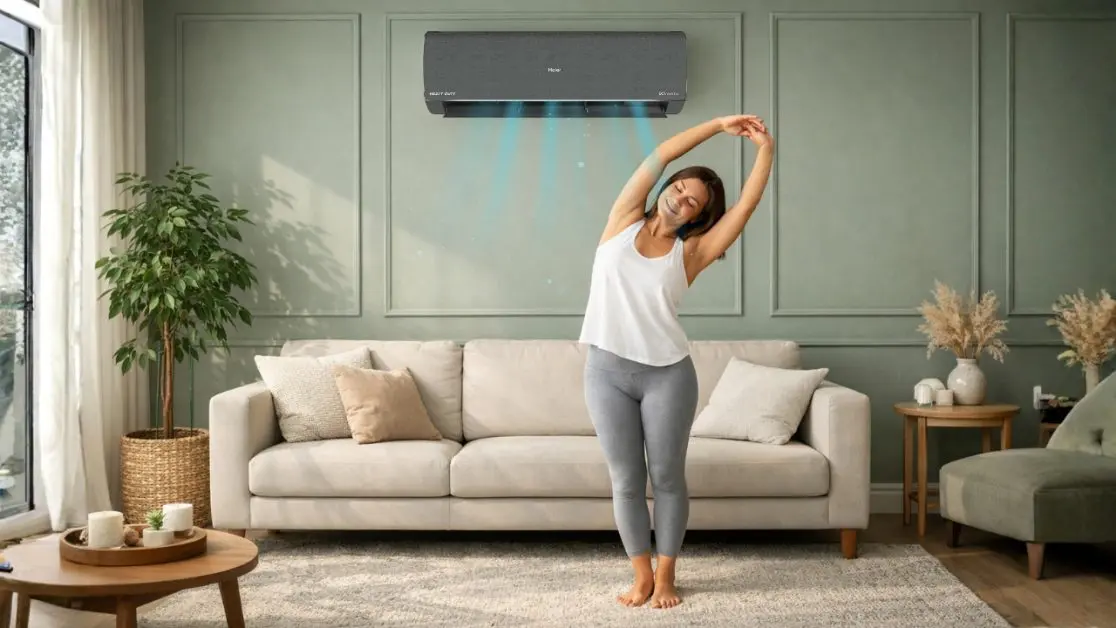
Traditional ACs cool the entire room evenly.
But people rarely occupy the entire room equally.
Someone sits on the sofa.
Someone works at a desk.
Someone sleeps on the bed.
AI target cooling changes how airflow is distributed.
Using installation data and spatial mapping, the AC directs airflow specifically toward occupied zones instead of cooling empty space.
This creates two benefits simultaneously:
| Benefit | Impact |
| Faster comfort | Air reaches people quicker |
| Energy savings | Less power wasted cooling empty areas |
Cooling becomes precise.
Not excessive.
4. AI Eco 2.0 Mode: Energy Efficiency That Adjusts Automatically
Energy consumption is where AI climate control shows its real value.
Instead of running the compressor at constant intensity, AI powered systems adjust performance based on the difference between the room temperature and the desired setting.
For example:
| Temperature Gap | AI Eco 2.0 Mode |
| More than 3°C | High power cooling |
| 1 to 3°C | Medium efficiency mode |
| Less than 1°C | Low power maintenance |
This dynamic adjustment prevents unnecessary power consumption while maintaining comfort.
Which leads to a simple insight.
Cooling is not the expensive part.
Overcooling is.
Smart Electricity monitoring 2.0 Changes How People Use ACs
Most households never actually know how much electricity their AC consumes.
The bill arrives weeks later.
And by then the usage patterns are forgotten.
AI powered Electricity monitoring 2.0 changes this behavior.
Modern smart AC systems display:
- Real time electricity consumption
- Daily and monthly usage patterns
- Eco mode operating hours
- Estimated cost in currency
- Energy saving targets
According to Haier’s AI power management interface, electricity usage can be visualized through graphical dashboards and calendar views to track consumption more easily.
When people see energy usage clearly, behavior changes.
Awareness becomes efficiency.
AI Human Detection Reduces Wasted Cooling
Here is another invisible inefficiency.
ACs often continue cooling empty rooms.
The living room AC keeps running after everyone leaves.
The bedroom AC runs while nobody is home.
AI powered human detection solves this problem.
Sensors detect movement and occupancy inside the room.
If no activity is detected:
- Cooling automatically shifts to energy saving mode
- Compressor load reduces
- AC eventually powers down if the room remains empty
This prevents unnecessary electricity consumption while maintaining comfort when people return.
Efficiency becomes automatic.
Not dependent on human memory.
Self Cleaning Systems Improve Long Term Cooling Efficiency
Another hidden factor affecting AC performance is dust accumulation.
Outdoor condenser units gather dust and debris over time.
Indoor coils collect moisture and bacteria.
These factors reduce cooling efficiency and increase electricity consumption.
Modern AI powered AC systems include automated cleaning systems such as:
| Feature | Purpose |
| Frost Self Clean | Cleans indoor coils through frost wash cycle |
| Cyclone Clean | Removes outdoor condenser dust using reverse airflow |
| Auto Clean | Maintains airflow efficiency |
For example, Haier’s outdoor cyclone cleaning system reverses the fan motor briefly to blow dust off the condenser surface, maintaining heat exchange efficiency.
Cleaner coils mean better airflow.
Better airflow means lower power usage.
Why AI Climate Control Fits Modern Indian Homes
Modern homes behave differently than homes twenty years ago.
Apartments are smaller.
Work from home is common.
Electricity costs fluctuate.
Weather patterns shift faster.
Cooling systems must adapt to these realities.
AI climate control brings three advantages that matter in everyday life.
One. Comfort becomes automatic.
The system adjusts cooling based on environmental data.
Two. Energy usage becomes smarter.
Power consumption adapts to real time conditions.
Three. Maintenance becomes easier.
Self cleaning features maintain performance over time.
Smart systems remove friction from daily routines.
And that is the real purpose of good technology.
Not complexity.
Ease.
The Bigger Insight: Cooling Systems Are Becoming Decision Systems
Air conditioners used to be simple machines.
Switch on.
Cool room.
But intelligent systems are turning appliances into decision engines.
They observe.
They learn.
They adapt.
Haier’s AI Atmox platform demonstrates how cooling systems are evolving from manual appliances into intelligent climate management systems that balance comfort, energy efficiency, and user behavior.
Which leads to an interesting conclusion.
The future of home appliances is not about more buttons.
It is about fewer decisions.
The Quiet Promise of AI Climate Control
The best technology rarely announces itself loudly.
It simply removes friction from everyday life.
A cooler room when you enter.
Lower electricity bills at the end of the month.
Comfort that adjusts quietly with the seasons.
That is the quiet promise of AI climate control.
When machines learn the rhythm of your home, comfort stops being something you manage.
It becomes something that simply happens.
Frequently Asked Questions
Why do I keep changing my AC temperature throughout the day?
Because traditional ACs don’t adapt to changing heat and humidity. Your comfort needs to shift, but the AC stays static.
Why does my room feel different even at the same temperature setting?
Humidity, sunlight, and airflow affect how temperature feels, and normal ACs don’t adjust for these factors.
Why does my AC feel too cold at night but not during the day?
Night temperatures drop naturally, but your AC keeps cooling at the same intensity.
Is it normal to feel uncomfortable even when my AC is running?
Yes if the AC isn’t adjusting to humidity and occupancy, comfort can feel inconsistent.
What is AI climate control in simple terms?
It’s a system that learns your habits and adjusts cooling automatically.
Can my AC start cooling before I reach home?
Yes, with AI pre-cooling using location tracking.
Does AI AC really save electricity?
Yes, by avoiding overcooling and shutting down when not needed.
What is human detection in ACs?
Sensors detect occupancy and adjust cooling accordingly.