
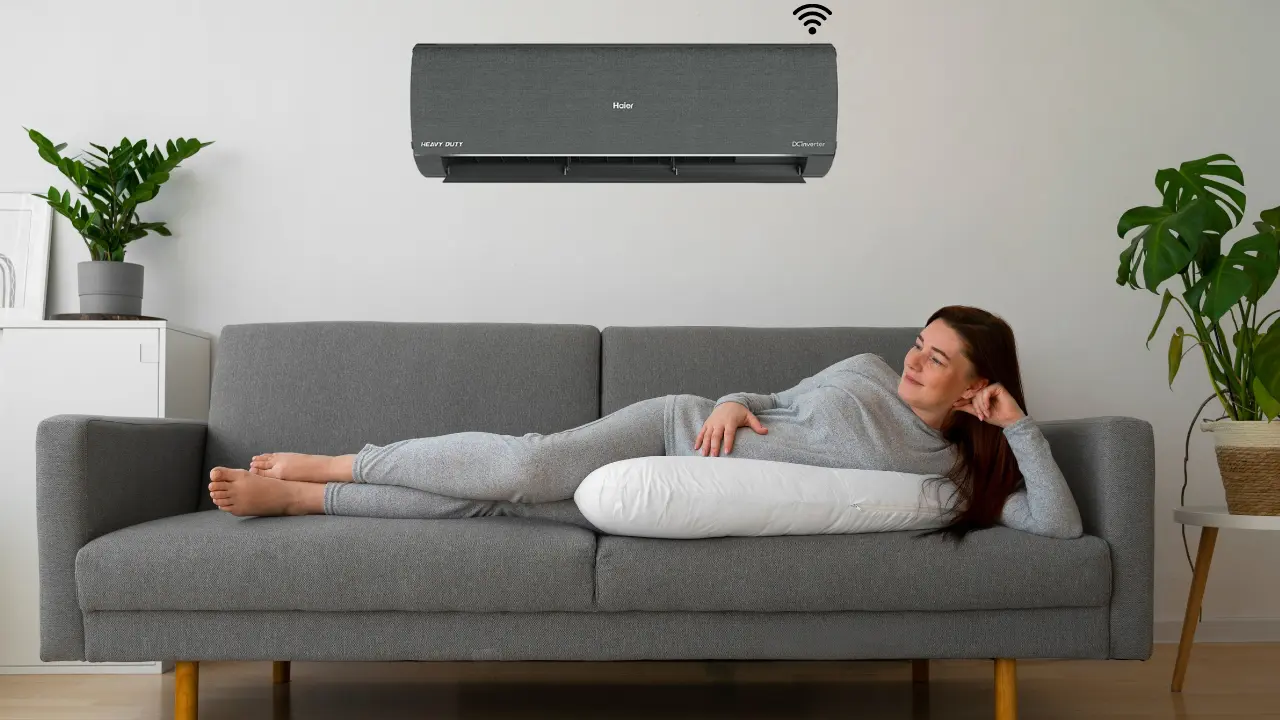

Modern AI-powered air conditioners learn your daily habits by analyzing how and when you use cooling.
They track room temperature, occupancy, usage patterns, and environmental conditions, then automatically adjust cooling, airflow, and power usage to deliver comfort exactly when you need it while reducing electricity consumption.
Comfort used to be manual.
You pressed a button.
Adjusted the temperature.
Waited.
But modern homes are changing.
Air conditioners are no longer just machines that blow cold air. They are systems that observe patterns. Systems that adapt. Systems that quietly learn the rhythm of your home.
In other words, the AC is beginning to understand your life.
The Hidden Pattern Inside Every Indian Home
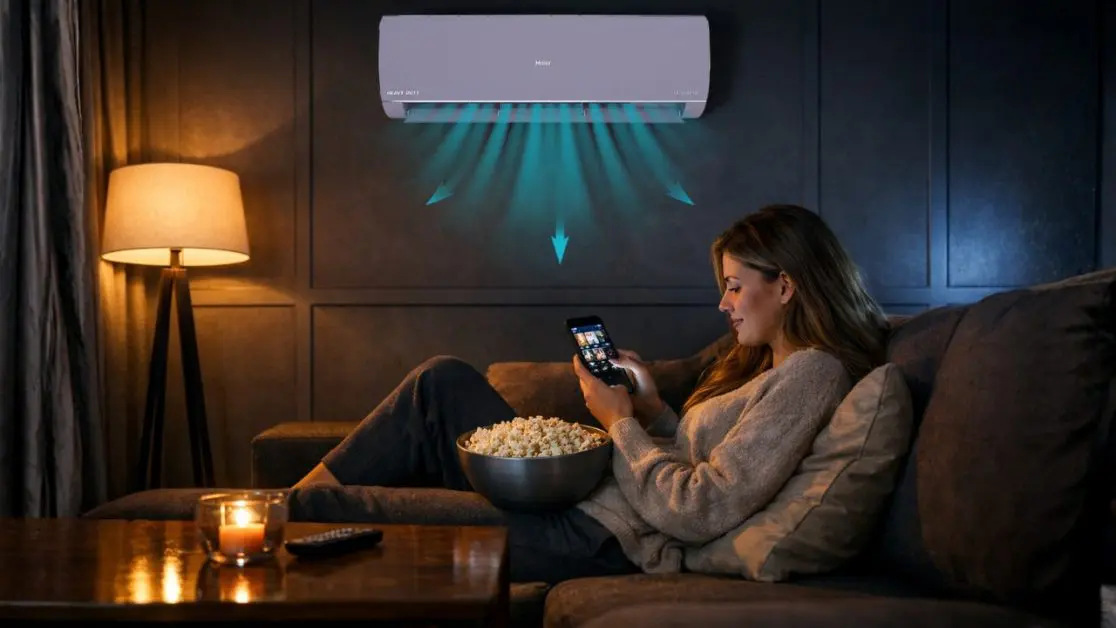
Walk into a typical Indian household on a summer evening.
A working professional returns home around 7 pm.
Parents switch on the AC after dinner.
Children prefer slightly cooler rooms during sleep.
These routines repeat. Day after day.
Most appliances ignore this pattern. AI-powered air conditioners study it.
The result is simple but powerful:
The machine stops waiting for instructions. It starts anticipating comfort.
Modern systems such as Haier’s AI-powered climate platform AI Atmox are built around this principle. Instead of reacting to commands, the system learns behavior patterns and adapts cooling automatically.
Why Traditional ACs Always Needed Constant Adjustment
Traditional air conditioners operate on a simple rule.
You tell them what to do.
Set temperature to 24°C.
Change fan speed.
Turn on sleep mode.
The system never learns.
Which creates three common problems in Indian homes:
| Problem | What Happens | Result |
| Overcooling | AC runs longer than needed | Higher electricity bills |
| Uneven comfort | Air spreads randomly | Some areas feel warm |
| Manual effort | Users keep adjusting settings | Frustration |
In short:
The machine remains static while life remains dynamic.
AI-powered cooling solves this mismatch.
How AI ACs Learn Your Daily Habits
Modern AI air conditioners rely on a combination of sensors, cloud data, and machine learning.
They observe how you use cooling across time.
Gradually, the system builds what engineers call a behavior model.
According to the AI Atmox architecture, the system tracks several inputs in real time.
Key Data Signals an AI AC Observes
- Room temperature trends
- Time of usage throughout the day
- Preferred cooling modes
- Duration of operation
- Outdoor weather conditions
- Human presence inside the room
Each signal alone means little.
Together, they reveal patterns.
And patterns are where intelligence lives.
The Three Ways Smart ACs Adapt to Your Lifestyle
Not all smart features work the same way.
Most AI cooling systems improve comfort through three specific mechanisms.
1. Predictive Cooling
Predictive cooling focuses on anticipation.
Instead of waiting for you to switch on the AC, the system learns when you typically arrive home.
For example:
- Office return time: 7 pm
- AC start time: 7:10 pm
- Preferred temperature: 24°C
After learning this pattern, the AC prepares the room in advance.
AI-powered systems like Haier’s AI Pre-Cooling activate cooling automatically when you approach home using geofence detection.
The idea is simple.
Comfort should greet you at the door.
Not arrive ten minutes later.
2. Targeted Cooling
Traditional ACs cool an entire room equally.
But people rarely use every corner of the room.
Think about your living room.
You sit on the sofa.
The AC cools the empty walls.
AI-powered target cooling solves this inefficiency by directing airflow toward the occupied area.
Benefits include:
- Faster cooling
- Lower energy consumption
- More focused comfort
AI systems determine airflow direction using installation data and environmental mapping to cool the specific zone where users are sitting.
In other words:
Cooling becomes precise rather than excessive.
3. Adaptive Energy Optimization
Energy usage often peaks during summer.
But many homes waste cooling power when rooms are empty.
AI-powered air conditioners solve this through occupancy detection.
Sensors monitor movement inside the room.
When no activity is detected, the system automatically adjusts power usage.
| Situation | AI Response |
| Room occupied | Full cooling comfort |
| Reduced activity | Energy saving mode |
| Room empty | Power reduction or auto shutdown |
AI-powered human detection can reduce unnecessary cooling and optimize electricity usage automatically.
The benefit is not only comfort.
It is efficient.
Why Learning Behavior Improves Energy Efficiency
Electricity consumption is not only about compressor efficiency.
It is about timing.
Consider two scenarios.
Scenario 1: Manual Cooling
The user turns the AC to 18°C to cool the room faster.
The compressor runs aggressively.
Room overcools.
Scenario 2: AI Adaptive Cooling
The system predicts required cooling.
Adjusts airflow and compressor gradually.
Maintains stable temperature.
The difference is subtle.
But over an entire season, the savings add up.
AI-driven cooling platforms monitor power consumption, track mode usage, and optimize performance automatically to balance comfort and energy efficiency.
Which leads to an important insight.
Energy efficiency is not just about power. It is about intelligence.
The Five Signals Smart ACs Use to Understand Your Home
To understand habits, AI air conditioners rely on multiple signals.
Each signal reveals a small piece of household behavior.
Together they form a complete picture.
| Signal | What It Reveals |
| Time patterns | When cooling is usually required |
| Temperature preference | Ideal comfort levels |
| Occupancy detection | Whether someone is present |
| Environmental data | Weather and humidity changes |
| Power usage history | Efficiency improvements |
Machine learning systems analyze these signals continuously.
Over time the model improves.
Which means the AC becomes more accurate.
And more personal.
Smart Homes Are Quietly Becoming Self-Learning Systems
The idea behind intelligent cooling extends beyond air conditioners.
It reflects a larger shift inside modern homes.
Appliances are becoming adaptive systems.
A smart refrigerator learns food habits.
A washing machine studies laundry cycles.
An AI AC learns cooling preferences.
Individually, these changes feel small.
Together, they transform daily life.
The home begins to respond rather than react.
Why This Matters for Modern Indian Households
Indian homes operate under unique conditions.
- Long summers
- Rising electricity costs
- Multi-generational families
- Diverse climate zones
A cooling system that adjusts automatically solves real problems.
Consider three typical users.
Young Professionals
Return home late.
Prefer instant cooling.
Value energy efficiency.
Families
Use AC across multiple rooms.
Require balanced comfort.
Need electricity control.
Solo Urban Residents
Live in smaller apartments.
I want automation and convenience.
AI-powered cooling adapts to all three scenarios.
Without manual effort.
What Makes AI Cooling Different from Smart Controls
Many appliances today advertise smart features.
But there is an important distinction.
| Smart Feature | AI Feature |
| App control | Behavioral learning |
| Manual scheduling | Predictive cooling |
| Remote temperature change | Adaptive optimization |
Smart systems obey commands.
AI systems learn patterns.
That difference changes everything.
The Real Insight Behind AI Air Conditioning
Technology rarely changes life in dramatic moments.
It works quietly.
A few seconds saved.
A few units of electricity were reduced.
A room that feels comfortable the moment you enter.
These improvements accumulate.
And suddenly daily living feels easier.
That is the promise behind AI-powered cooling platforms such as Haier’s AI Atmox climate system, which continuously analyzes environmental data and user behavior to deliver adaptive comfort automatically.
The Future of Cooling Is Learning
For decades, air conditioners followed instructions.
Now they observe patterns.
Soon they will anticipate needs.
That shift matters more than it appears.
Because the future of appliances is not just efficiency.
It is understanding.
And when technology understands how people live, the home becomes something different.
Not just a place that shelters you.
But a system that quietly works in your favor.
Frequently Asked Questions
Do I still need to adjust my AC temperature every day?
No. AI ACs learn your routine (like setting 24°C at night) and start applying it automatically.
Why do I keep changing AC settings multiple times a night?
Because traditional ACs don’t adapt. AI systems stabilize temperature based on your past behavior.
Is AI AC better for people who don’t understand AC settings?
Yes. It reduces manual effort by automating decisions.
Will it remember my preferences if my schedule is irregular?
Yes, over time it adapts to patterns, even variable ones.
How does an AI AC know when I come home?
Through geofencing and usage pattern tracking.
What data does an AI AC collect?
Temperature, usage time, occupancy, weather, and preferences.
Can AI AC direct cooling only where I sit?
Yes. Targeted airflow focuses on occupied zones.
What is predictive cooling?
Pre-cooling your room before you arrive.