

An air conditioner can look perfectly convincing in a showroom. Sleek indoor unit, attractive display, plenty of modes. Switch it on and, yes, cold air comes out.
The harder question comes later.
What happens after several Indian summers, long operating hours, dust settling around the outdoor unit, monsoon humidity and outdoor temperatures that can become seriously demanding?
That is where AC build quality begins to matter far more than appearance alone.
A lower-priced or lightly built AC is not automatically a poor product, and a heavier machine is not automatically superior either. Durability comes from something more meaningful: the quality and protection of the components doing the hard work. Heat exchanger material, PCB protection, corrosion resistance, inverter system, outdoor-unit design and even the machine’s ability to keep itself clean can all influence dependable performance over time.
So, when comparing a strong build with a cheap build, look beneath the plastic shell.
What Does a “Strong Build” Actually Mean in an AC?
People sometimes interpret strong construction literally: thick plastic, a bulky outdoor unit, perhaps a reassuring amount of weight.
That misses the point.
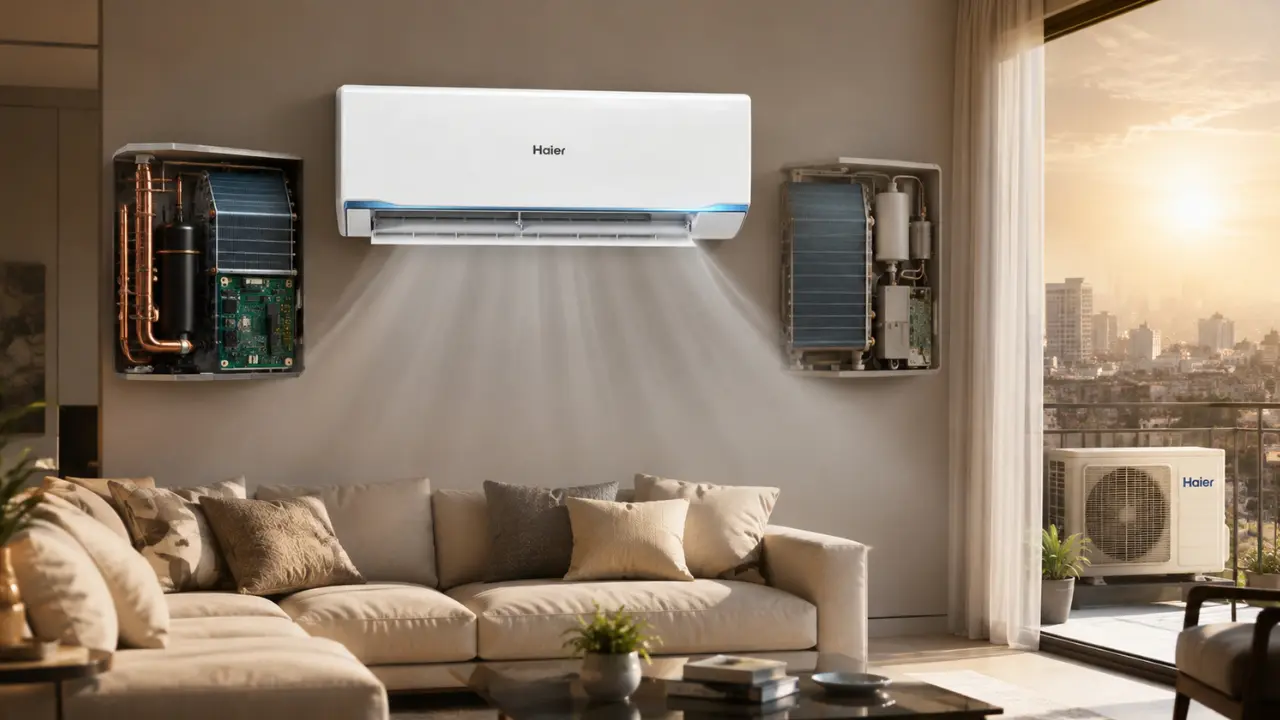
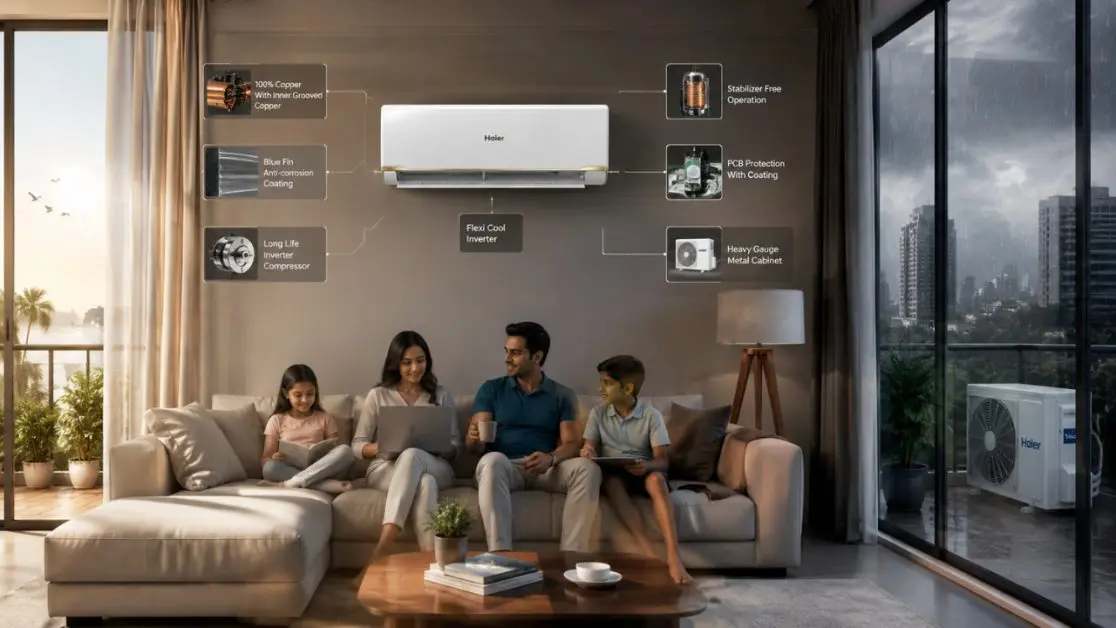
For an air conditioner, meaningful build quality exists inside the system. The compressor, heat exchanger, copper tubing, electronic controls, cooling fins and outdoor components repeatedly face heat, moisture and contaminants while the AC operates.
A better assessment therefore asks:
- What material is used in the heat exchanger?
- How are the fins protected against corrosion?
- Is the PCB designed for demanding operating conditions?
- Can the outdoor unit manage accumulated debris?
- What inverter technology controls cooling?
- Has the AC been designed to perform during extreme ambient heat?
- What warranty support accompanies the machine?
These details are not as immediately visible as the front fascia. Over years of ownership, however, they become considerably more relevant.
Cheap Build vs Strong Build: The Difference Is Under the Skin
Here is a more practical way of looking at the distinction.
| What to examine | Basic or cost-focused construction | Stronger AC construction |
| Heat exchanger | Material and protection may be more basic | Copper construction can provide a robust cooling foundation |
| Cooling fins | Limited protection may leave surfaces more exposed | Anti-corrosion coatings add another protective layer |
| PCB | Standard electronics | Protected or stronger PCB design can be better suited to demanding conditions |
| Outdoor unit cleanliness | Greater dependence on periodic manual cleaning | Self-cleaning functions can help manage debris accumulation |
| Cooling control | Conventional operation | Advanced inverter control can dynamically manage output |
| Extreme heat capability | Performance depends heavily on design limits | Models specifically designed for high ambient temperatures offer clearer reassurance |
The important distinction is not “expensive versus cheap”. It is engineering versus shortcuts.
And that is a much more useful comparison for an Indian household.
Why Indian Conditions Put AC Construction to the Test
An AC installed in India may have a fairly eventful life.
May can bring punishing afternoon heat. Then the monsoon arrives with moisture and humidity. In many cities, outdoor units also deal with dust, pollution and debris. Depending on installation, they may sit on balconies, external walls or other exposed spaces for years.
The outdoor unit is doing real mechanical work through all of this.
Heat is an obvious stress point
An AC has to transfer indoor heat outdoors. As ambient temperature rises, achieving comfortable indoor conditions becomes increasingly demanding.
This makes high-temperature operating capability worth checking rather than treating it as another specification buried near the bottom of a product page.
Corrosion is quieter, but important
Moisture and environmental exposure can gradually affect metallic components. Anti-corrosion treatment is therefore not simply cosmetic.
The Haier 1.7 Ton 5 Star Desert Rose Air Conditioner (HSA20DSD-NAI5NB-I), for example, incorporates Super Anti-Corrosion protection with Indoor and Outdoor Blue Fins. Haier also specifies 100% grooved copper, a Hyper & Stronger PCB and conformal coating as part of its construction and protection approach.
That is the sort of detail buyers should investigate when longevity is high on the priority list.
The PCB Deserves More Attention Than It Gets
Ask someone what makes an AC durable and “compressor” will probably be the first answer.
Fair enough. But modern inverter ACs also depend heavily on sophisticated electronics.
The PCB manages crucial aspects of operation, which makes its protection particularly relevant in challenging conditions. Haier’s Desert Rose models use a Hyper & Stronger PCB, while the product documentation states that conformal coating and Hyper PCB protection help the AC operate at ambient temperatures reaching 60°C.
That 60°C capability is particularly relevant to the topic of strong construction. It indicates that the machine has been designed with extreme outdoor operating conditions in mind rather than only comfortable laboratory-like surroundings.
Copper Still Matters
There is a reason copper remains such a familiar word when Indians shop for an AC.
Haier specifies 100% grooved copper along with a copper heat exchanger and copper compressor configuration for its 1.7 Ton 5 Star Desert Rose models.
Yet material alone should not become the entire buying decision. Durability works as a system.
Copper construction becomes more meaningful when it sits alongside:
- anti-corrosion protection;
- protected electronics;
- effective heat exchange;
- sensible inverter control;
- maintenance-oriented features;
- appropriate installation and servicing.
One strong component cannot compensate indefinitely for weaknesses everywhere else.
There Is Another Durability Issue: Dirt
This one is easy to underestimate.
The outdoor condenser continuously encounters the surrounding environment. Over time, dirt and debris around heat-exchange surfaces can interfere with efficient operation if they are allowed to accumulate.
Haier addresses this differently with ODU Cyclone Clean. After shutdown, intelligent programme control can run the outdoor fan in reverse to help remove debris from the condenser and heat-exchange fins. The intention is to support efficient heat transfer and sustained energy performance.
Inside, the Desert Rose also provides Frost Self Clean. So rather than treating cleanliness purely as an occasional external maintenance issue, cleaning support has been incorporated into the AC’s operating design.
That is a thoughtful connection between maintenance and long-term performance.
Strong Construction Should Still Deliver Strong Cooling
Durability is useful only if the AC actually keeps the room comfortable.
This is where the Haier 1.7 Ton 5 Star Desert Rose Air Conditioner combines its structural features with the HEXA Inverter system. The product is rated at 5460W cooling capacity, with maximum cooling capacity reaching 6600W. It also provides Supersonic Cooling in 10 seconds and an air flow of up to 20 metres.
Then there is the 7-in-1 Convertible system, allowing cooling capacity adjustment from 40% to 110% depending on requirements.
In other words, robust construction is not being positioned separately from everyday comfort. Both are part of the same machine.
Where Haier Desert Rose Makes Its Case
For buyers comparing ACs on more than their initial appearance, the Haier 1.7 Ton 5 Star Desert Rose Air Conditioner (HSA20DSD-GAI5NB-I) presents a fairly substantial specification package.
Its durability-focused credentials include:
- 100% grooved copper
- Hyper & Stronger PCB
- Indoor and Outdoor Blue Fins with Super Anti-Corrosion protection
- Conformal coating for component protection
- ODU Cyclone Clean
- HEXA Inverter technology
- Cooling operation designed for ambient temperatures up to 60°C
- R32 refrigerant
- 5 Star energy rating with an ISEER of 5.65
Haier additionally lists 7 years warranty on the product and 12 years on the compressor, subject to the applicable warranty terms, installation and maintenance requirements.
For consumers who want the Desert Rose design without the Gold Deco Strip, the HSA20DSD-NAI5NB-I carries a Blue Deco Strip while retaining the core specifications and durability-oriented technologies discussed above.
Buy an AC for Its Fifth Summer, Not Just Its First
Almost any capable AC feels impressive when it is brand new. The more meaningful test is whether its construction has been designed around the conditions it will repeatedly face.
For Indian homes, that means looking for protected electronics, copper construction, corrosion resistance, effective inverter technology, cleaning support and the ability to operate through serious summer heat.
That is precisely where Haier’s Desert Rose range becomes worth a closer look. The combination of HEXA Inverter technology, 100% grooved copper, Hyper & Stronger PCB, Super Anti-Corrosion protection, ODU Cyclone Clean and cooling designed for ambient temperatures up to 60°C gives buyers tangible specifications to examine rather than asking them to accept a vague promise of “strong build”.
Because an AC is rarely bought for one summer.
Choose the machine with the next several summers in mind.
Frequently Asked Questions
What does strong build quality mean in an air conditioner?
Strong build quality refers to the quality and protection of the AC’s internal components rather than simply its weight or exterior. Important factors include heat exchanger material, copper tubing, corrosion protection, PCB protection, inverter technology, outdoor-unit design, and cleaning features.
Is a more expensive AC always more durable?
Not necessarily. A higher price does not automatically guarantee better durability. Buyers should evaluate the quality and protection of the components, the AC’s operating capabilities, maintenance features, and warranty support.
Why is AC build quality important in Indian conditions?
Indian ACs can face intense summer heat, dust, pollution, monsoon humidity, and long operating hours. These conditions can put additional stress on outdoor units and internal components, making corrosion protection, electronics protection, and high-temperature performance important considerations.
Why is copper important in an AC?
Copper is used for heat exchange and refrigerant circulation. The Haier Desert Rose models discussed in the article specify 100% grooved copper, along with copper heat exchanger and compressor configurations.
What is Hyper & Stronger PCB protection?
The Hyper & Stronger PCB is part of the Desert Rose Series’ approach to protecting the AC’s electronic components. The article also mentions conformal coating and Hyper PCB protection in connection with operation at high ambient temperatures.
How does corrosion protection help an AC last longer?
Moisture and environmental exposure can gradually affect metallic components. Features such as Indoor and Outdoor Blue Fins with Super Anti-Corrosion protection provide an additional layer of protection against these conditions.