
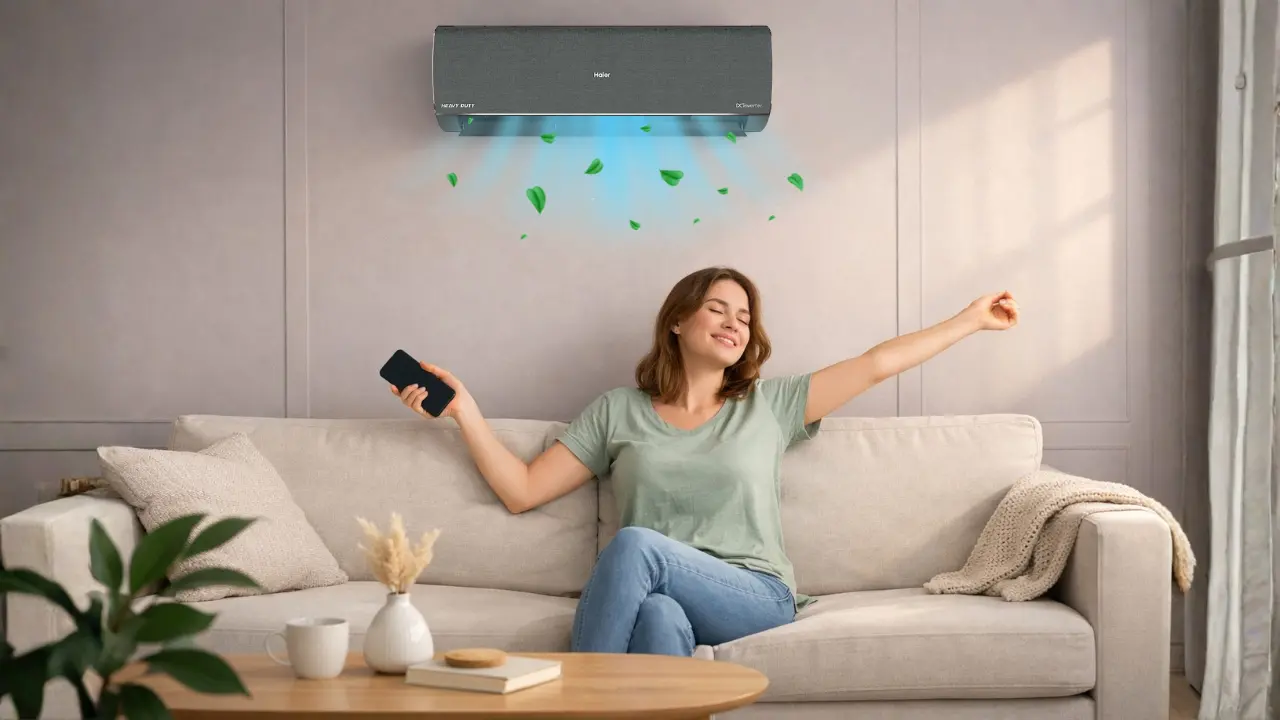

Intelligent air distribution for larger living rooms means cooling that reaches people evenly across the space instead of concentrating only near the air conditioner.
Smart airflow systems combine directional cooling, AI climate control, and adaptive sensors to distribute comfort intelligently while reducing wasted energy.
That is the simple answer.
But the real story begins in a very familiar Indian living room.
It is 8:20 pm.
Dinner plates are stacked near the sink. Someone opens Netflix. A cricket discussion begins before the match even starts.
Three people sit on the sofa. One sits on the rug. Someone stands near the balcony door holding chai.
The air conditioner is running.
Yet someone says what almost every family has heard.
“AC chal raha hai, phir bhi thoda garam lag raha hai.”
Cooling exists.
Comfort does not.
Large living rooms reveal something most homeowners rarely think about.
Cooling power is not the real problem. Air distribution is.
Why Large Living Rooms Are Harder to Cool
Modern Indian homes have changed dramatically over the last decade.
Living rooms are bigger.
Layouts are more open.
Ceilings are higher.
Balconies bring sunlight and heat deep inside the room.
What used to be a single rectangular space is now a connected environment.
Living room.
Dining area.
Open kitchen.
All sharing the same air.
The Hidden Physics of Cooling
Air does not behave like a light switch.
It behaves like water.
It spreads slowly.
It bends around furniture.
It weakens with distance.
In large living rooms, that creates temperature pockets.
| Area of the Room | What People Experience |
| Directly below the AC | Too cold |
| Sofa across the room | Slightly warm |
| Balcony seating | Warmest |
| Corner lounge | Weak airflow |
This is why people often lower the thermostat.
But that rarely solves the real issue.
Lower temperatures change numbers. They do not change airflow behaviour.
The Shift From Cooling Power to Airflow Intelligence
For decades, air conditioners focused on one metric.
Cooling capacity.
But modern homes demand something different.
Cooling intelligence.
The goal is no longer just reducing temperature.
The goal is distributing comfort evenly across the room.
This is where new technologies such as AI Climate Control are changing how cooling systems behave.
For example, advanced systems such as the Haier AI-Atmox analyse environmental data and user patterns to optimise cooling automatically.
Instead of blasting cold air in one direction, the system studies the room.
Then it adjusts airflow dynamically.
The difference is subtle.
But the experience feels completely different.
Three Ways People Try to Cool Large Living Rooms
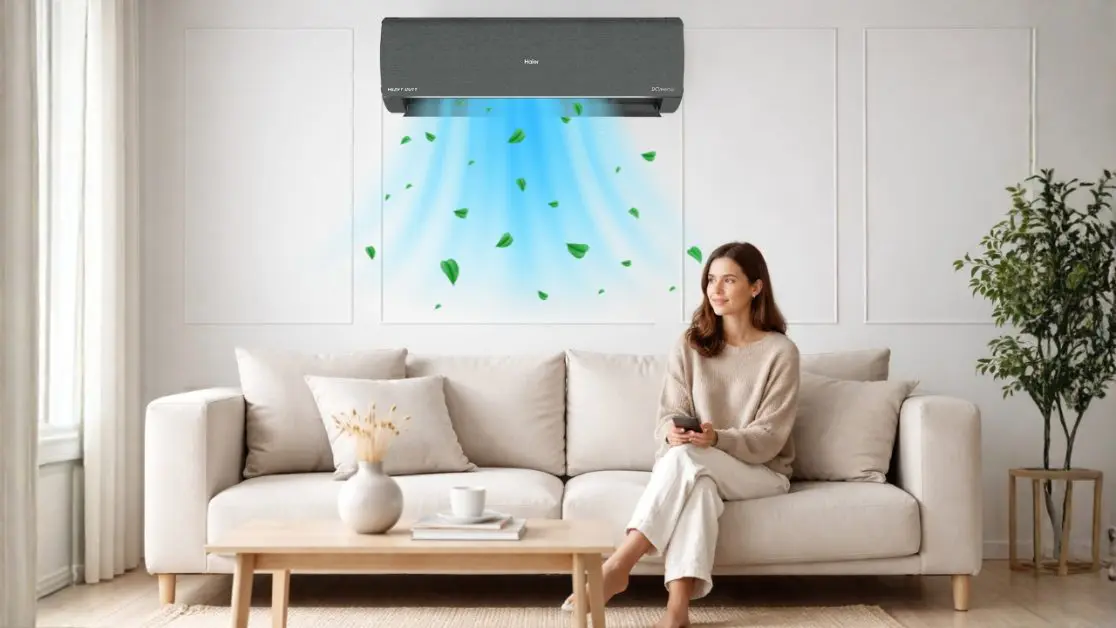
When uneven cooling becomes noticeable, most households try one of three solutions.
Each one works.
Each one has trade-offs.
1. Lower the Temperature Setting
This is the most common reaction.
Someone reduces the thermostat from 26°C to 22°C.
Benefits
- Immediate cooling sensation
- Simple solution
Costs
- Higher electricity consumption
- Cold spots near the AC
- Energy waste
Lowering temperature does not improve distribution.
It simply overwhelms the room.
2. Install a Higher Capacity AC
Some homeowners upgrade to a higher tonnage unit.
More cooling power means faster cooling.
Benefits
- Quick temperature drop
- Better performance in peak summers
Costs
- Higher purchase cost
- Increased power usage
- Still uneven airflow
Power changes speed.
It does not change airflow patterns.
3. Use Intelligent Air Distribution
The smarter approach focuses on how air moves.
Modern air conditioners now combine sensors, AI learning, and airflow design to distribute cooling intelligently.
Systems like AI Climate Control powered by AI-Atmox use multiple intelligent technologies:
- AI Climate Control that adapts cooling based on environment and user habits
- AI Target Cooling that directs airflow exactly where people are sitting
- AI Pre-Cooling that prepares the room before occupants arrive
These technologies learn, adapt, and optimize cooling automatically.
Instead of cooling empty space, the system focuses on comfort where it matters.
How Intelligent Air Distribution Actually Works
Most people imagine air conditioners as simple machines.
Cold air goes out.
Temperature goes down.
Modern climate systems operate very differently.
The Smart Cooling System Behind the Scenes
Advanced AC systems constantly evaluate several variables.
- Room temperature patterns
- Occupancy behaviour
- Outdoor weather conditions
- Usage duration and cooling modes
- Environmental temperature differences
AI-based systems analyse this data in real time to maintain optimal comfort while reducing unnecessary cooling.
Over time, the system begins to understand patterns.
When people arrive.
Where they sit.
How the room heats up.
Cooling becomes adaptive rather than static.
Features That Matter Most in Large Living Rooms
In bigger spaces, several features become far more valuable than raw cooling power.
Target Cooling
Target cooling directs airflow toward specific seating zones.
Instead of cooling the entire room uniformly, the system sends air where comfort is needed first.
Benefits include:
- Faster comfort delivery
- Lower energy usage
- Improved airflow reach
For larger living rooms, this can dramatically improve comfort distribution.
Predictive Pre-Cooling
Imagine walking into a room that is already comfortable.
AI-powered pre-cooling systems predict user arrival using smart behavioural models and begin cooling in advance.
Benefits:
- Immediate comfort
- Reduced temperature shock
- More efficient cooling cycles
Instead of waiting for cooling to begin, the room is ready before you enter.
Human Detection Technology
Large living rooms often remain empty for hours.
Intelligent systems now include occupancy detection.
Sensors monitor human presence and adjust cooling automatically.
Benefits include:
- Reduced electricity waste
- Automatic energy optimisation
- Smarter cooling behaviour
If no one is in the room, cooling intensity drops automatically.
Comfort returns instantly when someone enters.
Design Tips That Improve Air Distribution
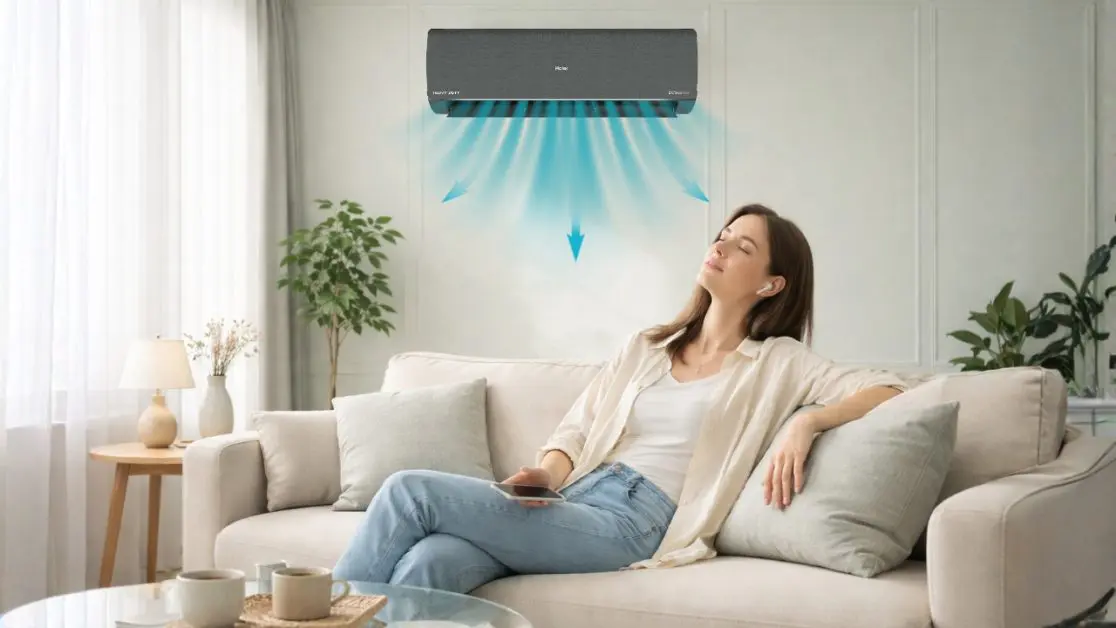
Technology helps.
But room design plays an important role too.
Maintain Clear Airflow Paths
Avoid tall cabinets directly beneath the AC.
Cold air needs space to travel.
Choose Strategic AC Placement
Central placement often improves airflow reach in large rooms.
Corner installations limit distribution.
Use Balanced Room Layout
Furniture positioning affects airflow direction.
Open seating arrangements allow cooling to spread evenly.
Traditional Cooling vs Intelligent Air Distribution
| Cooling Method | Focus | Result |
| Traditional AC | Temperature reduction | Uneven comfort |
| High-capacity AC | Faster cooling | Higher energy use |
| Intelligent Air Distribution | Airflow behaviour | Balanced comfort |
This shift explains why modern air conditioners are evolving rapidly.
Homes are larger.
Expectations are higher.
Cooling systems must become smarter.
Why Intelligent Air Distribution Matters for Modern Indian Homes
Indian living rooms are social spaces.
They are not static.
They host everything.
Cricket matches.
Festival gatherings.
Late night movies.
Family conversations.
People constantly move around the room.
Traditional fixed airflow cannot keep up with that movement.
Intelligent climate systems adapt in real time.
Advanced systems like the AI Climate Control powered by AI-Atmox analyse environment, occupancy, and usage patterns to maintain balanced cooling automatically.
The result feels subtle.
But noticeable.
The room stays comfortable everywhere.
Not just near the AC.
The Insight Worth Remembering
Here is the idea most homeowners overlook.
Cooling power creates cold air.
Air distribution creates comfort.
Large living rooms do not need stronger machines.
They need smarter airflow.
When cooling systems begin to understand how people actually use a space, comfort becomes effortless.
And the living room finally feels like what it was meant to be.
A place where everyone can sit.
And feel comfortable.
Frequently Asked Questions
I already have a powerful AC. Why does my living room still feel unevenly cooled?
Because cooling power ≠ comfort. Your AC may be strong, but airflow isn’t reaching all zones evenly. Large rooms create “temperature pockets,” so some areas stay warm while others get too cold.
Should I upgrade to a bigger AC tonnage for my large living room?
Not necessarily. Higher tonnage improves cooling speed, not distribution. You may still face uneven cooling just faster.
I keep lowering my AC temperature, but it still feels uncomfortable. What am I doing wrong?
Lowering temperature only forces more cooling, it doesn’t fix airflow gaps. You’re overcooling one area while others remain warm, increasing energy bills.
My living room connects to the dining and kitchen. Does that affect cooling?
Yes, significantly. Open layouts allow heat to travel freely, making it harder for traditional ACs to maintain uniform cooling.
Why does it feel warmer near the balcony even when AC is on?
Sunlight and external heat create micro hot zones. Without directional airflow, these areas remain warmer.
I sit on the floor or move around a lot. Does that impact how cooling feels?
Absolutely. Traditional ACs assume fixed seating. If people move, airflow doesn’t follow leading to discomfort.
My family sits in different corners. How can one AC handle that?
Only systems with targeted airflow (AI Target Cooling) can adapt to multiple seating zones dynamically.
Is faster cooling always better for large living rooms?
Not always. Fast cooling can create cold spots and waste energy if airflow isn’t distributed intelligently.
Why does my room cool quickly but still not feel comfortable?
Because comfort depends on uniform distribution, not just temperature drop.
Does intelligent air distribution save electricity or consume more?
It usually reduces energy usage by focusing cooling only where needed instead of blasting the entire room.