
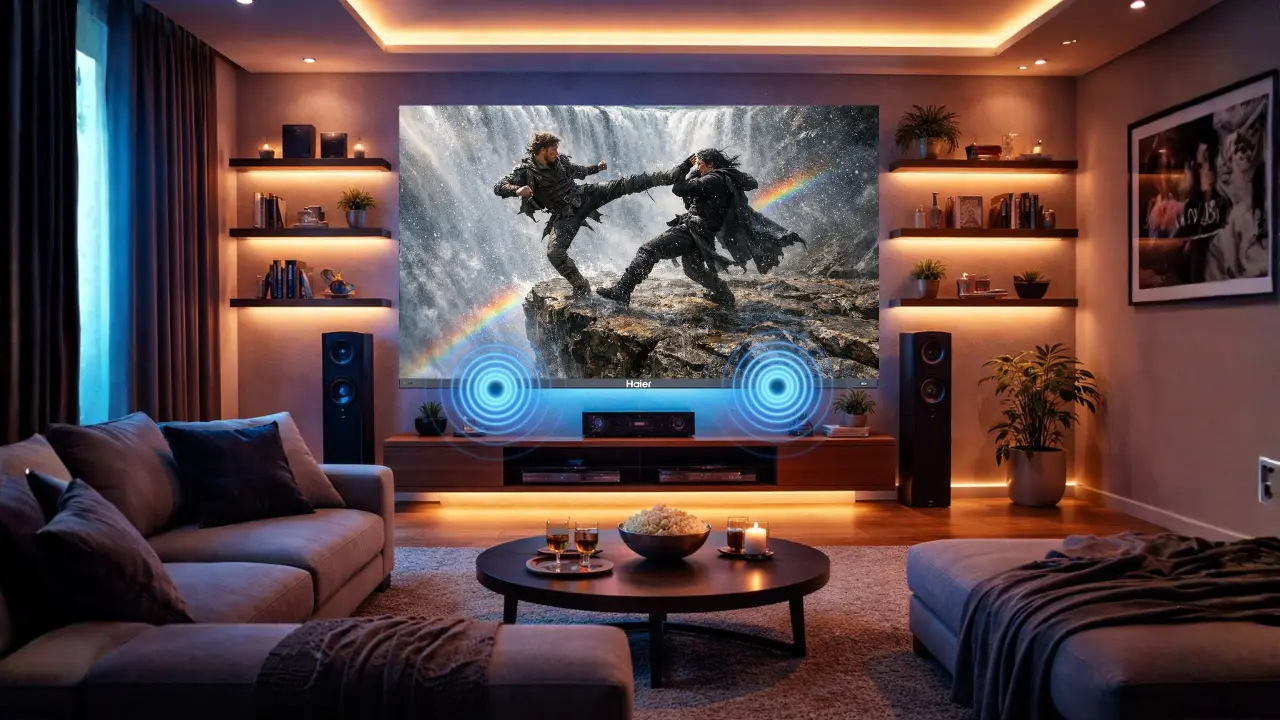

If sound matters as much as the screen, Haier TVs with Sound by KEF-tuned audio, Dolby Atmos, and 2.1 channel woofer systems deliver a cinematic experience at home.
Models like the Haier M80F Mini LED and M92 QD-Mini LED series combine powerful 50W output, spatial sound, and AI-driven tuning to turn everyday watching into immersive listening.
Why do most TVs fail sound lovers?
It is 9:30 pm.
The room is quiet. The scene is intense. The dialogue matters.
And yet, you reach for subtitles.
Not because you want to.
Because you have to.
Most TVs treat sound as an accessory.
Thin speakers. Flat output. No depth.
The screen gets the spotlight. Sound gets the leftovers.
But sound is not a feature. It is a system.
It decides whether a moment feels real or distant.
What actually makes a TV great for sound?
Sound quality in TVs is not about loudness. It is about structure.
Here is how it breaks down:
1. Channel design decides depth
- 2.0 speakers give basic stereo
- 2.1 speakers add a subwoofer for bass
- Multi-channel systems create spatial layering
Insight: Bass is not about noise. It is about presence.
2. Audio tuning defines clarity
- Generic speakers distort at high volume
- Tuned systems like Sound by KEF focus on balance and detail
3. Audio formats shape immersion
- Dolby Atmos creates 3D sound movement
- Standard audio stays flat and directional
4. Power output controls experience
- 20W feels like a TV
- 50W starts feeling like a room
For example, the Haier M80F Mini LED 165cm (65) Google TV Sound By KEF (H65M80FUX) delivers 50W output with a 2.1 channel woofer system, creating deeper bass and clearer vocals.
The hidden truth about TV sound
Most people upgrade screens.
Very few upgrade sounds.
That is why the experience never changes.
Better visuals without better sound is like HD video on mute.
Best Haier TVs for sound lovers right now
Let’s break this into real choices.
Not features. Decisions.
Option 1: The balanced cinematic experience
Haier M80F Mini LED 165cm (65) Google TV Sound By KEF (H65M80FUX)
Haier M80F Mini LED 189cm (75) Google TV Sound By KEF (H75M80FUX)
If you want cinema-like sound without external speakers, this is where most people should start.
What makes it different:
- Sound by KEF audio tuning
- 2.1 channel speakers with subwoofer
- 50W audio output for room-filling sound
- Dolby Atmos for 3D spatial audio
This combination creates a layered experience where dialogue, music, and background effects do not compete.
They collaborate.
For example:
- Dialogue stays crisp even during action scenes
- Bass adds weight without distortion
- Surround effects feel directional
The 189cm (75) variant also enhances immersion with 264 local dimming zones, aligning visuals with audio depth.
Cost vs benefit:
- Cost: Mid to premium range
- Benefit: Strong all-rounder for movies, OTT, and sports
Who it’s for:
Families. Movie lovers. Everyday premium users.
Option 2: The large-room, theatre-like setup

Haier M80F Mini LED 215cm (85) Google TV Sound By KEF (H85M80FUX)
Some rooms demand scale.
And sound behaves differently in larger spaces.
This model keeps the same Sound by KEF-powered sound system but amplifies the experience through size.
Why size matters for sound:
- Larger panels reflect audio differently
- Bigger rooms need stronger presence
- Sound dispersion becomes critical
With Dolby Atmos and 2.1 channel woofer output, this model creates a wider sound field that fills the room more naturally.
Cost vs benefit:
- Cost: Higher investment
- Benefit: Theatre-level immersion without external soundbars
Who it’s for:
Large living rooms. Home theatre setups. Weekend binge watchers.
Option 3: The AI-powered sound experience
Haier New M92 Series 164cm (65) QD-Mini LED AI Smart Google TV (H65M92FUX)
Haier New M92 Series 189cm (75) QD-Mini LED Smart AI Google TV (H75M92FUX)
This is where things shift.
From sound systems to sound intelligence.
What changes here:
- AI Homey AI integrates visuals, sound, and gaming
- AI Ultra Sense Processor tunes sound dynamically
- Sound by KEF with Dolby Atmos
- Total Sonic sound enhancement
This means the TV actively adjusts sound based on what you are watching.
A cricket match feels different from a thriller.
A podcast feels different from a movie.
Because the system adapts.
The 65-inch variant includes advanced AI processing with dynamic sound tuning and 448 dimming zones, creating real-time audio and visual balance.
Cost vs benefit:
- Cost: Premium
- Benefit: Smart, adaptive, future-ready experience
Who it’s for:
Tech-first buyers. Gamers. Smart home users.
Quick comparison for clarity
| Model | Sound System | Output | Key Strength | Ideal Use |
| H65M80FUX | 2.1 CH + Sound by KEF | 50W | Balanced audio | Daily OTT |
| H75M80FUX | 2.1 CH + Sound by KEF | 50W | Bigger immersion | Sports, family |
| H85M80FUX | 2.1 CH + Sound by KEF | 50W | Theatre feel | Large rooms |
| H65M92FUX | AI + Sound by KEF + Dolby | 50W | Smart tuning | Mixed content |
| H75M92FUX | AI + Sound by KEF + Dolby | 50W | Premium adaptive | Gaming + OTT |
What most buyers get wrong
They ask:
“Does it have Dolby Atmos?”
They should ask:
“Does the system support the experience I want daily?”
Because:
- Watching news needs clarity
- Watching cricket needs crowd depth
- Watching movies needs layered sound
One feature cannot solve all three. A system can.
How to choose the right Haier TV for sound
Think in terms of your daily patterns.
One option is: Keep it simple
- Choose Haier M80F Mini LED 165cm (65) Google TV (H65M80FUX)
- Best for balanced everyday viewing
The second option: Scale your experience
- Choose Haier M80F Mini LED 189cm (75) or 215cm (85) (H75M80FUX, H85M80FUX)
- Better for larger rooms and group viewing
The third option: Let AI handle it
- Choose Haier New M92 Series QD-Mini LED AI Smart Google TV (H65M92FUX, H75M92FUX)
- Ideal if you switch between content types frequently
Each choice solves a different problem.
The bigger pattern most people miss
Appliances are not upgrades.
They are systems.
Your TV is not just a screen.
It is your:
- Weekend theatre
- Match-day stadium
- Late-night escape
- Background companion
And sound decides how real those moments feel.
A simple way to think about it
Picture a bookstore.
Two people walk in.
One reads silently.
The other listens to audiobooks.
Same content. Different experiences.
Sound is the difference between reading and feeling.
The final insight
Great TVs show you the story. Great sound makes you part of it.
And once you experience that difference, there is no going back.
Because silence is not the absence of sound.
It is the absence of immersion.
Frequently Asked Questions
Do I need a 50W sound system for late-night Netflix and YouTube?
Yes if you care about clear dialogue at lower volumes. A 50W system helps voices stay crisp without turning the volume up too much.
What actually matters for good sound?
Focus on three things:
2.1 channel (adds bass depth)
Sound tuning (for clarity and balance)
Dolby Atmos (for immersive audio)
You can safely ignore most extra marketing terms.
TV with built-in sound vs cheaper TV + soundbar?
Go for a TV with strong built-in audio if you want simplicity and fewer devices.
Choose a soundbar setup if you prefer flexibility and future upgrades.
Will I notice a better sound if I don’t watch movies often?
Yes. Even everyday content like news and YouTube benefits from clearer dialogue and more natural background sound.
What does AI sound tuning actually do?
It automatically adjusts audio based on what you’re watching like movies, sports, or dialogue-heavy content so you don’t need to tweak settings manually.
Is AI useful if I switch between gaming, movies, and YouTube?
Yes. It adapts sound in real time, making transitions smoother without constant adjustments.
Is AI sound noticeable?
It’s subtle but effective. You’ll notice fewer moments where audio feels off or unbalanced.
Does AI replace a soundbar?
Not completely, but it gets close enough that many users won’t feel the need for one.