
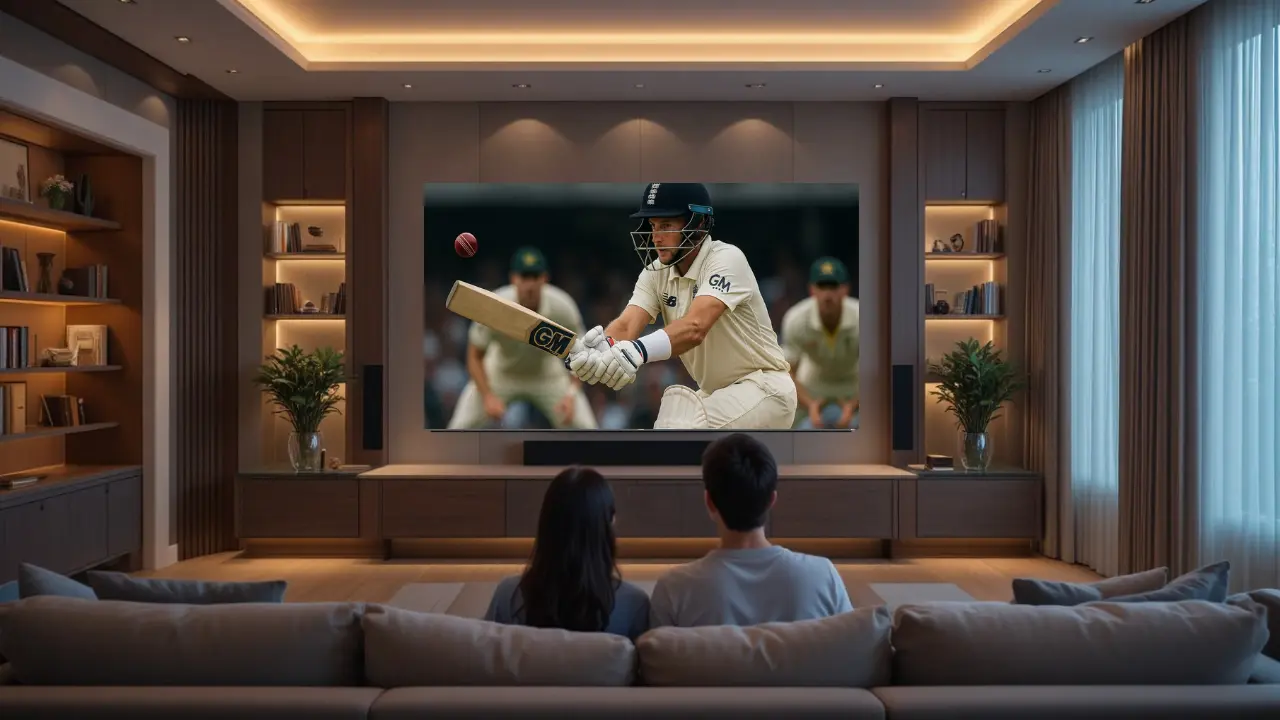

The best TVs for movie and sports sound experience combine three things: powerful built-in audio, intelligent sound processing, and motion clarity.
Look for TVs with Dolby Atmos, dedicated subwoofers, high refresh rates, and AI-driven audio tuning. These systems do not just play sound. They place you inside it.
Why does TV sound still feel underwhelming in most homes?
It is 9:15 pm.
The match is on. India needs 12 runs in the last over.
You increase the volume.
But something feels off.
The crowd sounds distant. The commentary feels flat. The moment feels smaller than it should.
Now imagine the same scene again.
This time, the stadium surrounds you. The bat crack feels sharp. The commentator sits right in front of you.
Nothing changed on screen.
Everything changed in sound.
Sound does not support the experience. It defines it.
What actually makes a TV great for movies and sports sound?
Most people focus on resolution.
4K. HDR. Bigger screens.
But the real system is hidden.
A powerful TV sound experience depends on three layers working together.
1. Hardware that creates depth
- 2.1 channel speakers with subwoofer
- 40W to 50W audio output
- Dedicated bass for impact
For example, the Haier M80F Mini LED 165cm (65) Google TV Sound By KEF (H65M80FUX) features a 2.1 channel woofer system with 50W output, delivering deeper bass and fuller sound compared to standard TVs
2. Audio technologies that create immersion
- Dolby Atmos for spatial sound
- AI-based sound tuning
- Scene-based audio adjustments
Dolby Atmos places sound around you, not just in front, creating a 3D listening experience that feels closer to a theatre
3. Motion clarity that supports perception
Sound feels more real when visuals keep up.
- 120Hz to 144Hz refresh rate
- MEMC for smoother motion
- Low latency modes for live sports
Because when motion is smooth, the brain trusts what it hears.
The three types of TV buyers. Which one are you?
Every home optimizes differently.
Not for features. For experience.
One option is: The Cinema Seeker
You watch films late at night. Dialogue matters. Background score matters more.
What you need:
- Dolby Atmos
- Balanced audio tuning
- Deep contrast visuals
Best fit:
- Haier M92 Series 164cm (65) QD-Mini LED AI Smart Google TV (H65M92FUX) with AI-driven sound and Dolby Atmos
Outcome: Theatre-like immersion without leaving your sofa
The second option is: The Sports Loyalist
You live for cricket. Every ball matters.
What you need:
- Loud, punchy audio
- Clear commentary
- Smooth motion
For instance, TVs like the Haier M80F Mini LED 189cm (75) Google TV Sound By KEF (H75M80FUX) offer smoother motion with DLG 120Hz and powerful sound output, ideal for fast-paced sports
Outcome: Stadium energy inside your living room
The third option is: The All-Rounder Household
Movies on weekends. Matches midweek. YouTube daily.
What you need:
- Balanced audio system
- Smart content recommendations
- AI-based optimization
Best fit:
Outcome: One TV that adapts to everything
Why built-in sound matters more than ever
There was a time when thin TVs meant weak sound.
So people added soundbars.
But now, the system is evolving.
Modern TVs like the Haier M80F Mini LED 215cm (85) Google TV Sound By KEF (H85M80FUX) integrate premium audio systems directly, including KEF-engineered sound and Dolby Atmos for immersive output
This changes behavior.
You do not think about external speakers anymore.
The best sound system is the one you do not need to add later.
How AI is quietly transforming TV sound
Most people do not notice it.
But AI is already shaping how TVs sound.
What happens behind the scenes
- Scene recognition adjusts sound automatically
- Dialogue gets enhanced in movies
- Crowd noise expands during sports
- Volume balances without manual changes
The Haier M92 Series QD-Mini LED TVs use AI processors that analyze scenes in real time and optimize both sound and visuals simultaneously
You stop adjusting. The TV starts adapting.
What to look for in the best TVs for movie and sports sound experience
Here is a simple framework.
Core Features Checklist
| Feature | Why It Matters | Ideal Benchmark |
| Audio Output | Loudness and clarity | 40W to 50W |
| Speaker System | Depth and bass | 2.1 channel |
| Dolby Atmos | Immersive sound | Essential |
| Refresh Rate | Smooth visuals | 120Hz or 144Hz |
| AI Sound | Automatic tuning | Recommended |
| Sound Engine | Audio quality | KEF or equivalent |
Why Haier TVs stand out in real homes
Haier does not optimize one feature.
It builds a system.
Take this combination:
- QD-Mini LED for contrast and brightness
- Dolby Vision IQ for adaptive visuals
- KEF-powered audio for clarity
- Dolby Atmos for immersion
For example, the Haier M92 Series 164cm (65) QD-Mini LED AI Smart Google TV (H65M92FUX) offers:
- 144Hz refresh rate for smooth sports
- AI Ultra Sense Processor for real-time optimization
- Dolby Atmos with 2.1 channel speaker system
This is not about specs.
It is about how everything works together.
The hidden truth about cinematic experience
Most people think cinema equals bigger screens.
It does not.
Cinema is a system.
- Deep blacks create depth
- Bright highlights create realism
- Surround sound creates immersion
- Smooth motion creates continuity
Remove one piece.
The experience breaks.
Cinema is not a feature. It is coordination.
Why sports sound is a completely different challenge
Movies are predictable.
Sports are chaotic.
Crowd noise. Commentary. Sudden spikes.
A TV must manage all three at once.
What great sports sound feels like
- Commentary remains clear at all times
- Crowd noise surrounds but does not overwhelm
- Sudden moments feel sharp and impactful
This is why Dolby Atmos and dedicated subwoofers matter more for sports than most people expect.
Because sports is not about clarity alone.
It is about energy.
Common mistakes people make while choosing TVs
Mistake 1: Choosing size over sound
Big screen. Weak audio.
The experience feels incomplete.
Mistake 2: Planning to add sound later
It rarely happens.
Built-in sound matters more than you think.
Mistake 3: Ignoring refresh rate
Low refresh rate leads to motion blur.
Motion blur reduces immersion.
Mistake 4: Buying features, not outcomes
Numbers look good.
But the experience feels average.
How to choose the right TV for your home
Think in systems.
Not features.
Step 1: Define your primary use
- Movies
- Sports
- Mixed
Step 2: Match features accordingly
- Movies → Dolby Atmos + AI sound
- Sports → High refresh rate + strong output
- Mixed → Balanced system
Step 3: Choose the right size
- Small room → 55 to 65 inches
- Medium room → 65 to 75 inches
- Large room → 75 inches and above
Step 4: Look for integration
Modern TVs are not standalone devices.
They connect with your entire home.
Voice control. Smart content. Seamless casting.
Even features like solar remotes are becoming part of the ecosystem
The bigger shift happening in Indian homes
We are not just buying TVs anymore.
We are designing experiences.
The living room is evolving into:
- A theatre on Friday nights
- A stadium on match days
- A personal screen after work
And the TV sits at the center of all three.
The one insight to remember
Sound is not what you hear. It is what makes you feel present.
What should you do next?
Do not ask:
“What is the best TV?”
Ask:
“What kind of experience do I want every evening?”
Because once you answer that, the choice becomes clear.
And the right TV stops being a device.
It becomes the system that upgrades how your home feels.
Frequently Asked Questions
Why does my current TV feel underwhelming despite having 4K, HDR, or 120Hz?
Because picture quality alone doesn’t define immersion. What’s missing is coordinated audio, motion clarity, and intelligent sound tuning working together.
Should I prioritize sound or screen size for movies and sports?
Sound first. A large screen with weak audio feels empty, while strong audio can elevate even a slightly smaller screen.
What should I actually focus on instead of overthinking specs?
Focus on outcomes:
Movies → immersive sound (Dolby Atmos + AI tuning)
Sports → smooth motion + punchy audio
Mixed → balanced system
What does AI sound actually do in a TV?
It automatically adjusts audio based on content, enhancing dialogue, expanding crowd noise, and balancing volume in real time.
Will I notice AI features in daily use?
Not directly. The benefit is that you stop adjusting settings, the TV adapts for you.
Is Dolby Atmos really necessary, or just marketing?
It’s essential for immersion. It creates a 3D sound environment instead of flat front-facing audio.