

Modern air conditioners are no longer just cooling machines.
They are intelligent systems that learn your habits, sense your environment, optimize energy usage, and automate comfort decisions in real time.
The shift is simple but powerful. ACs are moving from manual control to predictive thinking.
Why does cooling still feel like a manual job in a smart world?
It is 11:30 PM.
The room is warm. You pick up the remote.
Temperature down. Fans speed up. Mode change. Sleep setting.
Five decisions for one outcome. Comfort.
Now think about this.
Your phone predicts what you want to type. Your OTT app knows what you want to watch. Your cab app knows where you are going.
But your AC still waits for instructions.
That gap is what technology is closing.
The future of cooling is not controlled. It is anticipation.
From machines to systems: The real shift in air conditioning
Most people think AC innovation means better cooling.
Faster. Stronger. Colder.
That is only half the story.
The real shift is happening quietly.
From hardware to intelligence.
From fixed settings to adaptive systems.
From reaction to prediction.
Take modern AI-powered systems like those in the Haier 1.8 Ton 5 Star Desert Rose Air Conditioner (HSA20DSD-NAI5NB-I) and the Haier 1.8 Ton 5 Star Gold Desert Rose Air Conditioner (HSA20DSD-GAI5NB-I).
These systems do not just run. They observe, learn, and adjust.
For example:
- They analyse room temperature and humidity in real time
- They track your usage patterns across days and seasons
- They respond to external weather changes automatically
- They optimise cooling modes without user input
In simple terms: the AC starts behaving less like a tool and more like a system.
And systems reduce friction.
What actually makes an AC “intelligent”?
Let’s break it down.
Not all smart features are equal. Some are convenient. Some are transformations.
Here is how intelligent ACs are structured today:
1. Sensing layer: Understanding the environment
This is where intelligence begins.
Modern ACs use sensors to read:
- Room temperature
- Humidity levels
- Human presence
- External weather conditions
For instance, AI Human Detection in models like the Haier 1.8 Ton 5 Star Desert Rose Air Conditioner (HSA20DSD-NAI5NB-I) ensures the AC adjusts when no one is in the room, reducing unnecessary energy use.
Insight:
What gets measured gets optimised.
2. Learning layer: Understanding behavior
This is where it becomes personal.
AI-driven systems study:
- When you turn the AC on
- Your preferred temperature range
- How long you run it
- Seasonal usage patterns
Over time, your AC starts predicting your comfort needs.
No reminders. No manual tweaks.
Just alignment.
3. Decision layer: Taking action
This is where intelligence delivers value.
Modern ACs automatically:
- Adjust cooling modes
- Switch to energy-saving settings
- Optimise airflow
- Balance temperature distribution
For example, AI ECO modes in the Haier 1.8 Ton 5 Star Gold Desert Rose Air Conditioner (HSA20DSD-GAI5NB-I) can cut energy consumption by up to 56 percent by adapting to usage patterns dynamically.
Insight:
Good technology does not give you more choices. It removes unnecessary ones.
Three ways intelligent ACs are changing everyday life
Let’s make this real.
Not features. Situations.
One: The late-night reset
You fall asleep. The room cools too much.
Traditional AC: You wake up. Adjust settings.
Intelligent AC: It senses inactivity, adjusts temperature gradually, maintains comfort.
Cost: Slightly higher upfront investment
Benefit: Better sleep, zero interruptions
Two: The empty room problem
You leave for work. The AC keeps running.
Traditional AC: Wasted energy. Higher bills.
Intelligent AC: Detects absence. Reduces or pauses cooling using AI Human Detection available in the Haier 1.8 Ton 5 Star Desert Rose Air Conditioner (HSA20DSD-NAI5NB-I).
Cost: Requires sensor-based systems
Benefit: Lower electricity bills and reduced wastage
Three: The Indian summer test
It is 45 degrees outside.
Traditional AC: Takes time to stabilise cooling.
Advanced systems like the Haier 1.8 Ton 5 Star Gold Desert Rose Air Conditioner (HSA20DSD-GAI5NB-I) deliver supersonic cooling in 10 seconds using integrated technologies.
Cost: More advanced compressor systems
Benefit: Instant comfort in extreme heat
The hidden system: Energy efficiency is no longer manual
Energy saving used to be a habit.
Now it is a system.
Technologies like Hexa Inverter compressors in the Haier 1.8 Ton 5 Star Desert Rose Air Conditioner (HSA20DSD-NAI5NB-I) optimize performance dynamically, reducing power consumption significantly.
But here is the deeper insight.
Efficiency is no longer about discipline. It is about design.
You do not have to remember to save electricity.
The system does it for you.
Smart control is not the future. It is the baseline
A few years ago, controlling your AC through your phone felt premium.
Today, it is expected.
Modern intelligent ACs like the Haier 1.8 Ton 5 Star Gold Desert Rose Air Conditioner (HSA20DSD-GAI5NB-I) allow:
- App-based control
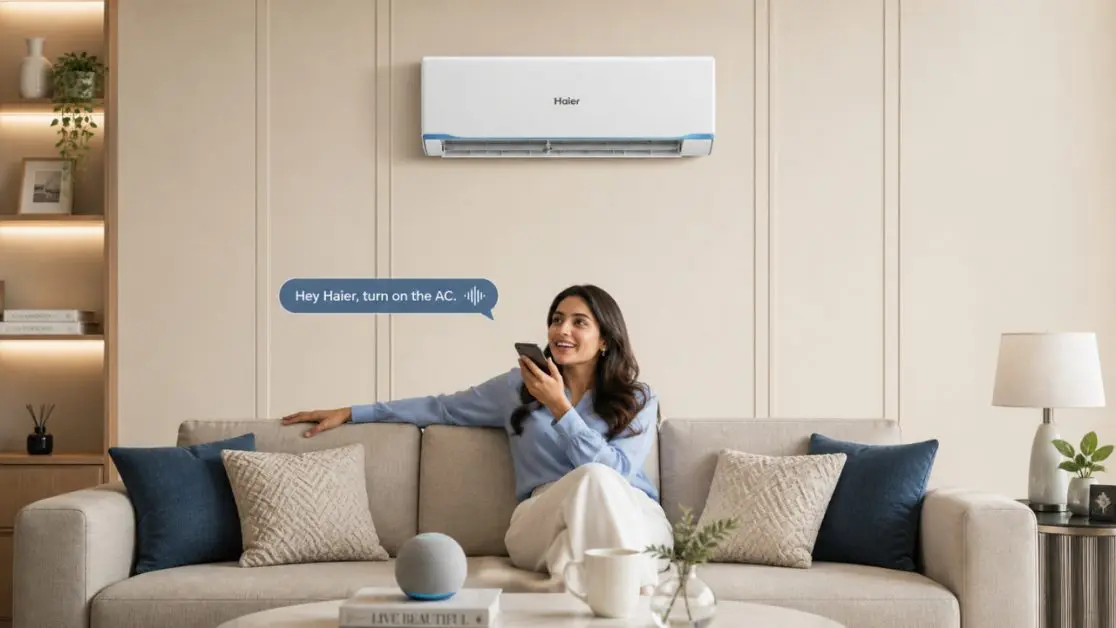
- Voice commands via Alexa or Google Assistant
- Real-time monitoring
- Remote scheduling
Your AC is no longer a room device. It is part of your digital ecosystem.
Technology is solving problems you didn’t notice before
Not all innovation is visible.
Some of the most impactful features solve silent inefficiencies.
Self-cleaning systems
Models like the Haier 1.8 Ton 5 Star Desert Rose Air Conditioner (HSA20DSD-NAI5NB-I) automatically clean indoor and outdoor units to maintain airflow efficiency and hygiene.
Cyclone cleaning in outdoor units
Dust buildup affects cooling performance.
The same model uses reverse fan operation to clear debris automatically.
Long air throw technology
Both Desert Rose models offer long air throw up to 20 metres for even cooling across large spaces.
Insight:
The best technology solves problems you did not know you had.
A quick comparison: Traditional vs Intelligent ACs
| Feature | Traditional AC | Intelligent AC |
| Control | Manual remote | App + Voice + AI |
| Cooling logic | Fixed settings | Adaptive and predictive |
| Energy usage | User dependent | Automatically optimised |
| Maintenance | Manual servicing | Self-cleaning systems |
| Comfort | Reactive | Proactive |
What should you actually look for in an intelligent AC?
Not all features matter equally.
Focus on systems, not specs.
One option is: Basic smart features
- App control
- Scheduling
- Voice integration
The second option: Adaptive systems
- Sensors
- Auto mode adjustments
- Energy monitoring
The third option: Full AI-driven systems
- Learning algorithms
- Behaviour tracking
- Predictive cooling
Insight:
The value of intelligence is not in features. It is in fewer decisions.
Why this matters more in Indian homes
India is not one climate.
It has many climates at once.
Modern ACs like the Haier 1.8 Ton 5 Star Desert Rose Air Conditioner (HSA20DSD-NAI5NB-I) are built to cool even at 60°C ambient temperatures, making them suited for extreme Indian summers.
This adaptability is not a luxury.
It is a necessity.
The bigger picture: Appliances are becoming decision systems
This is not just about air conditioners.
It is about how homes are evolving.
Washing machines automate detergent use.
Refrigerators manage freshness.
ACs manage climate decisions.
The pattern is clear.
Manual → Assisted → Autonomous
Conclusion: Comfort is becoming invisible
Here is the truth most people miss.
The goal of technology is not to impress you.
It is to disappear.
The best AC is not the one with the most features.
It is the one you do not think about.
Models like the Haier 1.8 Ton 5 Star Desert Rose Air Conditioner (HSA20DSD-NAI5NB-I) and Haier 1.8 Ton 5 Star Gold Desert Rose Air Conditioner (HSA20DSD-GAI5NB-I) quietly move in that direction.
They learn. They adjust. They optimize.
Without asking.
What this means for your next decision
The next time you look at an AC, ask a different question.
Not “How powerful is it?”
Ask:
“How much thinking does it remove from my life?”
Because in the end, comfort is not about cooling.
It is about clarity.
Frequently Asked Questions
Why does my AC still need so many manual settings at night?
Traditional ACs depend on manual inputs like temperature, fan speed, mode, and sleep settings. Intelligent ACs reduce this effort by sensing room conditions and adjusting cooling automatically.
I keep changing my AC temperature again and again. Can a smart AC learn what I like?
Yes. AI-driven ACs can study your usage patterns, preferred temperature range, and daily habits to predict comfort settings over time.
Is an intelligent AC useful if I do not want to keep using the remote?
Yes. The main benefit is fewer decisions. App control, voice commands, auto modes, and AI-based adjustments reduce the need for constant manual control.
Can I control an intelligent AC from my phone?
Yes. Many modern smart ACs support app-based control, remote scheduling, real-time monitoring, and voice commands.
Can my AC work with Alexa or Google Assistant?
Some intelligent AC models support voice control through Alexa or Google Assistant, making cooling part of your smart home setup.
Are app control and AI control the same thing?
No. App control lets you operate the AC remotely. AI control helps the AC make decisions automatically based on conditions and behaviour.