
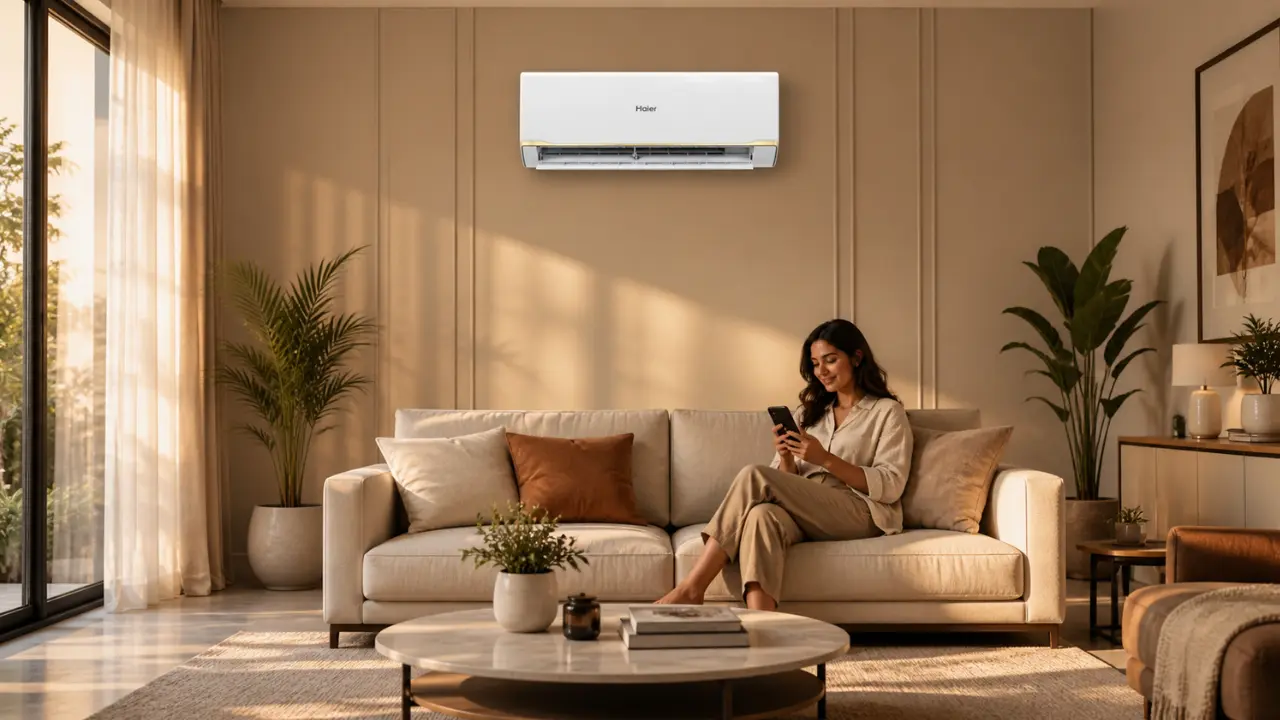

Haier AI Human Detection Technology uses intelligent sensors and AI algorithms to detect human presence in a room, automatically adjusting cooling, airflow, and energy usage.
The result is precise comfort, reduced energy waste, and a system that responds to people, not just temperature.
Why does your AC cool empty rooms?
It is 2:15 PM.
You step out for a quick call. The AC keeps running.
Same temperature. Same airflow. Same energy consumption.
But no one is there.
That is the real inefficiency most homes live with. Not just electricity bills.
Mismatch.
Machines operate continuously. Humans don’t.
The shift: From temperature machines to human-aware systems
Traditional air conditioners follow one rule.
Maintain temperature.
But homes are not static environments.
- People move between rooms
- Usage changes throughout the day
- Cooling needs fluctuate constantly
This is where Haier AI Human Detection Technology changes the system.
It stops focusing only on temperature.
It starts responding to presence.
What is Haier AI Human Detection Technology?
At its simplest, it is a presence-aware system.
It detects whether someone is in the room and adjusts cooling accordingly.
In the Haier 1.8 Ton 5 Star Desert Rose Air Conditioner (HSA20DSD-NAI5NB-I) and Haier 1.8 Ton 5 Star Gold Desert Rose Air Conditioner (HSA20DSD-GAI5NB-I), this feature enables precise presence detection with minimal energy waste
That sounds like a feature.
But it is actually a shift in how cooling decisions are made.
How does AI Human Detection actually work?
The three-layer system behind it
1. Detection Layer
Sensors identify human presence in real time.
It recognises presence, not just movement.
2. Decision Layer
AI evaluates:
- Is someone in the room?
- How long has the room been empty?
- What cooling level is needed right now?
3. Action Layer
The system adjusts:
- Cooling intensity
- Fan speed
- Energy mode
Or reduces activity when the room is empty.
Why this matters
“Most energy waste in homes comes from systems running without purpose.”
AI Human Detection directly addresses that gap.
What problem does it actually solve?
Most people assume AC innovation is about faster cooling.
It is not.
It is about smarter cooling.
The real problems inside Indian homes
- ACs running in empty rooms
- Cooling left on during short breaks
- Overcooling with fewer people present
Now layer this with reality:
- ACs contribute up to 40 percent of urban household electricity usage
- Idle runtime can waste 20 to 30 percent energy
That is not a machine issue.
It is a decision gap.
Three ways homes deal with this today
Option 1: Manual control
Turn the AC off every time you leave.
Cost: Effort and inconsistency
Benefit: Full control
Reality? People forget.
Option 2: Timer-based systems
Set schedules in advance.
Cost: Rigid timing
Benefit: Basic automation
Reality? Life doesn’t follow fixed schedules.
Option 3: AI Human Detection
Let the system respond to presence.
Cost: Slightly higher upfront investment
Benefit: Real-time optimisation and zero guesswork
Reality? The system adapts, even when you don’t.
The invisible shift most people miss
Good technology does not add complexity.
It removes decisions.
That is the real role of Haier AI Human Detection Technology.
It eliminates one repeated question:
Should I turn the AC off or keep it running?
How it works inside Haier Desert Rose AC models
In models like:
- Haier 1.8 Ton 5 Star Desert Rose Air Conditioner (HSA20DSD-NAI5NB-I)
- Haier 1.8 Ton 5 Star Gold Desert Rose Air Conditioner (HSA20DSD-GAI5NB-I)
AI Human Detection is part of a larger system called AI Atmox.
System-level intelligence
- Tracks indoor conditions
- Learns usage patterns
- Detects human presence
- Adjusts cooling automatically
This is not a single feature.
It is a connected decision system.
What actually changes in daily use
- AC reduces energy use when no one is in the room
- Cooling resumes when someone enters
- No manual switching required
- Comfort stays consistent
Combined with AI ECO mode, these models can achieve up to 56 percent energy savings through intelligent adjustments
Real-life scenarios where it matters
Scenario 1: Work-from-home days
You move between rooms.
The AC adapts. It does not waste cooling.
Scenario 2: Afternoon naps
No movement for a while.
The system understands presence and maintains comfort.
Scenario 3: Late-night routines
You leave the room and forget the AC.
The system reduces unnecessary usage automatically.
The cost-benefit equation
Costs
- Slightly higher upfront price
- Dependence on sensor accuracy
Benefits
- Lower electricity bills
- Less manual effort
- Consistent comfort
- Improved energy efficiency
The simple insight
Energy saves daily compounds faster than money spent once.
How it compares with traditional smart features
| Feature | What it does | Limitation |
| Timer | Runs on fixed schedule | Cannot detect presence |
| Remote App | Manual control | Requires user action |
| Temperature Sensor | Adjusts to heat | Ignores occupancy |
| AI Human Detection | Responds to people | Real-time adaptability |
Why this matters more in India
India’s climate pushes AC usage higher every year.
- Temperatures cross 45 degrees in many regions
- Urban heat retention increases cooling demand
- Electricity costs continue to rise
More usage without smarter systems leads to higher waste.
That is where Haier AI Human Detection Technology becomes relevant.
The bigger shift: Homes are becoming responsive systems
Look around.
- Lights switch off automatically
- Cars adapt to driving behaviour
- Phones learn your habits
Cooling is evolving the same way.
From static systems to responsive environments.
What should you look for before buying?
1. Presence awareness
Does the AC detect people or just temperature?
2. Integrated intelligence
Is AI part of a larger system like AI Atmox?
3. Simplicity
Does the system reduce decisions or add more?
A simple way to think about it
Old systems need instructions.
New systems learn patterns.
That is the difference.
The insight worth remembering
Comfort is not about cooling more. It is about cooling right.
Conclusion: Cooling that understands presence
Haier AI Human Detection Technology is not just a feature.
It is a shift towards awareness.
In models like the Haier 1.8 Ton 5 Star Desert Rose Air Conditioner (HSA20DSD-NAI5NB-I) and Haier 1.8 Ton 5 Star Gold Desert Rose Air Conditioner (HSA20DSD-GAI5NB-I), it transforms how cooling works.
Less guesswork. Less waste. More comfort.
In modern Indian homes, where routines change every hour, systems that adapt quietly create the biggest difference.
Because the future of cooling is not about power.
It is about precision.
Frequently Asked Questions
Do I really need AI Human Detection in my AC, or is it just a fancy feature?
If you often forget to turn off your AC or move between rooms frequently, this isn’t just a feature, it removes constant decision-making and prevents energy waste automatically.
I already use a timer on my AC. Why should I switch?
Timers assume your schedule is predictable. AI Human Detection adapts in real time when your routine changes, which is far more practical for daily life.
Is the higher price actually worth it for me?
If your AC runs many hours daily (common in Indian summers), even 20–30% reduced idle usage can noticeably lower your electricity bills over time.
Will this actually reduce my mental load, or just add more settings?
It reduces decisions. You don’t need to think about switching the AC on/off the system handles it based on presence.
How is this different from regular smart ACs with apps?
App-based ACs require manual input. AI Human Detection works automatically without needing constant interaction.
Does the AC learn my habits over time?
Yes, especially when combined with Haier’s AI Atmox system it tracks patterns and adjusts cooling behavior accordingly.
Is it just motion detection like lights, or something smarter?
It’s more advanced. It detects presence, not just movement, and uses AI to decide cooling levels.
What exactly changes when no one is in the room?
Cooling intensity, fan speed, and energy mode are adjusted to minimize waste.