
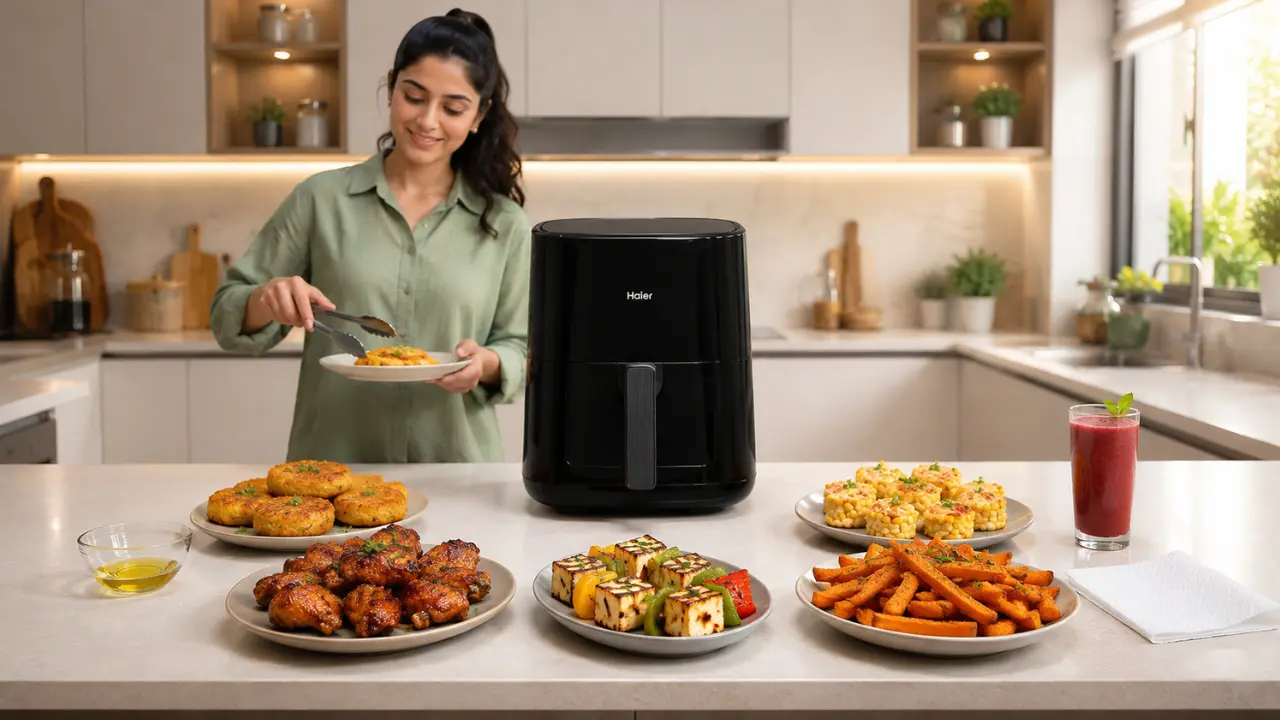

Air fryers reduce oil consumption by replacing deep frying with rapid hot air circulation. Instead of submerging food in oil, they use high-speed heated air to create a crispy texture with little to no oil.
The result is familiar taste, lower grease intake, easier cleanup, and smarter everyday cooking for modern homes.
It usually starts with something small.
A late-night craving for fries.
Sunday paneer tikka.
Rain outside. Pakodas inside.
And then comes the familiar ritual. Oil heating in a deep pan. Kitchen smoke. Extra cleanup. The quiet guilt that follows food which tastes comforting but feels heavy afterwards.
This is where the air fryer changes the system.
Not by removing flavour.
By changing how cooking happens.
The hidden reason traditional frying uses so much oil
Most people think oil is only about taste.
It is not.
In deep frying, oil acts as a heat-transfer medium. The food sits inside hot oil because oil surrounds every surface evenly and cooks quickly. That is why samosas crisp up. That is why fries turn golden.
But this system has a cost.
A lot of oil stays behind:
- On the food
- In the pan
- In the kitchen air
- And eventually, in the body.
The problem is not one plate of fries.
The problem is repetition.
Tiny daily habits quietly become long-term systems.
Air fryers flip the equation
An air fryer works differently.
Instead of oil carrying heat, hot air carries heat.
A heating element creates high temperatures. A fast fan circulates that heat around the food. This creates a crispy outer layer while cooking the inside evenly.
Think of it like this.
A convection oven is like still traffic.
An air fryer is like an expressway.
The speed of moving hot air changes everything.
That is why air fryers can reduce oil usage by up to 70% to 90% for many recipes, depending on the food type and cooking style.
Not oil-free always.
But dramatically lower.
And that distinction matters.
Why “less oil” does not mean “less taste”

This is the biggest misconception.
People assume oil equals flavour.
Sometimes it does.
But often, oil mainly creates texture.
Crispness. Crunch. Browning.
Air fryers replicate much of that through airflow and high heat.
What actually creates flavour?
- Spices
- Marinades
- Salt balance
- Surface caramelisation
- Cooking temperature
Not just oil quantity.
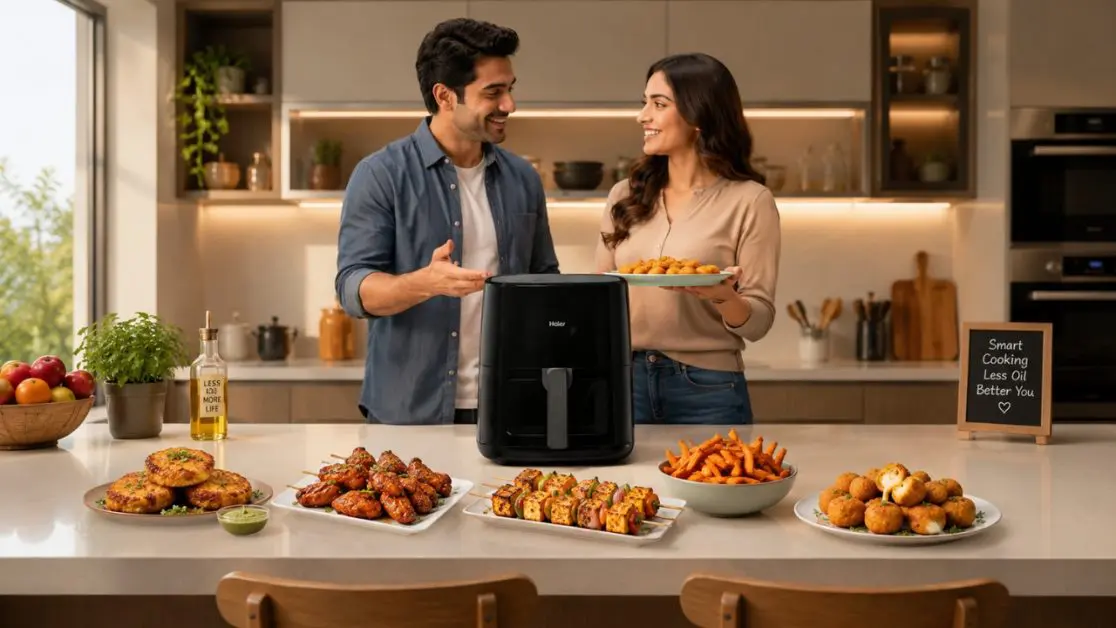
That is why foods like:
- Aloo tikki
- Chicken wings
- Paneer tikka
- Sweet potato fries
- Corn cheese bites
I still feel satisfied in an air fryer.
The texture changes slightly. The heaviness changes dramatically.
And many people quietly prefer that balance after a few weeks.
Because comfort food tastes better when it does not slow the evening down afterwards.
The real benefit is not health alone
Health is the obvious headline.
Convenience is the hidden advantage.
Traditional frying creates multiple layers of effort:
- Heat oil
- Monitor temperature
- Prevent splatter
- Flip carefully
- Drain excess oil
- Dispose used oil
An air fryer removes friction from that process.
You place food inside. Set temperature. Wait.
That changes behaviour.
And behaviour shapes lifestyle more than motivation ever does.
A quick comparison
| Traditional Deep Frying | Air Fryer Cooking |
| Requires large oil quantity | Uses little or no oil |
| Heavy cleanup | Easier cleaning |
| Strong kitchen smell | Reduced odour |
| Oil disposal needed | Minimal waste |
| Constant monitoring | Mostly automated |
| Higher calorie load | Lower oil intake |
The appliance is not just saving oil.
It is reducing mental load.
Why air fryers fit modern Indian homes so well
Indian kitchens are intense environments.
There is frying during festivals.
Batch cooking during family gatherings.
Quick reheating during work-from-home days.
Midnight snacks during IPL matches.
An appliance succeeds in India when it adapts to multiple lifestyles, not one perfect scenario.
That is why air fryers are growing quickly across urban households.
One option is the solo-living use case
A working professional reheats frozen snacks without turning the kitchen into a cleanup project.
The second option is family convenience
Parents prepare evening snacks with less grease and less supervision.
The third option is festive flexibility
During Diwali or Ramadan, repeated snack preparation becomes easier and lighter.
The appliance quietly enters routines where time and energy matter more than culinary perfection.
Oil consumption is also an economic system
People rarely calculate this.
Cooking oil prices fluctuate constantly in India.
A household using deep frying multiple times weekly consumes significantly more oil over time.
Now zoom out.
Less oil usage means:
- Fewer oil refills
- Lower recurring grocery costs
- Less used oil waste
- Reduced kitchen residue buildup
One appliance changes multiple small expenses at once.
That is how smart appliances create value.
Not through dramatic transformation.
Through invisible efficiency.
The science behind crispiness without deep frying
Crispiness comes from moisture leaving the food surface quickly.
Deep oil does this aggressively.
Air fryers do it through concentrated heat circulation.
That is why air fryers perform especially well with:
- Frozen snacks
- Breaded foods
- Marinated vegetables
- Dry-coated recipes
Foods release internal moisture while the outer layer browns.
The process resembles roasting plus frying combined together.
That balance is what people respond to emotionally.
It feels indulgent without feeling excessive.
Where air fryers work best and where they don’t
Air fryers are useful.
They are not magical.
That distinction matters because unrealistic expectations ruin good products.
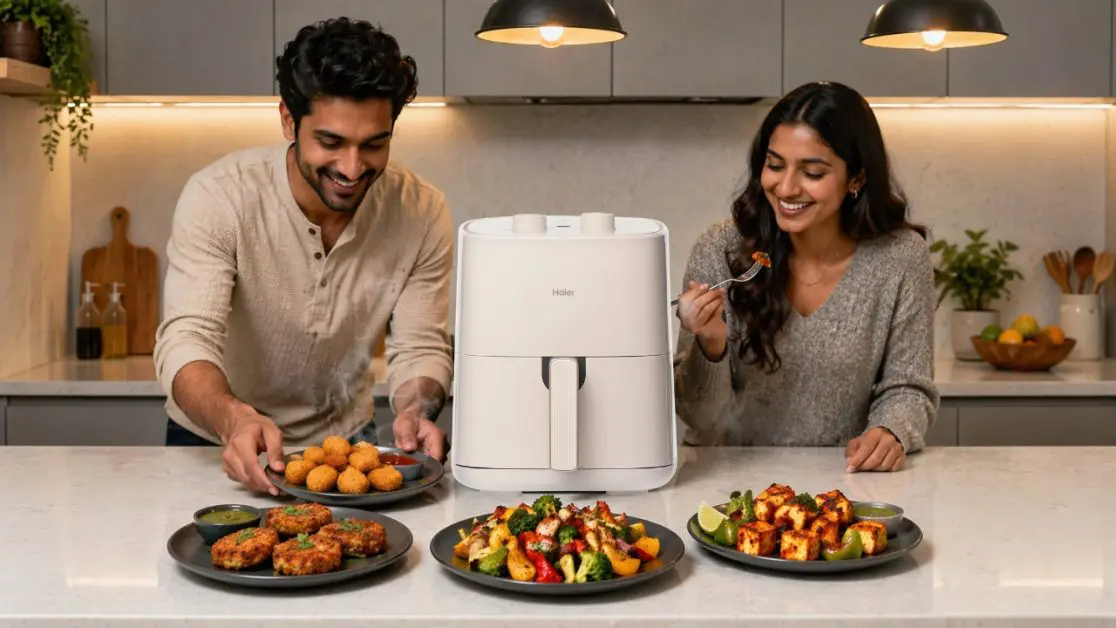
Air fryers work extremely well for
- Fries
- Nuggets
- Cutlets
- Paneer tikka
- Frozen snacks
- Roasted vegetables
- Chicken wings
- Reheating crispy food
They are less ideal for
- Large curry-based dishes
- Foods needing deep batter immersion
- Very large family quantities in one batch
- Delicate wet coatings
The smartest appliance decisions happen when people understand fit, not hype.
A tool succeeds when matched with the right behaviour.
How modern air fryers are evolving beyond “healthy cooking”
The first generation of air fryers sold one idea:
“Less oil.”
That is no longer enough.
Modern buyers now expect:
- Faster cooking
- Bigger capacity
- Better controls
- Multi-function cooking
- Cleaner kitchen aesthetics
That is why newer models focus on workflow, not just frying.
The Haier BLACK Air Fryer 5L Capacity (HAF-D503B), for example, combines 3D hot air circulation, 1500W high-power cooking, digital touch controls, and a visible cooking window for easier monitoring.
The Haier IVORY Air Fryer 5L Capacity (HAF-M503I) focuses on mechanical knob controls, quick heating, and a large 5L basket suited for family-sized batches.
Notice the shift.
The conversation is no longer just about “diet food.”
It is about:
- Speed
- Simplicity
- Space efficiency
- Lifestyle convenience
That is the real appliance revolution happening quietly across Indian kitchens.
Why air fryers change habits more than recipes
This is the deeper insight.
Most people do not suddenly become health-conscious overnight.
They become convenience-conscious first.
If healthier cooking feels difficult, it fails.
If healthier cooking feels easy, it becomes routine.
That is why air fryers matter.
Not because they eliminate oil completely.
Because they reduce the effort barrier attached to better choices.
And systems beat willpower almost every time.
A simple framework before buying an air fryer
Not every household needs the same setup.
Choose based on household size
- 2 to 3 people: 3L to 4L
- 4 to 6 people: 5L and above
Choose based on cooking style
- Frequent snacks: Compact models work well
- Batch cooking: Larger baskets matter
- Tech-friendly users: Digital touch controls feel easier
- Simplicity-focused users: Mechanical controls stay reliable
Choose based on routine
The best appliance is not the most advanced one.
It is the one you actually use consistently.
That is the hidden rule behind every successful kitchen setup.
The bigger shift happening inside modern kitchens
Air fryers are not replacing Indian cooking.
They are reshaping how convenience works inside Indian homes.
That distinction matters.
Pressure cookers reduced cooking time.
Mixer grinders reduced manual effort.
Microwaves changed reheating.
Air fryers reduce friction around indulgence.
And that is why they fit modern life so naturally.
Because today’s households are not just managing meals.
They are managing time, energy, work schedules, family routines, and health awareness simultaneously.
The kitchen is no longer only a cooking space.
It is an efficiency system.
And appliances that quietly reduce complexity tend to stay for years.
That is the real story behind air fryers reducing oil consumption.
Not just fewer calories.
A lighter system.
Frequently Asked Questions
How does an air fryer actually reduce oil consumption?
Air fryers use rapid hot air circulation instead of submerging food in oil. The moving hot air cooks and crisps the surface, so most recipes need only a light oil spray or none at all. That is why many dishes use 70% to 90% less oil compared to deep frying.
Why do deep-fried foods absorb so much oil?
In traditional frying, food sits directly inside hot oil. As moisture escapes from the food, some oil replaces that space and remains on the surface and inside the coating. Repeating this cooking method regularly increases overall oil intake significantly.
Does “less oil” mean my food will taste bland?
Not necessarily. Most flavour comes from:
Spices
Marinades
Salt balance
Browning
Cooking temperature
Oil mainly contributes texture and richness. Air fryers can still create crispiness and caramelisation with far less grease.
Why do fries and nuggets still turn crispy in an air fryer?
Crispiness happens when surface moisture evaporates quickly. Air fryers create intense circulating heat that dries and browns the exterior while keeping the inside soft.
Is an air fryer basically a small oven?
Partly, but airflow speed makes the difference. A normal oven circulates heat slowly. Air fryers push hot air rapidly around food, which creates faster cooking and crispier textures.