

The best AI features in an air conditioner are the ones you stop noticing after a week.
That is the paradox.
A good AI AC does not demand attention. It quietly studies your room, adjusts cooling automatically, reduces electricity waste, cleans itself, and understands how your home actually behaves during Indian summers. The smartest feature is not flashy technology. There are fewer daily decisions.
Because modern cooling is no longer about lowering temperature.
It is about managing life.
An Indian summer exposes every weakness in a home.
By 2 PM, the living room feels like a pressure cooker.
By midnight, one person feels cold while another still complains about heat.
Electricity bills climb. Humidity rises. Sleep quality drops.
Most people still buy ACs using old logic:
- Tonnage
- Star rating
- Brand familiarity
- Discounts during seasonal sales
Important? Yes.
Enough? Not anymore.
Today, the real difference between an ordinary AC and a genuinely intelligent one lies in how it thinks.
An AI-powered AC studies patterns the same way a good host reads a room.
Who entered.
How long they stayed.
Whether the room is crowded.
Whether sunlight changed the indoor temperature.
The humidity suddenly increased because the monsoon arrived early.
That changes everything.
AI cooling is really about energy discipline
Most Indian households do not suffer from lack of cooling.
They suffer from inefficient cooling.
The AC runs harder than necessary.
The room cools unevenly.
Nobody changes modes properly.
Electricity consumption spikes silently.
This is where AI begins to matter.
According to the International Energy Agency, air conditioners already account for nearly 10% of global electricity use. In countries like India, where heatwaves are becoming longer and more intense, intelligent energy management is no longer optional.
The hidden cost of an AC is not the purchase price.
It is ten summers after the purchase.
1. AI Human Detection changes how cooling behaves
Traditional ACs cool empty rooms with complete dedication.
Which is absurd when you think about it.
An AI-enabled AC with human detection understands presence. Some advanced systems can detect whether people are inside the room and reduce unnecessary cooling automatically. Haier’s AI Human Detection technology in the Haier 1.8 Ton 5 Star Desert Rose Air Conditioner (HSA20DSD-NAI5NB-I) focuses specifically on minimizing energy waste through precise presence sensing.
Why does this matter?
Because Indian homes are dynamic.
People move constantly:
- Kitchen to dining area
- Bedroom to balcony
- Living room to work desk
- Kids running in and out every fifteen minutes
An AC that keeps blasting full cooling into an empty room is not intelligent. It is expensive.
What to check before buying
- Presence detection sensors
- Occupancy-based cooling adjustment
- Automatic eco mode activation
- Motion tracking airflow systems
The principle is simple.
The future of cooling is responsive, not constant.
2. AI climate control matters more than lower temperature
Many buyers still think cooling means “make the room colder.”
But comfort is more complicated than temperature.
Humidity matters.
Airflow matters.
Outdoor weather matters.
Even the direction of sunlight matters.
This is where AI climate control systems stand apart.
Some modern AI ACs analyse indoor conditions and external weather patterns in real time to select the most efficient operating mode automatically. Haier’s AI-ATMOX platform in the Haier 1.8 Ton 5 Star Gold Desert Rose Air Conditioner (HSA20DSD-GAI5NB-I) is built around this idea of adaptive climate control.
Think about how Indian seasons behave:
- April brings dry heat
- June brings sharp humidity
- September feels sticky despite rain
- North Indian winters still require airflow balance
One static cooling mode cannot solve all four.
Best AI climate features to look for
| Feature | Why It Matters |
| Real-time climate sensing | Adjusts cooling automatically |
| Humidity balancing | Prevents sticky indoor air |
| Adaptive fan speed | Avoids overcooling |
| Sleep comfort mode | Maintains stable night temperature |
| Seasonal intelligence | Changes behavior based on weather |
A smart AC should behave less like a machine and more like a thermostat with intuition.
3. AI energy monitoring prevents bill shock
There is a particular kind of anxiety Indian households understand deeply.
Opening the electricity bill during peak summer.
Especially after guests stayed over.
Especially after children remained home during holidays.
Especially after work-from-home became permanent.
AI-powered energy monitoring addresses this directly.
Some AI ACs now track electricity usage patterns, notify users when consumption increases, and shift automatically into energy-saving modes. The Haier 1.8 Ton 5 Star Desert Rose Air Conditioner (HSA20DSD-NAI5NB-I) claims up to 56% energy savings through AI-driven ECO optimization in specific conditions.
The important shift here is psychological.
Older appliances forced users to manually manage efficiency.
New systems manage it themselves.
The three levels of AC intelligence
- Basic AC
Cools the room. - Inverter AC
Reduces energy fluctuations. - AI AC
Studies behavior and optimizes continuously.
That third layer is where long-term savings begin.
4. Convertible AI modes make more sense than fixed tonnage
Here is a strange thing about modern Indian homes.
The same room behaves differently across the day.
At 1 PM, sunlight heats the walls.
At 10 PM, the room cools naturally.
During gatherings, body heat changes everything.
During sleep, lower cooling becomes sufficient.
Yet traditional ACs operate like fixed machines.
That mismatch wastes energy.
Convertible AI cooling solves this.
The Haier 1.8 Ton 5 Star Gold Decco Desert Rose Air Conditioner (HSA20DSD-GAI5NB-I) comes with Intelli Convertible 7-in-1 technology that adjusts cooling between 40% and 110% capacity depending on room conditions.
This matters because cooling flexibility is often more useful than raw power.
When convertible modes become useful
- Small family dinners versus house parties
- Afternoon heat versus late-night sleep
- Single occupancy versus guests visiting
- Monsoon humidity versus dry summer heat
A fixed-capacity AC assumes your life never changes.
An AI convertible AC assumes it always does.
That assumption is far more realistic.
5. Smart app control is not luxury anymore
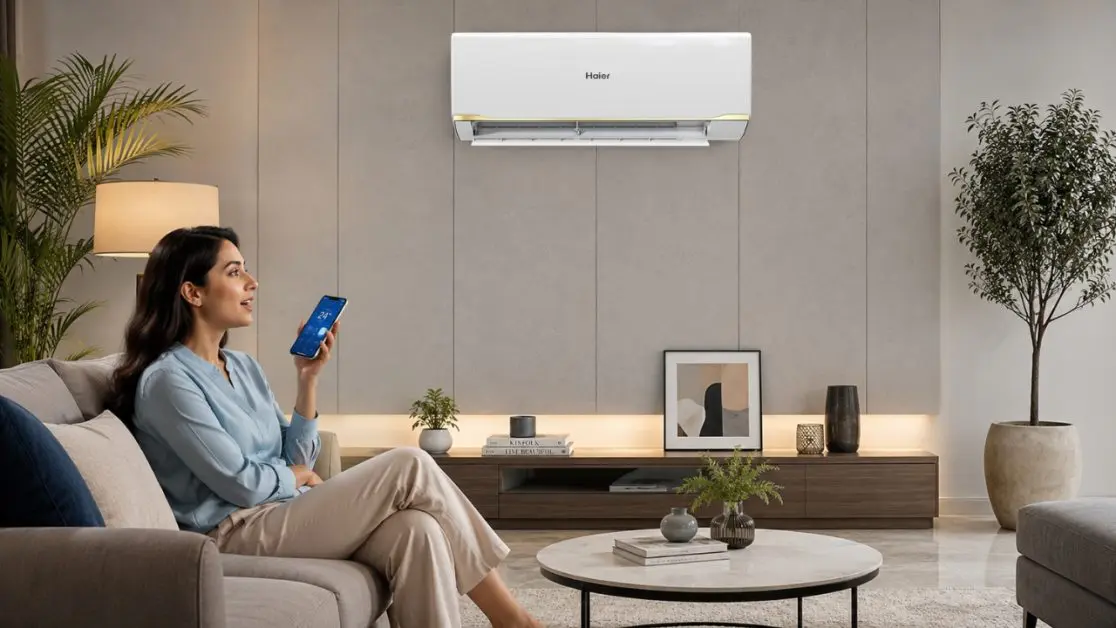
Ten years ago, controlling an AC through a phone felt excessive.
Today it feels practical.
Because life became mobile.
People leave offices unpredictably.
Traffic delays change arrival times.
Parents manage appliances remotely.
Working professionals return to empty homes late at night.
This is why pre-cooling matters.
Some AI-enabled air conditioners now allow users to switch on cooling remotely before reaching home. Haier’s AI Pre-Cooling system highlights this convenience-driven approach.
The smartest remote features to prioritize
- Remote ON/OFF control
- Electricity usage tracking
- Voice assistant integration
- Smart scheduling
- Temperature automation
The point is not technology for technology’s sake.
The point is reducing friction.
Every smart appliance is really a time-management tool disguised as hardware.
6. AI self-cleaning systems quietly improve air quality
People obsess over cooling performance.
But neglected AC hygiene creates a bigger long-term problem.
Dust accumulation.
Odour formation.
Reduced airflow.
Higher electricity consumption.
And eventually, poor indoor air quality.
AI self-cleaning systems address maintenance automatically.
Some premium AI ACs now clean internal components and outdoor units independently to maintain airflow efficiency and reduce odor buildup. Features like ODU Cyclone Clean reverse outdoor fan motion to remove debris from heat-exchange fins.
This matters more in India because:
- Urban dust levels remain high
- Pollution affects indoor air
- Kitchens often sit close to living spaces
- AC usage stretches across longer seasons now
A neglected AC loses efficiency slowly.
Which makes the damage invisible until the bill arrives.
7. Fast cooling still matters. But context matters more.
Many brands advertise cooling speed aggressively.
“10-second cooling.”
“Instant chill.”
“Turbo airflow.”
Useful? Absolutely.
But incomplete.
Fast cooling without intelligent airflow becomes uncomfortable quickly.
Some advanced AI ACs combine high-speed cooling with long air throw and adaptive fan control to cool larger rooms evenly. Haier’s Supersonic Cooling and 20-meter airflow positioning are designed around this broader comfort principle.
The real checklist for cooling performance
| Feature | Why It Actually Matters |
| Fast compressor response | Immediate heat relief |
| Long air throw | Better large-room coverage |
| Adaptive airflow | Prevents harsh direct cooling |
| Quiet operation | Better sleep quality |
| Ambient heat tolerance | Stable cooling during extreme summers |
Cooling speed impresses buyers.
Cooling consistency keeps them happy for years.
What most people misunderstand about AI in appliances
AI in home appliances is not about futuristic robots.
It is about removing small daily inefficiencies.
That is the real system.
Good AI:
- Reduces unnecessary decisions
- Minimizes energy waste
- Predicts routines
- Improves comfort silently
- Extends appliance efficiency
The best technology disappears into the background.
Just like good architecture.
Just like a well-designed kitchen.
Just like excellent lighting in a room.
You stop noticing it because it simply works.
Before buying an AI AC, ask these five questions
1. Does it adapt automatically or rely on manual settings?
True AI learns behavior.
2. Does it actively reduce electricity waste?
Energy savings should be dynamic, not passive.
3. Can it manage changing Indian weather conditions?
Heat is not the only problem. Humidity matters too.
4. Does it improve comfort while sleeping?
Night comfort reveals the quality of climate control.
5. Will this still feel useful after three summers?
Features age quickly. Intelligent systems age slower.
That last question matters most.
Because the smartest appliance purchase is rarely about this month.
It is about the habits your home builds over years.
The future of air conditioning is less visible and more personal
Air conditioners used to be seasonal appliances.
Now they are environmental systems.
They influence:
- Sleep quality
- Productivity
- Electricity bills
- Air quality
- Daily comfort
- Family routines
Which means buying an AC today is no longer just a hardware decision.
It is a lifestyle infrastructure decision.
And AI changes that equation permanently.
Not because machines became smarter.
But because homes became more complicated.
The families are busier.
The schedules are fragmented.
The weather is harsher.
The expectations are higher.
So the next generation of ACs is learning something important:
Comfort is not about colder air.
Comfort is about understanding people.
Frequently Asked Questions
How do I know if an AI AC is actually intelligent or just marketing?
Most real AI air conditioners automatically adjust cooling based on room occupancy, humidity, weather conditions, and usage patterns. If the AC still depends heavily on manual mode switching, it is probably not truly “smart.”
Is an AI AC worth paying extra for in India?
Yes, especially if:
Your AC runs daily during summer
You work from home
Electricity bills are already high
Your household has changing schedules
The long-term savings in electricity and comfort often outweigh the higher upfront cost.
Should I prioritize AI features over star rating?
No. Start with:
Correct tonnage
Energy efficiency (5-star preferred)
Inverter technology
Then evaluate AI features as the layer that improves efficiency and convenience further.
What AI feature matters the most before buying an AC?
For most Indian homes:
AI energy optimization
Occupancy sensing
Humidity control
Convertible cooling
These features affect daily comfort more than flashy app controls.
I only use my AC at night. Do AI features still matter?
Yes. AI sleep modes and adaptive temperature balancing help:
Prevent overcooling
Improve sleep quality
Reduce nighttime electricity waste
Night usage is actually where intelligent climate control becomes most noticeable.