

Air conditioners no longer just cool rooms. They now study behaviour, adjust to habits, manage electricity usage, and quietly make homes feel more balanced.
The journey from manual ACs to AI-powered cooling systems reflects something bigger: modern Indian homes are moving from reactive living to intelligent living.
A remote once felt futuristic.
Now the AC itself makes decisions.
That shift happened slowly. Then suddenly.
One generation adjusted fan speed manually at 2 AM. Another generation asks a phone or voice assistant to cool the room before they even reach home.
Technology evolves fastest when discomfort becomes routine.
And few things feel more routine in India than heat.
The first air conditioners solved one problem. Modern AI ACs solve many.
Early air conditioners had one job.
Cool the room.
That was enough in the 1990s and early 2000s. Indian summers were intense, but expectations were simpler. People tolerated uneven cooling, loud compressor sounds, rising electricity bills, and manual controls because the alternative was worse.
A hot room changes behaviour.
Sleep becomes lighter. Tempers rise faster. Productivity drops quietly.
The first window ACs created relief, but they demanded compromise.
The era of manual cooling
Older air conditioners worked like ceiling fans with more power.
- Turn on.
- Set temperature.
- Wait.
- Adjust again later.
That cycle repeated every day.
There was no understanding of room conditions. No learning. No optimization. The machine followed commands literally.
And literal systems often waste energy.
For example:
| Old Manual AC Experience | Hidden Cost |
| Fixed-speed compressor | Higher electricity bills |
| Constant manual adjustment | Uneven comfort |
| Loud operation | Interrupted sleep |
| No adaptive cooling | Energy wastage |
| Basic filters | Poor indoor air quality |
The AC cooled the room. But it never understood the room.
That difference matters.
Inverter technology changed the economics of cooling
The real transformation started before AI.
It started with inverter technology.
This was the moment air conditioners stopped behaving like switches and started behaving like systems.
Traditional compressors worked in bursts.
Full power. Then stop. Then restart.
That constant restart cycle consumed energy aggressively. It also created temperature fluctuations people could physically feel.
Inverter ACs changed this pattern.
Instead of stopping and restarting repeatedly, inverter compressors adjusted speed dynamically depending on cooling demand.
The result?
- Better energy efficiency
- More stable temperatures
- Lower noise
- Faster cooling
- Longer compressor life
This was not just engineering progress.
It changed how families used air conditioners.
Earlier, many households switched off ACs frequently to “save electricity.” Inverter systems reduced that anxiety.
Cooling became sustainable enough for longer usage.
That psychological shift matters more than people realise.
Why inverter technology became essential in Indian homes
India’s climate creates unique stress on appliances.
A Delhi summer afternoon and a Bengaluru evening demand different cooling behaviour. A compact Mumbai bedroom traps humidity differently than a large living room in Jaipur.
Static cooling systems struggle in dynamic environments.
Inverter systems respond better because they adapt continuously.
Haier’s HEXA Inverter technology, for instance, focuses on maintaining powerful cooling while improving energy efficiency by up to 65%.
That sounds technical.
But the real-life translation is simple:
A family can sleep comfortably through the night without constantly worrying about the next electricity bill.
Smart controls changed convenience. AI changed intelligence.
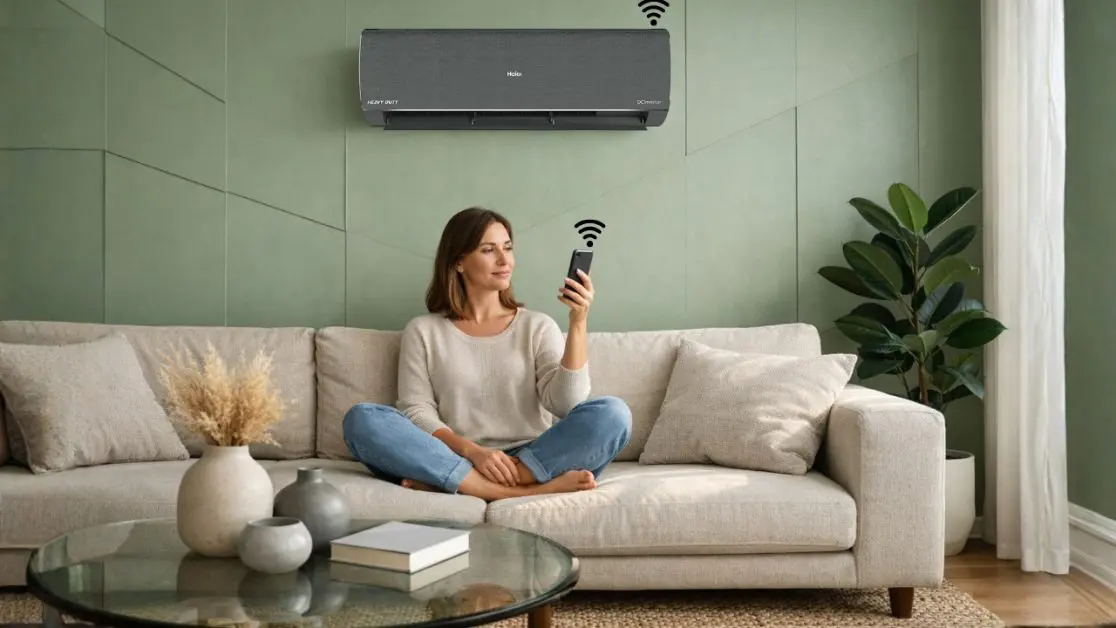
The remote control era made ACs easier.
The smartphone era made them connected.
AI made them aware.
There is a difference.
A connected device obeys commands.
An intelligent device understands patterns.
That distinction defines the next generation of home appliances.
The hidden problem with traditional smart devices
Many “smart” appliances are not actually smart.
They simply move buttons from a remote to a mobile app.
That is convenient. Not intelligence.
True AI systems analyse behaviour, context, and environment simultaneously.
Modern AI air conditioners now study:
- Outdoor temperature
- Indoor humidity
- Usage habits
- Occupancy patterns
- Electricity consumption
- Preferred cooling schedules
Then they optimize automatically.
Haier’s AI-ATMOX platform is designed around this idea. It analyses environmental conditions and learns usage habits to deliver adaptive cooling experiences.
This changes the role of the appliance itself.
The AC stops becoming a machine you manage.
It becomes a system that manages comfort for you.
AI cooling reflects how modern Indian homes actually function
Look closely at a typical weekday.
A working professional returns home at 8:45 PM.
Parents lower temperatures briefly after cooking because kitchens increase indoor heat.
Children need different cooling comfort during afternoon naps compared to nighttime sleep.
Homes are dynamic systems.
Older ACs are treated every hour identically.
AI systems do not.
That is the real evolution.
Three stages of AC evolution
1. Manual ACs
Cooling depended entirely on user input.
Good for basic relief.
Poor for optimisation.
2. Inverter ACs
Cooling became efficient and adaptive mechanically.
Better energy management.
More stable operation.
3. AI-Powered ACs
Cooling became contextual.
The AC studies habits, adjusts modes automatically, tracks electricity usage, and improves comfort continuously.
The machine starts participating in the environment instead of simply reacting to commands.
The future of cooling is invisible
The best technology disappears into daily life.
Nobody praises a light switch anymore because it became expected.
AI cooling is heading the same way.
Soon, the smartest air conditioners will feel almost invisible because they reduce friction quietly.
No repeated temperature adjustments.
No unnecessary overcooling.
No constant electricity anxiety.
Just balance.
Energy savings are becoming behavioural, not mechanical
This is important.
Most people think electricity savings come only from better hardware.
That is incomplete.
Real savings happen when systems influence behaviour intelligently.
For example, Haier’s AI For Savings monitors energy consumption and automatically shifts to AI ECO mode when usage increases, helping reduce wastage with up to 56% energy savings.
That changes household decision-making.
Instead of forcing users to constantly think about saving electricity, the appliance itself participates in the optimisation process.
Good AI removes cognitive load.
That principle applies far beyond air conditioners.
Indian summers pushed innovation faster than most markets
Necessity accelerates invention.
India’s climate is brutal on cooling systems.
Extreme heat waves, long summers, voltage fluctuations, dust exposure, humidity differences, and rising urban temperatures create conditions that force manufacturers to innovate faster.
An AC in India cannot behave like an AC designed only for mild climates.
It needs resilience.
That is why features like high ambient cooling matter.
Haier Gravity AI Series air conditioners are designed to maintain cooling performance even at 60°C ambient temperatures.
That sounds like a specification.
But it represents something deeper.
Modern appliances are no longer designed only for ideal conditions.
They are designed for real life.
Cooling is now connected to health and sleep
The conversation around air conditioners changed after people began spending more time indoors.
Today, users notice things they ignored earlier:
- Noise levels during sleep
- Air quality
- Dust circulation
- Humidity balance
- Odours
- Maintenance hygiene
That changed product evolution too.
Modern AI ACs increasingly focus on air quality and self-maintenance systems.
Haier’s Gravity AI Series includes AI-driven self-cleaning systems and anti-microbial filtration features designed to improve indoor hygiene and maintain cleaner airflow.
Because cooling comfort is no longer just about temperature.
It is about recovery.
People do not want cold rooms anymore.
They want better sleep.
The design language of appliances changed too
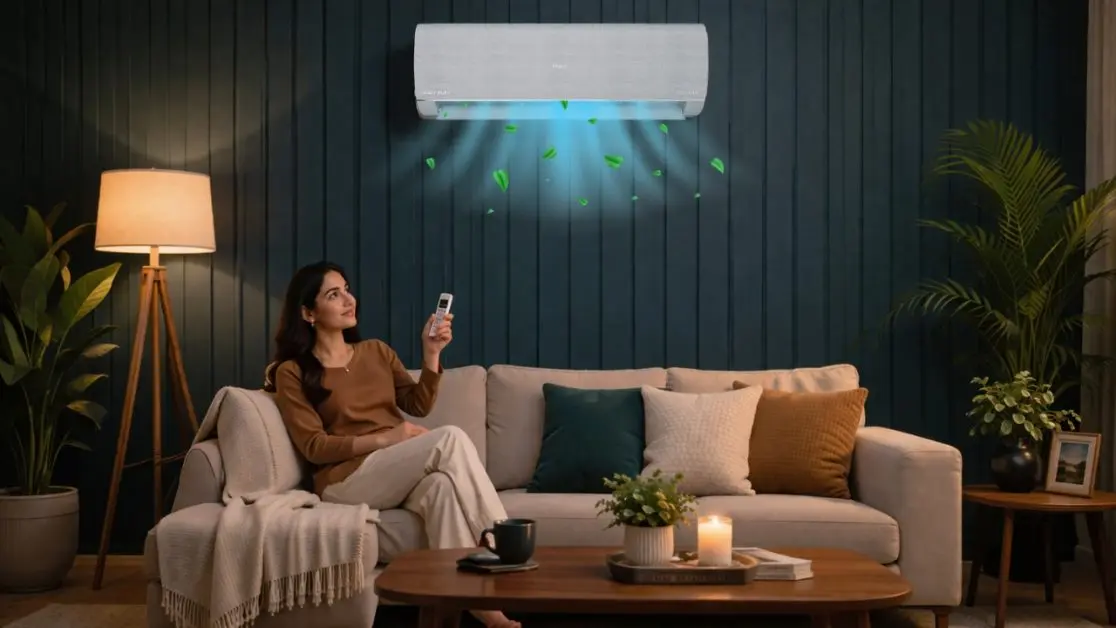
Older air conditioners looked industrial.
Today’s premium ACs behave more like interior elements.
This reflects another hidden shift.
Appliances moved from utility spaces into visual spaces.
People now care about:
- Colour finishes
- Wall aesthetics
- Texture
- Minimalist design
- Premium materials
Haier’s Gravity AI Series includes textured fabric finish designs in variants like Moonstone Grey, Morning Mist, Galaxy Slate, and Midnight Dream.
That matters because modern Indian homes are becoming emotionally curated spaces.
People do not just buy appliances for function anymore.
They buy for the atmosphere.
What AI air conditioners are really teaching us
Every technology evolution reveals a larger human pattern.
Cars became smarter because cities became chaotic.
Smartphones became essential because attention became fragmented.
AI air conditioners evolved because modern life became mentally overloaded.
People do not want more controls.
They want fewer decisions.
That is the hidden system behind intelligent appliances.
Good technology removes invisible stress.
The next evolution will not feel like technology at all
The future of air conditioning is not colder air.
It is adaptive living.
Imagine systems that coordinate cooling with:
- Electricity pricing
- Solar energy availability
- Sleep cycles
- Weather forecasts
- Occupancy detection
- Smart curtains and lighting
Not as separate devices.
As one connected environment.
That future has already started.
Quietly.
The real story is not about air conditioners
It is about how homes are evolving.
Homes used to be static spaces.
Now they are responsive systems.
The evolution from manual ACs to AI-powered climate control mirrors the evolution of modern Indian life itself:
More connected.
More personalized.
More energy-aware.
More experience-driven.
And perhaps the biggest insight is this:
The smartest homes are not the ones filled with technology. They are the ones where technology removes friction so effectively that people barely notice it exists.
Frequently Asked Questions
What actually makes an AC “AI-powered” instead of just an inverter AC?
An inverter AC mainly controls compressor speed to reduce electricity fluctuations. An AI AC goes further by learning room conditions, occupancy patterns, humidity changes, and usage behavior to optimize cooling automatically.
Is an AI AC really worth paying extra for in India?
It can be worth it if your AC runs daily for long hours, especially during Indian summers. The long-term value comes from lower electricity consumption, improved comfort, reduced manual adjustments, and smarter cooling behavior over several years.
Should I prioritize AI features over tonnage and star rating?
No. Tonnage and energy efficiency ratings still matter first. AI features become valuable after the fundamentals are correct.
Which AI features actually help reduce electricity bills?
The most useful ones are:
Human detection
AI ECO mode
Adaptive climate control
Convertible cooling modes
Energy monitoring systems
Do AI ACs work well in extremely hot Indian cities?
Yes, but buyers should still check:
Ambient temperature tolerance
Compressor quality
Long air throw capability
Humidity management
AI improves efficiency, but hardware strength still matters during peak heatwaves.