

Choosing the right AC is less about buying cooling and more about designing comfort
The right air conditioner does three things at once. It cools efficiently, fits the rhythm of your home, and saves money quietly over time. The wrong AC does the opposite. It increases electricity bills, cools unevenly, and turns comfort into constant adjustment.
An AC is not a summer purchase anymore.
In many Indian homes, it has become infrastructure.
The same way we think about Wi-Fi, refrigerators, or water purifiers.
Always there. Always shaping daily life.
Most people choose an AC backwards.
A common pattern repeats itself every summer.
Someone walks into a store or opens an e-commerce app. They compare:
- Tonnage
- Price
- Star rating
- Discounts
- Cashback offers
Then they pick the “best deal.”
Three months later:
- One room feels too cold
- Another never cools properly
- Electricity bills spike
- Sleep gets interrupted
- The AC keeps turning on and off aggressively
The problem was never the AC alone.
The problem was the system around the AC.
Cooling depends on:
- Room size
- Sunlight exposure
- Usage habits
- Number of people
- Ceiling height
- City temperature
- Airflow patterns
- Daily routines
An AC works like a good restaurant kitchen.
The ingredients matter. But timing, flow, and coordination matter more.
Start with the room, not the machine
Room size changes everything
A small bedroom and a large living room demand completely different cooling behavior.
Yet many households install the same AC everywhere.
That creates imbalance.
Here is a simple practical framework:
| Room Type | Suggested AC Capacity |
| Small bedroom up to 120 sq ft | 1 Ton |
| Medium room 120–180 sq ft | 1.5 Ton |
| Large room or living area 180+ sq ft | 2 Ton |
But square footage alone is incomplete.
A west-facing room in Jaipur behaves differently from a shaded apartment in Bengaluru.
Heat load matters.
Sunlight is the invisible electricity bill
Two identical rooms can feel completely different.
One receives harsh afternoon sunlight. The other stays shaded.
The first room heats faster, retains warmth longer, and pushes the AC harder.
That means:
- Higher compressor load
- Longer cooling cycles
- More energy use
- Faster wear
This is why tonnage decisions cannot rely only on room measurements.
The environment matters as much as the dimensions.
Star ratings matter more than people think
Cheap cooling often becomes expensive cooling
A lower-priced AC can quietly become a high-maintenance monthly expense.
This is where energy efficiency changes the equation.
According to the Bureau of Energy Efficiency in India, higher star-rated ACs consume significantly less electricity annually compared to lower-rated units.
A 5-star AC costs more upfront.
But over 5 to 7 years, the savings compound.
Like buying good shoes.
The first bill feels expensive. The next hundred walks feel effortless.
Inverter technology changes how comfort feels
Traditional ACs operate like traffic lights.
Full power. Stop. Full power again.
Inverter ACs behave differently.
They adjust continuously based on room conditions.
That creates:
- Stable temperatures
- Lower electricity consumption
- Less noise
- Better sleep comfort
Haier’s Hexa Inverter technology, for example, focuses heavily on energy optimization and continuous cooling efficiency.
The hidden benefit?
Consistency.
And consistency is what comfort actually feels like.
Noise is an underrated decision factor
The loudest appliance often becomes the most irritating one
During daytime, noise feels manageable.
At 2:17 AM, it feels personal.
Bedrooms especially need quieter operation.
Parents with toddlers understand this immediately.
So do people working hybrid schedules.
Many modern ACs now operate below 50 dB noise levels. Haier’s Desert Rose series, for instance, lists a 47 dB operating noise level.
That matters more than most feature lists admit.
Because comfort is not only about temperature.
It is also about interruption.
Cooling speed matters differently in different homes
Fast cooling is not always a luxury feature
In Indian summers, rooms can heat aggressively between 2 PM and 6 PM.
Especially:
- Top-floor apartments
- Homes with large windows
- Urban apartments with trapped heat
- Cities crossing 42°C regularly
This is where fast cooling changes daily life.
Not symbolically.
Practically.
Features like Supersonic Cooling in 10 seconds, available in models such as the Haier 1.8 Ton 5 Star Desert Rose Air Conditioner (HSA20DSD-NAI5NB-I), are designed for these conditions.
The benefit is not speed alone.
It is recovery.
A room that cools quickly restores comfort faster after heat exposure.
That affects:
- Sleep quality
- Work focus
- Evening relaxation
- Family routines
Convertible modes solve a very Indian problem
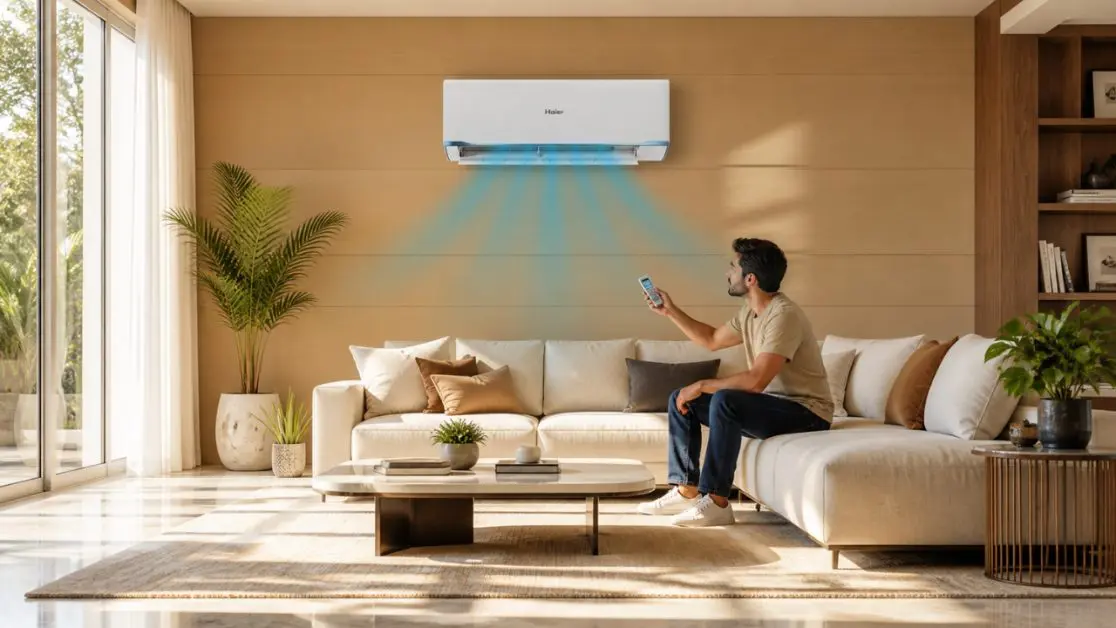
Most homes do not need maximum cooling all day
This is where AC buying gets interesting.
Indian homes rarely have constant occupancy.
A room feels different:
- At 3 PM
- During dinner
- During sleep
- During monsoon evenings
- When guests arrive
Fixed cooling wastes energy.
Flexible cooling adapts.
That is why convertible ACs matter.
Models with 7-in-1 Convertible modes allow users to adjust cooling capacity based on real conditions. Haier’s Intelli Convertible system, for example, operates between 40% and 110% capacity.
That flexibility matters because Indian homes are dynamic systems.
Not static environments.
One option is fixed cooling
Economical initially.
But less adaptable.
The second option is convertible cooling
Higher upfront cost.
Better long-term efficiency.
More control during changing weather.
The third option is AI-driven cooling
This is where modern ACs are heading.
Systems that learn usage patterns and optimize automatically.
Not just cooling.
Decision-making.
Smart AC features are becoming practical, not gimmicky
The smartphone changed expectations for every appliance
People no longer want appliances that only “work.”
They want systems that anticipate.
Modern AC usage now includes:
- Voice commands
- App controls
- Electricity monitoring
- AI energy optimization
- Remote scheduling
Haier’s AI-ATMOX platform, for example, includes AI Human Detection, AI energy management, and app-based controls.
The important thing is not the technology itself.
It is the reduction of friction.
Good technology disappears into routine.
Pre-cooling changes the experience of coming home
One subtle shift modern ACs introduced is pre-cooling.
You leave work.
You start the AC remotely.
You enter a cooled room instead of waiting 20 uncomfortable minutes.
That changes the emotional experience of homecoming.
Small convenience.
Big psychological impact.
The Desert Rose series highlights AI Pre-Cooling functionality designed around this exact use case.
Durability matters more in Indian summers
Indian weather punishes weak cooling systems
Dust.
Voltage fluctuations.
Extreme heat.
Humidity.
Long operational hours.
Indian ACs operate under stress conditions many global markets never experience.
This is why build quality matters.
Look for:
- Copper condensers
- Anti-corrosion coatings
- Strong PCB protection
- Heat tolerance
Some modern systems are specifically designed to cool even at 60°C ambient temperatures. Haier’s Desert Rose AC series includes this capability alongside conformal coating protection.
This becomes especially important in:
- Delhi NCR
- Rajasthan
- Central India
- Top-floor urban apartments
Because extreme weather exposes shortcuts quickly.
A practical AC selection checklist
Before buying an AC, ask these seven questions
| Question | Why It Matters |
| What is the room size? | Determines tonnage |
| Does the room get direct sunlight? | Impacts cooling load |
| How many people use the room? | Affects heat generation |
| Will the AC run overnight? | Noise and inverter matter |
| Is electricity cost a concern? | Star ratings become critical |
| Do you want an app or voice control? | Smart features improve convenience |
| Does your city face extreme heat? | Durability and fast cooling matter |
A better AC decision usually comes from better questions.
Not better advertising.
The best AC is the one that disappears into life
People rarely talk about appliances when they work perfectly.
That is the real benchmark.
No constant remote adjustments.
No fighting over temperature settings.
No worrying about bills every month.
Just consistent comfort.
Quietly delivered.
And this is the hidden shift happening in Indian homes right now.
Appliances are no longer isolated machines.
They are becoming responsive systems that adapt to routines, weather, occupancy, and energy behavior.
The future of cooling is not colder air.
Comfort that understands context.
Comfort that adjusts without demanding attention.
Comfort that lets homes feel calmer, lighter, and easier to live in.
That is what selecting the right AC is really about.
Not just surviving summer.
Designing a better everyday life.
Frequently Asked Questions
How do I know whether I need a 1 Ton, 1.5 Ton, or 2 Ton AC?
The right tonnage depends on more than room size alone. A small shaded bedroom may work perfectly with a 1 Ton AC, while a sun-facing top-floor room may need 1.5 Ton cooling even at the same size. Consider:
Room dimensions
Ceiling height
Sunlight exposure
Number of people using the room
Local summer temperatures
My room is 150 sq ft but still feels hot. Did I buy the wrong AC?
Possibly. Direct sunlight, poor insulation, large windows, or top-floor heat can increase cooling load significantly. Many people calculate tonnage using only square footage and ignore heat retention.
Why does one room in my house cool quickly while another never feels comfortable?
Rooms behave differently depending on:
Window direction
Heat exposure
Ventilation
Furniture placement
Air circulation
A west-facing room in Jaipur and a shaded room in Bengaluru may need completely different cooling strategies.
Can I install the same AC model in every room?
You can, but it often creates uneven comfort and wasted electricity. Bedrooms, living rooms, and workspaces all have different cooling patterns and occupancy habits.
Why did my electricity bill increase so much after buying an AC?
Common reasons include:
Incorrect tonnage
Non-inverter AC usage
Poor insulation
Frequent temperature changes
Running the AC at extremely low temperatures
Long compressor cycles caused by direct sunlight
Is an inverter AC really worth paying extra for?
For most Indian households, yes. Inverter ACs:
Maintain stable temperatures
Consume less electricity
Produce less noise
Avoid aggressive on/off cycling
The comfort difference becomes especially noticeable during overnight use.
I only use my AC at night. Should I still buy a high star-rated model?
Yes, especially if you use it daily during summer. Overnight usage accumulates quickly over months.