


The moment temperatures start crossing 40°C across India, air conditioners become part of the daily routine. They keep running for months because the heat stays intense. Then the electricity bill arrives, and the same question comes up every year. How much power does an AC use, and is a 5-star model cheaper to run through the summer season?
This blog breaks down what actually drives AC power consumption in Indian homes, how tonnage and star ratings affect your monthly bill, and where a well-engineered 5-star AC can genuinely make a difference once the heat sets in for good.
What Actually Decides How Much Power Your AC Draws
An air conditioner’s power draw isn’t one single fixed number, it shifts depending on several factors working together at once. The compressor type, tonnage of the unit, star rating, room insulation, outside temperature and how long the AC runs each day, all of it adds up over a billing cycle.
A few things matter more than people usually assume:
- Tonnage of the unit. A 1 ton AC cools a smaller area and pulls less power than a 1.5 ton or 2 ton unit under similar load.
- Star rating (ISEER value). A higher ISEER means the AC delivers more cooling per unit of electricity it consumes.
- Inverter vs fixed-speed compressor. Inverter compressors modulate their speed based on room temperature, so they don’t pull full-load power constantly.
- Ambient temperature. An AC fighting against 44°C outside heat draws noticeably more power than one running in mild 32°C weather.
- Usage pattern. Running the AC at 24°C for 8 hours costs less than running it at 18°C for that same stretch.
How Much Electricity Does a 1 Ton and 1.5 Ton AC Use Per Hour?
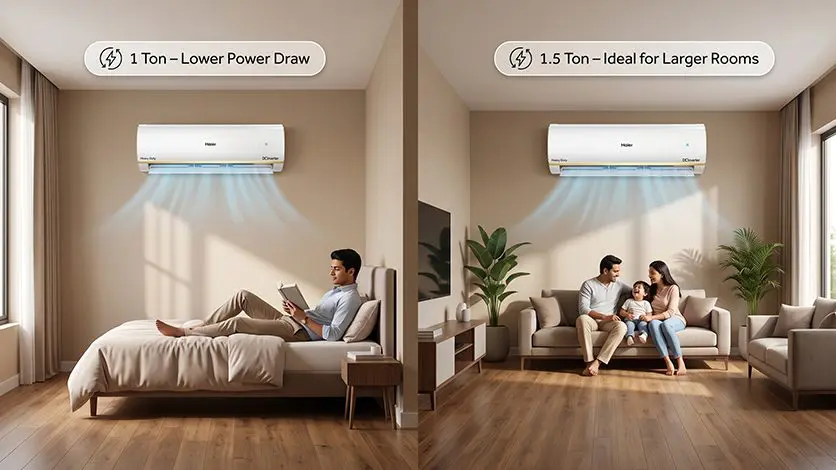
Most Indian households run either a 1-ton or 1.5 ton split AC, so it’s worth looking at what these units actually draw. On average, a decent 1-ton AC power consumption per hour figure for a 5-star inverter unit ranges between 0.7 and 0.9 units (kWh), depending on ambient heat and set temperature.
For bigger rooms, a 1.5-ton unit is far more common, and that’s where the gap between ratings starts to show. A 1.5 ton ac power consumption per hour for a 3-star model can climb up to 1.5 or 1.6 kWh at full load, while a 5-star 1.5-ton inverter version usually stays closer to 1.1 to 1.2 kWh under similar room conditions.
Inverter ACs rarely sit at 100% load once the room hits the set temperature, they cycle down on their own. That’s also why real bills often come out lower than worst-case estimates people calculate online.
Haier’s inverter AC range is built around this exact behaviour. Models running on HEXA Inverter Technology modulate compressor speed in smaller steps, so the unit settles into a steady low draw once the room cools down, instead of swinging between full blast and shut off.
3 Star vs 5 Star AC Power Consumption: What Actually Changes
The gap in 3-star vs 5-star AC power consumption isn’t marginal once you run the unit for 6 to 8 hours daily across a 4-month cooling season.
| Star Rating | Typical ISEER | Power Input (1.5 Ton, 100% Cooling) | Approx. Monthly Units (8 hrs/day) |
| 3 Star | 4.30 to 4.40 | 1500 to 1600 Watts | 300 to 320 units |
| 5 Star | 5.65 | 1150 to 1200 Watts | 230 to 250 units |
A higher ISEER value simply means the compressor and the heat exchange system are built to give the same cooling with less electrical input. Over a full season, that difference in 3-star vs 5-star AC power consumption turns into a noticeably lower bill, even though the upfront price of a 5-star unit tends to run a little higher.
How To Calculate AC Power Consumption At Home

You don’t need an engineering degree for this, the formula is fairly simple to work with.
Power Input (in kW) x Number of running hours x Electricity rate per unit = Daily running cost.
So if your AC draws 1.2 kW and runs for 8 hours a day, with electricity priced at ₹8 per unit, that’s roughly 1.2 x 8 x 8, which comes to ₹76.8 a day. Multiply that across the month, and you get a fair estimate, though actual usage varies since inverter units don’t hold full load throughout the day.
Want to learn simple daily habits that can cut your AC’s electricity usage even further? Read this blog: Smart Cooling Habits That Help Save More Electricity
How Haier Thinks About Power and Comfort
At Haier, we don’t believe cooling and electricity savings should be a trade-off, one shouldn’t really have to come at the cost of the other. Every 5-star AC we build works on the idea that Indian summers shouldn’t translate into an unpredictable bill at month-end. Here is what goes into that thinking on our side:
- Our AI Eco mode adjusts cooling capacity automatically based on room conditions and can deliver up to 56% more energy savings compared to conventional AC usage.
- AI Electricity Monitoring through the Haismart App tracks real-time power usage in kWh and shows the actual running cost in rupees, so there’s no guesswork left.
- HEXA Inverter Technology keeps compressor performance steady even at 46°C ambient heat, without forcing the unit to overwork itself.
- AI Human Detection shifts the AC to a lower capacity automatically when no one’s in the room, and switches it off after 30 minutes of no activity detected.
- Our units run on R32 refrigerant, which is considered a more eco-friendly option compared to older refrigerants used earlier.
- Every Haier 5-star split and window AC comes backed with a 5-year comprehensive warranty, plus 12 years on the compressor for inverter models.
We build these features not as add-ons for the sake of it, but because that’s genuinely how a modern AC should behave in Indian conditions, where heat doesn’t let up for months on end.
Conclusion
Choosing an AC gets confusing because every model promises better cooling and lower bills at the same time. The good part is that you don’t need to understand every feature before making a sensible choice. Pick the right tonnage for your room, compare the ISEER rating, and then see what the long-term electricity cost looks like.
A 5-star AC with features such as AI Eco and Electricity Monitoring usually saves more over regular summer use, even if the buying price feels higher. Once you compare the difference between 3-star and 5-star AC power consumption, the better option becomes much easier to figure out.
Frequently Asked Questions
How to reduce the AC bill?
Set the temperature to 24-26°C instead of running it colder, use ceiling fans alongside the AC, and clean filters regularly. Picking a 5-star inverter unit with AI Eco mode also helps bring monthly consumption down further.
How to calculate AC power consumption?
Multiply the AC’s power input in kilowatts by daily running hours, then multiply that by your electricity rate per unit. This gives a rough estimate of AC power consumption, though inverter units usually consume less once the temperature is reached.
How much electricity bill for a 1.5 ton AC?
A 5-star 1.5-ton inverter unit keeps 1.5-ton AC power consumption per hour near 1.1 to 1.2 kWh. Over 8 hours daily, that adds up to roughly 230-250 units a month, costing around ₹1800 to ₹2200 monthly
Which AC temperature is best for the electricity bill?
24°C is generally considered the most balanced setting between comfort and electricity savings. Every degree lower than this can increase power consumption noticeably, since the compressor has to work harder to hold a colder room temperature.
What is the power consumption of a 1.5 ton AC?
A 1.5 ton AC’s power consumption depends on star rating, ranging from 1150-1200 watts for 5-star inverter models to 1500-1600 watts for 3-star models at full load. A 1-ton AC power consumption per hour stays comparatively lower.