
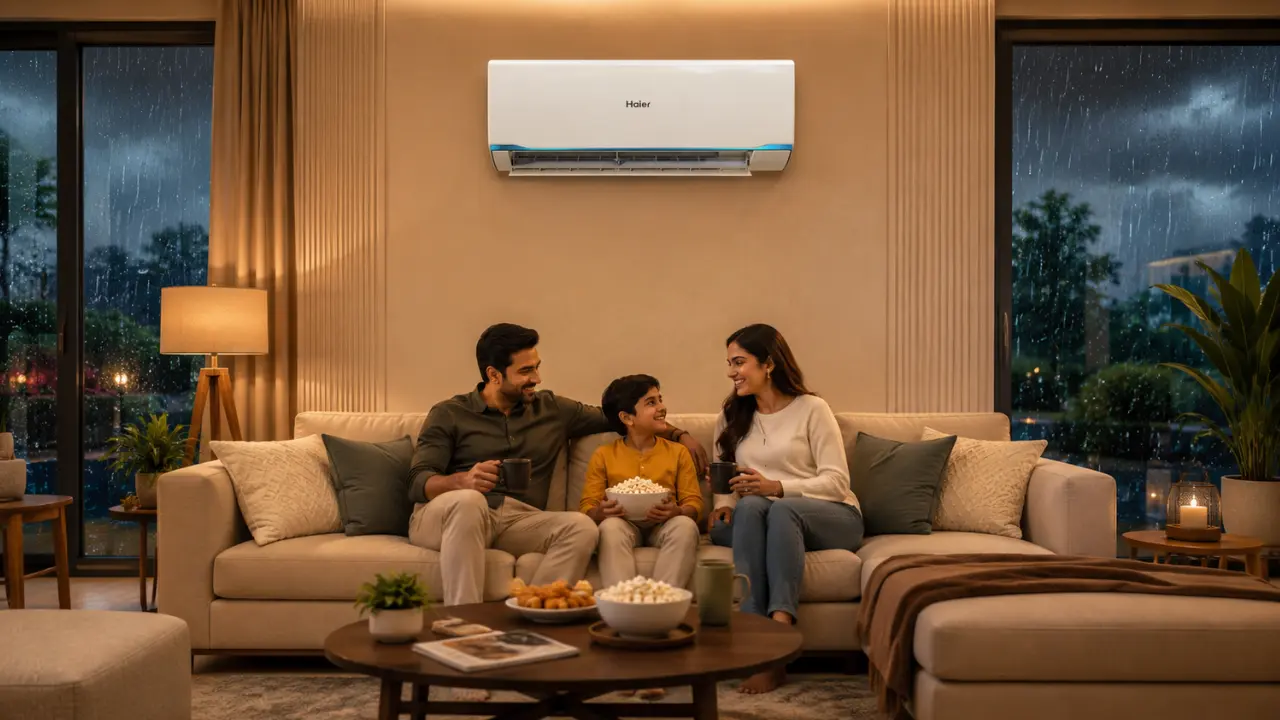

Rain outside. Damp clothes inside.
That, honestly, sums up the Indian monsoon for many households.
The first showers bring relief from the scorching summer, but they also introduce a different challenge altogether. Rooms start feeling sticky. Walls retain moisture. Bedding feels slightly damp. Even on days when temperatures are lower, comfort somehow disappears.
It’s a strange contradiction.
The weather isn’t particularly hot, yet your home doesn’t feel comfortable.
The reason? Humidity.
And this is exactly why monsoon cooling requires a different approach than summer cooling.
A powerful air conditioner alone is no longer enough. Modern homes need intelligent cooling systems that can adapt to changing weather conditions, optimize comfort automatically, and operate efficiently even when outdoor conditions fluctuate throughout the day.
Why Monsoon Comfort Is Different From Summer Comfort
Many people make the mistake of treating monsoon cooling the same way they treat summer cooling.
The two situations are completely different.
During peak summer:
- High temperatures are the primary concern
- Direct cooling becomes the priority
- Heat reduction drives comfort
During monsoon:
- Humidity becomes the bigger issue
- Indoor conditions change frequently
- Weather patterns shift multiple times a day
- Comfort depends on balanced cooling rather than aggressive cooling
This is why blindly lowering the AC temperature often fails to solve the problem.
In fact, it can sometimes make indoor conditions feel less comfortable.
Smart cooling systems are designed to understand these changes and respond intelligently.
What Does Smart Cooling Actually Mean?
Smart cooling goes beyond simply lowering room temperature.
It involves analysing environmental conditions, understanding usage behaviour, and automatically adjusting performance to create optimal comfort.
Think about it.
A rainy afternoon, a humid evening, and a cool monsoon night all require slightly different cooling behaviour.
Traditional air conditioners depend on manual adjustments.
Smart air conditioners adapt automatically.
The Haier 1.7 Ton 5 Star Desert Rose Air Conditioner (HSA20DSD-NAI5NB-I) and Haier 1.7 Ton 5 Star Desert Rose Air Conditioner (HSA20DSD-GAI5NB-I) feature AI-powered technologies designed to continuously analyse surroundings and optimise performance accordingly.
AI-ATMOX: Cooling That Learns Your Environment
One of the standout innovations in the Desert Rose range is AI-ATMOX technology.
Instead of operating through fixed patterns, the system analyses environmental conditions and learns usage habits over time.
The result?
A cooling experience that feels more personalised and responsive.
During monsoon season, when conditions can change dramatically within a few hours, this intelligent adaptation becomes particularly valuable.
Rather than constantly reaching for the remote, users can enjoy a more seamless cooling experience.
AI Human Detection: Smarter Energy Management
Let’s be honest.
Most households have left the AC running in an empty room at some point.
The Desert Rose models feature AI Human Detection, enabling precise occupancy detection to reduce unnecessary energy consumption.
This is especially useful during monsoon months when AC usage tends to be less predictable than during peak summer.
People move between rooms more often.
Weather changes frequently.
Cooling requirements fluctuate.
The system responds intelligently, helping improve efficiency without compromising comfort.
AI for Comfort: Built for Unpredictable Weather
Indian monsoons are rarely consistent.
A bright sunny morning can suddenly turn into heavy rainfall by afternoon.
A cool evening may become humid overnight.
The Desert Rose series addresses this challenge through AI for Comfort, which analyses real-time weather conditions, indoor environments, and user preferences to select the most suitable operating mode automatically.
Instead of forcing users to continuously adjust settings, the air conditioner works proactively in the background.
That convenience becomes surprisingly valuable over an entire season.
Monsoon Cooling Needs Energy Efficiency Too
Many households assume AC usage decreases significantly during monsoon.
In reality, air conditioners often continue operating regularly because humidity remains high.
This makes energy efficiency extremely important.
The Haier 1.7 Ton 5 Star Desert Rose Air Conditioner (HSA20DSD-NAI5NB-I) and Haier 1.7 Ton 5 Star Desert Rose Air Conditioner (HSA20DSD-GAI5NB-I) feature:
- AI for Savings
- Hexa Inverter Technology
- AI ECO Mode
- Intelligent energy monitoring
The system tracks consumption patterns and can automatically optimise performance to minimise unnecessary energy usage while maintaining comfort.
For Indian households balancing comfort and electricity bills, this creates a meaningful advantage.
Features That Make a Difference Beyond Monsoon
The Desert Rose range has been engineered for year-round performance.
Key highlights include:
Supersonic Cooling in 10 Seconds
Powered by advanced KTS and PKC technologies, the system delivers rapid cooling for instant comfort when needed.
7-in-1 Convertible Flexibility
Users can adjust cooling capacity from 40% to 110%, allowing greater control based on occupancy and weather conditions.
Long Air Flow
With airflow reaching up to 20 metres, cooling can be distributed more effectively across larger rooms.
Ultimate Smart Connectivity
Users can control the air conditioner through the Hai Smart App while also accessing voice commands through Alexa and Google Assistant compatibility.
AI for Service and ODU Cyclone Clean
The intelligent self-cleaning functions help maintain performance, support efficiency, and promote cleaner airflow over time.
Why Smart Cooling Is the Future of Monsoon Comfort
Modern air conditioning is no longer just about temperature control.
It is about creating a healthier, more comfortable indoor environment regardless of changing weather conditions.
The Haier 1.7 Ton 5 Star Desert Rose Air Conditioner (HSA20DSD-NAI5NB-I) and Haier 1.7 Ton 5 Star Desert Rose Air Conditioner (HSA20DSD-GAI5NB-I) combine AI-driven intelligence, smart energy management, powerful cooling performance, and connected convenience to deliver a more adaptive cooling experience.
And during India’s unpredictable monsoon season, adaptability often matters more than raw cooling power alone.
Because comfort isn’t just about feeling cool.
It’s about feeling right.
Frequently Asked Questions
Do I need a different type of AC for the monsoon season?
Not necessarily a different AC, but one with intelligent climate control can make a noticeable difference. During monsoon, humidity often affects comfort more than temperature, so features like AI-powered environmental analysis and adaptive cooling become especially valuable.
Is an AI-powered AC worth buying if I mostly use it during monsoon?
If your home feels damp or sticky during the rainy season, an AI AC can offer a more comfortable experience by automatically adjusting cooling based on changing weather, indoor conditions, and occupancy, rather than relying only on a fixed temperature setting.
Should I keep lowering the temperature when my room still feels uncomfortable?
Usually not. Lowering the temperature alone doesn’t always solve humidity-related discomfort. Smart cooling systems focus on creating balanced indoor comfort instead of simply making the room colder.
Why does my room feel sticky even when it’s raining and not very hot outside?
Rain increases humidity levels. Even if temperatures are lower, excess moisture in the air can make rooms feel damp and uncomfortable.
Why do my bedsheets and clothes feel damp even when I use the AC?
Traditional air conditioners primarily focus on lowering temperature. If humidity remains high, fabrics can continue absorbing moisture from the air, creating that damp feeling.