
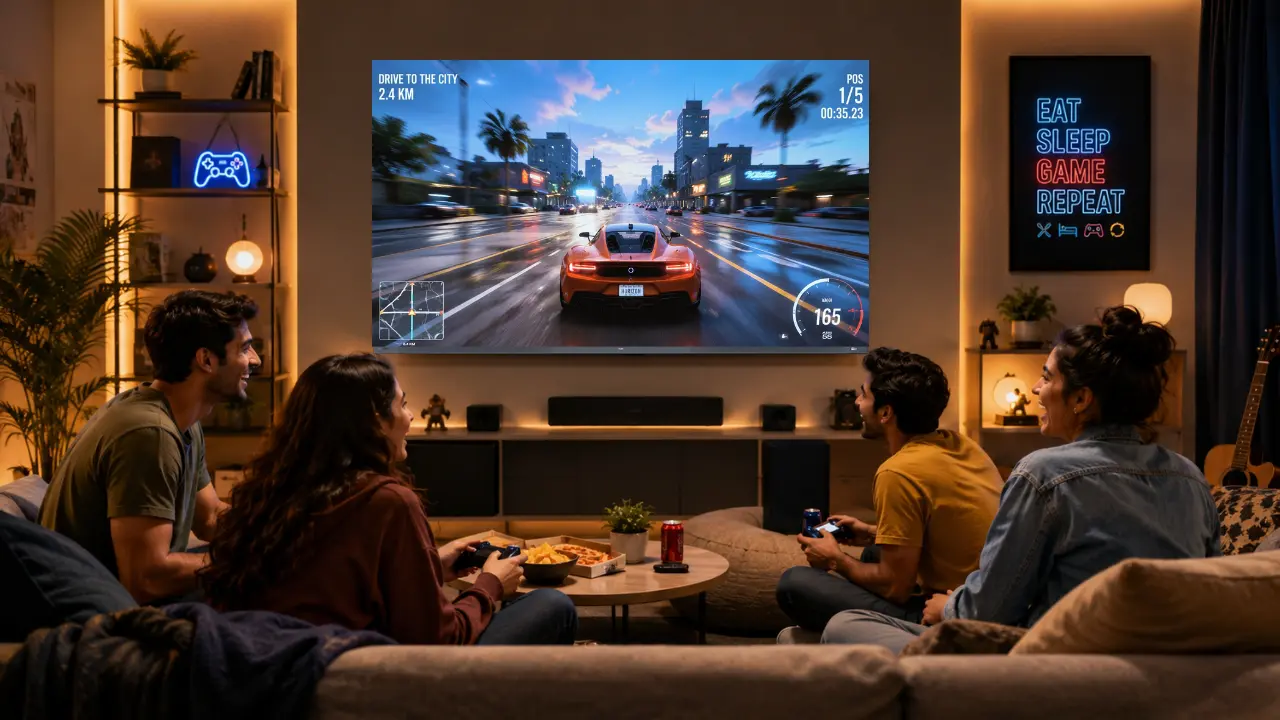

Gaming has a funny way of exposing weaknesses.
A television might look spectacular while streaming a movie. Colours pop. The sound feels rich. Everything appears perfect.
Then you launch a racing game.
Suddenly, the car seems slightly blurred while cornering. Fast camera movements feel less precise. Actions appear just a fraction behind your controller input.
Blame the game?
Nah, it’s usually the display.
Refresh rate and response time are two of the most important factors affecting how games play these days. But they’re also two of the most confusing TV specifications buyers face.
If you’re an occasional gamer, it might not matter too much.
If you play competitively, are into sports games, racers, open-world epics or console gaming cutting-edge releases, it can make the difference between how a game plays.
How a game plays matters.
These days gaming is no longer considered a niche pastime on Indian TV sets. The television you use to stream movies at night might also see some gaming action after dinner.
Why Does Gameplay Feel Smooth On Some TVs But Choppy On Others?
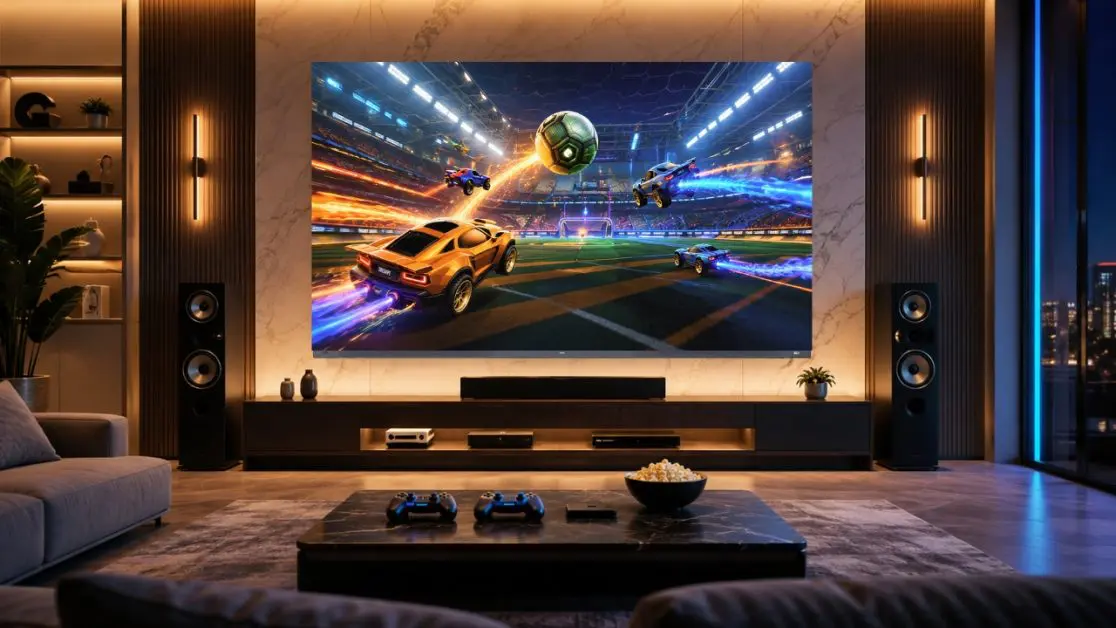
Have you ever noticed how some games play smoothly and react instantly while others just feel a tiny bit off?
The likely culprit is how fast the television can display and refresh data.
Here are the three main players when it comes to gaming:
The console producing the frames
The television displaying the frames
The gamer responding to what they see on TV
The quicker and more seamless this cycle can occur, the smoother a game will play.
Refresh rate and response time are what we’re talking about here.
Refresh Rate Made Simple, No Maths Added
Imagine reading a comic book.
The faster you flip through the pages, the smoother the animation looks. TVs refresh the image you see several times every second.
A television that refreshes at 60Hz will refresh:
60 times per second
A 120Hz TV refreshes:
120 times per second
A 144Hz TV refreshes:
144 times per second
The difference sounds minor on paper.
On screen?
Not even close.
Fast-moving objects become significantly smoother. Motion blur reduces. Camera pans feel more natural. Character movement appears cleaner and more detailed.
Haier’s New M92 Series and flagship New M96 Series have a native refresh rate of 144Hz to enhance motion performance for gaming, sports, and fast-paced content.
What happens when the Refresh Rate Is Too Low?
Let’s take an example most of you can relate to.
You are playing cricket. The bowler bowls a yorker.
The ball travels rapidly toward the stumps.
On a lower refresh rate display:
- Motion may appear less fluid
- Fast-moving objects can look blurry
- Tracking movement becomes harder
- Visual clarity drops during rapid action
On a higher refresh rate display:
- Motion appears sharper
- Movement feels more natural
- Fast scenes remain easier to follow
- Gameplay feels more responsive
This becomes even more noticeable in:
- Racing games
- First-person shooters
- Football simulations
- Battle royale titles
- Action-adventure games
Refresh Rate vs Response Time: They Are Not the Same Thing
Many buyers assume both specifications mean the same thing.
They don’t.
Refresh rate determines:
How often the screen updates.
Response time determines:
How quickly pixels change from one state to another.
A useful analogy:
Imagine refresh rate as how frequently a teacher writes new information on a blackboard.
Response time is how quickly the old writing disappears and the new writing becomes visible.
Both matter.
If either is slow, visual performance suffers.
Why Response Time Matters More Than People Think
Not gonna lie, response time rarely gets the attention it deserves.
Yet it has a huge impact on gaming quality.
When pixels take too long to transition, something called ghosting can occur.
You may notice:
- Faint trails behind moving objects
- Blurred edges
- Smearing during rapid motion
- Reduced visual precision
For story-based games, this may be manageable.
For competitive gaming?
It’s frustrating.
Nobody wants to lose a match because visual information arrived too late.
Modern gaming-focused televisions use advanced image processing and motion technologies to minimise these issues.
Haier’s AI Ultra Sense Processor continuously analyses scenes and intelligently enhances motion performance, colour accuracy, contrast and detail to maintain smoother visuals during fast-paced gaming moments.
The Hidden Problem Called Screen Tearing

Now let’s talk about something gamers instantly recognise.
Screen tearing.
You’ve probably seen it.
The image looks split.
Part of the screen updates while another section lags behind.
It breaks immersion immediately.
The solution?
Adaptive synchronisation technologies.
Haier’s M92 and M96 Series include AMD FreeSync Premium Pro along with VRR (Variable Refresh Rate) support to help synchronise frame output and reduce tearing during gameplay.
The result:
- Smoother gameplay
- Reduced visual interruptions
- Improved frame consistency
- Better gaming fluidity
Simple. Effective.
Exactly what gamers want.
Gaming Features That Work Together
Refresh rate alone doesn’t create a premium gaming experience.
Several technologies must work together.
Essential Gaming Technologies
| Feature | What It Does |
| 144Hz Refresh Rate | Improves motion smoothness |
| VRR | Matches display refresh with game output |
| ALLM | Automatically switches to gaming mode |
| AMD FreeSync Premium Pro | Reduces tearing and stuttering |
| HDMI 2.1 | Supports high-bandwidth gaming signals |
| MEMC Technology | Enhances motion clarity |
Haier integrates these technologies across its premium gaming-focused television lineup to create a more responsive gaming environment.
Why Modern Consoles Need Modern Displays

Gaming hardware has evolved dramatically.
The latest consoles are capable of delivering:
- Higher frame rates
- Better textures
- Real-time lighting effects
- Faster loading times
- More responsive gameplay
Yet many players still connect them to displays that cannot fully utilise these capabilities.
It’s a bit like buying a sports bike and riding it only in first gear.
You own the performance.
You simply aren’t experiencing it.
A display with 144Hz refresh rate, HDMI 2.1 connectivity, VRR support and AI-driven motion optimisation unlocks much more of what modern gaming hardware can actually deliver.
Beyond Gaming: Why Families Benefit Too
Interestingly, the refresh rate isn’t only about gaming.
The same technology improves:
Sports Viewing
Fast-moving cricket balls remain easier to track.
Football broadcasts appear smoother.
Camera pans feel more natural.
Action Movies
Fight scenes remain detailed.
Explosions look cleaner.
Motion blur reduces noticeably.
Streaming
High-action OTT content benefits from improved motion handling.
This means one investment supports multiple entertainment needs.
And that makes sense for Indian households where one television serves everyone.
A Closer Look at Haier’s Gaming-Ready QD Mini LED TVs
Gaming today demands more than a large screen.
It requires intelligence.
The Haier New M92 Series QD Mini LED AI Smart Google TV, available in 164cm (65) and 189cm (75) variants, combines a 144Hz refresh rate, AMD FreeSync Premium Pro, VRR, ALLM, HDMI 2.1 support, AI Ultra Sense Processor and Game Mode optimisation to create a smoother gaming experience.
For those seeking an even larger and more immersive setup, the Haier New M96 Series 254cm (100) QD Mini LED AI Smart Google TV brings premium gaming performance together with AI Ultra Sense Processor, a 144Hz refresh rate, KEF-tuned audio, Dolby Atmos, Dolby Vision IQ and advanced gaming features designed for modern console gaming.
What stands out isn’t just the specification sheet.
It’s how these technologies work together.
The AI processor optimises scenes.
The refresh rate keeps motion fluid.
AMD FreeSync Premium Pro helps eliminate tearing.
KEF audio enhances immersion.
The result feels cohesive rather than complicated.
Final Thoughts
Most gaming discussions focus on graphics.
Yet gameplay quality often comes down to something far simpler.
How quickly the television can respond.
How smoothly it can display motion.
How effectively it handles fast action.
Refresh rate and response time influence every second of gameplay, whether you’re navigating a racing circuit, scoring a last-minute goal, or exploring a vast open world.
A high-performance gaming television doesn’t just make games look better.
It makes them feel better.
And that’s where the latest Haier QD Mini LED AI Smart Google TV lineup creates a noticeable difference combining high refresh rates, advanced gaming technologies, AI-powered optimisation and immersive audio into a complete entertainment experience built for modern Indian homes.
Frequently Asked Questions
What is refresh rate, and why does it matter for gaming?
Refresh rate refers to how many times a TV updates the image every second. A 60Hz TV refreshes 60 times per second, while a 144Hz TV refreshes 144 times. Higher refresh rates make gameplay smoother, reduce motion blur, and improve responsiveness during fast-moving scenes.
What is response time on a TV?
Response time measures how quickly a pixel changes from one color to another. Faster response times help reduce ghosting and motion blur, making moving objects appear sharper during gameplay.
Is refresh rate the same as response time?
No. Refresh rate determines how often the screen updates, while response time determines how quickly pixels change. Both contribute to a smoother gaming experience, but they affect different aspects of image quality.
Which is more important for gaming: refresh rate or response time?
Both are important. A high refresh rate improves motion smoothness, while a fast response time minimizes ghosting and blurring. The best gaming TVs excel in both areas.
Why does my game feel smooth on one TV but laggy on another?
Even if your console performs well, the TV may not refresh images quickly enough or respond fast enough to keep up. Refresh rate, response time, and gaming technologies like VRR all affect how responsive gameplay feels.
Does a 144Hz TV really improve gaming?
Yes. A native 144Hz refresh rate delivers smoother motion, especially in racing games, FPS titles, sports games, and action-heavy adventures.
Will I notice the difference between 60Hz and 144Hz?
Most gamers notice smoother camera movement, clearer motion, and more responsive gameplay on a 144Hz display, particularly during fast-paced scenes.