
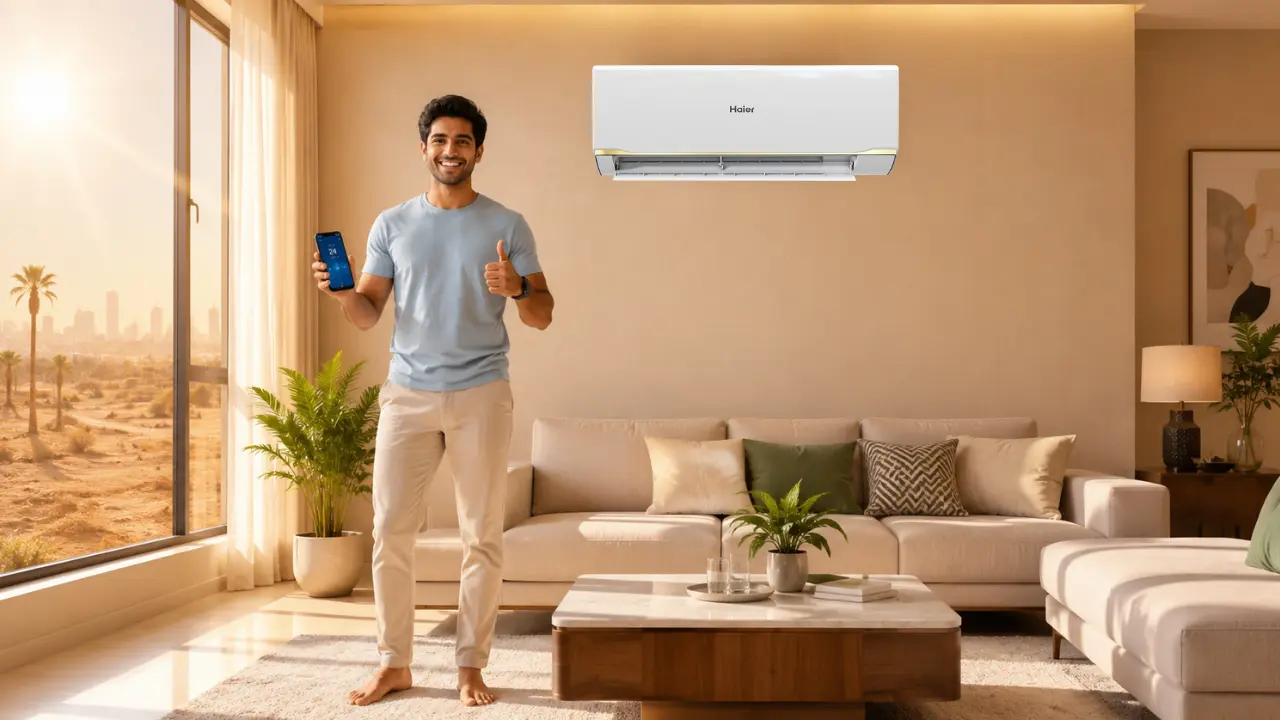

Your AC Doesn’t Work Alone. The Weather Outside Has a Bigger Role Than You Think.
Most people notice only one thing. The room feels cool.
A lot of things that go on outside the house are not seen. The outdoor unit is subjected to relentless exposure to the heat of the sun, the humidity of the air, the dusty winds, sudden rains and in many parts of India the temperature easily climbs beyond 45°C.
The air conditioner is not only reducing the internal temperature. It is in thermal equilibrium with the outside environment at all times. This means that the efficiency of the system to cool, its electricity usage and the load on its components are directly affected by the changes in weather.
The relationship assists the homeowners in buying a better air conditioner and selecting a model based on the Indian climatic conditions and not on the average conditions.
Different Weather Conditions, Different Cooling Challenges
Every season places a different demand on an air conditioner.
Instead of expecting identical performance throughout the year, it helps to understand what your AC experiences.
| Weather Condition | Impact on an Air Conditioner | What You Notice |
| Extreme summer heat | Higher compressor workload | Longer cooling time |
| High humidity | More moisture removal required | Sticky indoor feeling |
| Dust storms | Dirt accumulation on outdoor coils | Reduced efficiency |
| Coastal climate | Higher corrosion risk | Faster component wear |
| Monsoon season | Frequent weather fluctuations | Variable cooling demand |
The better an AC adapts to these conditions, the more consistent its performance remains over time.
Summer Heat Pushes Every AC to Its Limits
In peak summer times in India, the outdoor temperature can go above 45°C.
The more humid the outside air is, the more difficult it will be for an air conditioner to remove heat from the room.The more humid the outside air is, the more difficult an air conditioner will find it to remove indoor air temperature. The cooling efficiency will decrease if the system is not designed to cope with these harsh conditions, of course.
This is especially critical for buildings in urban areas where heatwaves are becoming more frequent in length.
If the ambient temperature is high, the cooling performance of a high-power air conditioner is more stable, and the cooling performance will not be significantly affected.
For example, the Haier 1.7 Ton 5 Star Desert Rose Series Heavy Duty AI Smart AC (HSA20DSD-NAI5NB-I) and Haier 1.7 Ton 5 Star Gold Desert Rose Series Heavy Duty AI Smart AC (HSA20DSD-GAI5NB-I) are designed to continue cooling even at ambient temperatures of up to 60°C, supported by specialised protective technologies including Hyper PCB and conformal coating.
Humidity Changes Comfort More Than Temperature
Ever come across a room that feels uncomfortable even if the thermostat reads 24°C?
It’s typically due to humidity.
The air in the room is more humid than the room temperature, and the human body feels warmer. Your air conditioner must then remove extra moisture from the air as well as cool it down.
That will require extra work.
In monsoon months, besides cooling, the indoor comfort is also related to the smartness of the AC system in adapting with the changing environment.
Modern AI-driven climate management can automatically adjust the cooling, based on indoor conditions as well as outdoor weather conditions, without fixed settings all day long.
Dust Doesn’t Just Make Homes Dirty
It Affects Cooling Too.
Dust accumulation is one of the biggest hidden enemies of an outdoor unit.
When dust settles on condenser coils and heat exchange surfaces:
- Heat transfer becomes less efficient.
- Airflow reduces.
- The compressor works harder.
- Electricity consumption gradually increases.
Unfortunately, many Indian regions experience dusty weather for several months every year.
An air conditioner equipped with intelligent maintenance features can significantly reduce this problem.
The Haier Desert Rose Series includes ODU Cyclone Clean, where the outdoor fan reverses after shutdown to remove debris from condenser fins. Combined with AI-powered self-cleaning for both indoor and outdoor units, this helps maintain efficient heat transfer while supporting long-term energy efficiency and cleaner airflow.
Coastal Weather Brings an Invisible Threat
People living near coastal regions often notice appliances ageing faster.
The reason?
Salt-rich air accelerates corrosion.
Outdoor AC components remain exposed throughout the year, making corrosion protection extremely important for long-term reliability.
When selecting an air conditioner for humid coastal cities, look for protective technologies rather than only cooling capacity.
Features like:
- Blue Fin protection
- Anti-corrosion coatings
- Copper heat exchangers
- Durable PCB protection
all contribute towards extending the operating life of the system.
The Haier Desert Rose Series incorporates Super Anti-Corrosion protection with indoor and outdoor Blue Fins alongside copper components designed for demanding weather conditions.
Weather Doesn’t Stay Constant. Neither Should Your AC.
Morning temperatures differ from afternoon heat.
Evenings become cooler.
Rain arrives unexpectedly.
Yet many conventional air conditioners continue operating exactly the same way unless someone manually changes the settings.
That isn’t always efficient.
Modern intelligent cooling systems are designed to adapt automatically instead of depending entirely on user intervention.
AI-powered climate adjustment can help by:
- Analysing real-time weather conditions.
- Learning everyday usage habits.
- Selecting suitable operating modes.
- Reducing unnecessary cooling.
- Improving overall comfort.
The AI-ATMOX powered Climate Control available in the Haier Desert Rose Series is built around this concept, automatically analysing environmental conditions while adjusting operation for smarter comfort.
Large Rooms Need Strong Air Distribution
Weather doesn’t just affect cooling performance.
It also changes how cool air travels inside your room.
During extremely hot afternoons, poor air circulation often creates uneven cooling with noticeable hot spots.
That’s why airflow matters just as much as compressor capacity.
A powerful long-distance air throw helps cool larger spaces more evenly, reducing the need to lower the thermostat unnecessarily.
The Desert Rose Series delivers airflow reaching up to 20 metres, supported by an improved fan, motor and air duct system for greater air volume across the room.
Smart Energy Management Becomes Even More Important During Peak Summers
Electricity usage naturally rises during extended summer months.
Running an air conditioner for several hours every day can increase household power consumption if the system continues operating at full capacity unnecessarily.
Modern intelligent systems now monitor energy usage and optimise performance accordingly.
Some useful capabilities include:
- Automatic ECO adjustments.
- Electricity monitoring.
- AI-based operating optimisation.
- Human presence detection.
- Convertible cooling capacities.
The Haier Desert Rose Series combines AI Human Detection, AI Electricity Monitoring and AI ECO optimisation, while offering 7-in-1 Convertible operation that allows cooling capacity adjustment between 40% and 110% according to changing requirements.
Choosing an AC for Indian Weather Requires Looking Beyond Star Ratings
Energy efficiency is important.
Cooling capacity matters.
But weather resilience is equally valuable.
Before making your decision, ask these practical questions:
- Can it perform during extreme summer temperatures?
- Does it adapt to humidity automatically?
- Is it protected against corrosion?
- Does it include self-cleaning features?
- Can it optimise electricity usage intelligently?
- Is airflow sufficient for larger rooms?
These factors often have a greater impact on everyday comfort than a specification sheet alone.
Built for India’s Changing Climate
The weather in India is not standardized and never stays the same. An air conditioner has different demands during various seasons of the year, such as heatwaves, humidity, dust etc.
Opting for an AC designed to adjust to these shifting challenges can ensure consistent cooling, boost efficiency and contribute to sustained performance.
The Haier 1.7 Ton 5 Star Desert Rose Series Heavy Duty AI Smart AC (HSA20DSD-NAI5NB-I) and Haier 1.7 Ton 5 Star Gold Desert Rose Series Heavy Duty AI Smart AC (HSA20DSD-GAI5NB-I) combine AI-driven climate management, cooling at ambient temperatures up to 60°C, HEXA Inverter technology, ODU Cyclone Clean, AI Human Detection, 7-in-1 Convertible operation, and smart app connectivity to deliver cooling that adapts to India’s diverse weather conditions rather than expecting you to keep adjusting it yourself.
Frequently Asked Questions
Should I buy an AC based only on its star rating?
No. While star ratings indicate energy efficiency, they don’t tell you how well an AC performs during extreme heat, humidity, dust, or coastal conditions. Weather resilience is equally important for long-term comfort and reliability.
How do I know if an AC is suitable for Indian weather?
Look for features like high ambient cooling capability, anti-corrosion protection, self-cleaning technology, humidity management, intelligent energy optimization, and strong airflow.
Is cooling capacity more important than weather adaptability?
Both matter. A powerful AC may still lose efficiency if it isn’t designed to handle high outdoor temperatures, humidity, or dusty environments.
Do I need a different AC if I live near the coast?
Yes, coastal homes benefit from ACs with Blue Fin protection, anti-corrosion coatings, copper heat exchangers, and durable PCB protection because salt-laden air accelerates corrosion.
Why does my AC struggle during extremely hot afternoons?
As outdoor temperatures rise, the compressor works harder to remove indoor heat. Cooling can take longer and electricity consumption may increase.