
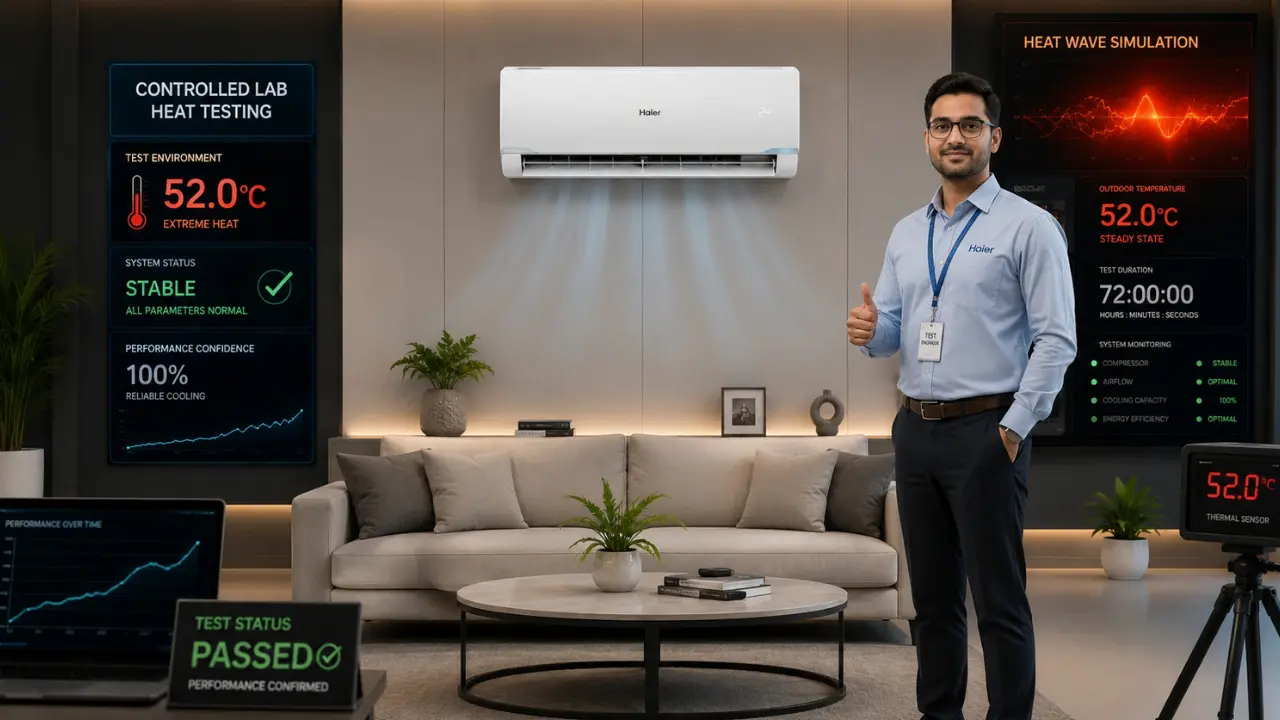

You don’t see it in the showroom. You don’t see it in advertisements either.
But before an air conditioner reaches someone’s bedroom in Jaipur, a living room in Nagpur, or an apartment in Chennai, there’s one question it has to answer:
Can it still cool when the weather stops being reasonable?
That’s where heat testing comes in.
An AC isn’t simply switched on to check if cold air comes out. Far from it. Modern air conditioners are put through demanding operating conditions designed to simulate the kind of summers many Indian households experience year after year. The objective isn’t just cooling. It’s stable performance, durability, efficiency, and reliability even when outdoor temperatures climb relentlessly.
If you’ve ever wondered what actually happens during AC heat testing, here’s a closer look.
Heat Testing Isn’t About One Afternoon of Hot Weather
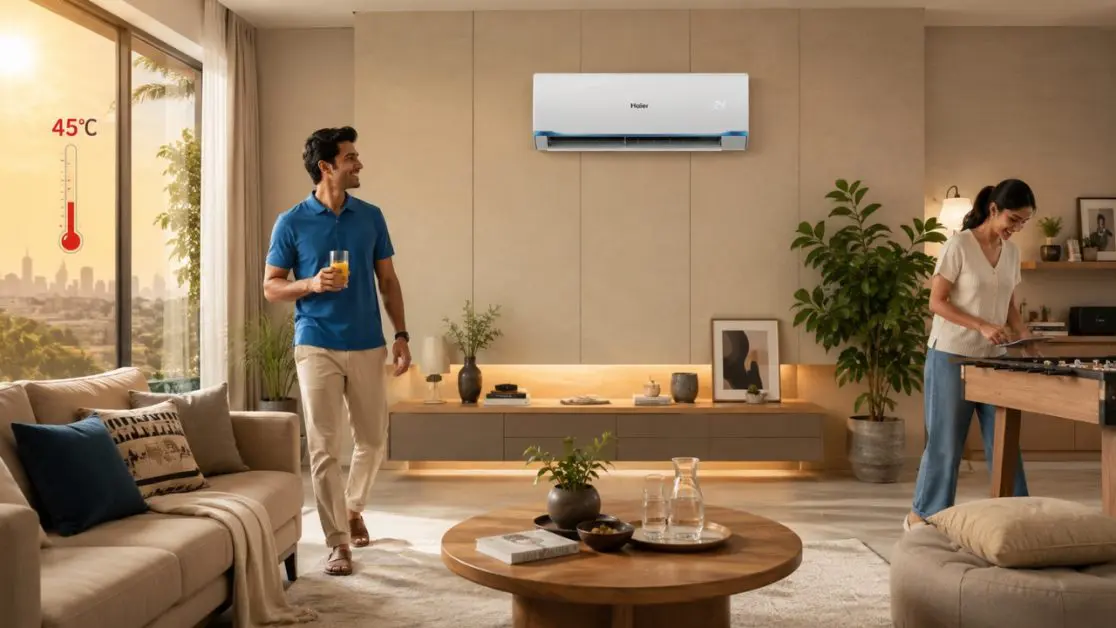
Think about a typical Indian summer.
Morning temperatures are manageable. By afternoon, balconies become almost untouchable. Outdoor units sit under direct sunlight. Voltage fluctuations happen. Dust keeps building up. And the AC? It often runs for hours without a proper break.
That’s exactly why manufacturers don’t evaluate performance under only comfortable laboratory conditions.
Instead, engineers recreate demanding environments where an AC has to continue functioning while maintaining cooling efficiency, protecting its internal components, and operating safely.
The idea is simple.
If an AC performs well during testing, it’s more likely to perform consistently inside your home.
Why High-Temperature Testing Matters More in India
Not every country demands the same thing from an air conditioner.
Indian weather presents a combination of challenges:
- Long cooling seasons
- Extremely high daytime temperatures
- Dust-heavy surroundings
- Continuous daily usage
- Coastal humidity in many regions
- Voltage instability in several locations
These conditions place significant stress on compressors, heat exchangers, electronics and airflow systems.
That’s why performance under heat becomes one of the biggest indicators of long-term reliability.
What Engineers Actually Observe During Heat Testing
Interestingly, cooling is only one part of the evaluation.
Several operating parameters are monitored simultaneously.
1. Cooling Stability
The first question is straightforward.
Can the AC continue delivering comfortable cooling as outdoor temperatures increase?
Rather than checking initial cooling alone, engineers observe whether performance remains consistent over extended operation.
2. Compressor Behaviour
The compressor is the heart of any air conditioner.
During heat testing, engineers observe:
- Operating efficiency
- Continuous workload handling
- Temperature management
- Stable performance under prolonged operation
A compressor that performs efficiently under heavy load usually contributes to dependable long-term cooling.
3. Airflow Performance
Cooling isn’t useful if it doesn’t reach across the room.
Engineers monitor:
- Air flow consistency
- Fan performance
- Air distribution
- Overall circulation
This becomes especially important in larger Indian living rooms where cooling needs to travel farther.
Quick Snapshot: What Gets Tested?
| Test Area | Why It Matters |
| Cooling consistency | Stable room comfort during extreme heat |
| Compressor performance | Reliable long-duration operation |
| Airflow | Uniform cooling across the room |
| Heat exchange | Efficient removal of indoor heat |
| Electronics | Reliable operation despite heat stress |
| Energy efficiency | Better cooling without unnecessary power consumption |
Electronics Are Under Pressure Too
People often focus only on compressors.
Actually, electronic components face their own challenges.
Modern air conditioners depend heavily on:
- Intelligent sensors
- PCBs
- Inverter controls
- Communication modules
- Smart operating systems
When outdoor temperatures rise significantly, these components also need protection.
This is where design choices become important.
For example, the Haier 1.7 Ton 5 Star Desert Rose Series Heavy Duty AI Smart AC (HSA20DSD-NAI5NB-I) and the Haier 1.7 Ton 5 Star Gold Desert Rose Series Heavy Duty AI Smart AC (HSA20DSD-GAI5NB-I) incorporate Hyper PCB protection and Conformal Coating, helping safeguard critical electronic components while maintaining cooling performance even in demanding outdoor conditions.
That matters because electronics are just as essential to dependable cooling as mechanical components.
Heat Testing Also Evaluates Energy Behaviour
Cooling fast is impressive.
Cooling efficiently is smarter.
During testing, manufacturers also monitor how much energy the system consumes while operating under demanding conditions.
This helps evaluate:
- Compressor optimisation
- Fan efficiency
- Inverter response
- Intelligent cooling adjustments
The goal isn’t simply maximum power.
It’s using only as much power as necessary to maintain comfort.
What Happens After Hours of Continuous Operation?
This is where endurance becomes important.
Many Indian households don’t use an AC for only twenty minutes.
Sometimes it’s:
- Entire afternoons
- Overnight operation
- Week-long heatwaves
- Continuous summer usage
Extended operation testing helps engineers understand whether performance remains stable without unnecessary stress on major components.
Consistency often matters more than short bursts of impressive cooling.
Dust, Heat and Outdoor Units
Let’s be honest.
Outdoor units don’t enjoy luxury conditions.
They’re exposed to:
- Hot air
- Dust
- Pollution
- Dry winds
- Seasonal debris
Heat testing therefore extends beyond indoor comfort.
Efficient heat exchange outside remains equally important because the outdoor unit is responsible for releasing indoor heat continuously.
When airflow reduces due to accumulated debris, cooling efficiency can decline.
To support long-term performance, Haier integrates ODU Cyclone Clean, where the outdoor fan intelligently reverses after shutdown to help remove debris from the condenser and heat-exchange fins. This contributes to efficient heat transfer and sustained performance over time.
Heat Testing Meets Smart Cooling
Modern air conditioners aren’t expected to cool the same way every minute.
Real homes don’t stay the same.
People walk in and out.
Sunlight changes.
Room occupancy changes.
Outdoor weather shifts throughout the day.
That means intelligent cooling systems are becoming increasingly valuable.
The Haier Desert Rose Series introduces AI-ATMOX, which analyses surroundings, learns usage habits and adjusts operating behaviour for smarter comfort. Alongside this, AI Human Detection helps identify room occupancy, while AI Climate Control analyses indoor conditions and weather patterns to optimise cooling automatically.
Instead of simply running harder, the AC focuses on running smarter.
Performance Under Extreme Heat
One specification often catches attention.
Can an AC continue cooling during severe outdoor temperatures?
For Indian summers, that’s a practical concern rather than just a technical number.
The Haier Desert Rose Series is designed to maintain cooling even at ambient temperatures up to 60°C, supported by protective technologies including Hyper PCB and specialised coatings.
For households located in regions where temperatures frequently remain above 40°C, this becomes a meaningful engineering consideration.
Features That Support Heat-Tested Performance
Rather than depending on a single technology, modern heavy-duty ACs combine multiple systems that work together.
Cooling Performance
- HEXA Inverter technology
- Supersonic Cooling in 10 seconds
- 20-metre long air flow
- 7-in-1 Convertible modes
Intelligent Efficiency
- AI Climate Control
- AI Human Detection
- AI Electricity Monitoring
- AI ECO optimisation
Long-Term Reliability
- Hyper PCB
- Conformal Coating
- 100% Grooved Copper
- Super Anti-Corrosion Blue Fins
- ODU Cyclone Clean
- Frost Self Clean
Each feature contributes to helping the AC perform more consistently under demanding Indian operating conditions rather than focusing on only one aspect of cooling.
Before an AC Reaches Your Home
It has already spent considerable time proving itself.
Heat testing isn’t a marketing exercise. It’s an engineering checkpoint that evaluates whether an air conditioner can continue cooling efficiently, protect its internal systems, and deliver dependable comfort when temperatures become genuinely challenging.
For Indian households, where summer often stretches for months rather than weeks, those tests carry real significance.
That’s why products like the Haier 1.7 Ton 5 Star Desert Rose Series Heavy Duty AI Smart AC (HSA20DSD-NAI5NB-I) and the Haier 1.7 Ton 5 Star Desert Rose Series Heavy Duty AI Smart AC (HSA20DSD-GAI5NB-I) combine heavy-duty cooling with AI-powered comfort, HEXA Inverter technology, intelligent energy management, self-cleaning features, and protection designed for demanding weather conditions.
Because when the real Indian summer arrives, performance shouldn’t become uncertain. It should already have been tested for it.
Frequently Asked Questions
Why do manufacturers perform heat testing on air conditioners?
Heat testing helps evaluate whether an air conditioner can maintain reliable cooling, stable operation, and efficient performance under high outdoor temperatures. It also assesses how key components perform during prolonged usage in demanding conditions.
Can an AC continue cooling effectively during extreme Indian summers?
Not every AC is designed for extreme heat. Models built for heavy-duty performance are engineered to maintain cooling even when outdoor temperatures rise significantly. The Haier Desert Rose Series Heavy Duty AI Smart AC is designed to cool at ambient temperatures of up to 60°C.
Does heat testing help improve the lifespan of an air conditioner?
Heat testing itself doesn’t increase an AC’s lifespan, but it helps manufacturers validate designs that can withstand demanding operating conditions. Features such as Hyper PCB protection, Conformal Coating, and Super Anti-Corrosion Blue Fins are designed to support long-term reliability.
How does the Haier Desert Rose Series perform during high-temperature conditions?
The Haier 1.7 Ton 5 Star Desert Rose Series Heavy Duty AI Smart AC (HSA20DSD-NAI5NB-I) and Haier 1.7 Ton 5 Star Desert Rose Series Heavy Duty AI Smart AC (HSA20DSD-GAI5NB-I) combine HEXA Inverter technology, AI Climate Control, ODU Cyclone Clean, and heavy-duty cooling capabilities designed to deliver stable performance even in challenging summer conditions.
What components are checked during AC heat testing?
Engineers typically monitor several areas, including:
Cooling consistency
Compressor performance
Airflow efficiency
Electronic control systems
Heat exchange performance
Energy efficiency during continuous operation
Together, these evaluations help determine how reliably the AC performs under heavy thermal stress.