
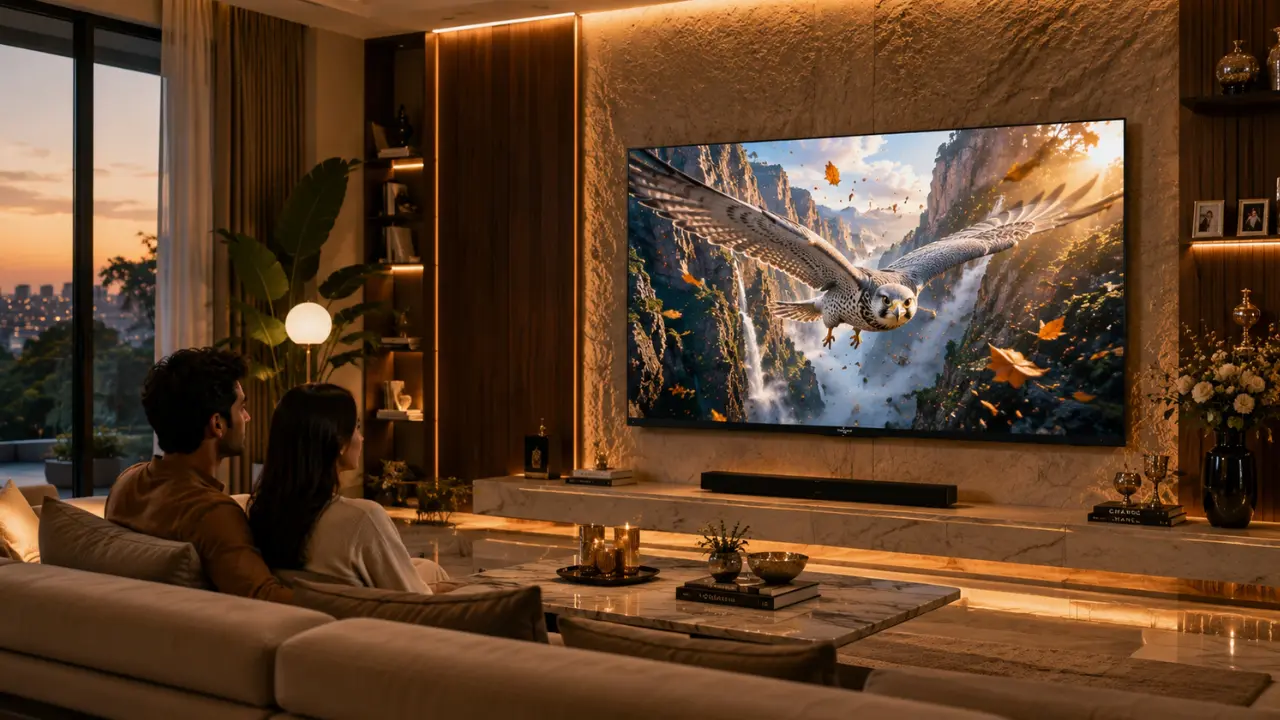

You press play on a new blockbuster. The trailer looked spectacular. Reviews called it “visually stunning”. Yet, a few minutes in, something feels off.
Dark scenes look blotchy. Fast action appears slightly blurry. Fine details on faces seem softer than expected.
Here’s the surprising part, it isn’t always your internet connection.
More often than people realise, what you’re noticing is streaming compression at work.
Almost every streaming platform compresses video before sending it to your TV. Without compression, streaming a 4K movie would require enormous amounts of data that most home internet connections simply couldn’t handle. Compression makes streaming practical, but it also changes the picture.
The good news? A capable television can recover much of what compression removes.
Let’s understand how.
What Exactly Is Streaming Compression?
Think of packing clothes into a suitcase.
If the suitcase is large enough, everything fits comfortably. If it’s small, you start folding tighter, removing unnecessary items, and squeezing everything together.
Video works similarly.
Streaming services reduce file sizes by removing information that viewers are less likely to notice. This allows movies and shows to stream smoothly without constant buffering.
Compression mainly reduces:
- Fine textures
- Extremely subtle colour transitions
- Certain background details
- Motion information between frames
- Data in darker areas of the picture
The result?
Smaller files that travel faster but sometimes at the cost of image quality.
Why Two 4K Streams Can Look Completely Different
Many people assume every 4K stream offers identical quality.
Not really.
A movie labelled as “4K” simply refers to its resolution. Resolution tells you how many pixels are displayed not how much information each pixel contains.
Several factors influence the final picture:
- Compression bitrate
- Encoding quality
- Internet stability
- HDR implementation
- Display processing
- Panel technology
This explains why the same film may appear sharper on one television than another, even when both are streaming from the same platform.
Common Signs You’re Watching Compressed Video
Compression isn’t always obvious.
Once you know what to look for, though, you’ll probably spot it during everyday viewing.
Blurry Motion
Quick camera pans or sports broadcasts may lose detail during fast movement.
Colour Banding
Instead of smooth skies or sunsets, you may notice visible colour steps.
Blocky Shadows
Dark scenes often reveal square patches instead of smooth gradients.
Missing Fine Details
Hair, grass, skin textures and distant buildings can appear softer than expected.
Noise Around Objects
Edges sometimes develop shimmering or pixelated outlines.
Not every compressed stream shows all these issues, but most display at least one depending on available bandwidth.
Your TV Plays a Bigger Role Than Most People Think
Here’s something interesting.
Compression happens before content reaches your home. Your TV cannot magically restore information that has been removed.
But
It can intelligently improve what remains.
That’s where premium picture processing becomes important.
Instead of merely enlarging compressed video, advanced televisions analyse each frame, identify missing detail, optimise contrast, improve colour accuracy and reduce visible compression artefacts.
The viewing experience becomes significantly cleaner.
How AI Processing Helps Reduce Compression Artefacts
Modern televisions don’t simply display images anymore.
They analyse them.
AI-powered processors recognise different scene types sports, films, landscapes, faces and animation and optimise them differently.
Some of the improvements include:
- Sharper textures
- Better edge definition
- Cleaner motion
- Improved colour reproduction
- Enhanced depth perception
- Reduced digital noise
Rather than applying identical processing across every frame, AI continuously adjusts image settings in real time.
This creates a picture that feels more natural, even when the original stream has been compressed.
Brightness Also Matters
Compression becomes easier to notice in dim displays.
Why?
Because subtle shadow details are already difficult to reproduce. If brightness is limited, compression artefacts become even more visible.
Higher brightness allows televisions to reveal:
- Better HDR highlights
- More realistic contrast
- Improved shadow separation
- Greater scene depth
This becomes especially noticeable while watching nature documentaries, cricket matches, action films and visually rich streaming content.
Why Display Technology Makes Such a Difference
Picture quality isn’t determined by software alone.
Display hardware matters just as much.
Premium Mini LED televisions use thousands of tiny LEDs organised into local dimming zones, allowing far greater control over brightness and contrast.
The advantages include:
| Picture Challenge | How Advanced Display Technology Helps |
| Compressed dark scenes | Better local diming reduces blooming and improves shadow depth |
| Soft highlights | Higher brightness restores visual impact |
| Motion blur | High refresh rates create smoother movement |
| Colour loss | Wider colour reproduction produces richer, more natural shades |
| Flat-looking images | Better contrast creates stronger depth perception |
When hardware and intelligent processing work together, streaming content often appears significantly more refined.
Internet Speed Is Important But Not the Whole Story
People often blame slow broadband for poor picture quality.
Sometimes that’s true.
But even with a fast fibre connection, streaming services continue using compression.
Higher internet speeds mainly help by allowing:
- Higher streaming bitrates
- Faster loading
- Fewer quality drops
- Reduced buffering
- More stable HDR playback
The television still needs to process whatever arrives.
That’s why upgrading only your internet may not completely transform picture quality.
Choosing a TV That Makes Streaming Look Better
If streaming is your primary source of entertainment, don’t focus only on screen size.
Look beyond the specification sheet.
Features that genuinely improve streaming include:
AI Picture Processing
Continuously analyses scenes and optimises picture quality.
High Peak Brightness
Improves HDR impact while preserving details.
Mini LED Technology
Offers superior brightness control and deeper blacks.
Dolby Vision IQ
Adjusts HDR performance according to your room’s lighting conditions.
High Refresh Rate
Creates smoother motion during sports and action sequences.
Advanced Colour Processing
Produces richer and more accurate colours.
Collectively, these technologies help minimise the visual compromises introduced by streaming compression.
Experience Streaming at Its Best with
The Haier New M96 Series 254 cm (100) QD-Mini LED AI Smart Google TV
If you regularly stream movies, sports, live events or high-quality OTT content, the television you choose becomes just as important as your internet connection.
The Haier New M96 Series 254 cm (100) QD-Mini LED AI Smart Google TV (H100M96FUX) has been designed with precisely these challenges in mind.
Its AI Ultra Sense Processor, co-developed with MediaTek, intelligently analyses scenes in real time to enhance motion, colour, contrast and depth.Combined with AI Center MAX, the TV optimises visuals, gaming, audio and entertainment together for a smarter viewing experience.
For streaming enthusiasts, several technologies work together to elevate compressed content:
- QD-Mini LED display technology
- Dolby Vision IQ with HDR10+ support
- Up to 2100 nits peak brightness
- 2,160 local dimming zones
- 144 Hz native refresh rate
- Sound by KEF with Dolby Atmos
- Google TV with personalised recommendations
- Hands-free voice control
- AMD FreeSync Premium Pro for responsive gaming
These features don’t eliminate compression itself but they help present streamed content with greater clarity, improved depth, smoother motion and richer colour, making everyday viewing noticeably more immersive.
A Better Streaming Experience Starts with Better Display Technology
Streaming compression isn’t disappearing anytime soon. As streaming libraries continue growing, efficient video compression will remain essential.
What changes the experience is how well your television handles those compressed images.
A thoughtfully engineered TV with intelligent AI processing, advanced Mini LED technology, powerful HDR capabilities and refined picture optimisation can make everyday streaming feel remarkably closer to the creator’s original vision.
Streaming compression isn’t disappearing anytime soon. As streaming libraries continue growing, efficient video compression will remain essential.
What changes the experience is how well your television handles those compressed images.
A thoughtfully engineered TV with intelligent AI processing, advanced Mini LED technology, powerful HDR capabilities and refined picture optimisation can make everyday streaming feel remarkably closer to the creator’s original vision.
If you’re planning to upgrade your home entertainment setup, the Haier New M96 Series 254 cm (100) QD-Mini LED AI Smart Google TV brings together advanced display technology, AI-driven picture enhancement and immersive audio to help you enjoy every frame with greater clarity and confidence. It’s a television built not just for bigger screens, but for better streaming experiences.
Frequently Asked Questions
Why doesn’t my 4K movie look as sharp as the trailer?
Resolution is only one part of picture quality. Streaming services compress video to reduce bandwidth, which can soften details, reduce colour accuracy, and introduce visible artefacts even when the content is labeled 4K.
Is my TV or the streaming service causing poor picture quality?
It can be both. Streaming platforms compress video before it reaches your TV, while your TV determines how effectively it processes and displays that compressed signal.
Does every streaming platform compress video?
Yes. Compression is a standard part of online video delivery because uncompressed 4K content would require far more bandwidth than most home internet connections can reliably provide.
Should I upgrade my TV or my internet first?
It depends on the problem. If buffering and frequent quality drops occur, your internet may be the limiting factor. If playback is smooth but the image looks soft or noisy, a TV with stronger picture processing may provide greater improvement.
Why do two TVs show the same movie differently?
Even when streaming identical content, differences in picture processing, display technology, brightness, HDR performance, colour accuracy, and motion handling can make one TV appear significantly better than another.