


Every summer, the same AC question returns to households across India. You compare two models on a website or inside a showroom. Both cool the room well enough, both come from known brands, yet the price difference makes the decision harder than expected. One costs less at the time of purchase. The other asks for a bigger investment but promises lower electricity bills for years ahead.
Salespeople explain it one way, online reviews explain it another. Most buyers end up with mixed opinions and too much information. This blog looks at how both technologies work in day-to-day use, what ownership costs can look like over five years, and where Haier’s inverter AC range stands in the overall comparison.
What Is an Inverter AC and How Does It Work?
The term inverter simply describes how the AC compressor runs during operation. A conventional compressor works in repeated cycles. It runs at full capacity, shuts off after reaching the set temperature, then starts again when the room gets warmer. Those constant restarts consume more electricity than many buyers realise, and over time the difference starts showing in monthly power bills.
An inverter AC compressor does not shut off completely once the room is cool enough. Instead, it slows to a reduced speed and keeps running at lower power, maintaining the temperature without those sharp cycling stops. When the room needs more cooling, the compressor speeds back up. When the room is already comfortable, it draws very little power and keeps running quietly in the background.
This steady adjustment keeps room temperatures more consistent through the day and night. The AC also stays quieter during operation, because the compressor works at lower levels for longer periods instead of repeatedly kicking into full power.
How Non-Inverter ACs Work?

Fixed-speed ACs follow a much simpler cooling pattern. The compressor operates at only one level and does not adjust its output. It starts at full capacity, cools the room until the target temperature is reached, then switches off completely. As the room warms again, the compressor restarts and repeats the same cycle throughout operation.
For short daily use of two to three hours in the evenings, this is not necessarily a serious problem worth stressing over. The inefficiency of on-off cycling does not compound into a large electricity cost at low usage levels. But for households running the AC through six, eight, or ten hours of Indian summer days, the difference in monthly electricity units becomes quite visible on the bill over time.
There is also the wear issue to consider. Every compressor restart at full load puts a mechanical jolt through the motor. That repeated stress shortens the compressor’s working life compared to an inverter unit that spends most of its runtime at partial speed rather than firing up at full power from a complete standstill.
Key Inverter AC Benefits You Should Know
The benefits of inverter AC go well beyond electricity savings, though that is where most of the numbers live. Here is what actually changes in day-to-day living when you move to an inverter model.
- Temperature that stays where you set it: Quality inverter ACs with PID control hold the room at the precise set temperature, with a control margin of ±0.1°C. That keeps the room locked to exactly what you set, without the repeated drifts and compressor restarts that fixed-speed cycling produces through the night. The difference in sleep comfort is real and noticeable once you experience it.
- Cooling output that does not fall apart in peak summer heat: When outdoor temperatures reach 46°C or 47°C during Indian summers, well-designed inverter ACs continue delivering near-full cooling output. Some models are built to maintain 100% cooling capacity at 46°C and hold up to 90% of that capacity at 48°C. Fixed-speed compressors see a more significant output drop at those same ambient conditions on the hottest afternoons.
- Voltage range wide enough for real Indian power supply conditions: Many inverter ACs operate stably from 120V all the way to 290V. For homes in smaller cities and towns where power supply fluctuates without much warning, this range stops the compressor from absorbing repeated stress during sudden voltage swings, which is a genuinely common situation across large parts of the country.
- Faster cooling from the moment you switch the unit on: Modern inverter compressors ramp to maximum frequency within seconds of starting. Some models reach 50Hz in just 0.24 seconds, which means a strong initial blast of cooling arrives almost immediately, before the system settles into its quieter, lower-power maintenance rhythm once the room is comfortable.
- Compressor that lasts longer under normal heavy use: Because the compressor never repeatedly goes through hard on-off restarts, the mechanical wear distributes much more evenly across the years of operation. Compressor warranties on inverter models typically run up to 12 years on select configurations, compared to 6 years on fixed-speed units, which reflects real differences in expected longevity.
- Capacity modes that match the AC to actual demand at different times of day: Inverter ACs support multiple capacity levels, so the unit can run at 40% or 55% capacity during mild evenings and drop even further at night, then push to full or above-rated output on the most intense summer afternoons when the room is being cooled from a high ambient temperature.
Which Is Better: an inverter or a non-inverter AC?

The inverter AC vs non-inverter AC debate usually comes down to cost, comfort, and long-term electricity usage. Both can cool a room effectively, but they work quite differently once daily usage starts increasing. The table below breaks down the key differences, so the choice becomes much easier to understand and compare.
| Feature | Inverter AC | Non-Inverter AC |
| Compressor Operation | Variable speed, adjusts based on demand | Fixed speed, cycles fully on and off |
| ISEER Rating (Top Models) | Up to 5.65 (5-star) | Around 3.84 to 3.90 (2-star range) |
| Energy Savings Potential | Up to 65% compared to fixed-speed units | Baseline reference |
| Temperature Stability | ±0.1°C with PID inverter control | Fluctuates 1°C to 2°C between on-off cycles |
| Performance at 46°C Ambient | 100% or near-full cooling capacity maintained | Noticeable capacity reduction under high heat |
| Compressor Warranty | Up to 12 years on select inverter models | Typically 5 to 6 years |
| Voltage Operating Range | 120V to 290V on select models | Standard rated voltage only |
| Upfront Cost | Higher than fixed-speed models | Lower upfront purchase price |
| Long-Term Running Cost | Significantly lower for extended daily use | Higher with six or more daily hours |
| Operational Noise | Lower, especially during partial-load operation | Higher, notably during compressor restarts |
The Technology Behind Haier Inverter ACs
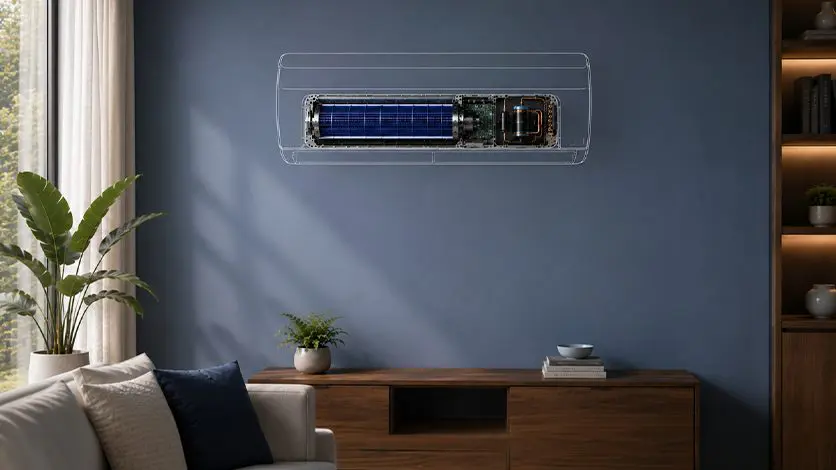
When we set out to design our inverter range for Indian conditions, the actual challenge was not just writing a features list. The real problem we were solving was building something that holds up through Delhi summers, inconsistent voltages in smaller cities, and households running the AC from 2 PM through midnight, expecting it to work the same way twelve years from now.
Our Gravity AI Series runs on HEXA Inverter Technology, which uses a Full DC Motor in both the indoor and outdoor units, an Electronic Expansion Valve for precise refrigerant flow management, and Full DC PCBs in both units. The system delivers 100% cooling capacity when outdoor temperatures hit 46°C, and maintains 90% of that capacity even at 48°C. For anyone in Delhi, Nagpur, Jaipur, or most of central and northern India, those temperature levels are not unlikely edge cases. They show up every year from May through July without fail.
The Triple Inverter+++ technology in our premium models combines three control systems that run simultaneously. TLFM, or Triple Linkage Frequency Modulation, manages compressor efficiency across different frequency ranges and load conditions. PID Inverter Control keeps room temperature locked within ±0.1°C of whatever you set. A-PAM Inverter Control adjusts the DC bus voltage dynamically based on what the compressor needs at any given moment, extending the effective operating voltage range and improving efficiency under varying load states. Together, these systems push energy savings up to 65% compared to conventional fixed-speed units.
Our Desert Rose AI Series carries Supersonic Cooling, and the mechanism behind it is straightforward to understand. The KTS system, which stands for Kick Torque Start, ramps the compressor to 50Hz in 0.24 seconds at startup. Cool air begins to flow within moments, and the room starts feeling comfortable much sooner. The Desert Rose AI also runs on our AI Atmox platform, which spends the first seven days studying your cooling patterns, what temperatures you prefer in the morning versus the afternoon, when you typically shut the unit off at night, and then starts adjusting the schedule automatically without requiring any manual input going forward.
The AI Eco mode, available across our inverter range, handles energy management in real time without you thinking about it. The system shifts between L1 at 75% capacity, L2 at 55% capacity, and L3 at 40% capacity, based on occupancy sensing and actual room conditions. If no movement is detected for 15 minutes, it drops to L3. After 30 minutes of no occupancy, it turns the AC off entirely. It responds to changing room conditions continuously, not through a fixed setting left unchanged.
The full split AC range, from 1-ton bedroom models to 2.2-ton hall units spanning 3-star, 4-star, and 5-star ratings, is available at All Split Air Conditioners. Every model carries the 5-year comprehensive product warranty and 12-year compressor warranty. That warranty duration says something on its own about how much confidence we place in the engineering inside each unit we manufacture.
Conclusion
The inverter AC vs non-inverter decision becomes much clearer when you look beyond the purchase price. Most Indian households use air conditioners heavily for several months each year. In that situation, the higher upfront cost often gets recovered through lower electricity bills within a few years.
The benefits are not limited to savings alone. Rooms stay more comfortable through long summer days, and performance holds up better when outdoor temperatures climb sharply. Non-inverter ACs still have their place. They work well for occasional use. For regular summer usage, though, inverter models usually prove to be the better long-term investment.
FAQs
Is the higher price of an inverter AC worth it?
For most Indian households, yes. The higher upfront cost gets recovered through lower electricity bills within two to three years of regular use. Add in a longer compressor life and fewer repair costs over the years, and the inverter model ends up costing less than the cheaper fixed-speed option overall.
Which AC consumes less electricity: an inverter or a non-inverter?
Inverter ACs consume significantly less electricity in real-world use. A 5-star inverter model carries an ISEER value around 5.65, while a 2-star fixed-speed model sits around 3.84. That gap translates to 40% to 65% lower energy consumption for the same number of daily cooling hours across the full season.
Should I buy an inverter AC if I use it every day?
Yes, daily use is exactly where inverter technology pays off the most. The compressor adjusts speed continuously rather than cycling on and off at full load, which reduces electricity consumption noticeably every month. Over a full season of daily use, the savings on electricity bills become quite significant.
Do inverter ACs cool faster than non-inverter ACs?
Yes, modern inverter ACs do cool faster at startup. Some models ramp the compressor to full frequency in 0.24 seconds, delivering immediate cooling rather than a gradual build-up.
Which AC requires less maintenance over time?
Inverter ACs generally need less maintenance over the years. The compressor runs at variable speeds without repeated hard restarts, reducing mechanical wear significantly.