
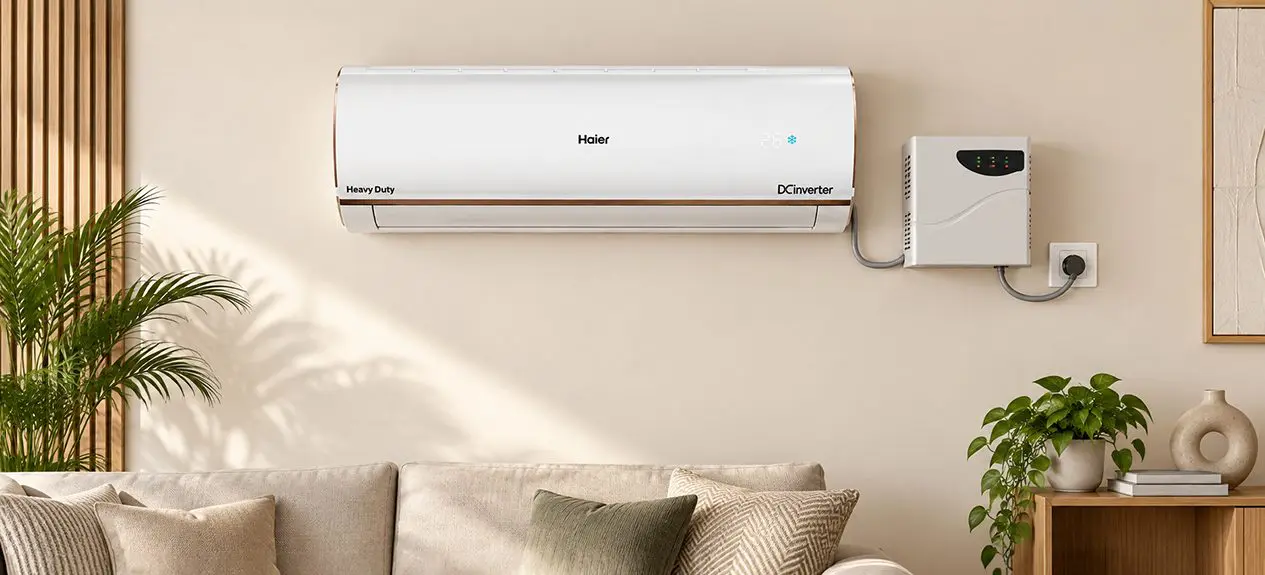

Voltage is not usually the first thing people think about when buying an air conditioner, but it can influence how the system performs in everyday use. Frequent dips, spikes or an uneven power supply can place additional stress on different electrical components over time.
This is why a voltage stabiliser for AC often becomes part of the buying conversation. Before deciding what your setup needs, it helps to look at voltage range, built-in protection and the electrical conditions in your home.
A closer look at voltage fluctuations makes the rest of the buying decision much easier to understand.
Why Voltage Fluctuations Matter to Your AC
An AC needs a power source that is stable so that its compressor, PCB and other parts work within their limits. If the incoming voltage continues to move too far above or below that range, the effect can manifest in different parts of the system.
- Lower voltage may stress the operation. If the supply is too low, the AC may not work as expected. Some systems may be protected by built-in protection, reducing or shutting down their output.
- High voltage can be rougher on delicate electronics. Sudden voltage spikes can put additional stress on the PCB, sensors and control circuitry.
- Repeated fluctuations can disturb normal cooling. If the voltage continues to fluctuate, the AC will shut off, restart or change its operation to protect itself. Frequent interruptions can also stress the system unnecessarily.
- Component life can be affected by long-term electrical stress. A single fluctuation might not be a problem, but repeated exposure to voltages outside the AC’s supported range can lead to wear over time.
What Does a Voltage Stabiliser Actually Do?
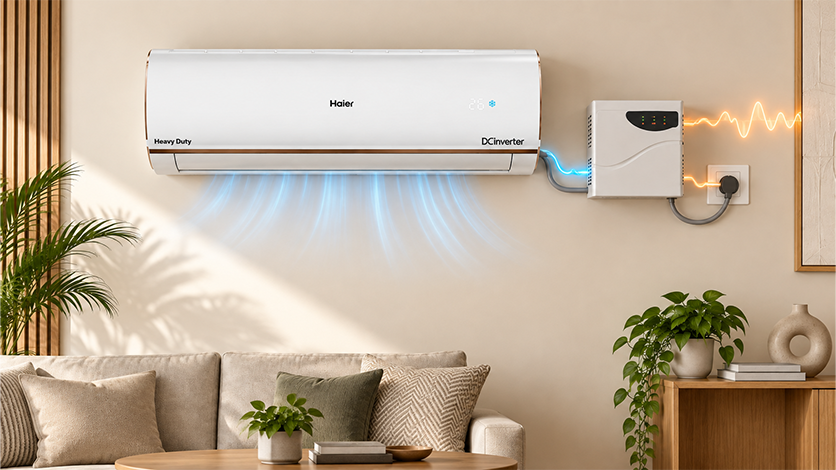
Sometimes you can have voltage problems; the power supply at home is not always constant. Is it good to use a stabiliser with AC? The question makes more sense once you understand the stabiliser’s place between the incoming supply and the appliance, before getting into ratings and other technical details.
- It regulates the incoming supply by buck and boost regulation. If the voltage is different from the required voltage, then the stabiliser can step it up or step it down before supplying power to the AC.
- It can cut off the supply when it stops being correctable. Every stabiliser has its own range of operating voltage. If the incoming supply exceeds that limit, the appropriate models can cut power rather than continuing to feed an unsuitable voltage to the AC.
- This can avoid a restart straight after a power cut. Most AC stabilisers have a time delay function that holds the supply for a few seconds when electricity returns. This prohibits fast reboots and gives the AC a more orderly return to service.
- This is purely for electrical protection, not for better cooling or less consumption. A stabiliser does not increase the AC capacity or directly improve the energy efficiency. The purpose is to control the incoming supply, so the capacity and operating range of the stabiliser must be adapted to the AC and local voltage conditions.
Does Every Modern AC Still Need a Stabiliser?
Today’s ACs are built very different than the old fixed-speed systems. Today, many models of inverters don’t even need a voltage stabiliser for AC in every setup, due to wider operating voltage ranges and built-in electrical protection. The key is to check the voltage range supported by the individual model, not simply tonnage or star rating.
A stabiliser-free AC is designed to function for normal voltage fluctuations within a range without the use of a separate stabiliser. Still, the condition of the local power grid does matter. But if the voltage is regularly wandering beyond the limits supported by the AC, then an external stabiliser can still have a role to play.
Do you really need to have an AC stabiliser in India?
Read through Do You Really Need an AC Voltage Stabiliser in India? Let’s Find Out!
Check Your AC’s Voltage Range Before Making the Decision
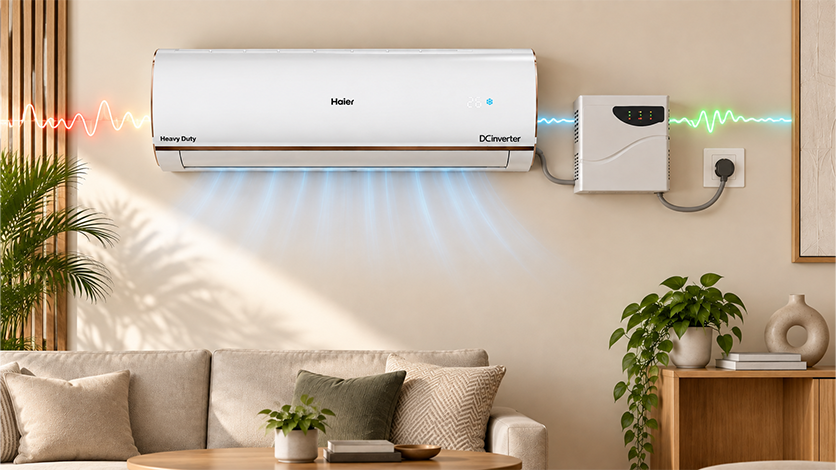
The supported voltage range gives you a better idea of how much fluctuation the AC can handle during regular use. When looking at the voltage required for a 1.5-ton AC, it is worth checking more than just the standard supply figure, because the usable operating range may be broader.
From there, compare the AC’s supported range with the voltage conditions in your home. If your supply regularly drops below or rises above those limits, a voltage stabiliser for AC can become a more practical consideration.
What Can Affect the AC Stabiliser Price?
The cost starts to make more sense once you look beyond the price tag itself. Two stabilisers may appear similar at first, but the way they are built and the protection they offer can be quite different. That is also why the question “which stabiliser is the best for AC?” cannot really be answered by price or brand alone; the right specification has to suit the AC and the power conditions it will be working with.
- Capacity has a direct bearing on cost. A stabiliser designed to handle a higher electrical load uses heavier-duty components. This is why the required kVA or ampere rating should be matched to the AC.
- A wider working voltage range can push the price up. Stabilisers designed to correct power over a broader input range require more capable voltage-regulation hardware. Homes that experience deeper voltage drops therefore need a different unit from those with a relatively stable supply.
- The protection package makes a difference. High- and low-voltage cut-off, thermal overload protection, surge handling and compressor time delay can influence the AC stabiliser price.
- Build quality and warranty also add value. Transformer quality, cabinet construction, cooling design and the length of the manufacturer’s warranty can all affect pricing.
A Simple Check Before You Buy a Stabiliser
Once you’ve sorted the main electrical requirements, there are a few smaller checks which can help you judge the stabiliser with more confidence:
- Check whether it suits your type of electrical supply. Most residential split ACs run on single-phase power, but the stabiliser should still be compatible with the supply available at the installation point.
- Look for clear voltage and fault indicators. A digital display or indicator system can show input/output voltage, delay status or protection cut-offs. It makes it easier to understand why the stabiliser has interrupted power.
- Pay attention to heat management. Stabiliser components generate heat while regulating voltage. Adequate ventilation, thermal protection and a design that can cope with sustained summer operation are useful details to look for.
- Check for recognised electrical safety compliance. Product markings, applicable safety certifications and clearly stated electrical ratings provide more useful information than vague protection claims.
How Haier ACs Handle Changing Voltage Conditions
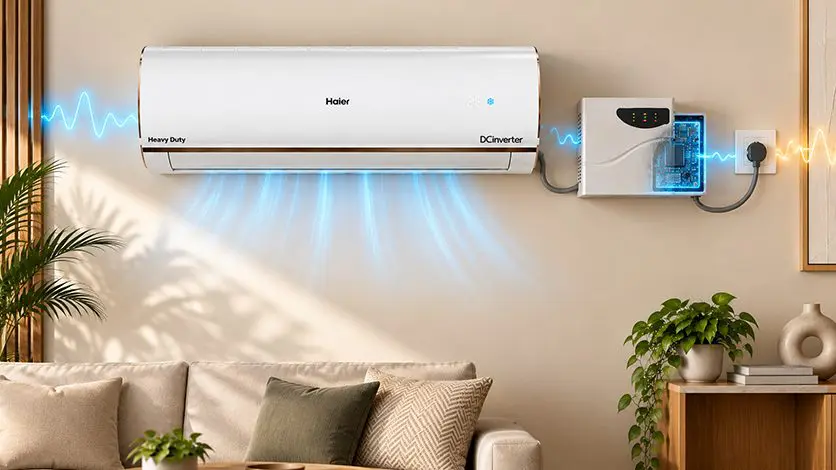
Voltage handling in an AC is not limited to a single component. Across selected Haier models, we bring together inverter control, PCB protection and a wider operating range, with each technology playing a different role when power conditions change.
- Triple Inverter+++ gives our ACs a wider operating window
Our Triple Inverter+++ technology is designed to operate stably between 120V and 290V. This wider operating window can be useful when household voltage moves above or below the nominal supply during the day. It also makes the supported voltage range an important detail to check before deciding whether an external stabiliser is necessary.
- A-PAM helps us match voltage to compressor load
Within our Triple Inverter+++ system, A-PAM inverter control adjusts the DC bus voltage according to the compressor load. In practical terms, this allows the AC to manage power differently as cooling demand changes, rather than following the same electrical response throughout operation.
- Hyper PCB helps protect sensitive electronics
Our Hyper PCB takes care of a different part of the system. A thicker conformal coating helps protect the PCB from moisture, chemicals, insects and extreme temperatures, while FR-4 material supports insulation and durability. It is also designed to withstand surge voltage of up to 550 V, adding another layer of protection around sensitive electronic components.
- Kinouchi Ultra AI brings these technologies together
Our Kinouchi Ultra AI range gives a practical example of how these technologies come together in an actual AC. The Kinouchi Ultra 4 Star AI-ATMOX Smart Split AC comes with a 230V, single-phase, 50Hz rated power supply, along with HEXA Inverter Technology and Hyper PCB. This is why we recommend checking the exact model specifications rather than judging stabiliser requirements only by tonnage or star rating.
Conclusion
Some ACs don’t require a stabiliser. More important is the voltage range the AC supports and the stability of the power supply in your home.
If the voltage is generally within the recommended range, an AC without a stabiliser may be fine on its own. Where there are frequent or extreme fluctuations, an external stabiliser can offer additional protection. Rather than buying a stabiliser by default, it is always better to make a practical choice. Checking these details before the installation helps you to do that.
Frequently Asked Questions
Does an AC need a voltage stabiliser?
Some air conditioners don’t need them. Most of the inverter ACs available today can operate over a wider range of voltages. The stabiliser is more efficient when the supply of power often goes out of the specified operating range of the AC.
What stabiliser capacity is needed for a 1.5 ton AC?
Not all 1.5 ton ACs are equal in capacity. Some stabilisers for ACs up to 1.5 ton are rated around 2.7-3.0 KVA or 12A depending on their design and working voltage range. Match the stabiliser with the electrical requirements of the particular AC.
Do inverter ACs need a stabiliser?
Not really. Some inverter ACs have a wide operating voltage range and built-in protection. If your home supply is commonly out of that range, an external stabiliser can offer some additional protection.
Is a stabiliser required for a 5-star AC?
A 5-star rating does not determine whether a stabiliser is needed. BEE star ratings indicate energy efficiency, while stabiliser requirements depend on the AC’s voltage tolerance and the quality of the incoming power supply.
How do I choose a stabiliser for my AC?
First, determine the electrical load of the AC and the range of voltages it can accept. Then select a stabiliser of suitable capacity and input range to satisfy local voltage conditions. Other features, such as time-delay overload protection, can also be useful.
Can I run a 1.5 ton AC without a stabiliser?
Yes, if the AC is designed to work without a stabiliser and the input voltage is within its acceptable range. Of course, if you live in an area with frequent or severe fluctuations, added voltage protection may still be wise.
Does a general window AC need a stabiliser?
It depends on the AC’s supported voltage range and the stability of the power supply. Some modern window ACs can handle a wider range on their own, while others may benefit from an external stabiliser if the incoming voltage frequently goes outside the specified limits.
What is the voltage required for a 1.5-ton AC?
Many residential 1.5-ton ACs in India use a rated supply of around 230V, single-phase, 50Hz, but the supported operating voltage range can vary by model. Always check the electrical specifications of the particular AC, especially when selecting a stabiliser