
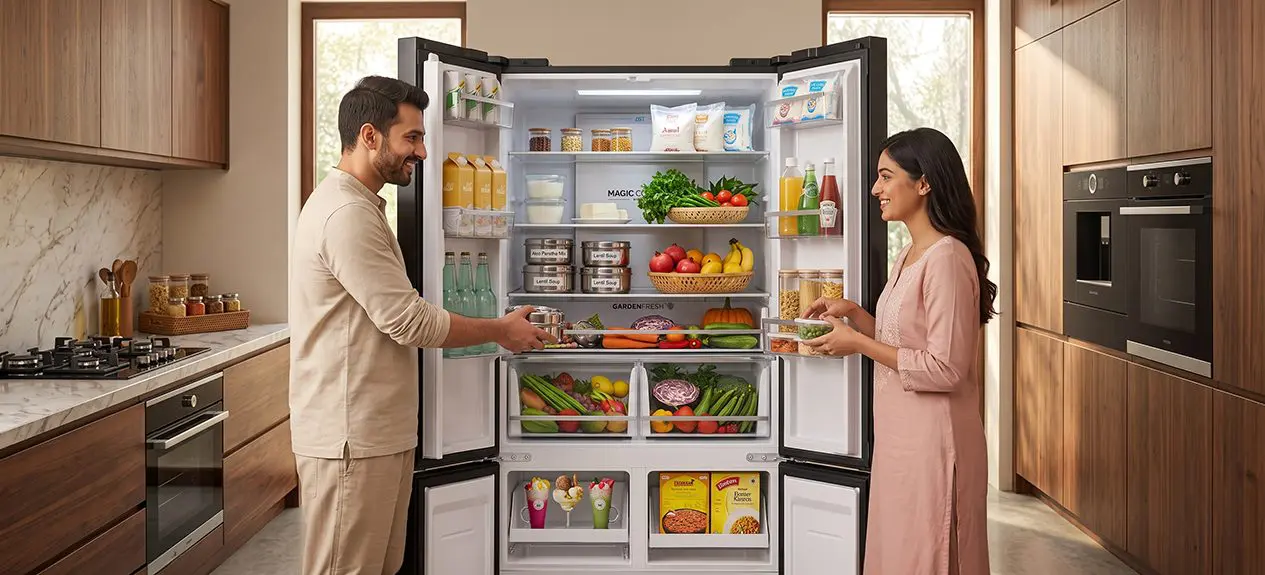

Most of us open the fridge, push things around until a gap appears, and shove the groceries in wherever they fit. It works, until the milk turns a day early, the coriander wilts by Tuesday, or you find last week’s leftovers sitting behind a jar of pickle you forgot existed. None of this is really about a “bad” fridge. It is almost always about fridge organization, or the lack of it.
A refrigerator is not one single cold box. It has different temperature zones, different humidity levels, and different airflow patterns in different corners. When you understand this, you start to see why where to store food in fridge actually changes how long it stays fresh, how safe it is to eat, and how much of it you end up throwing away. This blog breaks down what goes where, the small habits that make a real difference, and how the right refrigerator design can do half the organizing for you.
Why Food Placement Inside the Fridge Actually Matters
Cold air in a refrigerator does not sit still. It moves, and it moves unevenly. The back of the fridge is colder than the front. The top shelf is warmer than the bottom. The door shelves are the warmest zone of all because they are exposed to room temperature every time the door opens. This is basic food safety refrigerator storage science, yet it is the part most kitchens overlook.
Store something in the wrong zone and you are not just risking a slightly soggy vegetable. Raw meat left in the wrong spot can drip juices onto ready to eat food. Dairy stored in a warm door shelf spoils faster than it should. Fruits and vegetables kept together release gases that speed up each other’s decay. Small placement mistakes, repeated every day, add up to spoiled food, wasted money, and in some cases, genuine health risks.
Understanding the Zones: Top Shelf, Bottom Shelf, Door and Drawers
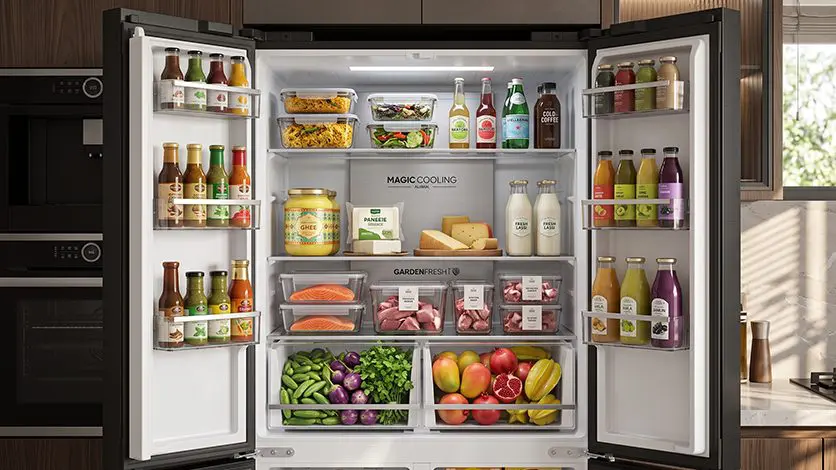
Think of your fridge as having four broad zones, each suited to a different kind of food.
Top shelves stay the most consistent in temperature since they are furthest from the door and not directly above the cooling vents. This makes them ideal for drinks, leftovers, ready to eat meals, and packaged food that does not need the coldest possible temperature.
Bottom shelves are the coldest part of the fridge, since cold air sinks. This is where raw meat, poultry and fish belong, ideally in a sealed container placed low enough that nothing can drip onto the shelves below or the crisper drawers underneath.
Door shelves see the biggest temperature swings, so they should hold things that are naturally more stable, such as condiments, juices, and butter. Milk and eggs are better off on an interior shelf rather than the door, even though most fridge doors are designed with a slot for them.
Crisper drawers are built with humidity control for a reason. Higher humidity settings help leafy greens and herbs stay hydrated and crisp, while lower humidity settings suit fruits that release ethylene gas, like apples and bananas, keeping them from ripening everything around them too fast. Keeping fruits and vegetables in separate drawers, using the humidity dial correctly, is one of the simplest fridge organization tips and tricks that people skip entirely.
How to Organize a Fridge for Food Safety, Not Just Tidiness
Organizing a fridge is often treated as a Pinterest exercise: matching containers, labeled jars, a picture perfect grid. Real fridge organization is less about how it looks and more about how it protects your food.
A few habits genuinely change outcomes. Always store raw meat below cooked or ready to eat food, never above. Keep a thermometer or rely on your fridge’s digital display to make sure the interior stays around 4 degrees Celsius or below, since that is the range where bacterial growth slows down significantly. Do not overload shelves to the point where air cannot circulate, because trapped warm pockets form even in a fully functioning fridge. And be intentional about grouping food by type rather than by whatever container is closest at hand, so vegetables, dairy, meat and leftovers each have a dedicated space you return to every time.
This is where how to organize a fridge for food safety stops being a one time cleanup and becomes a routine, the same way handwashing or checking expiry dates is a routine.
Want to keep your food fresher for longer?
Read more: Organized Cooling with Dedicated Storage Zones
Choosing a Refrigerator That Organizes Itself: Haier’s Approach
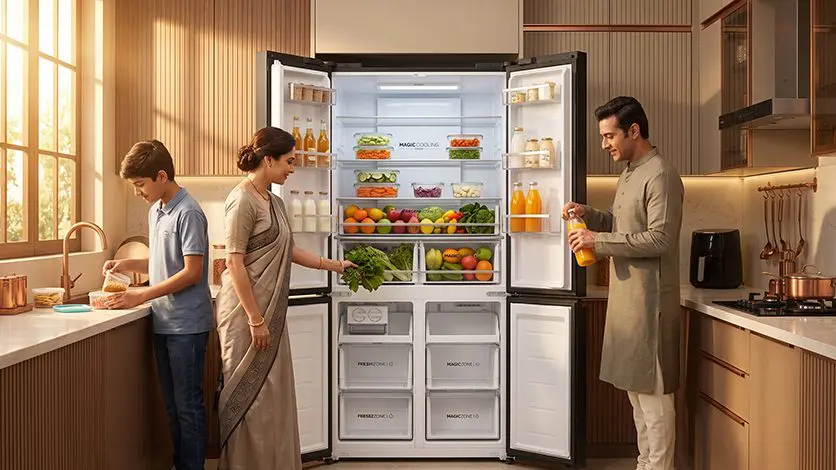
Good habits help, but they are much easier to keep up when the refrigerator itself is designed around them. Haier’s range is built with this exact problem in mind, giving every category of food a purpose built space instead of leaving it to guesswork.
The Lumiere Series, India’s only 4 door convertible refrigerator, and Haier’s 3 door convertible refrigerator, the first of its kind in India, both offer smart convertible space that lets you shift capacity between the fridge and freezer as your household’s needs change through the week. The Customizable My Zone feature takes this further with dedicated modes for cheese, beverages, spices and fruits and vegetables, so nothing sits in the wrong temperature by accident.
Storage design is where Haier’s bottom mounted and top mounted refrigerators stand out. Separate fruit boxes, bigger vegetable boxes, and Magic Cooling technology work together to slow down spoilage naturally. The Jhukna Mat feature in select bottom mounted models even reduces the need to bend down repeatedly while reaching for daily essentials, a small but genuinely useful detail for everyday kitchens.
For freshness monitoring, the colourful digital display panel with motion sensor, a first for India, along with Smart Sense AI, adjusts cooling based on usage patterns and food load. Combined with ABT/ABT Pro technology that eliminates up to 99.9 percent of bacteria, viruses and odour, and toughened glass shelves that hold weight without cracking, Haier refrigerators are built to support proper food safety refrigerator storage rather than leave it entirely to the user. Every model also comes with a 10 year warranty on the compressor, so the cooling performance you organize your kitchen around stays consistent for years.
Want to discover Haier’s freshness-first innovations?
Read more : How Haier Improves Food Freshness and Storage
The Takeaway
Fridge organization is not a one time weekend project, it is a habit that pays off every single day in fresher food, fewer spoiled groceries, and a lower chance of anything unsafe reaching your plate. Once you understand why the top shelf, bottom shelf, door and crisper drawers each play a different role, storing food correctly stops feeling like a chore and becomes second nature. And when your refrigerator is built with dedicated zones, humidity control and smart cooling technology like Haier’s range offers, half the work of keeping food safe and fresh is already done for you. The rest is just building the routine.
FAQs
How to store vegetables in the fridge?
Keep vegetables in the higher humidity crisper drawer, unwashed, and away from fruits that release ethylene gas, which speeds up spoilage.
Where should raw meat be stored in a refrigerator?
On the bottom shelf, sealed in a container, so it stays at the coldest point and cannot drip onto other food.
Which foods should be stored on the top shelf vs. the bottom shelf?
Leftovers, drinks and ready to eat food go on top shelves. Raw meat, poultry and fish belong on the bottom shelf, the coldest zone in the fridge.
What goes in the crisper drawers, and how do the humidity settings work?
Leafy greens and herbs do well in high humidity drawers, while fruits like apples and bananas need low humidity drawers to avoid over ripening.
What temperature should a refrigerator be for safe food storage?
The interior should stay at or below 4 degrees Celsius, with the freezer at minus 18 degrees Celsius, to keep bacterial growth in check.