

Mini LED and QLED are used as if they mean the same thing, but they do not. Mini LED refers to how the screen is lit from behind. QLED refers to how colours are enhanced on top of that light. Both promise a better picture, but they improve it in very different ways. If you have ever wondered what is Mini LED, what QLED means, or found yourself stuck trying to compare Mini LED vs QLED, you are not alone.
This guide breaks down what each technology does, how they differ, and which one is likely to suit your home and viewing habits better.
What Does QLED Mean?
QLED stands for Quantum Dot Light Emitting Diode. Despite the name, a QLED TV still uses LED backlighting. The difference is a layer of quantum dots between the backlight and the display panel. These are tiny particles that help the screen produce richer colours and higher brightness than you’d get from a regular LED TV.
A QLED TV is designed to deliver:
- More vibrant colours
- Higher brightness levels
- Better visibility in bright rooms
- Consistent colour performance across different types of content
This makes QLED well suited to everyday TV, sports, gaming, and family entertainment.
What Is a Mini LED?
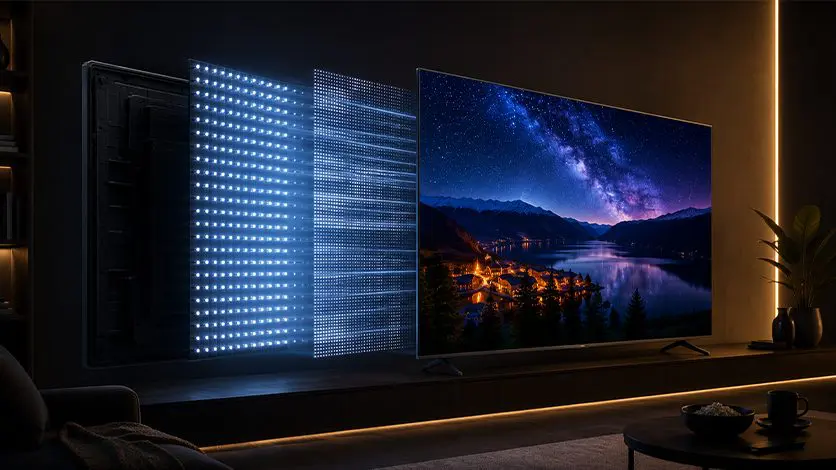
Mini LED is not a different display panel. It is a different type of backlighting.
Instead of using a relatively small number of standard-sized LEDs behind the screen, Mini LED TVs use thousands of much smaller LEDs. Because these LEDs are smaller, manufacturers can divide the backlight into many more local dimming zones.
The result is much finer control over brightness across different parts of the screen.
This gives the TV much finer control over brightness, resulting in:
- Brighter highlights
- Deeper blacks
- Better contrast
- Reduced light blooming around bright objects
- More detailed HDR performance
In simple terms, if QLED improves colour, Mini LED improves the way light is controlled behind the picture.
Want to see how Mini LED technology benefits everyday viewing, from family movie nights to sports and gaming?
Read this blog: Why Mini LED TVs Are a Great Choice for Indian Families
Mini LED vs QLED: Understanding the Difference
Mini LED and QLED are often presented as competing display technologies, but the relationship is a little more nuanced than that. QLED refers to the quantum dot layer that improves colour and brightness, while Mini LED refers to a more advanced backlighting system that improves contrast and light control. In many premium televisions, the two technologies actually work together rather than replacing one another.
| Feature | QLED | Mini LED |
| Primary technology | Quantum dot colour enhancement | Miniaturised LED backlighting |
| What it improves | Colour accuracy and brightness | Contrast and local dimming precision |
| Backlight type | Conventional LED backlight | Thousands of tiny LEDs |
| Black levels | Good | Deeper blacks with improved shadow detail |
| Brightness control | Entire backlight or fewer dimming zones | Many more local dimming zones for finer control |
| HDR performance | Bright, colourful HDR | More detailed HDR with stronger highlights and contrast |
| Blooming around bright objects | More noticeable in some scenes | Reduced due to precise light control |
| Best suited for | Everyday entertainment, sports and bright rooms | Movies, gaming and premium home theatre experiences |
Many premium televisions actually combine both technologies. Quantum dots enhance colour, while Mini LED improves light control, so the biggest differences usually appear during HDR movies, darker scenes, and high-contrast gaming rather than everyday TV viewing.
Picture Quality: Where the Difference Becomes Visible
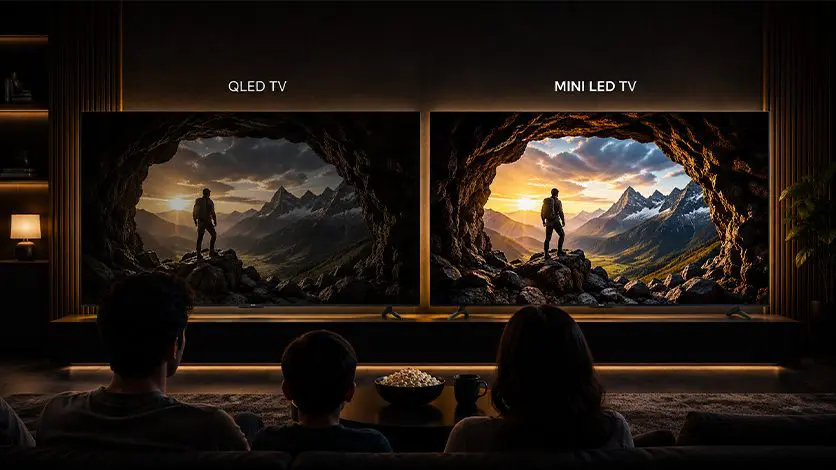
Beyond the names themselves, the real difference between Mini LED and QLED becomes clearer the longer you use them. Both deliver bright, colourful pictures, so everyday TV shows, sports, and streaming content look great on either. Where they begin to separate is in scenes that ask more from the display.
Mini LED’s smaller backlights allow it to control brightness with much greater precision, so darker scenes tend to look more detailed and bright highlights stay better defined. QLED, meanwhile, continues to stand out for its rich colours and impressive brightness, especially in rooms with plenty of natural light.
That is why asking yourself: is Mini LED better than QLED does not always have a single answer. It depends on what you watch most often and the room your TV sits in. They become more apparent over time, during a late-night film, an HDR series, or a long gaming session. They’re the kind of details that don’t always appear on a specification sheet but often influence how happy you are with your TV years after bringing it home.
Which Display Technology Is Right for Your Home?
If most of your viewing is everyday streaming, sports, and general television in a room that stays reasonably bright, a QLED TV already delivers vibrant colours, strong brightness, and a picture that holds up well across the content a typical household watches. It does not ask for specific room conditions or content types to perform well.
Where Mini LED starts to justify itself more clearly is in larger screen sizes, HDR movies, darker or mixed-lighting viewing environments, and gaming, where more precise lighting control becomes consistently noticeable. The bigger the screen, the more visible the contrast difference; the darker the room, the more improved black levels change how the picture actually feels.
Choose QLED if:
- Most viewing happens in a bright room during the day.
- The priority is vibrant colour and strong brightness for sports and everyday TV.
- Budget is a primary consideration, and the room conditions suit it.
Choose Mini LED if:
- Movie nights, HDR streaming, and gaming are a significant part of how the TV gets used.
- Viewing happens across both bright and dark conditions, or the room can be darkened.
- You are choosing a larger screen size where contrast precision becomes more visible.
- You want the most consistent picture quality across all types of content.
Explore our QLED and Mini LED TVs
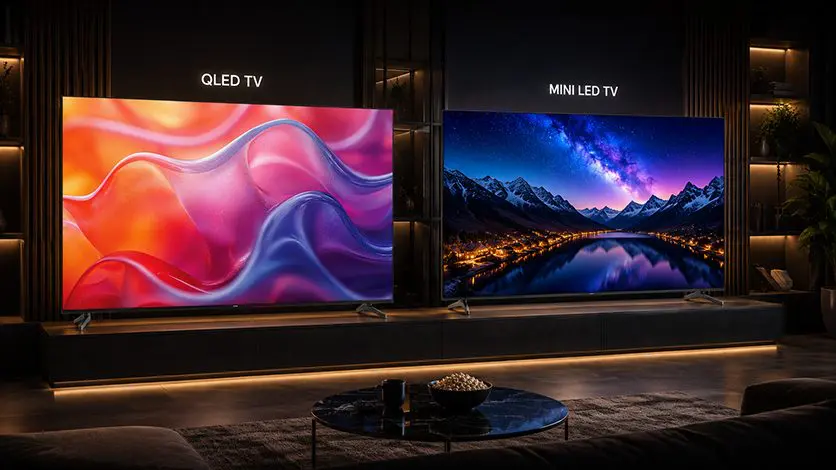
Once the technology decision feels clearer, the next step is finding a TV that delivers it well. At Haier, our TV range covers both QLED and Mini LED, each running Google TV with Dolby Vision, Dolby Atmos, and Variable Refresh Rate support on selected models.
The Haier New M70 Series MiniLED 215cm (85) AI Smart Google TV with Gemini | HDR10+ | 2.1 Ch with Subwoofer | Gaming 120Hz combines Mini LED backlighting with Quantum Dot colour, 120Hz gaming support, and Dolby Vision, a strong choice for larger rooms where both movie quality and gaming performance matter.
The Haier New P7 Pro Series HQLED 189cm (75) AI Smart Google TV with Gemini | HDR10+ | 2.1 Ch with Subwoofer | Gaming 120Hz brings QLED colour performance with Dolby Vision and 120Hz gaming capability, well suited to bright living rooms where vibrant, high-brightness picture quality is the priority.
Both run on Google TV with Gemini AI integration, so you’ll get the same smart TV experience, from personalised content recommendations and voice control to seamless smart home management, whichever display technology you choose.
Conclusion
The debate around Mini LED vs QLED isn’t about one technology replacing the other. QLED enhances colour, while Mini LED refines how light is controlled behind the screen. Together, they represent two important advances in modern television technology.
If your priority is bright, colourful everyday viewing, QLED remains an excellent choice. If you want deeper contrast and sharper HDR performance, Mini LED takes picture quality up another notch.
Whichever direction you choose, understanding the difference between Mini LED and QLED makes it much easier to invest in a television you’ll continue to enjoy for years to come.
FAQs
What is the difference between Mini LED and QLED?
The difference between Mini LED and QLED is that QLED enhances colour using quantum dots, while Mini LED improves contrast and light control through thousands of smaller backlights.
Which is better: Mini LED or QLED?
Mini LED vs QLED depends on how you watch TV: QLED is great for bright-room everyday viewing, while Mini LED offers deeper contrast and a more cinematic HDR experience.
Does Mini LED have better picture quality than QLED?
In darker scenes and HDR content, Mini LED often delivers better contrast, shadow detail, and highlight control, while QLED excels in brightness and colour vibrancy.
Does Mini LED have deeper blacks than QLED?
Yes, Mini LED generally produces deeper blacks because its smaller backlights can dim much more precisely than a standard QLED backlighting system.
Does Mini LED support Dolby Vision or HDR10+?
Yes, many Mini LED TVs, including selected Haier models, support Dolby Vision and HDR10+ for enhanced HDR picture quality and dynamic scene-by-scene optimisation.
Which is better for gaming: Mini LED or QLED?
Mini LED is usually the stronger gaming choice because its improved contrast, HDR precision, and local dimming make dark and bright game scenes look more detailed and immersive.