
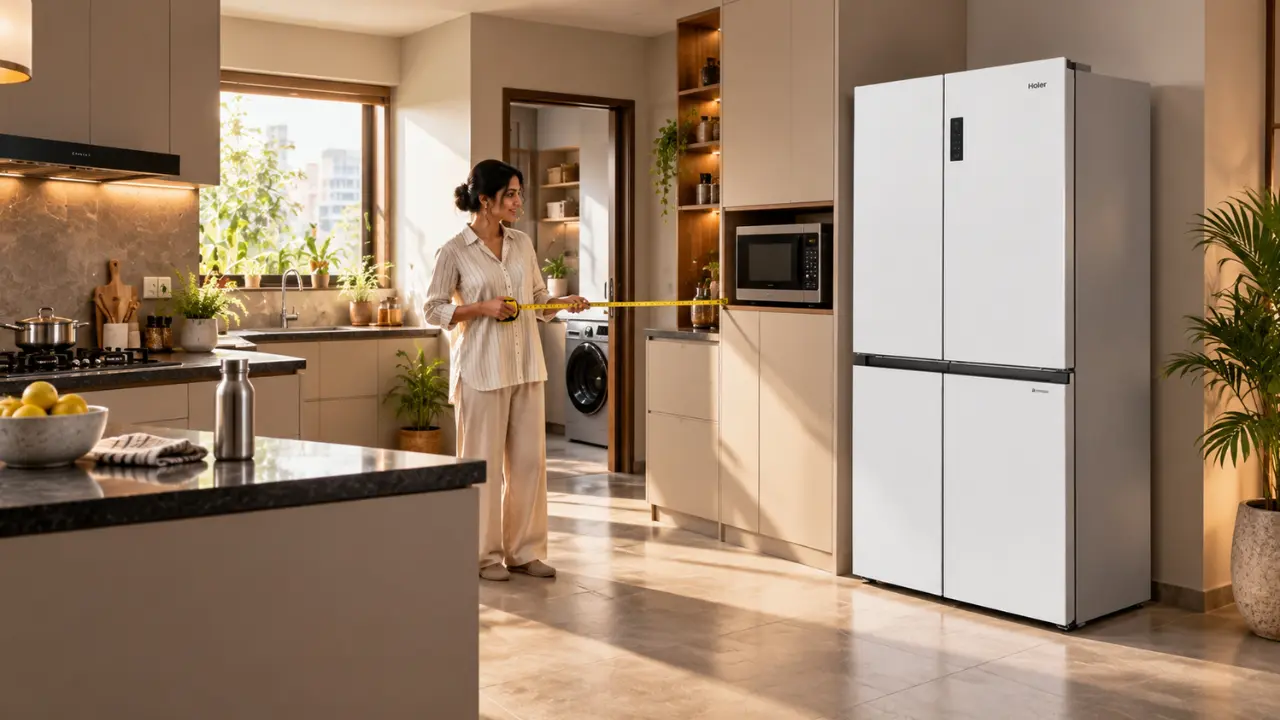

A refrigerator can be the right capacity, have the right features and look perfect in your kitchen and still feel awkward every single day if it has been placed badly.
This becomes especially important in Indian kitchens, where the refrigerator may have to share space with a gas hob, microwave, cabinets, utility doors and sometimes a fairly narrow passage. With larger French-door and side-by-side refrigerators, a few centimetres can decide whether the doors open comfortably or keep meeting a wall.
So, where should you place your refrigerator? Ideally, it should stand on a firm, level floor in a well-ventilated location, away from direct heat and with enough surrounding clearance for the appliance and its doors to operate correctly. The exact clearance requirement, however, should always come from the installation instructions for your specific refrigerator.
Here is what to check before deciding that final spot.
First Rule: Measure the Space, Not Just the Refrigerator

One of the easiest mistakes is measuring the refrigerator’s width and then finding a kitchen niche with roughly the same width.
That is only the beginning.
A refrigerator needs to function inside that space. You therefore need to think about:
- Appliance width, depth and height
- Manufacturer-specified ventilation clearance
- Door-opening space
- Nearby walls, cabinets and handles
- Access to drawers and shelves when doors are open
- The electrical connection
- The path through which the refrigerator will enter your home
That last point is surprisingly easy to forget. Measure your entrance door, lift, staircase and kitchen doorway too, particularly when purchasing a large-capacity model.
For perspective, the Haier Lumiere 520L 3 Star Inox Steel French Door Refrigerator (HRB-600IS) has listed net dimensions of 830 × 635 × 1900 mm (W × D × H).
A larger side-by-side model can require considerably more width. The Haier 598L Graphite Black 3 Door Smart Convertible SBS (HRT-683GKU1), for example, measures 905 × 697 × 1775 mm.
The practical lesson? Choose your refrigerator and its location together rather than treating placement as an afterthought.
Where Is the Best Place for a Refrigerator in a Kitchen?
There is no single spot that works for every kitchen. A sensible location balances access, ventilation, heat exposure and movement.
Keep It Convenient, but Out of the Way
The refrigerator is among the most frequently accessed appliances in a home. Someone may be reaching for milk while another person is preparing dinner and somebody else is filling a water bottle.
Its position should therefore allow people to open it without blocking the main cooking area.
In many layouts, placing it towards the outer edge of the working kitchen can make sense. Family members can reach chilled food or drinks without repeatedly crossing the cook’s workspace.
Also look at what happens when the doors are fully open. A location can appear spacious until a large refrigerator door swings into a passage.
How Much Clearance Does a Refrigerator Need?

Here, there is an important distinction between general planning advice and the actual installation requirement.
There isn’t one universal clearance number that should be applied to every refrigerator. Designs differ, so check the product manual or installation guidance for the exact model before creating cabinetry around it.
When measuring, account for clearance at the:
- Rear
- Sides
- Top
- Door-opening side
Why does this matter? Refrigerators generate heat during operation and need to dissipate it appropriately. Crowding an appliance into a space without respecting its specified installation clearances can interfere with the conditions it was designed to operate in.
Built-in cabinetry deserves particular attention. Don’t design the niche purely around the refrigerator’s body dimensions. Allow for the installation specifications of the chosen model.
The Forgotten Measurement: Door Swing
People usually measure the fridge. Far fewer measure the open fridge.
And that can become annoying very quickly.
Imagine positioning a wide refrigerator beside a wall. It fits beautifully. Then you open one door and discover that the wall stops it before you can comfortably access an internal drawer.
For French-door, multi-door and side-by-side designs, check:
- How far can each door open?
- Does a wall or cabinet restrict it?
- Can internal drawers still be pulled out?
- Will an open door obstruct the kitchen passage?
- Is there sufficient room to stand comfortably in front of it?
Some product-specific design features can help with everyday organisation. The Haier Lumiere 520L, for instance, lists adjustable shelves and a 95-degree anti-tipping design among its features.
Still, kitchen measurements should be taken before purchase rather than hoping the layout works afterwards.
Where Should You Not Put a Refrigerator or Freezer?

Some locations create avoidable problems.
Too Close to a Major Heat Source
Avoid positioning the refrigerator where it will be unnecessarily exposed to heat from cooking appliances or direct sunlight.
That means carefully considering its relationship with:
- A gas hob
- An oven
- Prolonged direct sunlight
- Other significant heat-producing appliances
If your kitchen layout leaves little choice, follow the installation and separation requirements provided for the appliances involved rather than relying on an arbitrary internet measurement.
Inside an Extremely Tight Cabinet Enclosure
That seamless floor-to-ceiling kitchen aesthetic can look excellent, but dimensions still matter.
Do not assume that squeezing a freestanding refrigerator tightly between cabinets gives it a built-in finish. The refrigerator’s required clearances and ventilation conditions should remain part of the cabinetry plan.
In a Damp or Water-Prone Spot
A refrigerator is an electrical appliance. Avoid locations where it can be exposed to persistent moisture, splashing or standing water.
On an Uneven or Unstable Surface
A refrigerator should stand securely and level. An unstable position can affect everyday usability, including how the appliance sits and how its doors operate.
How Can You Elevate a Refrigerator?
If by “elevate” you mean raising the refrigerator significantly above floor level, don’t improvise with loose bricks, timber blocks or unstable platforms.
In most normal kitchens, a refrigerator should sit on a solid, level surface according to its installation requirements. If your concern is an uneven floor, drainage issue or a kitchen platform, consult the product installation guidance or an authorised technician before creating a raised base.
There is a simple reason for being cautious: these are heavy appliances.
The Haier Lumiere 520L has a listed net weight of 100 kg, while the Haier 598L Graphite Black model is listed at 97 kg.
A makeshift platform is not the place to experiment.
Planning for a Large Refrigerator? Start With Your Family’s Storage Pattern
Placement and refrigerator selection are closely connected.
A compact household with limited kitchen width may prioritise a narrower footprint. A larger family that stores vegetables for the week, bottles, containers, leftovers and frozen foods may value additional capacity enough to plan the kitchen around a bigger refrigerator.
Haier India’s current refrigerator range includes different configurations that address these kinds of storage requirements.
Haier Lumiere 520L 3 Star Inox Steel French Door Refrigerator
For households looking at a premium multi-door configuration without moving to a conventional wide side-by-side layout, the Haier Lumiere 520L (HRB-600IS) offers an interesting balance of capacity and organisation.
Its 520-litre capacity includes a 440-litre refrigerator section and a flexible convertible section, while Haier also lists Deo Fresh Technology, toughened glass shelves and adjustable storage among its features.
That flexibility can be useful in Indian homes where storage needs change to more fresh-food space after the weekly vegetable run, for example, or different requirements around celebrations and family gatherings.
Haier 598L Graphite Black 3 Door Smart Convertible SBS
If a broader side-by-side format suits your kitchen, the Haier 598L HRT-683GKU1 adds smart functionality to the storage equation.
Haier lists Wi-Fi connectivity, ExpertInverter Technology, a digital control panel, Deo Fresh Technology and convertible storage among its key features. The model is also described as being designed based on Indian home requirements.
The important placement consideration is width: at 905 mm wide, this is exactly the sort of refrigerator you should measure for before finalising kitchen cabinetry.
Haier 596L Regal Steel 2 Door Smart Convertible SBS
Another option for households that want substantial storage is the Haier 596L HRS-682WRSU1.
It offers convertible functionality that allows freezer-to-fridge and fridge-to-freezer conversion, along with a 2.5-litre BPA-free in-built water dispenser. Haier also lists ExpertInverter Technology, smart connectivity, a Jumbo Ice Maker, My Zone and Deo Fresh Technology among the model’s features.
Its listed dimensions are 905 × 697 × 1775 mm, again making advance measurement important for side-by-side placement.
A 60-Second Refrigerator Placement Check Before You Buy
Before clicking “Buy Now” or approving the carpenter’s kitchen drawing, run through this quick check:
- Measure the refrigerator: Width, depth and height.
- Check specified clearance: Follow the chosen model’s installation guidance.
- Open the imaginary doors: Make sure walls and cabinets will not obstruct normal use.
- Check the floor: It should provide a firm, level installation surface.
- Look for heat exposure: Reconsider positions beside major heat sources or prolonged direct sunlight.
- Check the power point: Plan a suitable electrical connection in accordance with installation requirements.
- Measure the delivery route: Main door, corridor, lift and kitchen entrance included.
- Think beyond today: If you may upgrade to a larger refrigerator later, avoid designing cabinetry so tightly that you remove every bit of flexibility.
Good Refrigerator Placement Is Really About Everyday Usability
The best refrigerator position is not necessarily the empty corner where the appliance happens to fit.
It is the location where the refrigerator can operate according to its installation requirements, its doors and storage compartments remain genuinely usable, and people can access it without turning the kitchen into an obstacle course.
That matters even more when considering larger-capacity refrigerators. Haier India’s Lumiere French-door and Smart Convertible side-by-side options offer substantial storage and flexible features, but choosing the right model starts with something decidedly low-tech: a measuring tape and a properly planned kitchen space.
Get those measurements right first. The rest of the refrigerator experience becomes considerably easier.
Frequently Asked Questions
1. Where is the best place to put a refrigerator in the kitchen?
Place the refrigerator on a firm, level surface in a well-ventilated area that allows convenient access without obstructing the main kitchen walkway. Keep it away from unnecessary heat exposure and ensure there is sufficient space for the doors to open properly.
2. How much clearance should you leave around a refrigerator?
There is no single clearance measurement suitable for every refrigerator. Requirements can vary by model and design. Always follow the installation instructions for your specific refrigerator and account for the required space at the sides, rear and top, as well as enough room for unrestricted door movement.
3. Where should you not put a refrigerator or freezer?
Avoid placing a refrigerator or freezer in a location exposed to excessive heat, prolonged direct sunlight, persistent moisture or standing water. It should also not be squeezed into cabinetry without the clearances specified for that particular appliance.
4. Can a refrigerator be placed next to a gas stove?
It is preferable to avoid unnecessary exposure to heat from a gas hob or other major cooking appliances. If kitchen space makes nearby placement unavoidable, check the installation and separation requirements for both appliances before finalising the layout.
5. How can I elevate my refrigerator safely?
Avoid raising a refrigerator using loose bricks, wooden blocks or another makeshift arrangement. Refrigerators can be extremely heavy and should normally stand on a firm, stable and level surface. If elevation is necessary because of the kitchen design or floor conditions, follow the manufacturer’s installation guidance or consult an authorised technician.
6. What should I measure before buying a large refrigerator?
Measure more than the available kitchen niche. Check the refrigerator’s width, depth and height, required installation clearances, door-opening space and delivery route through your main door, lift, corridor and kitchen entrance. For example, Haier’s 598L HRT-683GKU1 has listed net dimensions of 905 × 697 × 1775 mm (W × D × H), making advance space planning particularly important.