
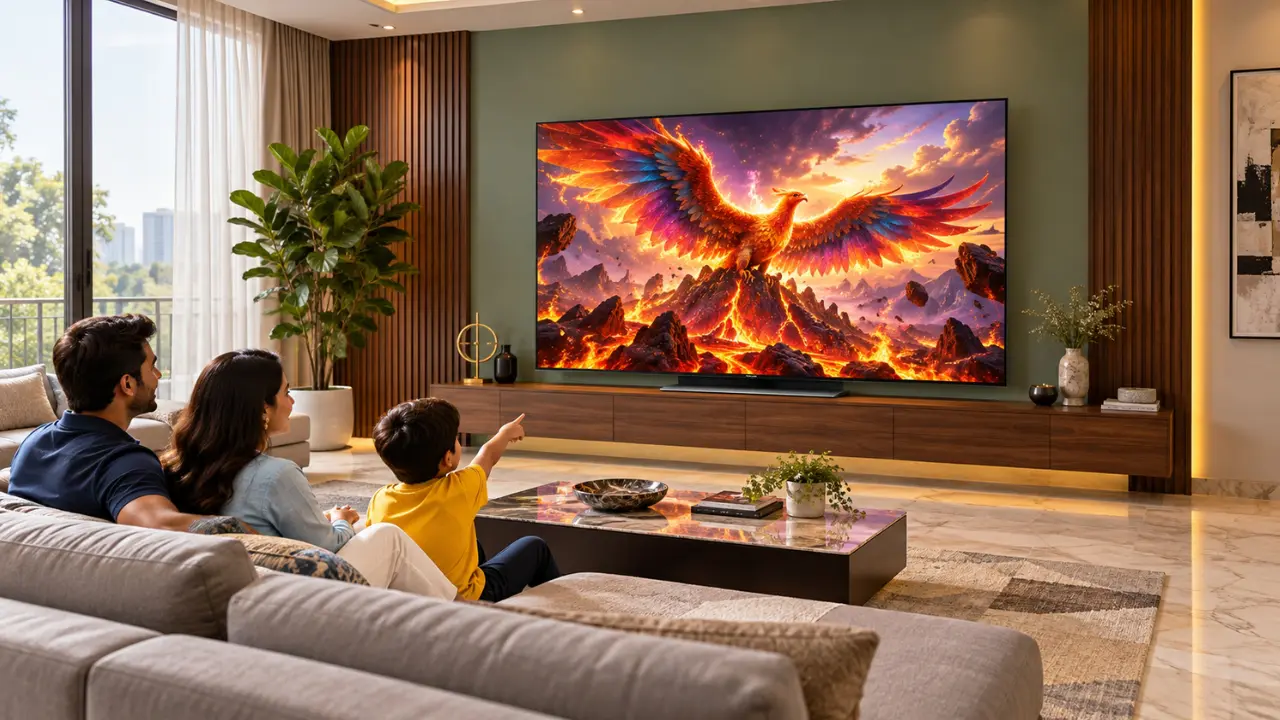

A 189 Cm (75) television can look spectacular in a showroom. Put the same screen three feet from your sofa, though, and the experience changes rather quickly. You stop watching the film and start watching different parts of the film.
That is why which size TV is best for home is not really a question about buying the biggest screen your budget allows. Screen size, viewing distance, resolution, room layout and even what you usually watch all matter.
For most Indian homes, the simplest way to choose is to measure the distance between the screen and the place where you normally sit. Once you know that number, choosing between a 109 Cm (43) , 139 Cm (55), 164 Cm (65) or 189 Cm (75) TV becomes considerably easier.
The Short Answer: What TV Size Works at Different Viewing Distances?
There is no single compulsory viewing distance because personal preference matters. However, for modern 4K televisions, these ranges make a useful starting point:
- 109 Cm (43) TV: roughly 5 to 7 feet
- 139 Cm (55) TV: roughly 6 to 8 feet
- 164 Cm (65) TV: roughly 7 to 10 feet
- 189 Cm (75) TV: roughly 8 to 11 feet
Think of these as practical ranges rather than hard rules.
Someone watching films in 4K may enjoy sitting towards the closer end because the screen occupies more of the field of view. A household mainly watching news, serials or casual television may prefer sitting slightly farther away.
There is another useful lesson here: room dimensions alone do not determine TV size.
A 12 x 12-foot bedroom where the bed is only six feet from the television needs a different screen from a 12 x 12-foot room where the viewing position sits nine feet away.
Why Viewing Distance Matters More Than Most Buyers Realise
A television needs to feel large enough to pull you into the content without making you constantly move your eyes around the picture.
Go too small and films can feel rather distant. Subtitles become less comfortable to follow and cinematic content loses some of its scale.
Go unnecessarily large for a very short viewing distance and the opposite can happen. The picture dominates the room, and following fast-moving scenes may become less comfortable.
Modern 4K displays have made larger televisions far more practical than they once were. Their higher pixel density allows you to sit relatively close without the picture appearing as visibly coarse as older, lower-resolution televisions.
Still, physics has not disappeared. Distance counts.
Is a 109 Cm (43) TV Good for a Bedroom?
Very often, yes.
A 109 Cm (43) screen is particularly practical when viewing takes place from around five to seven feet away. That makes the size suitable for many bedrooms, compact living rooms and apartments where furniture sits relatively close to the television wall.
Consider Haier’s 43P7 Pro, for example. It is a 109 cm (43) 4K HQLED television with a 3840 x 2160 resolution. The model combines HQLED picture technology with AI Picture Quality, Dolby Vision, HDR10 and MEMC.
For entertainment, it also brings Google TV with Gemini, hands-free voice control, Chromecast built-in and 2GB RAM with 32GB storage. The 30W audio system supports Dolby Atmos.
So a smaller screen does not necessarily mean choosing a stripped-down television.
That distinction matters in bedrooms, where people increasingly use the TV for considerably more than cable television: streaming, YouTube, casting photographs and videos, occasional gaming and late-night films all enter the picture.
Is 55 Inches the Practical Middle Ground for Indian Homes?
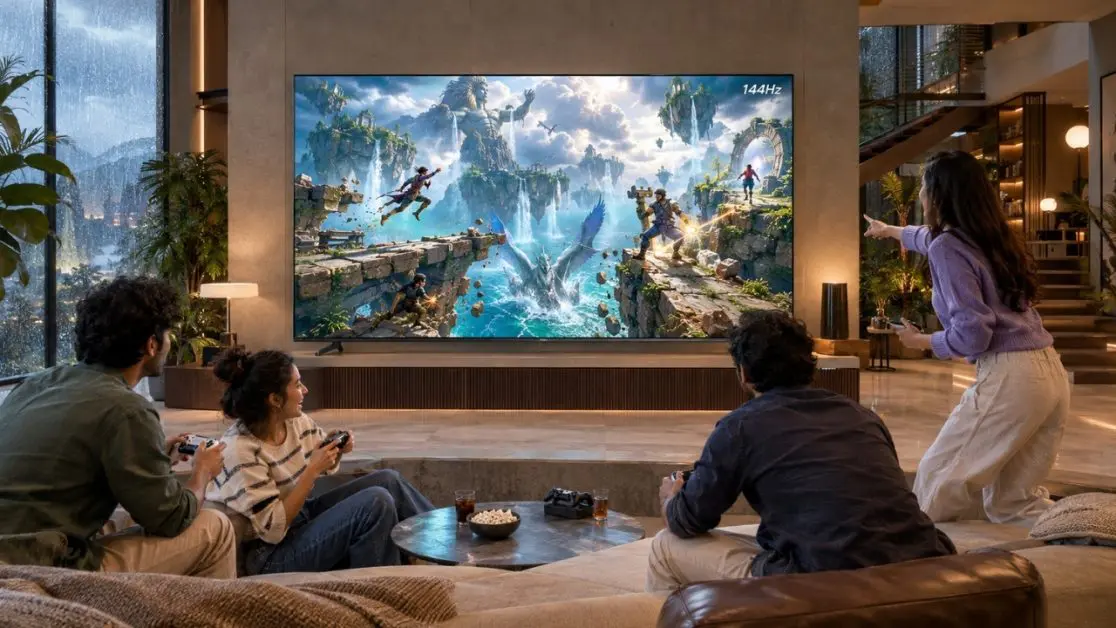
For many households, it can be.
At roughly six to eight feet, a 139 Cm (55) television gives you substantially more visual presence than a 109 Cm (43) model without immediately demanding an enormous living room.
It is also a useful size when several people watch together. Think weekend cricket, a family film after dinner or friends coming over for a match. A little extra screen area becomes surprisingly noticeable from different seating positions.
Haier’s 55P7 Pro moves this experience further with its 139 cm (55) HQLED display. Along with 4K resolution, AI Picture Quality and Dolby Vision, the model supports HDR10+ and MEMC.
Sound also changes at this size. The 55P7 Pro features 50W 2.1-channel audio with a built-in subwoofer, while Dolby Atmos is designed to add greater dimensionality to compatible entertainment.
Gaming gets additional attention too, with Gaming 120Hz, Game Mode, ALLM and VRR among the listed capabilities.
For households wondering which TV is good for home when movies, sports, OTT entertainment and gaming all matter, this sort of balanced 139 Cm (55) configuration deserves consideration.
What Size TV Is Right for a 12 x 12 Room?
This is one of those questions where the room measurement sounds helpful but tells only half the story.
Imagine two 12 x 12 rooms.
In the first, a wall-mounted television faces a bed approximately six feet away. A 109 Cm (43) or 139 Cm (55) model may make more sense.
In the second, the television is on one wall and the sofa is eight or nine feet away. Now 55 or even 65 inches becomes considerably more natural.
Before buying, measure screen to eye distance, not wall to wall distance.
Then check something equally mundane but important: whether the television physically fits your intended unit or wall.
A large display may suit the viewing distance beautifully and still overwhelm a narrow TV cabinet.
When Does a 164 Cm (65) TV Start Making Sense?
Once the main seating position moves towards approximately seven to ten feet, 65 inches becomes a compelling option for a living room.
This is where television starts shifting from simply being another appliance in the room to becoming a genuine entertainment centre.
The Haier 65P7 Pro offers a 164 cm (65) HQLED display with 4K resolution. It carries the P7 Pro family’s AI Picture Quality, Dolby Vision and HDR10+ capabilities, alongside 93% DCI-P3 colour coverage and MEMC.
For action-heavy entertainment, the model adds Gaming 120Hz along with ALLM and VRR. Audio comes through a 50W 2.1-channel system with built-in subwoofer and Dolby Atmos.
There is a practical benefit to going larger here too. When several people are sitting across a broad sofa rather than directly in front of the television, the larger picture can make shared viewing feel less compromised.
Cricket scorecards become easier to read. Film details are more apparent. Console gaming gains scale.
Simple things, but they add up.
How Far Should You Sit From a 72- or 189 Cm (75) TV?
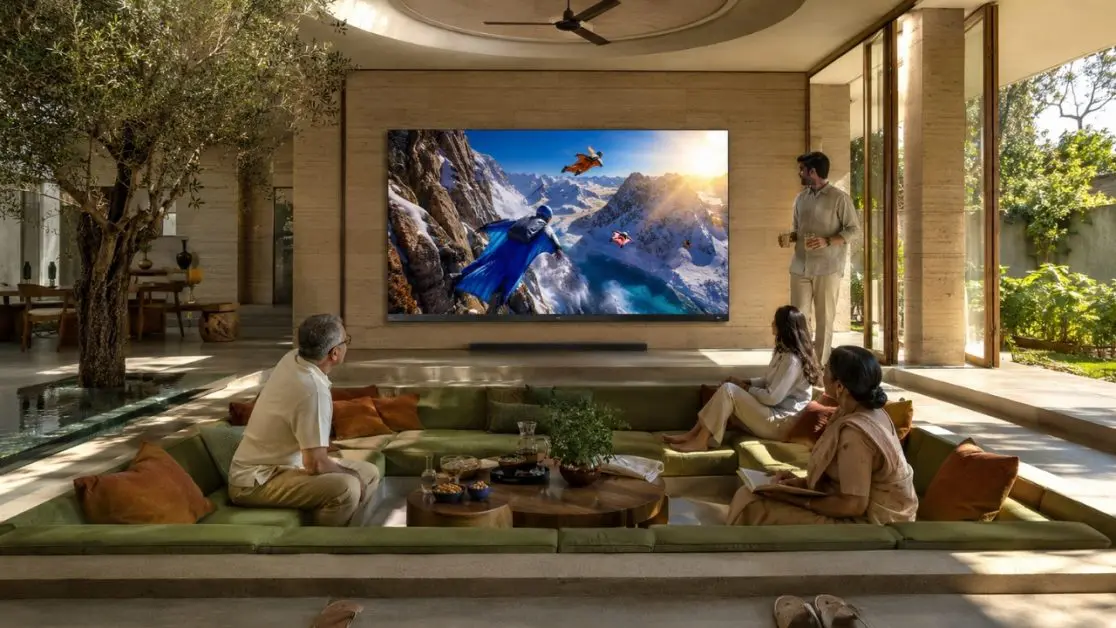
Around eight to eleven feet is a sensible starting range for a modern 189 Cm (75) 4K television. A 72-inch display would fall into broadly similar territory.
The exact position will depend on how immersive you want the experience to feel.
A cinema enthusiast may happily sit closer. Someone who watches mostly regular television might prefer another foot or so of breathing room.
The Haier 75P7 Pro, measuring 189 cm (75), is designed for this large-screen territory. It offers 4K HQLED picture technology, AI Picture Quality, HDR10+, Dolby Vision and 93% DCI-P3 colour coverage.
Fast content benefits from MEMC and the model’s Gaming 120Hz capability, while Game Mode, ALLM and VRR broaden its appeal for console gaming.
The television also includes a 50W 2.1-channel system with built-in subwoofer and Dolby Atmos.
At 75 inches, however, installation planning becomes important.
Check:
- Actual wall width
- TV-unit width and depth
- Nearby doors or cabinets
- Viewing position
- Power socket placement
- Space required for connected devices
- Whether wall mounting or tabletop installation suits the room better
Measure first. Large-screen enthusiasm is considerably less fun when the television arrives and the furniture disagrees.
Don’t Choose Screen Size Without Considering What You Watch
Two families sitting eight feet away may reasonably buy different television sizes.
Why? Their viewing habits are different.
Movies and OTT Series
A larger screen usually makes cinematic content more involved. If the room and budget comfortably support it, moving from 55 to 65 inches can noticeably change the experience.
Cricket and Other Sports
Screen size helps when several people watch together, while motion handling matters for fast action.
This is where features such as MEMC become relevant because smooth motion can be just as important as sheer screen area.
Gaming
Gamers should look beyond inches.
Features such as high-refresh gaming support, VRR and ALLM can influence responsiveness and motion performance. The 55, 65 and 189 Cm (75) P7 Pro variants list Gaming 120Hz, Game Mode, ALLM and VRR.
Everyday Family Television
For news, serials, YouTube and mixed streaming, extreme screen size is not essential. Comfort at the normal seating distance should come first.
What Else Should You Check Before Buying a Smart TV?
Screen size gets the attention, but it should not make the entire decision.
When evaluating the best Smart TV for home use for your own requirements, also check:
Picture technology
Resolution tells only part of the story. Colour reproduction, HDR capability, contrast handling and picture processing influence how content actually appears.
Across the P7 Pro models discussed here, Haier combines HQLED technology with AI Picture Quality. The larger 55, 65 and 189 Cm (75) variants include HDR10+, while the 109 Cm (43) model lists HDR10; Dolby Vision is available across these variants.
Smart experience
A television now doubles as a streaming and connected-entertainment hub.
The P7 Pro range includes Google TV with Gemini, hands-free voice control and Chromecast built-in, allowing compatible content to move easily from a phone to the larger display.
Sound
As screens become larger, weak audio becomes more noticeable.
The 43P7 Pro provides 30W audio, while the 55-, 65- and 189 Cm (75) versions feature 50W 2.1-channel sound with a built-in subwoofer. Dolby Atmos is supported across the models covered here.
A Simple Way to Make the Final Choice
Forget the showroom for a minute.
Sit in the exact place from which you normally watch television. Measure from your eyes to the planned screen position. Then consider the content you watch most often.
From there:
- Around 5–7 feet: start with 43 inches
- Around 6–8 feet: consider 55 inches
- Around 7–10 feet: 65 inches becomes attractive
- Around 8–11 feet: consider 75 inches for a more cinematic experience
There will always be overlap. That is normal.
The point is not to obey an inch-by-inch formula. It is to avoid buying a TV purely because a larger number looks better under bright showroom lights.
Find the Haier P7 Pro That Fits Your Room
The useful thing about Haier’s P7 Pro line-up is that the core experience is available across distinctly different screen sizes.
A compact bedroom can accommodate the 43P7 Pro without giving up 4K HQLED viewing, Dolby Vision or smart functionality. A typical living room can move towards the 55P7 Pro. Larger spaces can step up to the 65P7 Pro, while the 75P7 Pro creates the scale expected from a dedicated big-screen entertainment setup.
And that is ultimately the answer to which size TV is best for home: not the biggest one.
The one that looks right from your sofa.
Frequently Asked Questions
Is a bigger TV always better?
No. TV size should be matched to viewing distance, room layout, resolution and viewing habits. A screen that is too large for a short viewing distance can become less comfortable to watch.
Does TV resolution affect the ideal viewing distance?
Yes. Modern 4K TVs can generally be viewed relatively close because their higher pixel density makes the picture appear less coarse than older, lower-resolution displays.
What should you consider besides TV size?
Consider picture technology, resolution, HDR support, colour reproduction, smart features, sound quality and gaming features such as refresh rate, VRR and ALLM.
What TV size is best for movies and OTT?
A larger screen can make cinematic content more immersive. If the room and budget allow it, moving from 55 to 65 inches can noticeably change the viewing experience.