
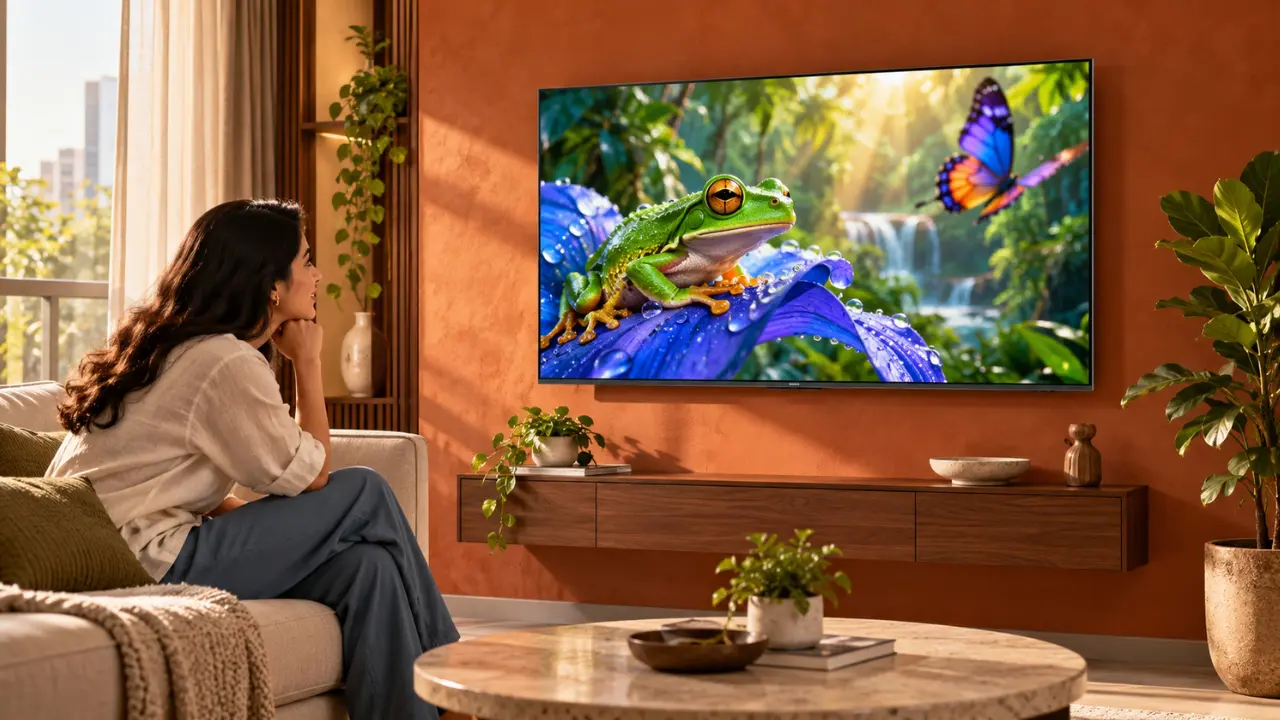

For your bedroom or living room, a 109 cm (43) TV screen could be just the right size. However, comes the hard part. If you invest more in a 4k resolution, is a Full HD resolution as impressive?
It’s a fair question, particularly once both televisions look virtually identical on a showroom wall.
There’s a fact to know. The 43″ 4K TV will have 4 times the number of pixels as a Full HD TV of the same size. That’s impressive, but it will take a while before you notice the extra pixels if you’re sitting far away, watching something that doesn’t require as much detail, and a good TV.
It’s good to be aware of this distinction for Indian households considering upgrading, as they might end up spending money on features they don’t even use.
Should You Get 4K Resolution on a 43″ TV?
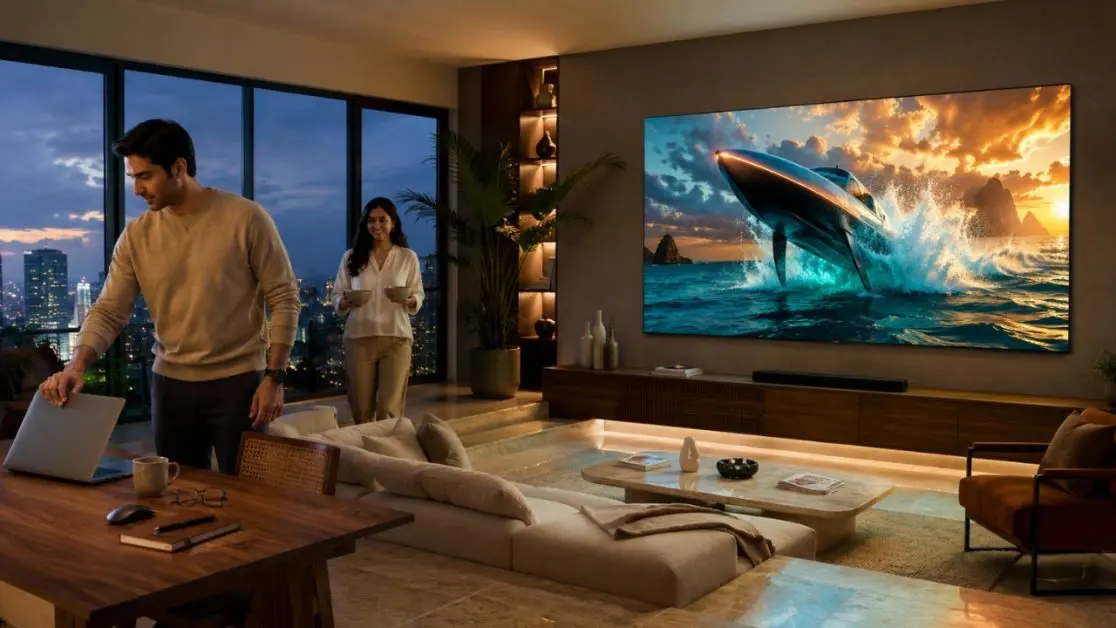
Yes, a 109 cm (43) 4K TV can be worth purchasing, especially if you’re a sports fan and watching original 4K broadcast television or sports games, a couple of feet back from the screen, or looking for more detailed pictures. This improvement is less noticeable at further viewing distances, however.
Think of an average Indian living room. The TV is mounted on a wall, the sofa is about 8 ft away and most nights have a combination of cricket and YouTube and OTT shows.
Even a good Full HD TV can be fairly sharp at that distance.
However, when you get up close, there is a change.
A higher resolution screen will make it easier to appreciate the fine details in a nature documentary, small specifics in a streaming interface and textures in a 4K film.
More pixels isn’t the only benefit. It’s having a good amount of detail available when you can view it.
43 Inch TV, What is the difference between Full HD and 4K?
The diagonals of both televisions are 43 inches. They are comparable in size physically, too.
In what way is the number of pictures’ pixels changing?
Full HD Resolution: 1920 × 1080 Pixels
There are about 2.07 million pixels in a Full HD television.
This resolution can be sufficient for regular TV programming, HD television and normal streaming.
4K Ultra HD Resolution: 3840 × 2160 Pixels
The number of pixels in a 4K Ultra HD TV is around 8.29 million.
That’s four times the number of pixels in Full HD.
The extra pixels can capture more detail, particularly if the video source is in native 4K.
The trick is, there’s a catch.
A low quality broadcast cannot be magically turned into a high-quality 4K broadcast. The lower resolution content can be up-scaled by its processor, which is dependent upon both the original video quality and the processing power of the TV.
Ideal Distance From 43″ 4K TV?
The distance of view may be more important for buyers than they think.
The TV that looks 43″ from 4′ will look quite different from the same TV from 10′.
Sitting around 3.5 to 5.5 feet back (around the height of the screen) may help for fine 4K details, depending on each viewer’s eyesight and taste.
Here’s a simple method to measure your room:
- 3.5 to 5.5 feet: Fine details in native 4K content are more likely to be noticeable.
- 6-8 feet: 43” screen is comfortable, but the contrast of Full HD may start to be noticeable.
- Beyond 8 feet: Screen size may influence your viewing experience more than the additional resolution.
These are suggested viewing guidelines, but not rules.
For instance, a person sitting in a bed 5 feet away will find a 109 cm (43) 4K TV better than a viewer in the large drawing room.
And don’t forget, comfort is important. The principle is that you don’t have to change the layout of your furniture to justify 4K.
Does a 109 cm (43) 4K TV Make OTT Content Look Better?
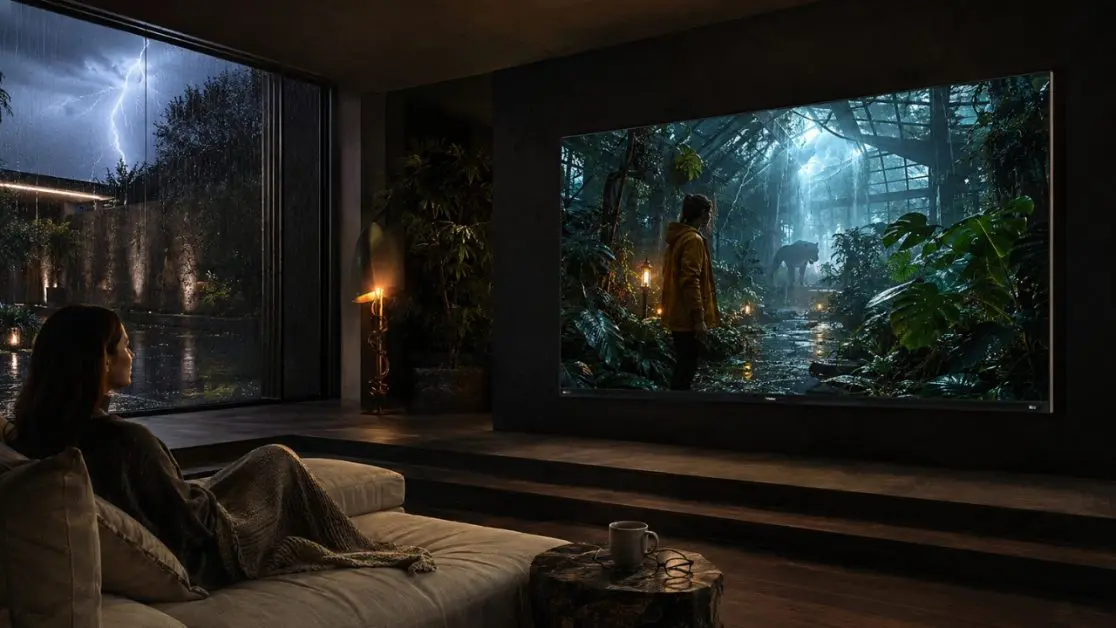
Picture a wildlife show with a dark forest, mountains and closeup images of animals.
The added detail can make a difference in showing individual leaves, fine detail and distant views more clearly in a high-quality 4K stream.
Many popular streaming platforms like Netflix, Prime Video and YouTube have 4k content, but not every video is available in 4k and the availability may depend on subscription plans, device compatibility and internet connection.
This is quite significant for Indian viewers when they watch:
- Movies and web series available in Ultra HD.
- Explanation of the subject in nature documentaries and travel programmes.
- High-resolution YouTube videos.
- Compatible gaming content.
- 4K video footage taken personally.
What about the regular TV channels and what about cricket?
That is where there is a need to keep expectations low.
If a cricket match is streaming in HD, that does not necessarily mean that it is available in native 4K resolution just because it is being played on a 4K TV.
Upscaling can enhance the look, but not necessarily capture all the missing details from the original broadcast quality.
Also, fast moving sports require good motion handling and this is a real world factor outside of resolution.
That’s why things like MEMC can come into play when you’re selecting the best TV for sports.
Which Haier 109 cm (43) 4K TVs to Consider?
Haier India has a range of 43 inch 4K televisions with varying types of display technology, audio elements as well as smart features.
It’s important to understand the different roles that each of the 4K televisions can play in the daily viewing experience, rather than promoting a notion of “one size fits all”.
1. Haier P7 Pro 109 cm (43) 4K Ultra HD HQLED Google TV
The Haier P7 Pro 109 cm (43) (43P7 Pro) brings together 4K Ultra HD resolution, Google TV with Gemini, and Dolby Vision support.
At 3840 × 2160, it offers detailed 4K picture quality. Dolby Vision and HDR10 support help enhance contrast, brightness, and picture detail for compatible content.
Other significant characteristics are:
- Dolby Atmos: Delivers immersive, multidimensional sound with compatible content.
- MEMC: Reduces motion blur and judder for smoother fast-moving scenes.
- Hands-Free Voice Control: Enables convenient voice-operated control without needing the remote.
- Google TV with Gemini: Helps users discover content, get answers, and access supported entertainment apps.
- 30W Audio Output: Provides powerful built-in audio for movies, television, and everyday entertainment.
- 2GB RAM + 32GB Storage: Supports smart TV applications, entertainment content, and multitasking.
- Wide Colour Gamut: Reproduces richer colours, with 93% DCI-P3 colour-space coverage as specified by Haier.
For families who switch between movies, sports, and streaming, the P7 Pro is a good option to consider.
It’s especially noteworthy for its combination of HQLED display technology, Dolby Vision and Dolby Atmos, AI picture quality, and 30W audio output, making it an option for those seeking more than just 4K resolution.
2. Haier S80G 109 cm (43) 4K QLED Google TV
What if you’re looking for more than just sharpness, you’re looking for vibrant colours and an engaging viewing experience?
The Haier S80G H43S80GUX features a 4K Ultra HD QLED display with a resolution of 3840 × 2160.
QLED technology uses quantum dots to deliver vibrant colours and brighter, more lifelike images, making it an appealing choice for content where colour reproduction matters.
The model also contains the following:
- HDR10 and HLG Support: Enhances contrast, brightness, and colour presentation with compatible content.
- Dolby Audio: Enhances audio clarity and delivers an immersive surround-sound experience.
- Google TV and Google Assistant: Makes it easier to discover entertainment, access supported apps, and control the TV using voice commands.
- VRR and ALLM: Support smoother, more responsive gameplay with compatible gaming devices.
- 2GB RAM + 32GB Storage: Provides space for applications and supports the TV’s smart features.
- MEMC: Helps reduce motion blur and judder for smoother-looking fast-moving scenes.
- 20W Audio Output: Provides built-in stereo sound for everyday television viewing.
If you enjoy colourful animated films, travel videos, nature documentaries, or visually rich streaming content, the S80G is worth considering.
Its key distinction is the QLED display, which is designed to deliver vibrant colours and a wider colour range. Two televisions can have the same 4K resolution yet produce noticeably different colours and picture experiences.
The S80G also offers gaming features such as VRR and ALLM, making it worth considering for users who want a television for both everyday entertainment and compatible gaming.
4. Haier 43″ 4K Ultra HD Google TV (A9UG)
If you are searching for a 43” 4K smart TV, you can also look at the Haier A9UG 43A9UG.
It is equipped with Ultra HD resolution, Google TV support, HDR10 and HLG support and MEMC technology.
It has the following main features:
- 4K Ultra HD: 3840 x 2160 resolution for detailed visuals.
- MEMC: Motion processing designed to smooth out motion in scenes.
- Dolby Audio: Audio improvement for entertainment systems supported.
- 24W Audio Output: Internal audio for normal viewing.
- Google Assistant and Chromecast Built-In: Voice interaction and compatible content casting.
The A9UG is ideal for users who prefer basic 4K entertainment capabilities with the standard Google TV interface.
Each of the three models has specific specs and warranties, so it is important to compare the individual product specs before you buy.
So is 4K more important than QLED, HDR or refresh rate?

Not necessarily.
Resolution is a measure of the number of pixels on the screen. It doesn’t tell you all of the properties of those pixels.
HDR Affects Highlights and Shadows
HDR content can retain more of the image in the bright and dark parts of the image.
For instance, a good HDR display will show more differences in tone in a night scene with streetlight illumination.
But the noticeable difference is a function of the brightness, contrast and HDR capabilities of the television sets.
The Colours and the influence of QLED
While QLED technology can help to produce more vibrant colour representation, the image quality remains subject to the properties of the panels and image processing.
Motion is affected by Refresh Rate. Refresh Rate affects Motion
A 60 Hz TV refreshes its pictures 60 times a second.
Some shots may look smoother thanks to the motion-processing capabilities of a device like MEMC, which creates the in-between frames. They cannot convert a standard 60Hz monitor into a 120Hz monitor.
So, as far as image detail is concerned, 4K will have an impact but other technologies will affect the viewing experience.
So, should you opt for a full HD TV in larger sizes, or a 109 cm (43) 4K TV?
It depends on your priorities.
When you should get a 109 cm (43) 4K TV:
- A 109 cm (43) screen will fit in your room with ease.
- You are watching local 4K content on a regular basis.
- You sit sufficiently close to enjoy the finer details of the picture.
- You appreciate the HDR, smart connectivity and enhanced colour reproduction.
See if there’s a bigger TV to consider when:
- Your sofa is set up at a distance from the TV.
- Several family members are seated by multiple positions to observe.
- Expansive pictures are more important than pixel density.
- A bigger display is within the space and price of your room.
Larger screen, lower resolution doesn’t necessarily equal better. Likewise, a smaller 4K screen is not necessarily the best option to buy.
What can you do to achieve the best image from a 109 cm (43) 4K TV?
The process of purchasing a 4K TV is not just about purchasing a 4K TV. Some simple changes can be made at a level that makes a difference.
- Use native 4K content: Play the highest quality of 4K content that your streaming service supports.
- Review the internet connection: Higher streaming quality with stable internet connection. For instance, Netflix requires at least 15 Mbps to stream 4K videos.
- Optimize picture settings: Use various picture modes and do not excessively sharpen the picture.
- Lighting in control room: Minimize window or light reflections.
- Check HDMI device and cable compatibility: Ensure that an HDMI device or cable is compatible when connecting to a gaming console or external streaming device.
There’s one minor thing that is seldom noticed: the default showroom picture settings are not necessarily the best for at-home viewing.
It’s worth spending a few minutes to get the picture just right.
Upgrade Your 43 inch TV with Haier India
If the television is the right size for the room and the entertainment you enjoy takes full advantage of its 4K resolution, then a 109 cm (43) 4K TV can be a great room upgrade.
Whether it’s Dolby Vision support or QLED colour technology or Google TV convenience, Haier India has several options to enjoy 4K entertainment.
Visit the Haier India 43″ 4K TV collection to compare features, specifications and offers to decide which 43″ 4K TV fits into your home.
Frequently Asked Questions
1. Is 4K noticeable on a 109 cm (43) TV?
Yes. The improvement is easier to notice when watching native 4K content from a relatively close distance. At longer distances, Full HD and 4K may appear more similar.
2. Is a 109 cm (43) 4K TV good for a bedroom?
A 109 cm (43) 4K television can work well in a bedroom when the viewing distance, furniture arrangement and wall space suit the screen size.
3. Is 4K better than Full HD for Netflix?
Native 4K Netflix content can offer finer details than Full HD, provided the title, subscription, streaming device and internet connection support Ultra HD playback.
4. Is QLED better than regular 4K LED?
QLED can offer advantages in colour reproduction, but both QLED and conventional LED-backlit televisions can support 4K resolution. Actual picture quality depends on the individual model.
5. Can a 109 cm (43) 4K TV display Full HD content?
Yes. A 109 cm (43) 4K television can display Full HD content through upscaling. However, upscaled video is not identical to native 4K footage.
6. Which Haier 109 cm (43) 4K TV should I choose?
Consider the Haier P7GT for Dolby Vision and Dolby Atmos support, the S80 for QLED colour technology, or the A9UG for 4K entertainment with MEMC and Google TV. Compare their current specifications and warranty coverage before deciding.