
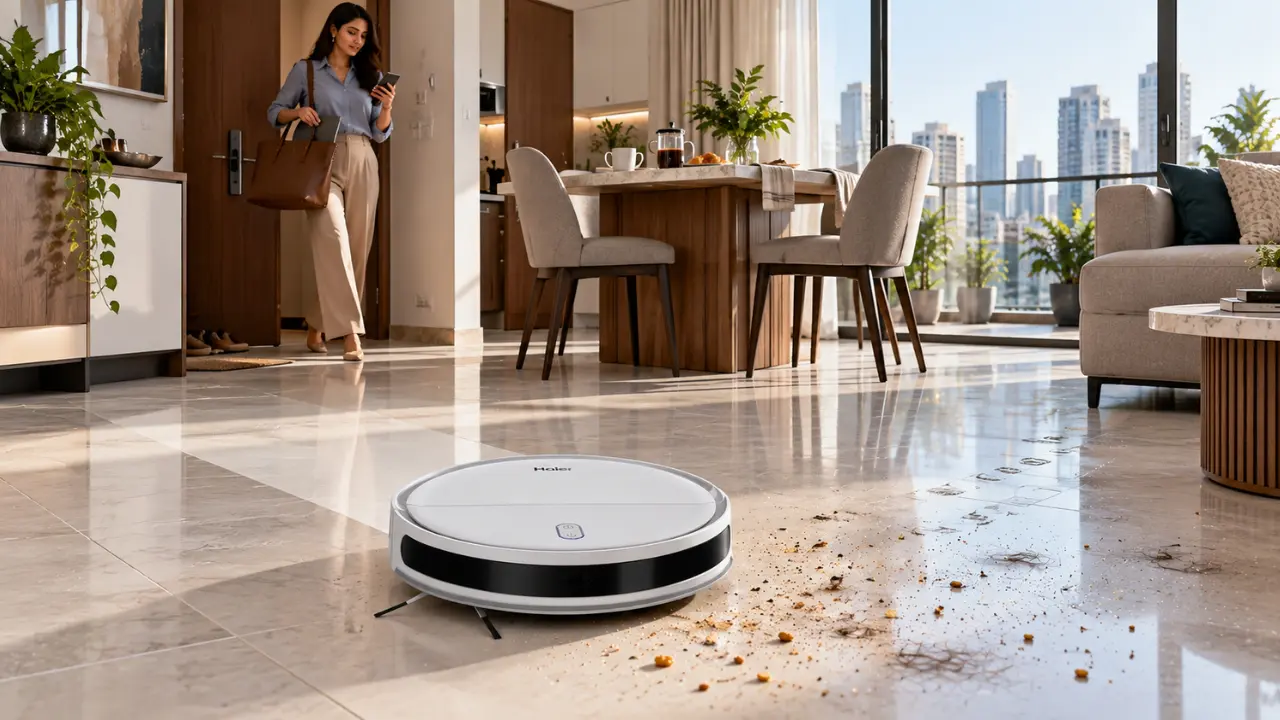

There is a fairly simple answer to the question “Do robotic vacuum cleaners actually work?” Yes, they do but only when you expect them to do the job they were designed for.
A robot vacuum is particularly useful for regular floor maintenance: the everyday dust, crumbs, hair and loose debris that somehow return even when the house was cleaned yesterday. What it is not is a tiny housekeeping professional capable of moving furniture, scrubbing stubborn stains and cleaning every corner from floor to ceiling.
That distinction matters.
For Indian homes, where tiled and marble flooring, daily dust, food crumbs and hair can make floor cleaning repetitive, an automatic cleaner can reduce the amount of routine work considerably. The more interesting question, then, is not simply whether cleaning robots work. It is what they clean well, where their limits begin, and which features actually make a difference.
So, Do Cleaning Robots Really Work?
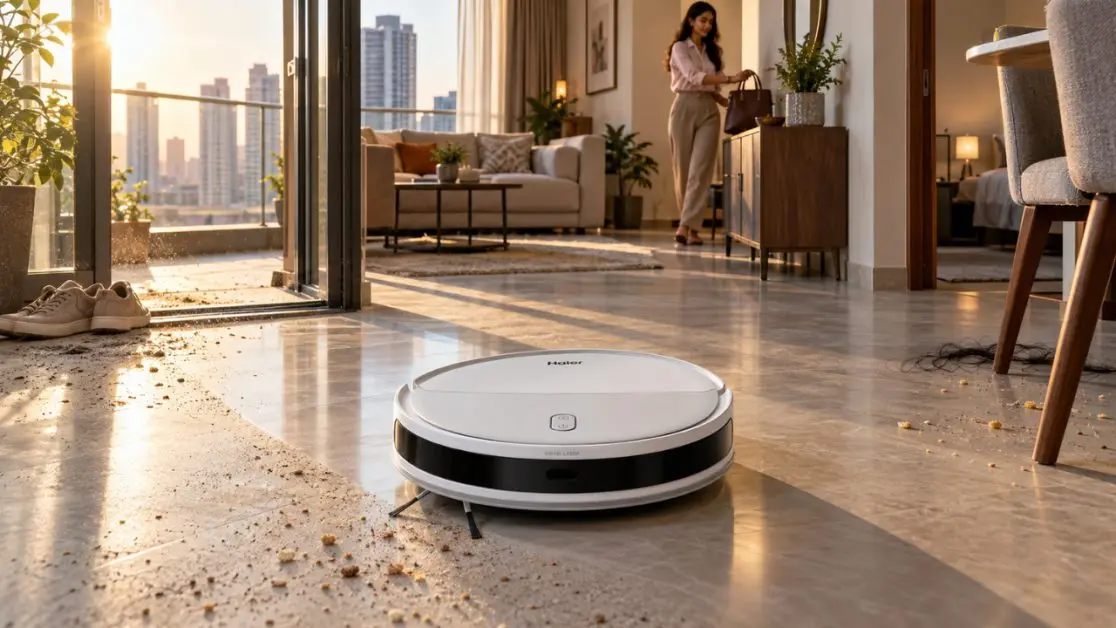
Yes. Robot vacuum cleaners work well for routine, automated floor cleaning when used on suitable surfaces and in a reasonably obstacle-free home. Their effectiveness depends on suction, navigation, sensors, brushes, cleaning modes and the layout of the space.
Modern models are also considerably more capable than machines that simply moved around until they bumped into something.
Take the Haier CIVIC X11 Robot Vacuum Cleaner, for example. It combines laser navigation with up to 5000Pa suction and 2-in-1 vacuuming and mopping. It also offers five-map memory, allowing the appliance to work with mapped spaces rather than treating every cleaning run as completely new.
That changes the experience from “a vacuum that moves by itself” to something much closer to scheduled floor maintenance.
What Can a Robot Vacuum Actually Clean?
Think about what lands on your floors during an ordinary week.
A little dust blows in when the balcony door is open. There are crumbs around the dining table after breakfast. Hair collects around the bedroom. A pet leaves fur behind. Fine debris settles under furniture.
These are precisely the repetitive jobs where a robot vacuum begins to make sense.
Everyday Dust and Loose Dirt
Routine dust is one of the strongest use cases.
Instead of allowing it to accumulate until the next full-house cleaning session, a robot vacuum can be scheduled to clean more frequently. This is especially useful in homes where floors begin looking dusty surprisingly quickly.
And frequency is arguably the bigger advantage here. A machine that cleans regularly can help prevent everyday debris from building up in the first place.
Crumbs and Small Dry Debris
Dropped biscuit crumbs, tiny food particles around a dining area and other loose dry debris are generally well suited to vacuum cleaning.
You still need to pick up larger objects beforehand, of course. A robot vacuum is not a rubbish collector. Coins, cables, toys, socks and similar items should not be left in its path.
Hair and Pet Hair
Hair is another recurring floor-cleaning problem, particularly because it tends to appear again almost immediately after cleaning.
Robot vacuums can help collect loose hair during their regular cleaning cycles. Haier also positions the CIVIC X11 Pro as pet-friendly, specifically highlighting its ability to pick up pet hair and dander.
For homes with furry family members, that can make automated daily or frequent cleaning far more useful than waiting for hair to visibly accumulate.
Hard Floors
Indian homes often contain a mix of vitrified tiles, marble and other hard-floor surfaces.
The Haier CIVIC X11 has a maximum suction specification of 5000Pa, with Haier listing its suitability across surfaces including rustic floors, hardwood, tiles, marble, carpets and linoleum.
That versatility matters when the robot has to move through different rooms rather than clean one uniform surface.
Light Mopping
Here expectations need to be realistic.
A 2-in-1 robot vacuum and mop can help maintain hard floors by combining vacuuming with wet cleaning. The CIVIC X11, for instance, supports wet and dry cleaning and incorporates a 300ml water tank alongside its 250ml dustbin.
That is useful for regular upkeep.
A dried, sticky kitchen spill that has been sitting there since lunch? Different story.
What Can’t Robot Vacuums Clean Properly?

This is where buying with realistic expectations pays off.
Robot cleaners automate floor maintenance. They do not eliminate every manual cleaning task in a home.
Deep or Stubborn Stains
A robot mop should not automatically be treated as a substitute for vigorous manual scrubbing.
Dried food, sticky spills, grease and stubborn marks may require targeted cleaning. The robot can maintain the surrounding floor, but difficult stains can still need human attention.
Stairs
A robot cannot vacuum one stair, climb to the next and continue cleaning the staircase.
Sensors can help the machine detect drops; the Haier CIVIC models include anti-fall sensing but the stairs themselves remain a manual-cleaning zone.
Furniture, Curtains and Above-Floor Areas
Sounds obvious, but it is an important limitation when comparing a robot vacuum with a conventional vacuum cleaner.
Robot vacuums are floor specialists. They will not vacuum:
- Sofas and upholstered chairs
- Mattresses
- Curtains
- Shelves
- Window tracks
- Ceiling corners
- Staircases
If you need those areas vacuumed, you will still require another cleaning method.
Very Tight Spaces
A robot can clean under furniture only where sufficient clearance exists. Its circular body also means extremely narrow gaps and awkward physical spaces may remain inaccessible.
The Haier CIVIC X11 is listed at 330 × 330 × 83mm, which gives buyers a useful reference point when checking whether it can pass underneath their furniture.
Before buying any robot vacuum, measuring the clearance beneath beds, sofas and cabinets is a small step worth taking.
What Are the Disadvantages of Robot Vacuums?
The biggest disadvantage is probably expectation mismatch. Someone expecting completely hands-off, whole-home cleaning may be disappointed; someone buying one to automate repetitive floor cleaning is evaluating a very different proposition.
There are practical limitations too:
- Floors still need some preparation. Loose charging cables, small toys and clutter can interfere with cleaning.
- Dustbins and water tanks need attention. Standard models still require periodic emptying, filling and maintenance.
- Difficult stains may remain. Mopping is useful for maintenance rather than every form of intensive scrubbing.
- Not every area is reachable. Stairs and above-floor surfaces remain outside the robot’s territory.
- Maintenance does not disappear. Brushes, sensors and other relevant components need to be kept clean for consistent operation.
None of these makes a robot vacuum ineffective. They simply define its job more accurately.
Navigation May Matter More Than You Think
Suction figures naturally get attention. Navigation deserves just as much.
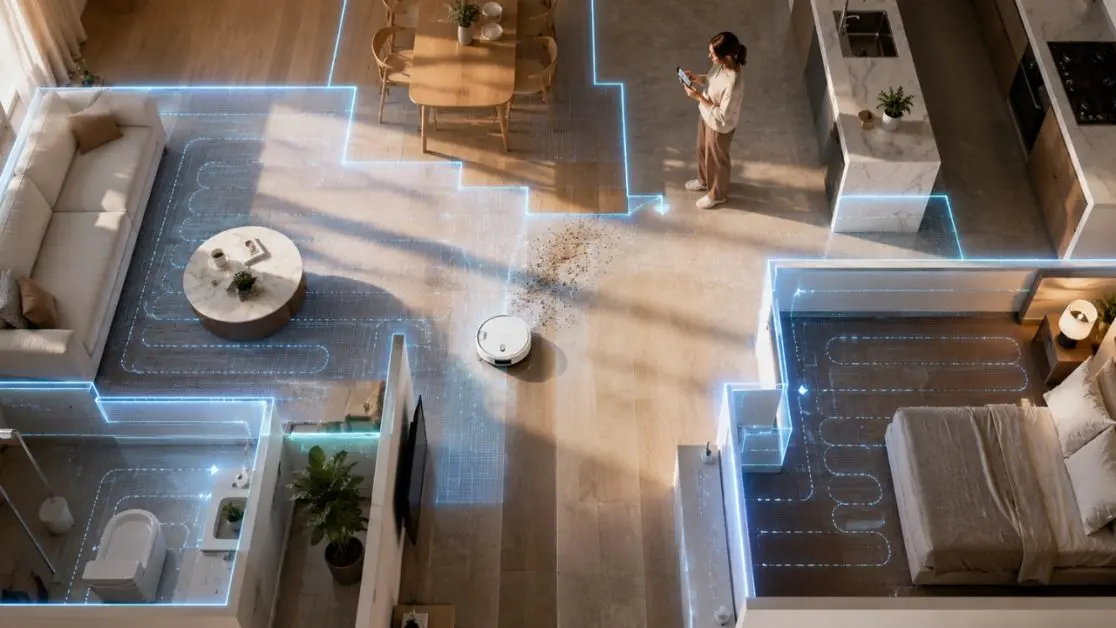
A robot needs to understand where it has cleaned, move around obstacles and cover the available floor logically. Otherwise, powerful suction is less useful if the machine repeatedly visits one area while overlooking another.
The Haier CIVIC X11 and CIVIC X11 Pro use laser navigation and support five-map memory. Haier also specifies smart features such as scheduled and customised cleaning, automatic return to charge, and control through the mobile app, TV app, Google or Alexa.
For a multi-room home or a house where cleaning needs vary from one area to another these are more than convenience extras. They affect how naturally robotic cleaning fits into a household routine.
When Does a Robot Vacuum Become Genuinely Useful?
Not necessarily on the first cleaning cycle.
Its real value becomes clearer when cleaning is repeated automatically.
Imagine the living and dining areas being cleaned every morning while you are getting ready for work. Or the floor being vacuumed after the family leaves home. Instead of waiting until dust becomes visible, cleaning becomes part of the background routine.
That is the behavioural shift a robot vacuum brings.
You stop thinking only in terms of cleaning day and start thinking in terms of continuous floor upkeep.
For busy professionals, families with children, pet households and anyone who dislikes repeating the same sweeping routine every day, that can be the stronger reason to own one.
Haier CIVIC X11 or CIVIC X11 Pro: What Changes?
Haier offers two closely related options for different levels of automation.
The Haier CIVIC X11 brings together 5000Pa maximum suction, laser navigation, 2-in-1 vacuuming and mopping, five-map memory, smart controls and a specified runtime of up to 120 minutes. Its 2600mAh battery and automatic return-to-charge capability are designed around extended, automated cleaning sessions.
The Haier CIVIC X11 Pro builds on that proposition with an important addition: an auto-empty station. Once the robot returns, the station can automatically transfer debris from the robot’s dustbin into a larger dust box.
The Pro model is specified with a 250ml onboard dustbin and a larger 3.5L dust capacity associated with its auto-empty system, while retaining the 300ml water tank, 5000Pa suction, laser navigation and smart controls.
In practical terms, the choice is straightforward: the CIVIC X11 already automates the cleaning movement itself; the CIVIC X11 Pro goes further by reducing how often you need to deal with collected dust.
Before Buying, Ask These Five Questions
Ignore the novelty factor for a minute. Look at your actual home.
- Are most of your floors suitable for robotic cleaning? Hard floors and compatible carpets make a robot vacuum more useful.
- How cluttered is the floor? A reasonably clear path makes automated cleaning easier.
- Do you want vacuuming alone or regular mopping too? A 2-in-1 machine can cover both parts of routine floor maintenance.
- Would mapping and scheduling improve your routine? These features matter more when you want cleaning to happen with less day-to-day involvement.
- How hands-off do you want the experience to be? If minimising dustbin emptying matters, an auto-empty model such as the CIVIC X11 Pro becomes particularly relevant.
Those questions tell you far more than simply asking whether robot vacuums are “worth it”.
The Better Way to Think About Robot Cleaning
A robot vacuum does not make conventional cleaning extinct.
What it can do is take one of the most repetitive parts of household cleaning and automate a substantial portion of it.
That is where Haier’s CIVIC X11 and CIVIC X11 Pro Robot Vacuum Cleaners fit in. Laser-guided navigation, 5000Pa maximum suction, vacuuming and mopping, multiple-map memory and connected controls address the things that matter during everyday automated floor cleaning. The X11 Pro’s auto-empty system takes the idea another step towards lower-intervention maintenance.
So, do cleaning robots actually work?
For dust, loose debris, hair and regular hard-floor maintenance, yes. For stairs, stubborn stains, furniture and every other cleaning job in the house, no and they were never really meant to.
Choose one for the jobs it can automate well, and that is when a robot vacuum stops feeling like a gadget and starts becoming a genuinely useful home appliance.
Frequently Asked Questions
1. Do robotic vacuum cleaners actually work?
Yes. Robot vacuum cleaners can effectively handle routine floor cleaning, including everyday dust, loose dirt, crumbs and hair. Their performance depends on factors such as suction power, navigation, floor type and obstacles. The Haier CIVIC X11, for example, combines laser navigation with up to 5000Pa suction and 2-in-1 vacuuming and mopping.
2. What are the main disadvantages of robot vacuums?
Robot vacuums cannot clean every part of a home. Stairs, furniture, curtains, mattresses and other above-floor surfaces still require separate cleaning. They may also struggle with stubborn or dried stains, while clutter such as loose cables and small objects can interfere with movement.
3. Can a robot vacuum replace regular sweeping and mopping?
A robot vacuum can reduce how often you need to manually sweep or mop floors, particularly when used regularly. However, it should be viewed as an everyday floor-maintenance appliance rather than a complete replacement for occasional deep cleaning.
4. Can robot vacuum cleaners work on different types of flooring?
Yes, provided the particular model is designed for those surfaces. Haier specifies the CIVIC X11’s 5000Pa maximum suction for cleaning across surfaces including tiles, marble, hardwood, rustic floors, carpets and linoleum.
5. Can a robot vacuum clean pet hair?
Robot vacuums can help collect loose pet hair and other everyday debris from floors. Haier specifically positions the CIVIC X11 Pro as pet-friendly, highlighting its ability to pick up pet hair and dander. Regular automated cleaning can be particularly useful in homes where pet hair quickly reappears after floors have been cleaned.