
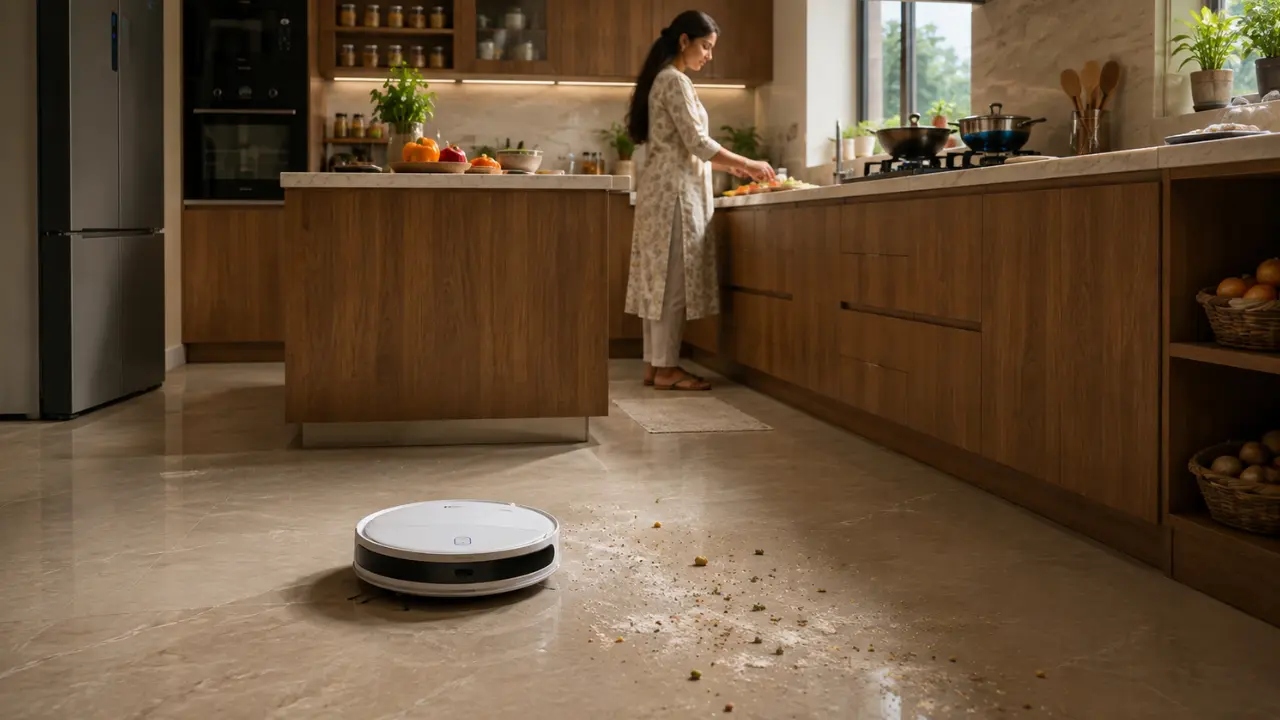

A few coriander leaves fall near the counter. A pinch of atta lands beside the stove. Someone walks in with slightly dusty slippers, the pressure cooker releases steam, and by dinner there are a couple of tiny oil spots that nobody noticed.
Nothing dramatic happened. Yet the kitchen floor is already asking to be cleaned again.
That is fairly normal in an Indian home.
Indian kitchens handle a remarkable mix of ingredients and cooking methods every day. Rotis are rolled, vegetables chopped, tadkas prepared, spices measured, batters poured and dishes moved between the sink and cooking area. Add India’s naturally dusty conditions, busy households and frequent movement between rooms, and the kitchen floor can collect dirt much faster than many other parts of the home.
This is why floor cleaning in an Indian kitchen is less of an occasional deep-cleaning job and more of an everyday hygiene routine.
The Kitchen Floor Collects More Than What You Can See
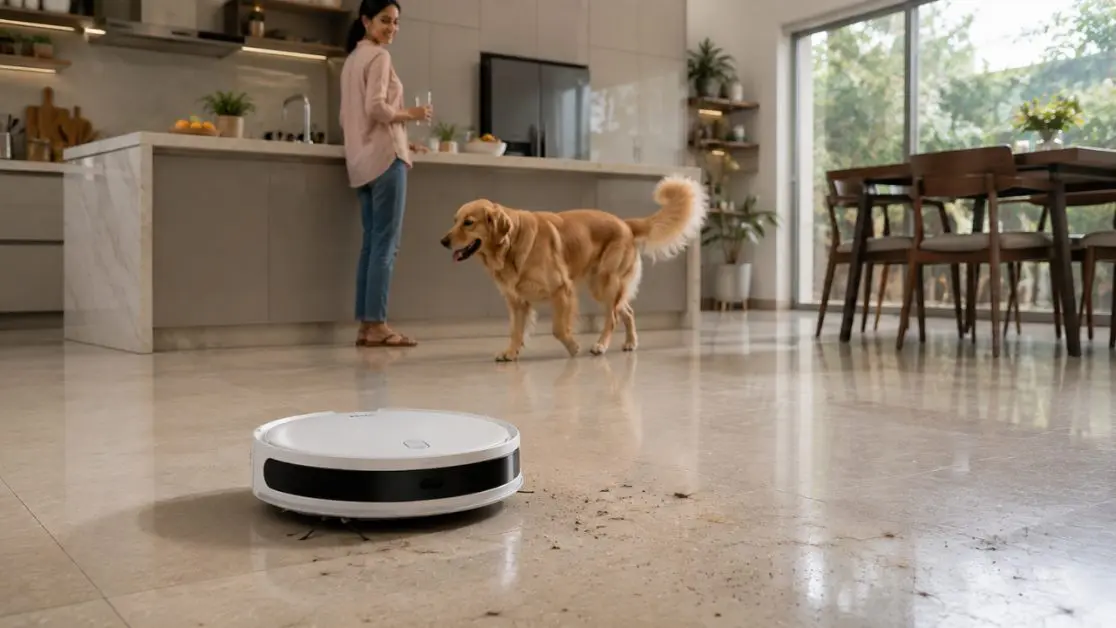
A floor can look reasonably clean and still have fine particles sitting across it.
Think about what reaches the kitchen floor during an ordinary day:
- Atta and other fine food powders
- Rice grains and vegetable scraps
- Crumbs from breakfast or evening snacks
- Cooking oil droplets
- Dust carried indoors on footwear
- Hair and pet hair
- Water around the sink
- Fine particles settling beneath cabinets and furniture
One crumb is hardly a problem. The issue is accumulation.
Dry particles get pushed towards corners. Oil can make dust adhere more firmly to the surface. Food debris may travel under cabinets or appliances. And because kitchens are used several times throughout the day, a floor cleaned in the morning may not necessarily remain that way until night.
Indian Cooking Creates Its Own Cleaning Rhythm
Cooking styles matter.
Preparing a simple sandwich creates a very different cleaning requirement from rolling rotis, frying pakoras or making a full Indian meal with multiple ingredients.
Take chapati preparation. Even when you are careful, dry flour has a habit of travelling beyond the chakla. Or consider frying. Tiny grease droplets do not politely stay inside the kadai.
Then there is masala preparation, peeling vegetables, washing rice and transferring ingredients from one container to another.
Individually, these are small things. Collectively, they explain why frequent floor cleaning makes practical sense.
Sweeping Once May Not Be Enough
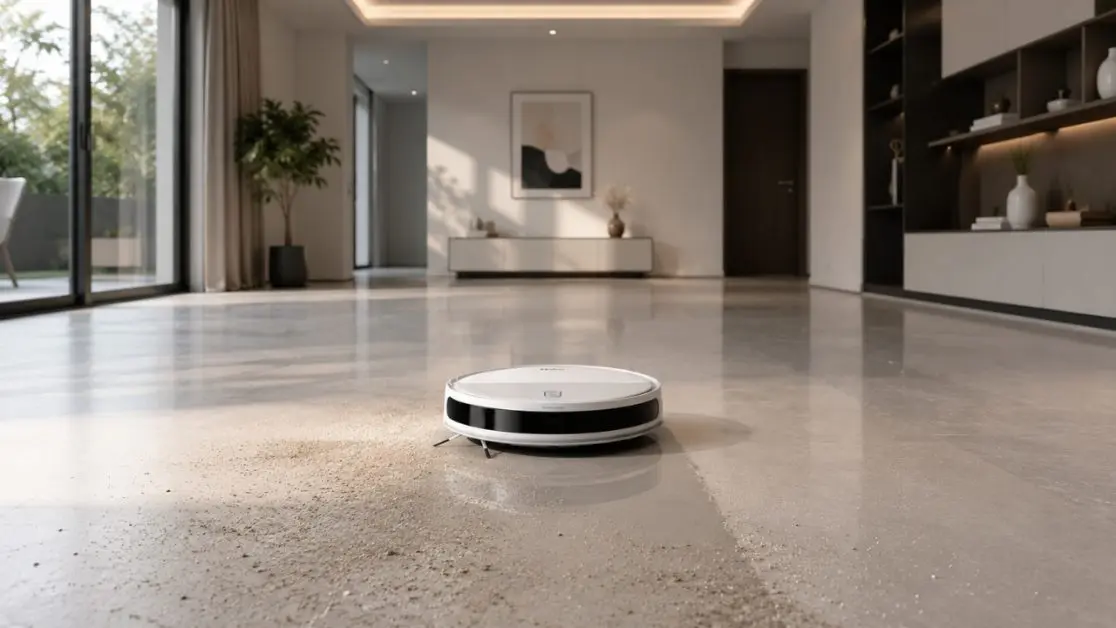
Traditional jhadu-and-pocha cleaning remains familiar in Indian households, but modern routines can make frequent manual cleaning difficult.
The challenge becomes particularly noticeable in homes where both adults work, children are constantly moving around, pets shed hair or the kitchen connects directly with the dining and living spaces.
There is another distinction worth making: dry dirt and stuck-on dirt are not the same problem.
Sweeping can collect loose particles. Mopping deals with the floor differently. When both types of cleaning are required regularly, doing them as separate chores can add considerably to everyday housework.
This is where automated floor-cleaning appliances start becoming relevant not because people suddenly forgot how to use a broom, but because repetition is precisely the kind of household work automation can handle well.
How Often Should an Indian Kitchen Floor Be Cleaned?
There is no universal schedule. A kitchen used twice a day by two people will naturally behave differently from one preparing meals for a large family.
A practical way to decide is to look at usage rather than the clock.
More frequent cleaning may be useful when:
- Several meals are cooked from scratch every day.
- Rotis or other flour-based foods are prepared regularly.
- Frying and tadka are common.
- Children frequently enter the kitchen.
- There are pets in the home.
- The kitchen opens directly into another living area.
- The home receives considerable outdoor dust.
- Crumbs or food particles regularly appear between major cleaning sessions.
For many households, this can mean quick floor maintenance more often rather than waiting for dirt to build up and then tackling one exhausting cleaning session.
And that changes what you should expect from a cleaning appliance.
What Makes a Robot Vacuum Useful for This Routine?
A robot vacuum cleaner intended for frequent household cleaning needs more than the ability to move around a room. Navigation, suction, mopping capability and intelligent controls become particularly important when cleaning is expected repeatedly.
Haier’s CIVIC X11 Robot Vacuum Cleaner brings several of these functions together. It offers 5000Pa maximum suction and 2-in-1 mopping and sweeping, allowing it to address dry floor debris while supporting wet cleaning within the same appliance. The model is designed for different floor surfaces, including tiles and marble, both common choices in Indian kitchens and homes.
5000Pa Suction for Everyday Debris
Kitchen dirt is rarely uniform.
There might be lightweight crumbs in one area and finer particles somewhere else. The CIVIC X11 provides 5000Pa maximum suction power, with Haier listing its suitability across multiple floor types such as tiles, marble, hardwood, rustic floors, carpets and linoleum.
For an Indian household, that versatility matters because the robot does not necessarily have to stop working when it leaves the kitchen. It can continue cleaning compatible flooring elsewhere in the home.
Sweeping and Mopping Together
This is arguably the more relevant feature for kitchens.
The CIVIC X11 supports 2-in-1 mopping and sweeping, rather than limiting floor care to vacuuming alone. Its specifications list wet and dry cleaning modes, along with a 250ml dustbin and 300ml water tank.
For routine cleaning, combining these functions can reduce the number of separate cleaning steps required.
Smart Navigation Matters More Than It Sounds
Random movement might eventually cover a small room. In a larger home, however, cleaning efficiency depends heavily on knowing where to go.
The Haier CIVIC X11 uses laser navigation for precise cleaning, obstacle avoidance and area coverage. It also offers five-map memory, which is particularly useful for homes where cleaning needs extend across different areas or floors.
The robot additionally includes multiple sensors, including anti-fall functionality, and supports automatic return to charge. Scheduled and customised cleaning are also listed among its smart capabilities.
So rather than thinking, I need to clean the kitchen again, households can increasingly treat cleaning as a routine that can be planned.
When Frequent Cleaning Needs Even Less Intervention
There is one mundane part of vacuuming that automation does not automatically eliminate: emptying collected dust.
Haier addresses that in the CIVIC X11 PRO Robot Vacuum Cleaner.
The PRO model retains key capabilities such as laser navigation, five-map memory, 5000Pa suction, 2-in-1 vacuuming and mopping, and smart controls, but adds an auto-empty station. The robot can automatically transfer collected dirt from its onboard dustbin into the larger dust box at the station.
That feature becomes more meaningful when cleaning happens frequently. More cleaning naturally means more collected debris, after all.
The CIVIC X11 PRO also offers a 2600mAh battery with a listed runtime of up to 120 minutes, alongside automatic return-to-charge functionality.
Cleaning Can Fit Around the Household, Not the Other Way Around
The most useful smart-home features are often the ones that remove small interruptions.
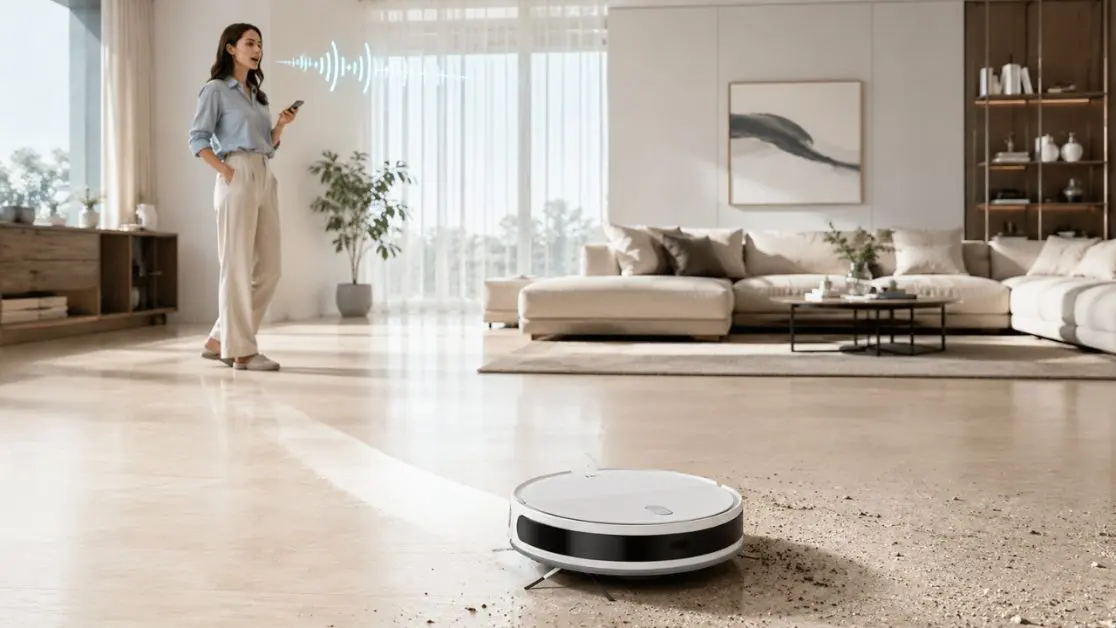
Both CIVIC models support connected controls through the mobile app, TV app, Google or Alexa, according to Haier’s product specifications. The CIVIC X11 can also support scheduled or customised cleaning.
That opens up some practical possibilities.
You might schedule cleaning after breakfast once everyone has left the kitchen. Another session could deal with the floor after evening meal preparation. Instead of waiting until crumbs, dust and other debris become obvious, maintenance can happen as part of the household’s normal routine.
For homes with furry companions, Haier also positions both CIVIC models as pet-friendly solutions designed to pick up pet hair and everyday messes.
A Cleaner Kitchen Starts at Floor Level
Kitchen hygiene tends to draw attention towards countertops, sinks, chopping boards and storage containers. The floor deserves a place in that conversation too.
After all, Indian kitchens are busy spaces. They see flour, crumbs, cooking residue, dust, water and constant foot traffic often several times within a single day. Waiting for the floor to look dirty is not always the most practical cleaning strategy.
More frequent cleaning is.
The Haier CIVIC X11 Robot Vacuum Cleaner brings 5000Pa suction, multi-function sweeping and mopping, laser navigation and 5 map memory and connected controls to the same floor-care solution, offering a solution for households that want to automate that chore. If you’re looking to eliminate even more manual labor, you might be interested in the Haier CIVIC X11 PRO Robot Vacuum Cleaner with an extra auto-empty station.
The point isn’t to turn kitchen cleaning into another complicated smart home project. Quite the opposite.
The floor gets dirty again. Let the cleaning get smarter too.
Frequently Asked Questions
1. Why do Indian kitchen floors need frequent cleaning?
Indian kitchens often involve flour, spices, vegetable scraps, crumbs, oil droplets and frequent foot traffic. These can accumulate quickly, making regular sweeping and mopping useful for maintaining everyday floor cleanliness.
2. Can a robot vacuum cleaner be used for kitchen floors?
Yes, provided the flooring and cleaning requirements are compatible with the appliance. The Haier CIVIC X11 Robot Vacuum Cleaner supports wet and dry cleaning and offers 2-in-1 mopping and sweeping for routine floor maintenance.
3. What suction power does the Haier CIVIC X11 offer?
The Haier CIVIC X11 offers 5000Pa maximum suction power. Haier lists it for use across various floor types, including tiles, marble, hardwood, rustic floors, carpets and linoleum.
4. Does the Haier CIVIC X11 vacuum and mop at the same time?
Yes. The CIVIC X11 features 2-in-1 mopping and sweeping, allowing the appliance to perform both functions simultaneously. It includes a 250ml dustbin and a 300ml water tank.
5. How does laser navigation help with everyday cleaning?
Laser navigation helps the robot navigate more precisely, avoid obstacles and achieve efficient area coverage. The CIVIC X11 also provides five-map memory, which can support cleaning across different mapped areas of the home.
6. What is the difference between Haier CIVIC X11 and CIVIC X11 PRO?
Both models offer features such as 5000Pa suction, laser navigation, multiple-map memory and vacuuming with mopping. The CIVIC X11 PRO additionally features an auto-empty station, which transfers collected debris from the robot’s dustbin into a larger dust box.