


The countdown has started. The turntable is rotating. The familiar humming noise can even be heard from the microwave.
All is well.
However, after opening the door to retrieve lunch, the food is still cold.
Annoying, isn’t it?
From reheating the dal you made the day before to warming milk for your morning coffee or quickly preparing dinner after work, a microwave that doesn’t heat anything can be a complete disruption to your kitchen dynamics.
Now the fun part! Just because your microwave switches on doesn’t necessarily mean its heating system is working.
Sometimes, the problem is as simple as selecting the wrong cooking mode. Other times, however, it may be an internal part that needs professional help.
If you’re thinking your microwave oven’s time is up, then let’s find out what is going on.
Here Are Some Questions to Ask if Your Microwave Is Working but Not Producing Heat
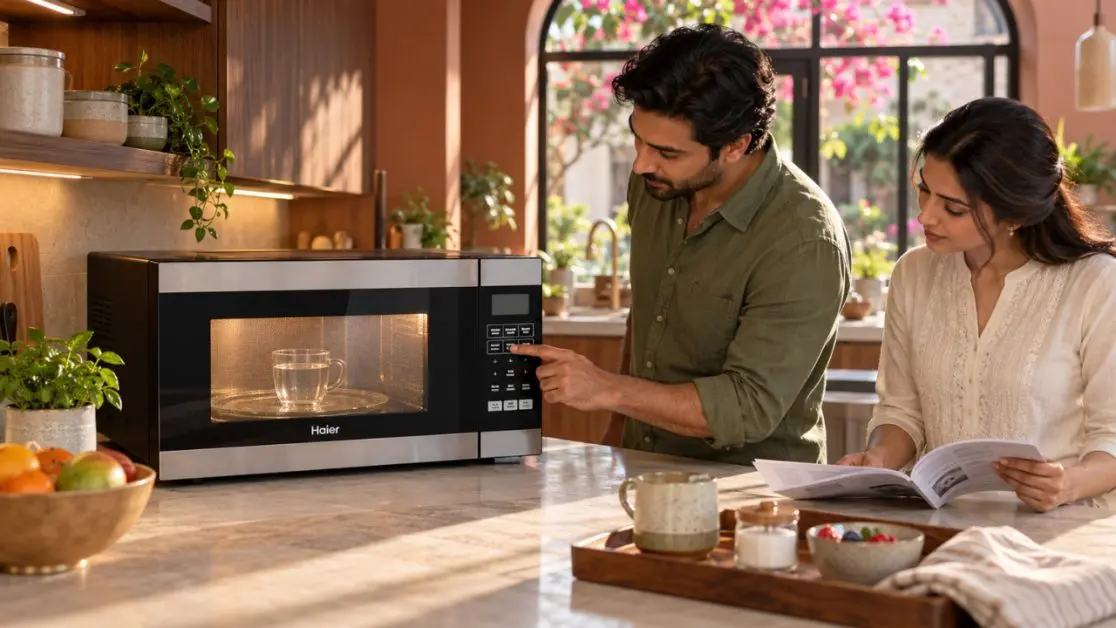
A microwave oven has multiple uses.
The control panel controls cooking instructions, the turntable spreads the microwave energy throughout the food, and the internal fan cools the appliance.
In reality, the heating is done through microwaves, and this is accomplished using a device known as a magnetron.
Microwave energy is produced in the magnetron and reacts with food, especially the water molecules, creating heat.
Here’s where it gets tricky, though.
Even if the microwave heating system has a fault, the display, fan, and turntable might still operate.
This is why some microwaves look like they’re working but don’t heat up the food in them.
How to Determine if There Is a Heating Issue?
Be alert if you notice any of the following:
- Food still remains cold after a normal reheating cycle.
- The microwave heats food much longer than normal.
- The turntable spins while the temperature of the food hardly changes.
- The appliance makes strange noises when it is running.
- Appropriate settings are used, but food does not heat evenly.
A single bad attempt at heating doesn’t necessarily mean a big issue is at hand.
After all, frequent heating failures should be addressed.
7 Reasons Your Microwave Is Running but Not Cooking
If your microwave is not heating food, there are numerous reasons why that could be.
Before embarking on repairs, it may be important to be conscious of the possible causes.
Some problems are due to common operating errors. Some are electrical or mechanical issues that should only be looked at by certified technicians.
1. The Wrong Cooking Mode Is Selected
This is an easy thing to miss, especially if you have a convection microwave oven that has a variety of different cooking settings.
There are four different cooking modes on a microwave: microwave, grill, convection cooker, and combination cooker.
For instance, a convection mode does not utilize microwave energy, but rather heated air. If you want something to be ready to reheat quickly but choose a baking setting, the results may not be what you’re expecting.
Check whether:
- The microwave heating mode is chosen.
- Cooking time is suitable.
- The power level is set appropriately for the food to be cooked.
- The appliance is not running in a demonstration mode, if applicable.
Refer to the cooking instructions in your microwave cooker’s user guide to find out what functions are available.
2. The Magnetron May Have Developed a Fault
The magnetron is one of the most vital parts that contribute to microwave heating.
If it doesn’t work, the machine might show the timer, run the fan, and turn the turntable while not heating food.
Common indications include:
- Complete loss of microwave heating
- Unusual humming or buzzing
- Failure to heat food even when set to the right temperature repeatedly
The symptoms, however, are not conclusive of magnetron failure.
A technician must determine what is truly causing the issue by servicing the appliance.
Do not attempt to gain access to or replace the magnetron. High-voltage equipment can hold lethal electrical charges in microwave ovens long after they have been unplugged.
3. The High-Voltage Diode Might Be Damaged
The high-voltage diode is a component of the rather complicated electrical system used to aid the magnetron in receiving electrical power.
If this component fails, the microwave might not produce enough heating energy.
Curiously, the display and turntable will still function.
This makes problem identification by visual inspection challenging.
Testing the diode involves dangerous electrical components, so a proper diagnosis is required.
4. Problems With the Door Safety Switch
Microwave ovens use door interlock switches to prevent microwave operation when the door isn’t securely closed.
Damaged or misaligned switches can cause the appliance to not start heating properly.
You might notice:
- The microwave fails to turn on regularly.
- Behaviour changes when the door is closed on the appliance.
- Heating does not work when a programme is chosen.
Never slam the door or try to circumvent its safety system repeatedly.
The door switch should not be repaired by a non-qualified person.
5. The High-Voltage Capacitor May Be Damaged
The high-voltage capacitor may be a possible cause.
This part is used in the high-voltage circuit of the microwave.
Should a fault occur, the heating system could fail to work properly.
Sometimes, the appliance may also make strange sounds or stop operating due to electrical issues.
Capacitors may hold dangerous electrical charges and should never be handled by untrained persons.
6. The Microwave May Be Experiencing Power Supply Problems
Not all heating problems are internal to the heating system.
Microwave operation may be impaired by any one of the following: an improper electrical connection, a damaged power cord, or an unstable power supply.
Sometimes, voltage fluctuations and overloaded electrical circuits can make operating appliances difficult in Indian homes.
Only examine what is clearly accessible.
For example, look at the appliance to see that it is plugged into an appropriate wall socket, and check whether there are any other electrical issues.
Don’t use extension boards or overloaded multi-plug adaptors with high-power kitchen appliances.
When sparks, burning odours, frayed wires, or circuit breakers tripping repeatedly are observed, discontinue use of the microwave and seek professional help.
7. Internal Heating Components Have Worn Out
Microwave ovens are like all household appliances; they have some parts that will wear out.
Various parts of the device, such as internal connections, control circuits, and items involved with heating, can eventually develop problems.
The cause can depend on the design of the appliance, its usage, and its condition.
A trained service technician can tell if it is possible to repair the microwave.
What Should You Do Before Calling a Technician?
It’s not always necessary to replace a microwave that isn’t heating food.
However, there are a couple of safe checks that should be done first.
| What to Check | What You Should Do |
| Cooking mode | Check that the mode for microwave heating is set. |
| Power level | Choose an appropriate power setting. |
| Cooking time | Make sure adequate heating time is selected. |
| Door closure | Check if the door fits properly and closes without forcing it. |
| Electrical connection | Check the exposed plug and socket for damage. |
| Control settings | Read the user manual for demo mode and/or operating restrictions. |
| Food container | Use a safe container suitable for the selected microwave mode. |
If everything is in order and there is no evidence of electrical damage, odd noises, or burning smells, then one simple heating check can be done.
Put a microwave-safe cup of water (about 200 ml of room-temperature water) into the microwave.
Choose the microwave setting that will give you high power, and heat for approximately one minute.
Carefully determine if the water is noticeably warmer.
If it is still cold, discontinue use and call an authorised service person.
Avoid running a microwave without anything in it.
When to Repair or Replace Microwave Ovens?
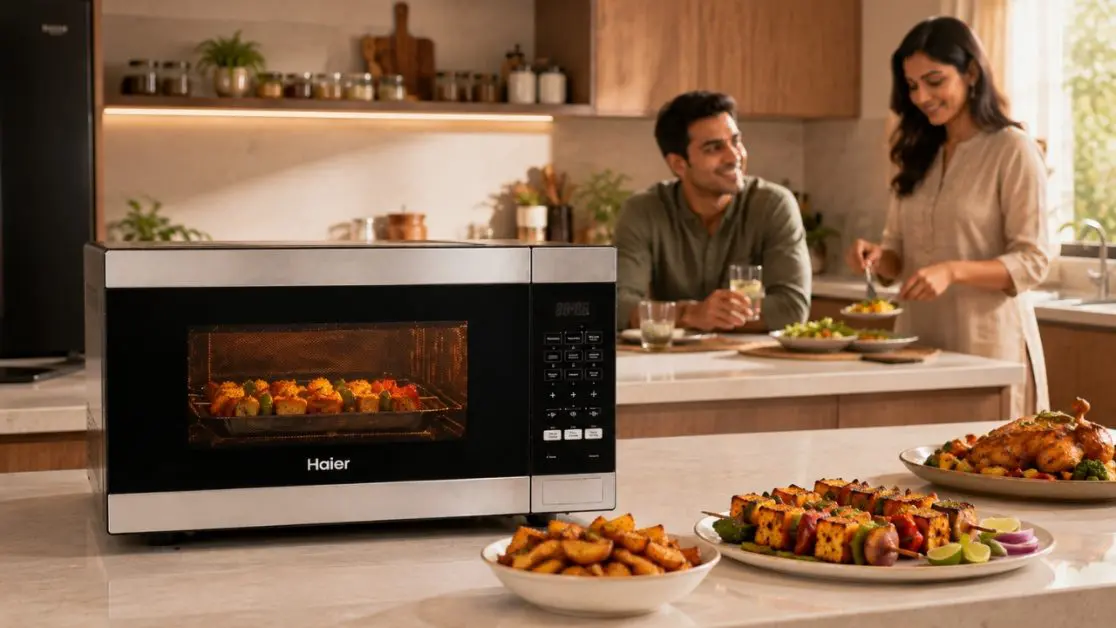
Not all problems indicate a broken appliance.
Sometimes, the replacement of a faulty part will restore normal operation.
But there are certain cases where it is better to buy a new microwave.
Take into account the following:
- Age of the appliance: If the microwave has been used for a while and has had multiple failures, it may need more repairs.
- Repair cost: Estimate the cost of repair versus the cost of a replacement that is appropriate to the situation.
- Safety issues: Unsafe doors, safety mechanism issues, or severe electrical issues must be addressed.
- Cooking needs: There could be a greater need for capacity or extra cooking capabilities at home.
- Warranty coverage: Make sure that the appliance is still covered by the manufacturer’s warranty.
For newer microwaves, the first line of defence is to contact the manufacturer’s approved service department.
Are You in Need of a Trustworthy Microwave? Get to Know Haier India’s Convection Microwave Ovens
Whether you’re in the mood for a home-cooked meal, a microwave meal, or trying out some new recipes, your microwave oven should make it easy.
When you’re thinking about upgrading, it’s just as important to pick the appliance that’s right for your family’s kitchen as it is to pick the right size.
Haier India provides convection microwave ovens with cooking features to suit various needs.
Here are three possibilities that you should consider.
Haier 30L Convection Microwave With In-Built Air Fryer (HIL3001ARSB)
If you’re a family that loves trying out various cooking methods, the Haier 30L Convection Microwave With In-Built Air Fryer will come in handy.
It has a 5-in-1 feature that includes microwave, grill, convection cooking, air frying, and rotisserie cooking modes.
Key features include:
- 30-litre capacity for everyday family cooking
- In-built air fryer with 36 dedicated air-frying menus
- 305 preset auto-cook menus
- A motorised rotisserie for grilling food
- Five power levels for microwave cooking
- Stainless steel cavity
- Touch control panel
- Child lock to help prevent accidental operation
Think of making crispy evening snacks, cooking dinner on the grill, and reheating leftovers.
It is a model that is particularly relevant for families that want more flexibility from their cooking gadgets, given the variety of cooking features it offers.
Haier 28L Convection Microwave Oven With Dual Heating Element (HIL2801DBSJ)
Ever cooked something that roasted perfectly on the outside but didn’t cook properly on the inside?
Baking and roasting may be affected by uneven heating.
This is a cooking need that the Haier 28L Convection Microwave Oven With Dual Heating Element is able to fulfil with its top and rear heating elements.
It has a back convection fan to distribute hot air for more uniform cooking.
Other interesting points are:
- 28-litre capacity
- Dual heating elements
- Back convection fan
- Grill, microwave, or combination cooking
- Easy Jog Control for easy operation
- Stainless steel cavity
- Premium black glass design
It provides some flexibility for Indian households that frequently cook baked foods, grilled vegetables, or roasted foods.
Haier 25L Convection Microwave Oven (HIL2501CBSH)
At times, you want an appliance that can cook your favourite Indian dishes without complicating the process.
The Haier 25L Convection Microwave Oven combines a number of handy cooking options into a single machine.
Its features include:
- 305 auto-cook menus
- Special bread basket function
- Various ways of preparing naan, paratha, tandoori roti, kulcha, and garlic bread
- Functions for paneer, ghee, and curd-making
- Healthy cooking methods, including oil-free or low-oil cooking
- Combination cooking functions
- Deodoriser function
- Stainless steel cavity
An important use of the bread basket is for families that like to make various kinds of Indian breads.
The preset menus are designed to make everyday cooking easier with predefined cooking settings.
These features help make cooking more convenient, but do not eliminate all mechanical or electrical issues.
Simple Things You Can Do to Keep Your Microwave Oven in Good Working Order
Just a little extra care after normal use will help maintain a clean and trouble-free microwave.
Keep the Interior Clean
Grease and food spills can get trapped inside the cavity.
After the machine is turned off and has cooled, clean the inside with a soft, damp cloth and a cleaning solution recommended by the user manual.
Do not use abrasive cleaning materials that can damage the inside surfaces.
Use Appropriate Cookware
Use utensils appropriate for the cooking method.
A microwave-safe container might not be suitable for convection baking or grilling.
Use suitable cooking utensils and cook according to the manufacturer’s guidelines.
Do Not Obstruct Ventilation Openings
When operating a microwave oven, it is necessary to provide the required air circulation.
Maintain the recommended clearances around the appliance and do not cover any ventilation openings.
Pay Attention to Unusual Behaviour
If you hear strange noises, smell burning, experience frequent shutdowns, or notice heating failures, it’s not something to be taken lightly.
Do not keep trying it out again and again. Stop using it and ask for expert help.
Make Everyday Cooking a Hassle-Free Experience With Haier India
That’s frustrating when you have a microwave that works but fails to heat food, it can be a real problem if you are depending on it for quick meals during your workday, school day, and family life.
What is important is to recognise the problem as being either one of operating settings or a fault within the system itself.
Minor problems can be solved by simple checks, and problems with the electrical or heating systems must be resolved by professionals.
If you already have a Haier microwave, service support can assist you in identifying the best course of action.
And if you’re planning to upgrade your kitchen appliance, explore Haier India’s range of convection microwave ovens.
Haier’s 30L Convection Microwave With In-Built Air Fryer, the Indian cooking features in the Haier 25L model, and the dual-heating capabilities of the Haier 28L model cover different needs in a household.
Explore Haier India microwave ovens and choose the model that complements the way your family cooks.
Frequently Asked Questions
1. Why is my microwave running but not heating food?
A microwave may run without heating because of incorrect cooking settings, a faulty magnetron, problems with the high-voltage circuit, or malfunctioning door safety switches. Professional diagnosis may be necessary to identify the cause.
2. Can a microwave turntable rotate even if the magnetron is damaged?
Yes. The turntable motor and microwave heating system perform different functions. The turntable may continue rotating even when the magnetron isn’t generating microwave energy.
3. Is it safe to use a microwave that runs but doesn’t heat?
If the microwave repeatedly fails to heat food despite correct settings, stop using it until the problem is identified. Never open the outer casing or attempt internal electrical repairs yourself.
4. Can I repair a microwave magnetron at home?
No. Magnetron replacement involves high-voltage components and requires specialised technical knowledge. Always contact an authorised service professional.
5. How do I know whether my microwave needs replacement?
Consider its age, repair history, safety condition, warranty coverage, and estimated repair cost. A technician can help determine whether repairing or replacing the appliance is appropriate.
6. Does convection mode work if microwave heating stops?
It may, depending on the nature of the fault and the appliance’s design. However, successful convection operation doesn’t establish that the microwave is safe to continue using. Arrange an inspection if microwave heating has failed.