


The first batch of thekua is getting golden brown in kadhai. Another batch of freshly shaped thekua is waiting next to the stove and the kitchen is filled with the aroma of warm ghee, wheat flour and jaggery.
Everything looks great until the frying gets going.
A slight haze starts to form around the cooking surface. It’s a bit cozier in the kitchen, the exhaust fan can’t keep up, and the smell of frying eventually permeates into the living room.
It is a usual scenario while preparing thekua during Chhath Puja for the families. The standard deep frying process takes a long time, high heat and is time consuming near the stove. Sadly, it also emits cooking fumes and airborne grease particles.
A kitchen duct that is fitted correctly can help the kadhai’s smoke from spreading around the building.
The important part? How to use it correctly without affecting the normal cooking procedure.
Why There Are So Many Fumes When Thekua Is Fried?
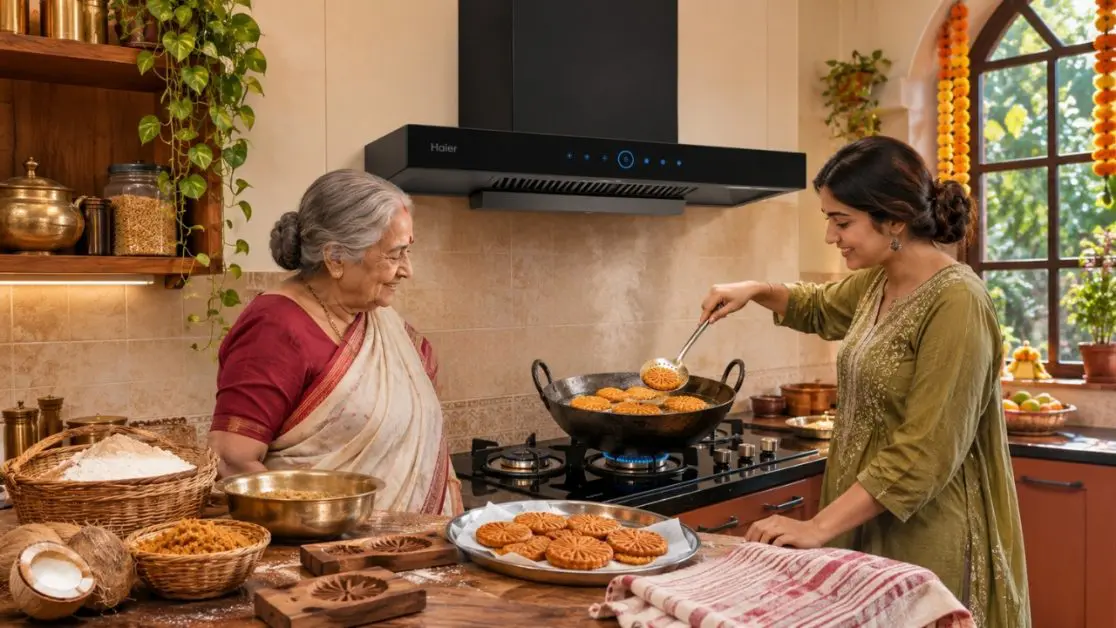
Thekua is traditionally made with wheat flour, jaggery or sugar and ghee or oil. The shaped dough is cooked slowly to give it this golden hue and crispiness.
It is possible to cook thekua in large quantities and then retain the cooking oil for a longer period of time as compared to quick frying.
In this process three factors affect kitchen fumes:
- The heated oil or ghee is emitting fumes and dust particles, especially at high temperatures.
- Dough loses moisture and releases steam which is combined with cooking vapours.
- If a fryer is used repeatedly, frying grease can collect around the fryer and cooking odours can build up.
As the oil heats up so much, there may also be visible smoke. This is a warning not to be given by raising the chimney suction.
Why Traditional Kadhais Need Special Attention
The need to pay particular attention to traditional kadhais.
Traditional kadai may be made of iron or steel, usually with a curved cooking surface that is broad. Fumes can rise from a relatively wide area depending upon the size of the fire and amount of oil.
Now visualize making thekua for the entire family. One batch is cooked and another is put in, and the stove is in use for quite a while.
If there is insufficient ventilation, grease particles can cling to the nearby cabinets, kitchen tiles, etc. and eventually settle.
This is where the kitchen chimney can be very helpful.
What Purpose Does a Kitchen Chimney Serve When Preparing Thekua?
Air is drawn through a kitchen chimney which can help to trap smoke, steam and grease-fumes from the cooking area.
A properly installed system will use an exhaust duct to expel the recaptured air to the outside.
This can minimize the frying vapors in the neighboring room, but the effectiveness is dependent on the installation, air flow, position of the chimney and heat level used in the frying process.
The selection of chimney with appropriate suction capacity and multiple fan speeds is of importance in traditional Indian cooking.
What Should You Look for in a Chimney for Deep-Frying?
There are different kitchen ventilation needs. The extraction arrangement may vary between a compact enclosed kitchen and a large open plan kitchen.
Consider these features:
- Effective suction capacity: Good in reducing fumes from cooking.
- Multiple speed settings: Can adjust airflow as needed for the intensity of the cooking.
- Flour and dough go into your hands, these are gesture controls.
- Heat Auto Clean: Eases the cleaning of the inner parts from the grease accumulation.
- Oil collector: Devices to collect grease that comes off during the cleaning process.
- Delay-off option: enables the chimney to run for a short amount of time after cooking.
When cooking traditional winter foods like several rounds of frying, these are important features.
Haier Kitchen Chimneys – Traditional Indian Cooking Chimneys

Haier India has kitchen chimney solutions to cater to daily cooking needs such as frying, tadka preparation and more, that create cooking fumes.
The Haier HIH-T1903, Haier HIH-T3903 and Haier HIH-T5905 are three models that are worth considering when deep frying in a kitchen.
1. The Haier HIH-T1903 Is a 1800 m³/h Suction Filter With Pyramid Filter Design
Haier Unique Pyramid Filter 1800 m³/h Suction Power Heat Auto Clean Chimney (HIH-T1903) is a combination of high suction power that features convenient controls.
It has a rated suction capacity of 1800 m³/h, suitable for extracting cooking vapors, which will work for those cooking thekua, pakoras and other fried foods.
Key features include:
- 1800 m³/h suction capacity.
- Double layer pyramid without filter.
- 3 speed settings and a 100-second Grand Turbo function.
- Touch and gestural controls.
- Use heat auto clean technology and oil collector.
- Reminder to clean after 15 operating hours.
- Three-minute delay-off function.
The variable speeds enable the user to adjust to varying cooking conditions when preparing thekua.
The gesture control is a godsend when it comes to shifting from shaping dough to watching the kadhai.
2. Haier HIH-T3903: 1800 m³/h Suction With Butterfly Filter Design
If you are looking for an alternative for the interior design, the Haier Unique Butterfly Filter 1800 m³/h Suction Power Heat Auto Clean Chimney (HIH-T3903) can be a solution.
This is a butterfly model without any filter and 1800 m³/h rated suction capacity.
It contains the following features:
- Touch and gesture operation.
- There are 3 different speeds as well as a Grand Turbo feature.
- Heat Auto Clean technology.
- Large oil collector that is used for collecting grease.
- Three-minute delay-off functionality.
- Reminder to clean after 15 total hours.
The suction and cleaning functions may be beneficial for those homes that are likely to cook fries and sweet dishes regularly on special occasions.
Importantly, Heat Auto Clean helps to remove grease in the chimney. It doesn’t mean that the oil collector has to be emptied and cleaned or other accessible surfaces have to be maintained.
3. Haier HIH-T5905: 2000 m³/h Suction for More Intensive Cooking
If multiple dishes are being prepared at the same time, the cooking fumes may be harder to control.
The Haier Unique Pyramid Filter 2000 m³/h Suction Power Heat Auto Clean Chimney (HIH-T5905) has a rated suction of 2000 m³/h.
Its features include:
- Suction capacity of 2000 m³/h.
- Double-layered pyramid with filters.
- Three speeds and 100-second Grand Turbo.
- Touch and gesture control.
- The use of this Heat Auto Clean technology on a large scale.
- Reminders for cleaning oil collectors.
- Three-minute delay-off function.
This is the reason this model is considered for the kitchens with more intense cooking needs for its higher suction rating.
But high suction value is not a measure of good fume capture. The correct placement of chimneys, ducting and kitchen air flow is still critical.
If You Have a Chimney, the Proper Way to Use It When Frying Thekua Is Its Most Important Aspect
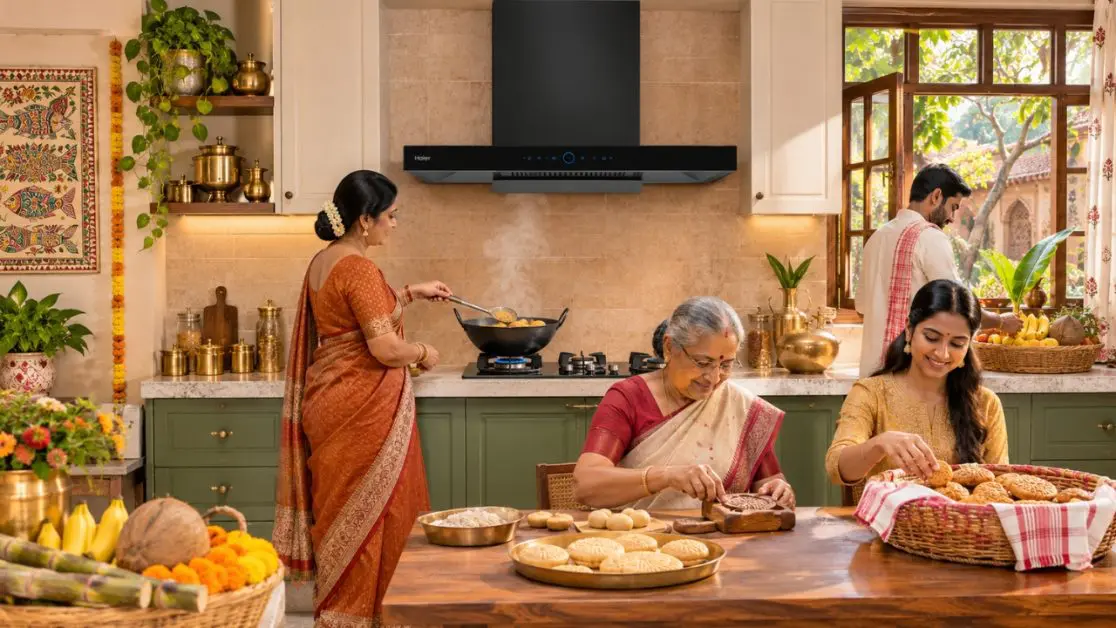
Even the best and the most powerful kitchen chimney is effective only when it is used properly.
Just a few changes to your cooking routine can make a difference.
Before the Frying: Set Up Kitchen
Turn the heating on for the oil/ghee a few minutes before it starts to melt in the chimney.
This creates some air flow around the cooking area prior to the beginning of fumes to rise.
Also:
- Position the kadhai in the centre under the capture area of the chimney.
- Keep the air inlet of the chimney clear.
- Select appropriate fan speed when preparing food.
- Ensure satisfactory replacement air flow, but not establish strong cross-draughts.
Avoid placing a powerful pedestal fan directly towards the stove. High crosswind speeds may help prevent fumes from being trapped by the chimney.
When Setting Up the Fryer, Control Heat and Suction at the Same Time While Frying
Thekua is usually fried at moderate heat and not at that high.
In case oil begins to smoke, lower the flame right away. A chimney by itself is not a safe way to regulate the temperature.
When frying:
- Care should be taken to not splash hot oil while adding the tea.
- Don’t over fill the kadhai.
- Keep the frying pan at a constant heat.
- When cooking fumes are more noticeable, increase the speed of the chimney.
- Keep children and unnecessary objects away from the hot cooking area.
The temporary boost is applicable when extra extraction is required and available on Haier models with Grand Turbo.
After Frying: Don’t Switch Off the Chimney Immediately
The last batch has been completed. The stove is off. But warm cooking vapours may still be present around the kadhai.
If the chimney is used for a short time after cooking, it will help to remove some of the remaining fumes.
This is performed by using the three minute delay off function on the HIH-T1903, HIH-T3903 and HIH-T5905.
After the cooking area is cool, clean around the cooking area and check the oil collector as needed.
Is It Possible to Remove Thekua Frying Smells Completely With a Chimney?
Frying odours can be reduced by the use of a chimney, as cooking fumes are drawn closer to their point of origin, but the use of a chimney will not make an oven free from frying odours.
Some odours can leak out before they get to the chimney, especially if there is a strong cross-draught, if the ducting is not right or after a long period of cooking.
For maximum benefits, along with using chimney extraction, use other simple kitchen strategies:
- Avoid having grease build up on kitchen surfaces.
- Cool and safely store the used cooking oil.
- Wash the kadhai and utensils when it is safe to touch them.
- Follow manufacturer’s instructions for the chimney maintenance.
- Avoid allowing oil to overheat or smoke.
Also, note that a kitchen chimney alone is not enough when using a gas stove to obtain sufficient ventilation.
The Selection of the Right Haier Chimney for Your Kitchen Is Crucial
Not all chimneys are created equal and the one with the highest suction rating isn’t always the best chimney.
Take into account the width of the hob, the type of chimney, ducting to get round the kitchen, the layout and how often you fry in the kitchen.
The Haier HIH-T1903 and HIH-T3903 are 1800 m³/h rated suction, with two different designs without filters, suitable for households that regularly make thekua and other deep fried food.
For the people who want to get a more powerful suction, the Haier HIH-T5905 delivers 2000 m3/h.
All three models include adjustable speeds, gesture controls, Heat Auto Clean and oil collection features for ease of chimney use and maintenance.
Discover the range of Haier India kitchen chimneys and select the one best suited for cooking style and space.
Don’t Let the Tradition Go, Take Control of the Fumes
One of the specialties of Chhath Puja is to make thekua in the traditional kadhai. This care over shaping, slow frying and familiar smell is memories to be preserved.
Don’t have to abandon traditions to manage cooking fumes.
By using a Haier Kitchen Chimney with suitable venting, wise frying and by the family preparing their favourite festive recipes, they can minimise the spread of grease-soaked cooking fumes.
Thekua can be kept traditional. The surrounding kitchen area will be easier to handle.
Frequently Asked Questions
Is a kitchen chimney useful when frying thekua in a kadhai?
Yes. A properly installed kitchen chimney helps capture smoke, steam and grease-laden cooking fumes generated during deep-frying, reducing their spread around the kitchen.
What suction capacity is suitable for deep-frying Indian snacks?
The appropriate suction capacity depends on kitchen size, hob dimensions, cooking intensity and ducting. Haier offers models with 1800 m³/h and 2000 m³/h rated suction capacities for consideration.
Should I use the highest chimney speed while making thekua?
Not necessarily. Choose the speed according to the amount of cooking fumes. Higher speeds may be useful during intensive frying, while lower settings may be sufficient during lighter cooking.
Does Heat Auto Clean remove all grease from the chimney?
No. Heat Auto Clean helps loosen accumulated grease and direct it towards the oil collector. Periodic cleaning and maintenance are still necessary.
Can I keep the chimney running after switching off the gas stove?
Yes. Running the chimney briefly after cooking helps extract residual fumes. The Haier HIH-T1903, HIH-T3903 and HIH-T5905 include a three-minute delay-off function.