
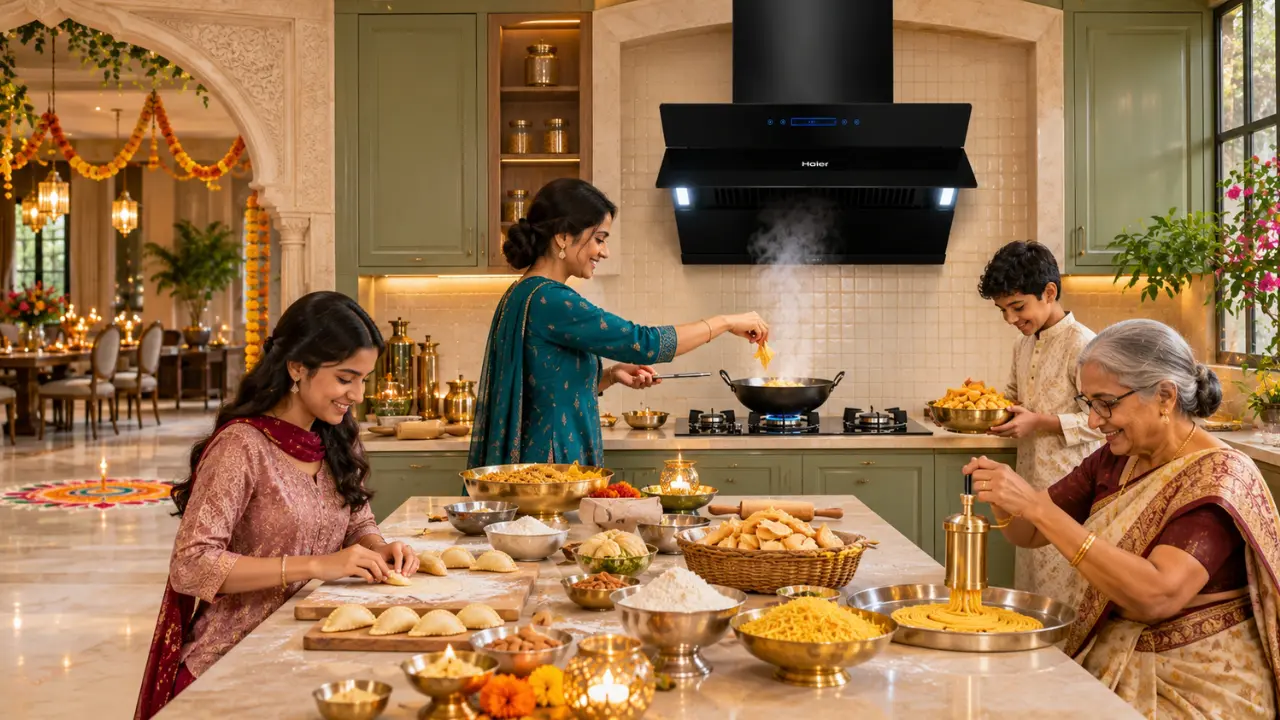

The first lot of crispy shankarpali is ready. Besan is getting ready for the next batch of sev; someone has begun to prepare gujiya filling. Meanwhile, the kitchen is becoming hot and the smell of hot oil is slowly entering the living room.
Doesn’t it sound like a typical Diwali preparation day?
Deep frying is a major element in festive cooking of the Indians. But, if several batches of snacks are prepared, then oil fumes, heat and airborne grease particles will be released and remain in the air for long after cooking.
Although it’s helpful to have a kitchen chimney, it’s also important to choose the correct fan speed as much as turning the fan on.
High chimney fan speed is generally good for deep frying during Diwali, if the smoke on the oil is more, otherwise medium speed can be used for lighter frying. It varies with the level of cooking, amount of food and chimney effectiveness in capturing the rising fumes.
What is the reason for having a higher chimney fan speed when deep frying?
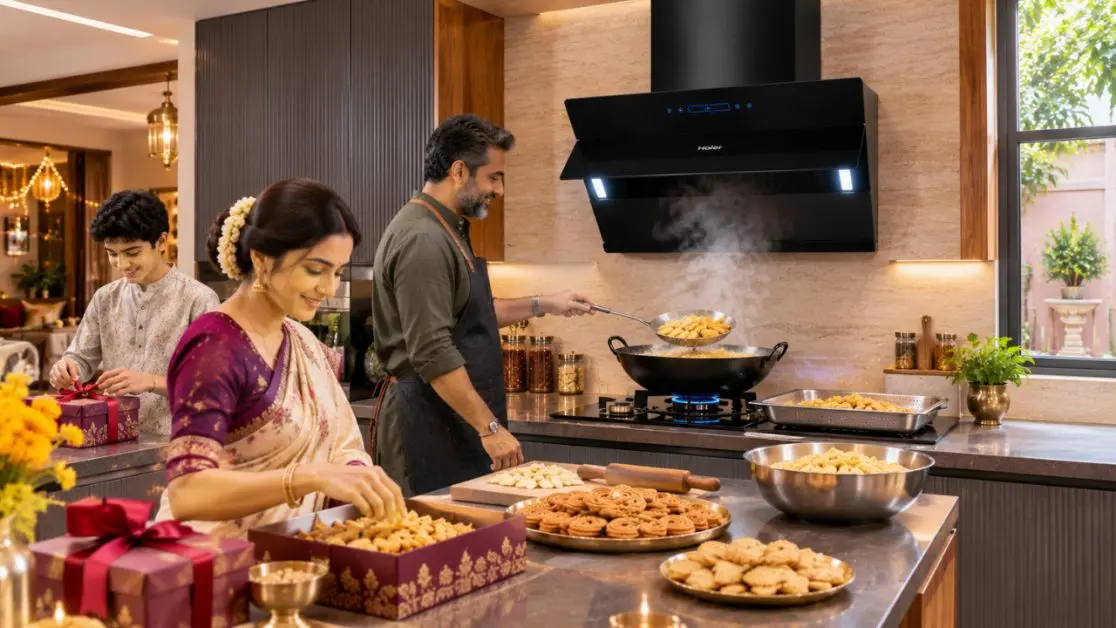
Consider the difference between making breakfast tea and frying 3kg of namak para.
Both require heating on the stove, and there are significant differences in the need for ventilation.
Deep-frying involves high-temperature exposure of hot oil for a long time. Moisture escapes from the oil as steam and fine oil droplets and other airborne particles may be released during the cooking process as ingredients are added to the oil.
The emissions are more prominent when multiple batches are made at once.
If the chimney fan is on, having it set to a higher speed may help to collect more of the air rising from the kitchen before it can spread across the room.
What will happen if the fan speed is too low?
If the extraction setting is set too low, cooking fumes can get past the chimney’s capture area.
You might notice:
- Odors from fried foods in adjacent rooms.
- Scuffed up around kitchen cabinets.
- Excessive fumes rising up towards the ceiling.
- Inability to cook food for longer periods without discomfort.
- Oil-related residues around the cooking site.
However, it is not always a good idea to use the maximum speed. The amount of fumes produced should be matched to the appropriate setting; not just cooked at full power.
What is the best Chimney Fan Speed for Various Diwali Snacks?
All Diwali recipes do not require the same amount of ventilation.
It’s not the same when a few papdis are fried as when a good number of chaklis are prepared for relatives and neighbours. Fumes emitted vary with cooking temperature, size of cooking batch and time of cooking.
Here is a simple strategy for selecting the right chimney setting.
Low Speed: For Light Cooking Between Frying Sessions
When the stove is used for relatively mild cooking with minimal fumes, a lower setting might be adequate.
For example:
- Preheating ingredients for sweet making.
- Slightly roasting spices over a controlled fire.
- Reducing visible fumes when cooking.
- Post-frying ventilation.
Generally, low speed is not appropriate if a lot of deep frying fumes are escaping into the kitchen.
Medium Speed: For Smaller Frying Batches
Making a little bit of mathri or frying some puris?
Medium may be sufficient for extraction if the oil temp is controlled and the fumes are limited.
Observe the rise of vapor towards the chimney. If it is continually blowing out the sides, up the fan speed.
High Speed: For Continuous Deep-Frying
When frying during intense Diwali, it is best to begin at a higher fan speed.
It can be really helpful when cooking:
- A big amount of shankarpali or namak para.
- Play and win Chakli and murukku in multiple rounds.
- Gujiyas which need to be fried long.
- Several pakoras or puris.
- Snacks at festive times based on repeated heating of oil.
What is crucial is to adjust the speed to the real cooking conditions.
Use a boost function on your chimney if it is fitted with one, to assist with occasional fume excesses. Operate according to the manufacturer’s directions.
How Haier Kitchen Chimneys Make Festive Cooking More Convenient
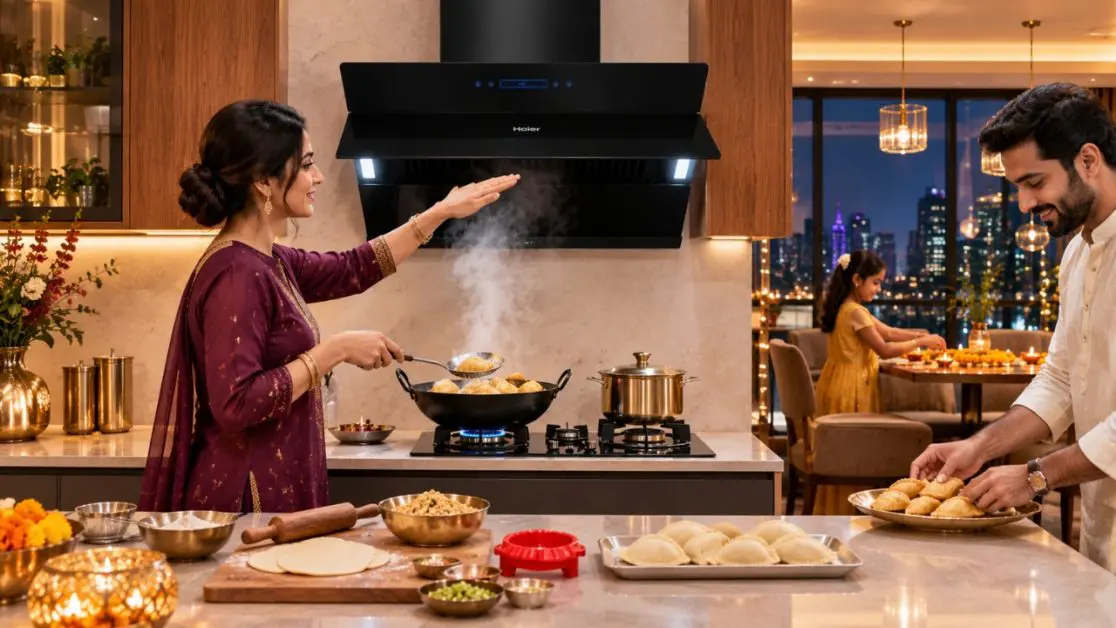
During Diwali preparations, fan speed shouldn’t become another thing you have to worry about.
Haier India provides kitchen chimneys that may be adjusted for different levels of cooking, using speed control.
Consider the following two models, Haier BLDC Motor with 1650 m³/h Suction Power Spin Clean Filterless Chimney (HIH-C1600-BLDC-IN) and Haier Colour User Panel with 1650 m³/h Suction Power Spin Clean Filterless Chimney (HIH-C1750-BLDC-IN).
Plenty of settings for both low and high temperatures, with a boost function to take the user between the two extremes of cooking and frying.
1. Haier HIH-C1600-BLDC-IN: Flexible Speed Control for Indian Cooking
The Haier BLDC Motor with 1650 m³/h Suction Power Spin Clean Filterless Chimney (HIH-C1600-BLDC-IN) has various speed setting options to meet the different cooking demands.
Its features include:
- Suction capacity 1650 m³/h, for cooking fumes.
- Eight fan speeds and boost for varying extraction intensity.
- Efficient and low noise BLDC motor design.
- Finger and gesture control functions for easy operation.
- Use Heat Auto Clean technology to aid in the removal of built up grease.
- Easy-to-maintain filterless design with oil collector.
Let’s say that you’re cooking gujiyas as another member of your family is setting up the Diwali decorations.Suppose that one member of the family is setting-up the Diwali decorations and another is cooking gujiyas. The adjustable speed control enables you to choose an appropriate extraction level while not disrupting your cooking process, as the intensity of the frying varies.
This gesture control is especially handy during the busy holiday season, when hands are otherwise busy with holiday cooking.
2. Haier HIH-C1750-BLDC-IN: Convenient Controls for Busy Kitchens
The other choice comes from Haier colour user panel, 1650 m³/h suction power spin clean filterless chimney (HIH-C1750-BLDC-IN).
This 75 cm chimney features a BLDC motor, touch and gesture operation and adjustable fan speeds.
It has the following main characteristics:
- Suction capacity of 1650 m³/h.
- A boost function and 8 programmable speeds.
- Use of Heat Auto Clean technology.
- Construction without filters and an oil collector.
- Reminder to clean after 30 total hours of operation.
- One-minute delay-off function.
The delay-off is great when you want to keep the chimney removing the fumes for a short period of time after cooking.
When cooking multiple Diwali dishes quickly one after another, having different fan speeds helps adjust to the ventilation requirements.
Three Stage Chimney Routine for Diwali Deep-Frying
A simple practice that will make a difference: don’t wait for fumes to accumulate in the kitchen before turning on the chimney.
Rather, plan ventilation throughout the cooking process.
Before Frying: Start the Chimney Early
Turn on the chimney just before heating the oil.
This is done to ensure air flow runs towards the extraction area before significant cooking fumes begin to form.
Also ensure that:
- The chimney’s air intake is unobstructed.
- The cooking vessel is placed in an appropriate position under the hood.
- The exhaust duct does not have any blockage.
- It is possible to supply fresh replacement air in the kitchen without generating strong cross-draughts.
During Frying: Match the Speed to the Fumes
Start at an appropriate setting (medium or high) depending on the amount of frying expected.
In case you are making a large quantity of chakli or gujiyas, a higher setting could be appropriate.
If there is a sudden increase in fumes, try to use the boost feature on a compatible Haier chimney.
Keep in mind that the fastest speed is not enough if the installation was not done correctly or it is affected by blocked ducting.
After Frying: Allow Residual Fumes to Clear
Do not turn off the chimney right after cleaning the last chimney.
Continue extraction until all the fumes are gone. In addition, the Haier HIH-C1600-BLDC-IN and HIH-C1750-BLDC-IN feature a one-minute delay-off function.
If cooking fumes still occur, additional ventilation might be required.
Does going as fast as the maximum make things work better all the time?
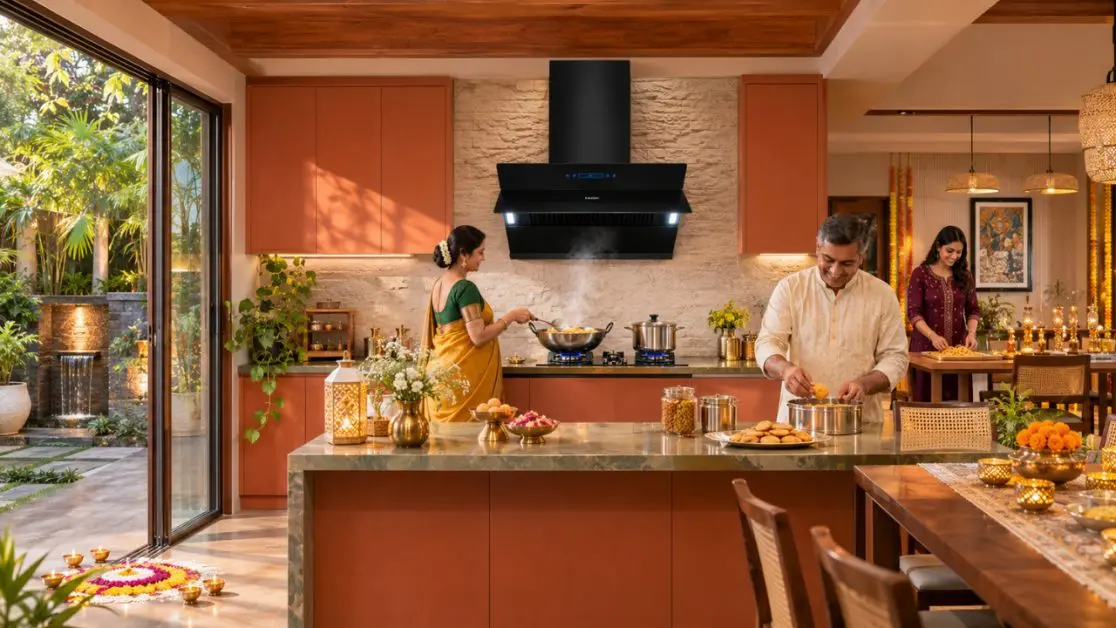
Not necessarily.
Generally speaking, higher fan speeds will provide more airflow but there are other factors, such as the location of the chimney, duct size, duct bends and air movement around it that will affect actual extraction.
A correctly installed chimney with a proper setting may even be able to capture fumes better than a poorly installed chimney operating at its maximum setting.
Another point is that high winds will cause fumes to rise above the cooking surface.
Therefore, do not point strong pedestal fans towards the stove while frying.
Preparing for the Next Holiday Dish with Your Chimney
Cooking for Diwali usually doesn’t stop with one snack. Another mathri may happen tomorrow, a family get together will occur over the weekend.
These are the times when regular chimney maintenance is particularly crucial.
Both had Haier chimney design, which has the function of “Heat Auto Clean” to help loosen the accumulated grease and guide it to the oil collector.
The cleaning reminder function also helps users to monitor the maintenance needs.
Some good common sense to consider:
- Examine the oil collector frequently in high intensity cooking.
- Drain and clean, following product directions.
- Clean accessible surfaces of the chimney for grease.
- Follow the suggested Heat Auto Clean procedure.
- Do not use the chimney when grease buildup or an obstruction poses a safety risk.
Even a chimney that is not equipped with a filter must be cleaned. The technology helps simplify cleaning; it doesn’t eliminate the need for it.
Make cooking Diwali easier with Haier India
Cooking for the holidays should involve enjoying shared comfort foods, not having to cope with lingering smoke all over the house.
Selecting the right kitchen chimney velocity can help to make daily cooking ventilation more effective, especially for frying multiple items at once.
The Haier HIH-C1600-BLDC-IN and HIH-C1750-BLDC-IN are equipped with eight speed settings, and with boost functionality, BLDC motor technology and Heat Auto Clean features, they provide practical choices to Indian households who want more control over kitchen ventilation.
Browse the kitchen chimney range at Haier India and select the one that matches your cooking style, hob size and kitchen setup.
After all, the aroma of freshly prepared Diwali snacks is welcome. Lingering cooking fumes? Not quite.
Frequently Asked Questions
Which chimney fan speed should I use for deep-frying puris?
Medium to high speed is generally suitable, depending on the quantity being fried and the amount of fumes produced. Increase the setting if fumes escape beyond the chimney’s capture area.
Should I use the chimney boost mode while frying Diwali snacks?
Boost mode can be useful during temporary increases in cooking fumes, especially when frying large batches. Use it according to your chimney’s operating instructions.
Can I keep my kitchen chimney running at maximum speed throughout Diwali cooking?
You can use higher speeds when needed, but maximum speed isn’t necessary for every cooking activity. Adjusting the setting to the actual ventilation requirement is generally more practical.
Do Haier kitchen chimneys offer multiple fan speeds?
Yes. The Haier HIH-C1600-BLDC-IN and HIH-C1750-BLDC-IN feature eight fan speeds and a boost function for different cooking intensities.
Does a filterless chimney require cleaning after deep-frying?
Yes. Filterless chimneys can still accumulate grease. Regularly inspect and clean the oil collector and follow the manufacturer’s recommended maintenance procedure.