


There’s a strong chance that your refrigerator takes no break in your kitchen. The washing machine is used for an hour, while the microwave can be used for a few minutes and the refrigerator is kept on all day.
Of course, there is a question that comes to mind. How many watts does a refrigerator use per month?
This will depend on how much capacity it has, how energy efficient it is, compressor technology and daily usage. Interestingly, this is not the case with a larger refrigerator, and you don’t have to expect an unreasonable electricity bill.
It is essential for Indian homes to know the electricity usage of their refrigerators, especially during the summer months when the heat in the rooms is likely to drive the refrigeration requirement up.
Let’s get a better feel for how power is used in a refrigerator, how to figure out the cost of electricity use in a month and fit Haier’s energy-saving refrigerator technologies into the equation.
How Many Joules Does a Refrigerator Use in a Month?

In India, the electricity consumed by the refrigerator is measured in monthly units of kilowatt-hours (kWh), which is also known as an electricity unit.
1 unit of electricity is 1 kWh.
Refrigerators run 24 hours a day, with compressors turning on and off or varying their speed to keep the temperature at a set level.
As an example, consider the Haier 445L 2 Star Bottom Mount Refrigerator.
Both models of Haier, HRB-4952BGKA-P and HRB-4952CKGA-P, are specified at 265.
If 265 kWh is used (which was the average annual energy consumption), the approximate monthly use would be:
265 ÷ 12 = 22.08 units per month.
This amounts to about 22 electricity units per month with the assumed annual consumption.
The real consumption, however, may differ in accordance with the plans of use, the temperature in the rooms, cooling systems and installation conditions.
The Monthly Electricity Cost of a 445L Refrigerator
Now let’s take a look at the approximate running cost, given different illustrative electricity tariffs.
| Electricity Rate | Monthly Consumption | Estimated Monthly Cost |
| ₹5 per unit | 22.08 units | ₹110 |
| ₹6 per unit | 22.08 units | ₹132 |
| ₹8 per unit | 22.08 units | ₹177 |
| ₹10 per unit | 22.08 units | ₹221 |
These are indicative costs, which are not guaranteed monthly running costs.
Electricity rates vary from state to state and company to company in India. Other applicable charges and fixed charges may also impact final charges, such as slab-based billing.
The important takeaway? When trying to figure out how much electricity your refrigerator uses, it’s much easier to do so by using the appliance’s annual energy rating, and not by its size.
What Causes Variations in the Amount of Electricity That a Refrigerator Uses?
Two households can buy the same refrigerator and have different electricity consumption.
Why?
Refrigerators are responsive; they react to their environment and how they’re used.
1. The Temperature of the Kitchen Can Have a Significant Impact
The temperature of the kitchen space can matter.
Suppose a refrigerator runs in a relatively cool kitchen room in Bengaluru.
Now, imagine the same refrigerator in an unventilated kitchen during the summer in Delhi.
The second refrigerator would have to operate more heavily to remove the heat and keep the temperature inside.
Increasing temperatures in the room could lead to more compressor operation and electricity use.
This is why positioning and venting a refrigerator are important, especially in Indian households which are subject to heat for such a long duration during summer.
2. Lots of Open Doors Lead to High Cooling Loads
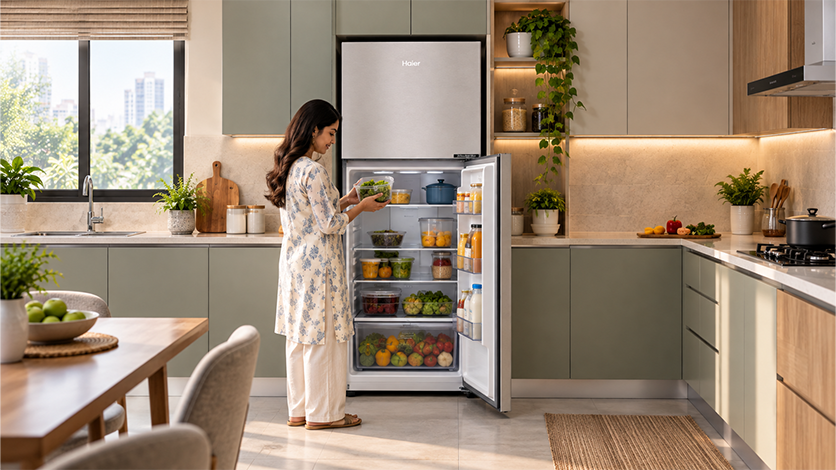
We’ve all done it.
Turned to the refrigerator, checked it out, shut it, came back two minutes later as we forgot what we were looking for.
Warm air enters the compartment every time the door is opened.
The appliance then has to dissipate the extra amount of heat to return to the set temperature.
Doors will open from time to time. But it’s important to remember, though, that leaving the door open needlessly consumes more energy.
3. Refrigerator Capacity and Storage Habits
The capacity of the refrigerator will affect its cooling needs, but only to a certain extent will that affect its electric consumption.
A sophisticated 445L refrigeration unit with a more efficient compressor design could run differently from an older 445L unit.
An overcrowded refrigerator can also limit the interior air circulation.
For effective cooling:
- Don’t obstruct internal air vents with food containers.
- Allow for good air circulation.
- Cool hot cooked food in the correct manner before storing it in the fridge.
- Keep frequently used items in order.
- Don’t open the refrigerator door when setting out the groceries.
These common routines help the refrigerator to function as designed.
Understanding Refrigerator Star Ratings in India
Refrigerator star ratings in India are an important consideration.
When purchasing a refrigerator, you’ve probably noticed the star rating displayed on its energy label.
What does it truly imply, though?
Under the Energy Conservation Act in India, the Bureau of Energy Efficiency (BEE) provides star ratings to facilitate consumers in making an informed choice about the energy performance of appliances in the applicable product group.
In general, the more stars a particular product receives, the more energy-efficient its energy performance will be according to the rating system.
But there’s an important piece of information that buyers may miss.
Choose a 5-star refrigerator, but not necessarily the one with the lowest electricity rating for all capacities and categories.
When comparing two models of refrigerators, just comparing their star ratings would not give a full picture. For example, consider a compact refrigerator compared with a model with a large bottom-mounted compressor.
Before You Purchase, What Should You Look At?
Don’t judge by the number of stars.
Consider:
- The electricity consumption of the equipment, as specified on the energy label, over a specified period annually.
- The refrigerator volume in litres.
- Compressor technology.
- Cooling and temperature controls.
- The amount of kitchen space required and the need for ventilation.
- The actual amount of food storage required in your home.
In addition, make comparisons of the ratings of similar labels where possible, as energy efficiency standards can vary over time.
While a refrigerator’s star rating offers some information, it may not be enough to make a practical choice.
How Haier Refrigerator Technology Is Helping to Address the Issue of Energy-Conscious Cooling

The decision to choose a refrigerator is not just about the electric power that it consumes.
Other room requirements for the typical Indian family include adequate storage, reliable cooling and easy access to everyday food.
Here, Haier India’s 445L Bottom Mount Refrigerator range deserves recognition.
Consider two models:
- Haier 445L 2 Star Graphite Black Bottom Mount Refrigerator (HRB-4952BGKA-P)
- Haier 445L 2 Star Black Glass Bottom Mount Refrigerator (HRB-4952CKGA-P)
Both models feature ample storage and features that aid in cooling and everyday use.
Triple Inverter and Dual Fan Technology
The Haier refrigerator’s special features include Triple Inverter and Dual Fan Technology.
The technology is intended to enable cooling to be carried out in an efficient and effective manner whilst keeping food fresh.
Inverter-based compressor systems can operate in a variable manner to meet the cooling needs instead of constant-speed operation.
This is one reason why it is important to look at compressor technology when making refrigerator electricity consumption comparisons.
When it comes to actual savings in energy, however, it will depend on the model, operating conditions and usage.
Convenient Digital Control Panel for Temperature Control
Consider how many times you open the refrigerator only to change a setting.
The digital control panel on these Haier models lets you control the refrigerator without opening the door.
This is especially handy during busy mornings when several family members are getting ready to make lunchboxes or breakfast.
Less need to open the door also means less warm air intrusion.
14-in-1 Convertible Modes
The storage needs of Indian households vary over the course of the year.
In festive periods, there may be a need for extra space for sweets, prepared food and food ingredients.
On regular school days, your needs may be entirely different.
The 14-in-1 Convertible function is designed to cater to the varying needs for storage.
The flexibility makes it possible for existing users to modify the way the refrigerator is used to meet their needs.
Important: Convertible modes should not be used with the assumption that they automatically save electricity, but should be chosen based on the manufacturer’s instructions.
Why Are Haier’s 445L Bottom Mount Refrigerators Practical for Indian Families?
Yes, of course, electricity efficiency is important.
A refrigerator must also aid in making day-to-day tasks simpler in the kitchen.
Haier’s 445L Bottom Mount models are smartly designed to cater to some of the practical demands of Indian homes.
A Bottom-Mounted Freezer for Easier Access
Typical refrigerators have the freezer on top of the fresh-food area.
Haier’s design is the opposite, with the freezer mounted at the bottom.
The fresh-food section will stay at the more convenient height, so that more frequently used foods, like vegetables and milk, as well as fruits and prepared foods, are within easy reach.
Haier’s Jhukna Mat is claimed to cut bending by up to 90%.
This may be a significant change for families who consume fresh ingredients more than once a day.
Bigger Vegetable Storage
Many Indian homes make weekly trips to the veggie shop.
There’s a lot of different vegetables and some seasonal items to add to the list of foods that need to be stored, from tomatoes and capsicum to leafy vegetables and seasonal produce.
These Haier models have a 2X Bigger Vegetable Box, offering extra space for fresh produce.
Organised storage also makes it simple to find ingredients without having to open the refrigerator door needlessly.
Home Inverter Connectivity
In some Indian locations, power outages are still an issue.
These Haier refrigerators feature a Home Inverter connectivity option that enables them to power on when the electricity goes out if there’s a home inverter system in place.
This aids in the maintenance of cooling when appropriate backup power is available.
The duration of backup, of course, will depend on the inverter system connected, the battery size and the total electrical load.
Warranty Coverage
The two-year comprehensive product warranty and ten-year compressor warranty are stated for each model, subject to their terms and conditions.
This is an extra level of comfort if you are buying a fridge for everyday use around your home.
How to Save Electricity in the Refrigerator: 7 Practical Ways
It is not always necessary to buy a new refrigerator to use it more efficiently.
Some common-sense practices can make a difference.
- Set temperatures within appropriate levels. Typical temperatures for the refrigerator compartment and freezer are around 3°C to 5°C and -18°C, respectively, for food storage. Follow the appliance’s instructions.
- Maintain the cleanliness of the door gasket. Rubber seal dirt or damage may cause the door to not seal properly or may admit warm air.
- Do not put the refrigerator near heat sources. The requirement for cooling may be greater in direct sunlight, in the presence of cooking appliances and with excessive surrounding heat.
- Maintain proper ventilation. Follow the manufacturer’s recommended clearance around the appliance to allow heat to escape.
- Check door closure. Even a slightly open refrigerator door will have a considerable impact on cooling.
- Don’t overload the compartments. Allow sufficient internal ventilation and make the best use of available storage.
- Check for abnormal usage of electricity. If the refrigerator suddenly starts to use more electricity, examine the refrigerator’s settings, door seals and ventilation. If the issue persists, get professional repairs.
Changing some of these settings might seem minor in isolation, but refrigerator efficiency goes hand in hand with daily use.
How to Measure the Real Monthly Electricity Consumption of Your Refrigerator
To get a better sense of how much electricity a device consumes than what is listed by the manufacturer in an annual rating, you must measure it.
There is a compatible electricity consumption meter that may be available to record the electricity consumed by an appliance during a period of time.
It’s more helpful to monitor refrigerator use for a few days or weeks than for an hour.
Then you can work out the approximate monthly cost.
For example:
If your refrigerator uses 24 units in 30 days and your applicable electricity rate is ₹8 per unit:
24 × ₹8 = ₹192.
Assuming no other charges in the bill, the estimated energy charge on your refrigerator for that month would be ₹192.
Keep in mind that electricity use can vary from summer to winter, and one month’s reading should not be viewed as a constant.
Make Every Unit Count With Haier India
Any refrigerator is a long-term investment for the household, so its value should be gauged by more than its upfront cost.
Everything from electricity use to flexibility in storage, cooling technology and convenience should be considered.
For families seeking a large refrigerator that can serve them well, the Haier 445L 2 Star Bottom Mount Refrigerator range has two fantastic choices.
The Graphite Black HRB-4952BGKA-P finish adds a tinge of elegance, and the Black Glass HRB-4952CKGA-P provides a unique modern look.
They all have Triple Inverter and Dual Fan Technology, 14-in-1 Convertible Modes, a bottom-mounted freezer and a digital control panel, all with ease of use in mind.
Take a look at the refrigerator collection from Haier India and understand the specifications, energy consumption and select a model that is best suited for your family’s storage requirements.
Because the right refrigerator shouldn’t simply keep your food cool. It should make everyday cooking life easier and more convenient and give you the information you need to make informed choices about electricity consumption.
Frequently Asked Questions
1. How many units of electricity does a refrigerator consume per day?
Daily consumption depends on the refrigerator’s annual energy rating and operating conditions. A refrigerator rated at 265 kWh annually would average approximately 0.73 units per day based on its rated consumption.
2. Does a refrigerator consume electricity continuously?
A refrigerator remains connected to electricity throughout the day, but its compressor does not necessarily operate at full capacity continuously. Compressor operation changes according to cooling requirements and the appliance’s technology.
3. Does a bigger refrigerator consume more electricity?
Not necessarily in every comparison. Larger refrigerators generally have greater cooling requirements, but actual consumption also depends on energy efficiency, insulation, compressor technology and usage conditions.
4. How much electricity does a 445L Haier refrigerator use monthly?
The Haier 445L 2 Star Bottom Mount models HRB-4952BGKA-P and HRB-4952CKGA-P list an energy consumption figure of 265. Interpreted as annual kWh consumption, this works out to approximately 22.08 units per month. Actual consumption can vary.
5. Can an inverter refrigerator help reduce electricity consumption?
Inverter compressor technology can adjust compressor operation according to cooling demand, supporting efficient temperature management. However, actual electricity savings depend on the refrigerator model, usage and operating conditions.
6. Should I switch off my refrigerator at night to save electricity?
Generally, no. Refrigerators are designed to maintain safe food storage temperatures continuously. Switching them off overnight can allow stored food to warm to unsafe temperatures, particularly during Indian summers.