
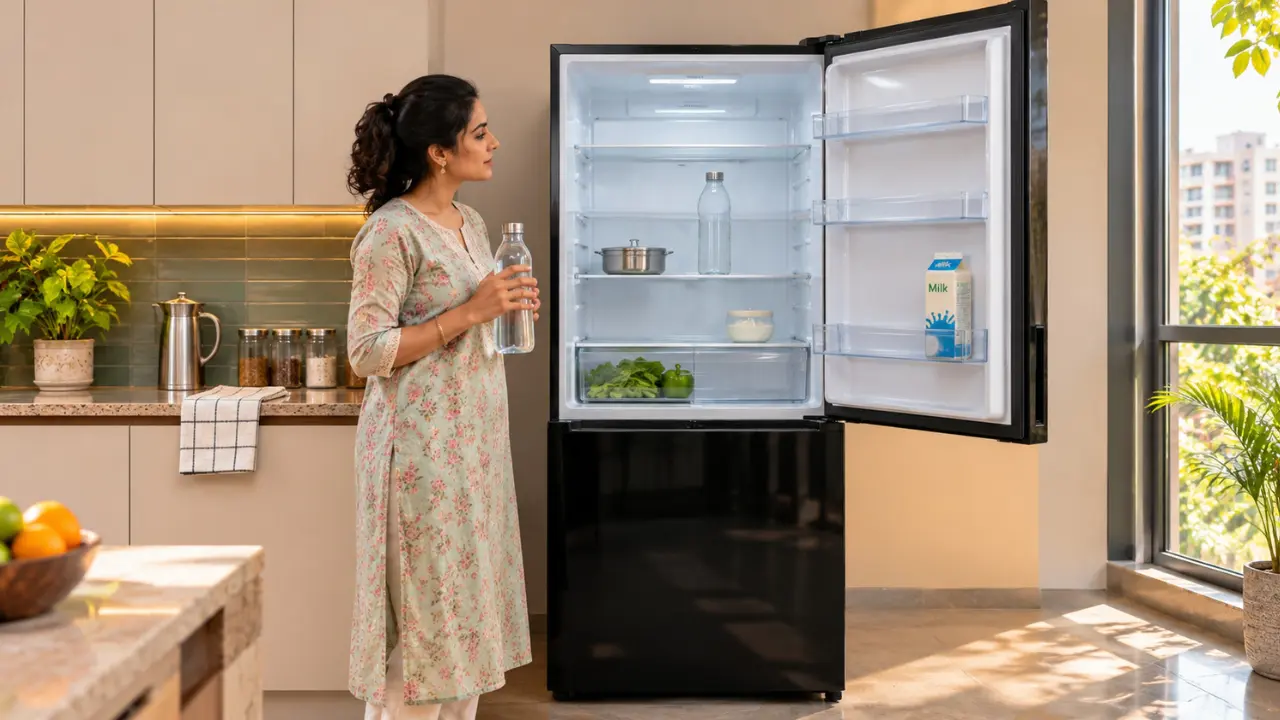

You open your refrigerator and notice that nearly half your shelves are empty. You take out a bottle of cold water. Maybe the weekly grocery shopping hasn’t been done yet, or most of the food has already been used. In either case, the refrigerator continues running.
So, here’s an interesting question. Do you think your refrigerator uses more power when it is empty?
Not quite as simple as you may think.
An empty refrigerator can lose its cool air faster when the door is opened, while a partially full refrigerator is more stable in cooling because of the food and drinks inside. But that doesn’t necessarily mean a full refrigerator will use fewer units of electricity.
This difference can be useful in Indian households, which use refrigerators all year round and experience high temperatures during summer, to manage electricity usage while maintaining food safety.
Let’s find out what is really happening inside your refrigerator and how you can make everyday cooling easier by selecting the right refrigerator.
Does an Empty Refrigerator Cost More to Run?

An empty refrigerator does not necessarily use more electricity than a full refrigerator. However, if the refrigerator is moderately full, it can maintain its internal temperature better, even when the doors are opened frequently.
Here’s why.
When the refrigerator door is opened, some cold air escapes from the refrigerator and hot air from the room enters. The refrigerator then has to remove the additional heat to bring the temperature back down to the set value.
There is comparatively less food or drink stored in the refrigerator to help keep its internal temperature regulated when the refrigerator is nearly empty.
The thermal mass of a refrigerator containing chilled food, drinks, and other items is greater. These materials retain their temperature longer than air and help reduce temperature fluctuations.
However, there is one key difference.
When the refrigerator is packed with groceries, it takes energy to cool the products added to it. The compressor must work harder initially if you put several kilograms of room-temperature food into it.
So, electricity consumption will be influenced by the following:
- Cooling technology and energy efficiency of the refrigerator.
- The temperature of the products being stored.
- The number of times the refrigerator door is opened.
- The ambient temperature of the room.
- The condition of the door gasket.
- Space for adequate ventilation.
The practical takeaway? It makes sense to have a partially filled refrigerator, but a heavily stocked refrigerator won’t necessarily save you money on your electricity bill.
What Happens Inside an Empty Refrigerator?
Imagine a typical Sunday afternoon in an Indian home.
A few vegetables, two water bottles, and some leftover dal are present in the refrigerator. Someone opens the door to see what is cold, keeps it open for a few seconds, and then closes it again.
Now the cooling system has to cope with the warmer air introduced.
Cold Air Can Escape More Easily Than You Think
Air is a relatively poor heat storage medium compared with water and most foods.
If there are only a few items in the refrigerator, the air may warm up fairly quickly after the door is opened.
Stored food, however, experiences a slower temperature change.
That is why a moderately filled refrigerator can provide more stable cooling during normal family use.
The electricity needed to cool the air itself, however, is relatively low. Other factors that affect energy consumption include the frequency of door openings, the amount of moisture that enters the cabinet, and the overall efficiency of the appliance.
The Compressor Still Has a Job to Do
Heat slowly enters the refrigerator through its insulated walls and door seals, even when the refrigerator is not opened.
This heat must be removed by the compressor and cooling system to maintain the desired temperature.
This means that the refrigerator, even when it is empty, uses electricity.
Simply removing the groceries is not enough to eliminate the appliance’s cooling requirements.
Which Is Better: Empty, Half-Full, or Completely Packed?

The relationship between the amount of food inside your refrigerator and its cooling behaviour is not as straightforward as assuming that more food means less electricity consumption.
Let’s explore how various storage conditions influence typical use.
1. Almost Empty Refrigerator
An almost empty refrigerator contains very little thermal mass.
This can cause the internal air temperature to fluctuate more noticeably when the door is opened.
But an empty refrigerator doesn’t have as much food to cool initially.
This doesn’t necessarily make it the least energy-efficient storage condition either.
2. Moderately Filled Refrigerator
This is a practical arrangement for most Indian families.
The temperature stability of chilled items helps a refrigerator store everyday groceries, cooked food, milk, fruits, and beverages.
It also leaves ample space to arrange groceries without blocking the airflow.
This makes storage convenient and helps maintain more consistent cooling conditions.
3. Overloaded Refrigerator
Now think about coming back from a big shopping trip to the supermarket.
Somehow, you get everything inside. There’s no space to pull out the milk, no room for the vegetable packets, and very little space for the containers.
This isn’t ideal.
If the refrigerator is frost-free, overloading can restrict the circulation of cooled air around the interior.
There may be some parts that are warmer than others, which can affect food storage conditions.
The more effective approach is to leave enough room between stored items and ensure there are no obstructions to the air vents.
How Haier Refrigerators Support Efficient Cooling in Indian Homes
It is beneficial to understand how much electricity a refrigerator uses. It is also important to pick a refrigerator specifically designed to fit your family’s actual storage needs.
Haier India’s bottom-mounted refrigerators combine practical storage arrangements with cooling technologies designed for everyday homes.
For instance, the Haier 445L 2 Star Graphite Black Bottom Mount Refrigerator (HRB-4952BGKA-P) and the Haier 445L 2 Star Black Glass Bottom Mount Refrigerator (HRB-4952CKGA-P) are two examples.
Both models have 445 litres of capacity, making them suitable for larger households that need plenty of room for fresh food and frozen goods.
More significantly, their features address a number of common refrigeration concerns.
Triple Inverter and Dual Fan Technology
Cooling depends on more than the amount of food you store in the refrigerator.
Both Haier 445L models incorporate Triple Inverter and Dual Fan Technology, which Haier describes as supporting freshness and energy savings.
The technology assists the refrigerator’s cooling operation, while the dual-fan system helps manage cooling across compartments.
Reliable cooling is an important consideration for Indian families storing everything from fresh vegetables to cooked food.
Actual electricity consumption will still vary depending on usage patterns and environmental conditions.
14-in-1 Convertible Modes for Changing Storage Requirements
Storage needs in Indian households seldom remain the same throughout the year.
Refrigerators may need to accommodate extra sweets, ingredients, and prepared dishes during festivals.
At other times, families may need greater flexibility between fresh-food and frozen-food storage.
Both Haier models offer 14-in-1 Convertible Modes, giving users the flexibility to choose the refrigerator’s storage configuration according to their needs.
This flexibility is especially beneficial when storage requirements change between regular weekdays and special occasions.
Instead of considering whether your refrigerator is full or empty, think about how effectively its available space works for your family.
Digital Control Panel for Easy Use
Air moves between the inside and outside of the refrigerator every time the door is opened.
Haier’s 445L refrigerators feature a Digital Control Panel that can be used to manage refrigerator settings without opening the door.
This is useful for families who frequently change settings depending on their storage needs.
It also reduces the need to open the door unnecessarily just to access the controls.
Why Storage Organisation Matters More Than Filling Every Shelf
The refrigerator shouldn’t be a puzzle of items that must be taken out one after another just to get the one you want.
Good organisation can simplify everyday use and reduce unnecessary time spent opening the doors.
Both Haier models feature a 2X Bigger Vegetable Box, which offers more room for fresh produce.
Consider a typical Indian supermarket shopping list.
Potatoes, tomatoes, carrots, capsicum, leafy vegetables, and seasonal fruits can fill up a lot of valuable refrigerator space in no time.
A dedicated vegetable compartment keeps produce neatly organised rather than spread across different shelves.
Bottom-Mounted Design for Everyday Convenience
These Haier refrigerators have the refrigerator compartment positioned above the freezer.
This design allows easier access to foods that are used regularly, particularly fresh ingredients.
Haier calls this feature Jhukna Mat, highlighting reduced bending of up to 90%.
The arrangement can make everyday kitchen tasks more convenient in households that need fresh ingredients, milk, and cooked food multiple times throughout the day.
The models are also equipped with toughened glass shelves that can accommodate regular Indian kitchen utensils and containers.
Seven Practical Tips to Reduce Refrigerator Electricity Consumption
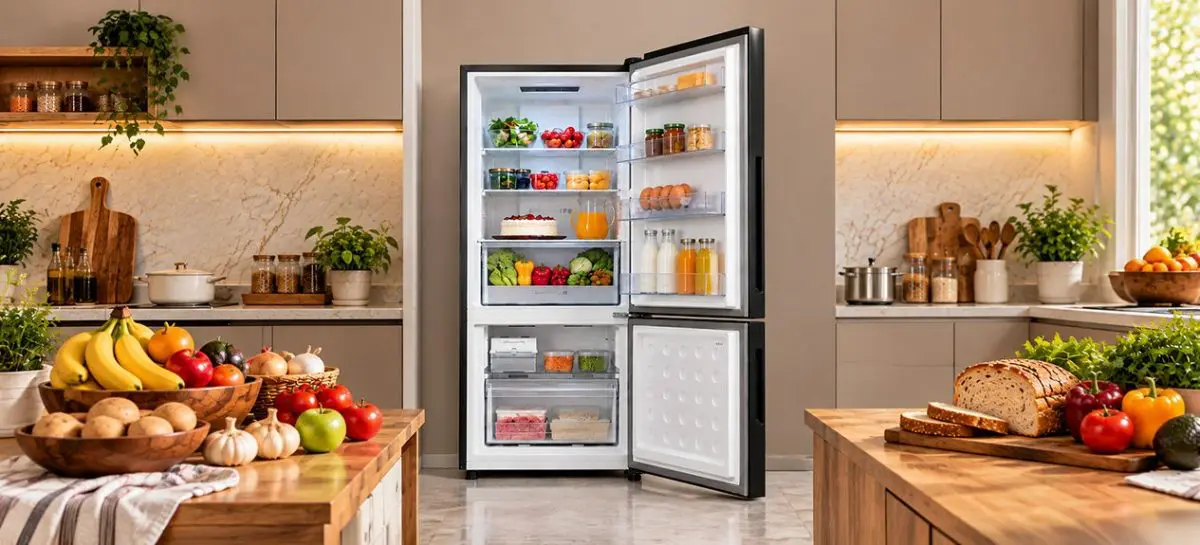
From a nearly empty fridge to a well-stocked one, everyday habits can influence electricity consumption.
Here are some useful tips and tricks.
1. Do Not Open the Doors Unnecessarily
Before opening the refrigerator, decide what you need.
Frequently leaving the door open introduces warm air and makes the cooling system work harder.
2. Let Hot Food Cool Before Refrigeration
Avoid placing steaming-hot vessels directly inside the refrigerator.
Allow food to cool sufficiently before refrigerating it promptly in shallow, covered containers. Avoid leaving perishable food at room temperature for extended periods.
3. Keep the Appropriate Temperature Settings
The refrigerator compartment should be around 4°C or lower, and the freezer should be around -18°C for everyday food storage.
When selecting settings, follow the manufacturer’s instructions for the particular appliance.
4. Do Not Block Air Vents
Avoid pushing containers against cooling vents.
Good airflow helps maintain more even temperatures throughout the refrigerator.
5. Check and Maintain the Door Gasket
If the gasket is damaged or does not seal properly, warm air may continually enter the refrigerator.
Check and clean the seal regularly according to the manufacturer’s recommendations.
6. Ensure Adequate External Ventilation
There must be sufficient space around the refrigerator’s exterior to release heat.
Do not install the appliance tightly against other surfaces. Follow the recommended clearances in the installation manual.
7. Select Capacity Based on Household Needs
A refrigerator that is significantly larger than necessary may use more electricity overall than a suitably sized refrigerator.
Compare capacity, energy ratings, and annual energy consumption when buying.
Understanding the Energy Rating of Haier’s 445L Refrigerators
For Indian consumers, the BEE star rating is an important factor to consider when selecting a refrigerator.
Both Haier 445L bottom-mounted refrigerator models have a 2-Star energy rating.
Their product specifications also include an energy consumption figure of 265 in the context of annual energy consumption.
This information is useful when comparing refrigerator models.
Keep in mind, however, that energy consumption figures are obtained under specified test conditions.
Electricity consumption may vary depending on ambient temperature, door-opening frequency, temperature settings, and food-loading patterns.
For example, a refrigerator used in a hot kitchen during summer might have different cooling requirements from the same refrigerator operating in a cooler environment.
A higher BEE star rating generally indicates better energy efficiency within the applicable product category and rating period.
So, check the relevant BEE label details alongside capacity and features before buying.
Which Haier 445L Bottom-Mounted Refrigerator Should You Consider?
Both refrigerators highlighted in this article have similar core cooling and storage technologies. If you’re looking for a large refrigerator for your home, their main differences lie in their exterior finishes and certain design details.
Haier 445L 2 Star Graphite Black Bottom Mount Refrigerator (HRB-4952BGKA-P)
This model comes in a Graphite Black finish and has a recessed handle.
Its key features include:
- 445L total storage capacity.
- Triple Inverter Technology and Dual Fan Technology.
- 14-in-1 Convertible Modes.
- Digital Control Panel.
- 2X Bigger Vegetable Box.
- 1 Hour Icing Technology.
- Stabiliser-free operation under specified operating conditions.
- Home inverter connectivity for compatible backup systems.
The Graphite Black finish offers a modern appearance that can complement various kitchen styles.
Haier 445L 2 Star Black Glass Bottom Mount Refrigerator (HRB-4952CKGA-P)
The Black Glass variant is suitable for those who prefer a glossy exterior.
Its features include:
- 445L total capacity.
- 2-Star energy rating.
- Triple Inverter and Dual Fan Technology.
- 14-in-1 Convertible Modes.
- Digital Control Panel.
- 2X Bigger Vegetable Box.
- Toughened Glass Shelves.
- Twist Ice Maker.
- Home inverter connectivity.
Both models list a two-year complete product warranty and a ten-year compressor warranty, subject to applicable terms and conditions.
Ultimately, the choice depends on your kitchen’s design, the amount of storage you need, and the exterior finish you prefer.
Make Refrigerator Efficiency a Part of Everyday Life With Haier India
A refrigerator that isn’t full doesn’t have to be a major electricity consumer, nor is a completely packed refrigerator automatically more efficient.
It’s all about how effectively your refrigerator keeps food cold, accommodates your groceries, and fits your lifestyle.
Haier India’s 445L bottom-mounted refrigerators are worth considering for households that require generous storage space and flexible cooling options.
The Haier HRB-4952BGKA-P and HRB-4952CKGA-P feature Triple Inverter and Dual Fan Technology, 14-in-1 Convertible Modes, convenient digital controls, and thoughtfully designed vegetable storage.
Learn more about Haier India’s refrigerator range and select the model that meets your family’s storage requirements, kitchen space, and energy-efficiency priorities.
Not all refrigerators are created equal. The right one isn’t just about how much food fits inside the unit. It’s about maintaining proper food storage conditions and making everyday home cooking easier.
Frequently Asked Questions
Does an empty refrigerator consume more electricity?
Not necessarily. An empty refrigerator may experience greater internal air-temperature fluctuations when its door opens, but actual electricity consumption depends on cooling technology, ambient conditions, and usage patterns.
Is it better to keep a refrigerator half-full?
A moderately stocked refrigerator is practical because chilled food helps stabilise internal temperatures while leaving room for air circulation. However, there is no universal filling percentage that guarantees minimum electricity consumption.
Does putting more food in the refrigerator save electricity?
Not automatically. Already chilled food can help maintain temperature stability, but adding warm groceries increases the initial cooling load. Overloading can also obstruct airflow.
Should I switch off my refrigerator when it is empty?
If the refrigerator will remain unused for an extended period, switching it off may be appropriate. Remove all food, clean and dry the interior, and follow the manufacturer’s storage instructions to prevent unpleasant odours and moisture buildup.
Do inverter refrigerators help reduce electricity consumption?
Inverter technology can improve cooling efficiency by adjusting compressor operation according to cooling requirements. However, actual energy savings depend on the refrigerator model, operating conditions, and usage.
What is the ideal refrigerator temperature for Indian homes?
A refrigerator compartment temperature of approximately 4°C or below and a freezer temperature of -18°C are generally recommended for safe food storage. Follow the manufacturer’s instructions for temperature adjustment.