
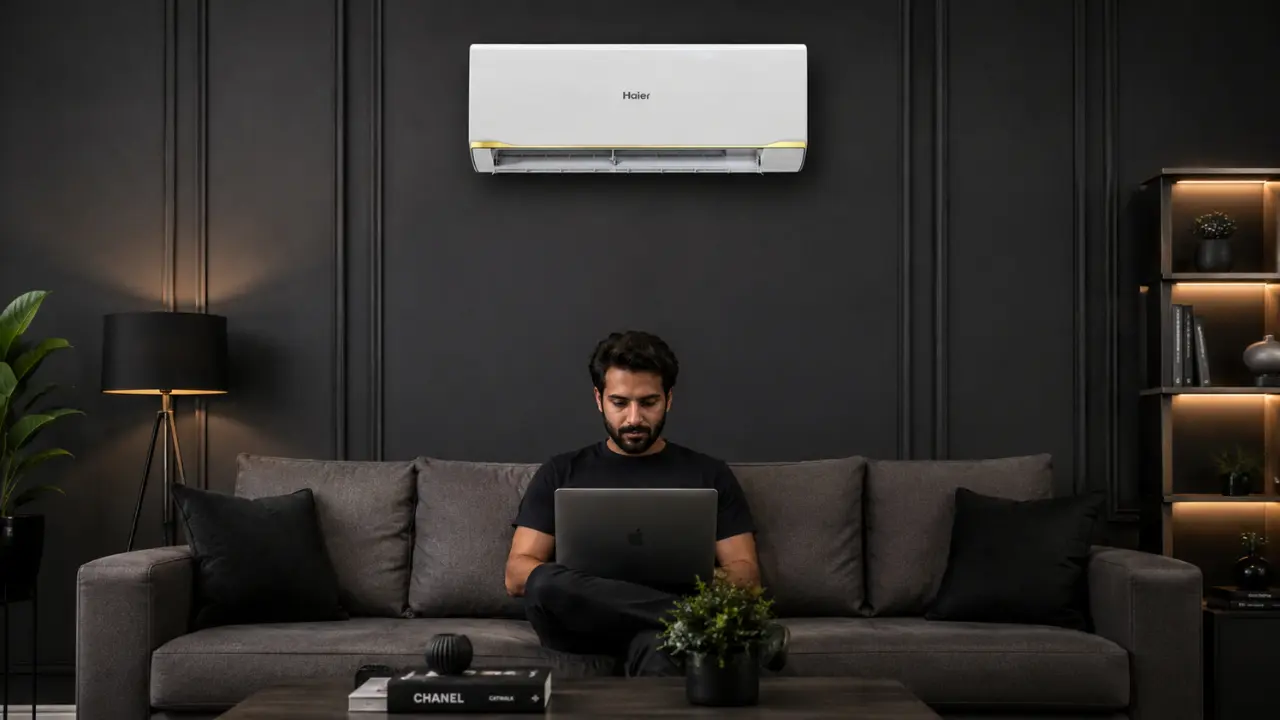

Choosing an AC for your bedroom versus your living room is not about brand or price. It is about how the room is used. Bedrooms need quiet, consistent cooling for long hours.
Living rooms need fast, powerful cooling for larger, dynamic spaces. Different Usages. Different systems.
Why does the same AC not work for every room?
It is 11:30 PM.
The bedroom lights are off. The AC hums softly. You want cool air. No noise. Not airflow hitting your face. Just comfort.
Now switch scenes.
It is Sunday afternoon. The living room is full. Family. TV. Maybe sunlight pouring in from a balcony. The same AC now struggles. It cools slowly. The room feels uneven.
Same house. Same AC.
A completely different experience.
Cooling is not about temperature. It is about context.
The hidden system behind AC decisions

Most people choose an AC based on:
- Price
- Brand
- Star rating
But the real system looks like this:
- Room size
- Usage pattern
- Heat load
- Occupancy
- Time of use
Miss this, and even the best AC feels average.
Understand this, and even a simple AC feels perfectly tuned.
Bedroom AC vs Living Room AC: What actually changes?
1. Purpose defines performance
A bedroom is a recovery space.
A living room is an activity space.
That one difference changes everything.
Bedroom cooling is about stability.
Living room cooling is about speed.
2. Cooling behaviour: Slow and steady vs fast and responsive
Bedroom AC needs:
- Consistent temperature through the night
- Low noise levels
- Gentle airflow
- Energy efficiency for 6 to 8 hour usage
Living room AC needs:
- Fast cooling when switched on
- Strong airflow across a larger area
- Ability to handle heat from people, lights, and devices
- Flexible power modes for changing conditions
For example, the Haier 1.8 Ton 5 Star Desert Rose Air Conditioner (HSA20DSD-NAI5NB-I) is designed with supersonic cooling in 10 seconds, making it ideal for spaces that demand quick temperature drops like living rooms
3. Room size is not just square feet. It is behaviour
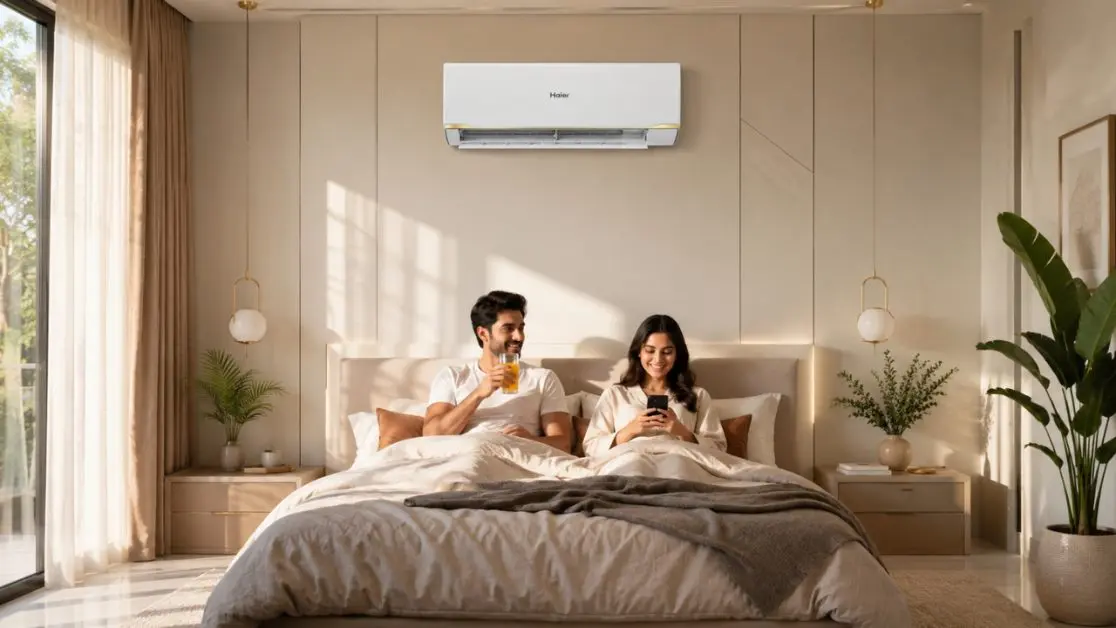
Bedroom reality
- Closed doors
- Fewer people
- Limited sunlight
- Stable environment
Typical requirement:
- 1 Ton to 1.5 Ton AC
Living room reality
- Open doors
- Multiple people
- Sunlight exposure
- Electronics running
Typical requirement:
- 1.5 Ton to 2 Ton AC
More space does not just mean more cooling. It means more variables.
4. Airflow matters more than tonnage
Most people focus only on tonnage.
But airflow decides comfort.
In a living room, long air throws become critical.
The Haier 1.8 Ton 5 Star Gold Desert Rose Air Conditioner (HSA20DSD-GAI5NB-I) offers airflow reach up to 20 metres, ensuring cooling spreads across larger areas effectively
In a bedroom, that same power can feel uncomfortable.
Too much airflow in a small room feels like a draft.
Too little airflow in a large room feels like inefficiency.
5. Noise is invisible until it isn’t
In a living room, background noise hides the AC sound.
In a bedroom, silence amplifies it.
Even a moderate 47 dB noise level can feel noticeable at night if not managed well
So the rule becomes simple:
- Bedroom AC must be quieter
- Living room AC can prioritise power over silence
6. Usage hours change everything
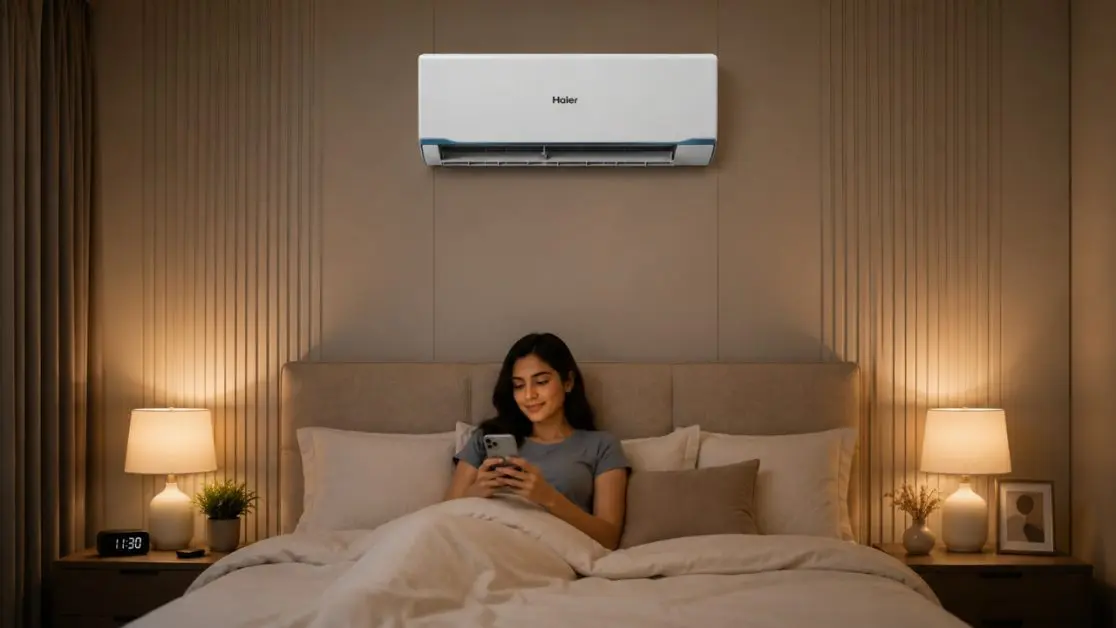
Bedroom usage
- Long duration
- Night-time
- Consistent cooling
Living room usage
- Short bursts
- Peak heat hours
- Intermittent usage
This is where intelligent systems matter.
The Haier 1.8 Ton 5 Star Desert Rose Air Conditioner uses AI-powered optimisation to monitor usage and shift to energy-saving modes, helping reduce unnecessary consumption
Choosing the right AC: A simple decision framework
One decision. Three paths.
Option 1: You optimise for comfort
- Choose lower tonnage for bedroom
- Focus on quiet operation and sleep modes
- Look for stable cooling features
Best for: Families, working professionals, light sleepers
Option 2: You optimise for performance
- Choose higher tonnage for living room
- Prioritise fast cooling and airflow
- Look for features like convertible modes
Best for: Large families, frequent gatherings, open layouts
Option 3: You optimise for intelligence
- Choose ACs that adapt automatically
- Look for AI-based cooling and human detection
The Haier 1.8 Ton 5 Star Gold Desert Rose Air Conditioner includes AI human detection that adjusts cooling based on presence, reducing energy waste
Best for: Smart homes, energy-conscious buyers
A quick comparison you can actually use
| Factor | Bedroom AC | Living Room AC |
| Purpose | Sleep and rest | Activity and gathering |
| Cooling Style | Steady and quiet | Fast and powerful |
| Tonnage | 1 to 1.5 Ton | 1.5 to 2 Ton |
| Noise Priority | High | Moderate |
| Airflow | Gentle | Strong and wide |
| Usage Time | Long hours | Short bursts |
The mistake most people make
They buy one AC. Expect it to do everything.
That is like using the same shoes for running, weddings, and trekking.
It works.
But it never feels right.
What modern ACs are quietly solving
Today’s systems are no longer just cooling machines.
They are decision systems.
The Haier 1.8 Ton 5 Star Desert Rose Air Conditioner (HSA20DSD-NAI5NB-I) offers 7-in-1 convertible cooling, allowing users to adjust capacity from 40% to 110% depending on room needs
This changes the equation.
You stop managing the AC. The AC starts managing the room.
How this shows up in real Indian homes
Scenario 1: The working professional
The bedroom matters more.
Long hours. Night usage. Quiet cooling.
A stable, efficient AC wins.
Scenario 2: The joint family
The living room becomes central.
Guests. TV. Conversations.
A powerful AC with strong airflow becomes essential.
Scenario 3: The new-age smart home
Both spaces matter.
But the approach changes.
You choose systems that think.
ACs that adjust to:
- Occupancy
- Weather
- Time of day
A small shift in thinking
Most people ask:
“What is the best AC?”
A better question is:
“What is the right AC for this room?”
That shift changes decisions.
Where Haier fits into this system
When an AC can:
- Detect human presence
- Adjust cooling automatically
- Optimise energy usage
- Deliver fast cooling when needed
It stops being a product.
It becomes part of how the home functions.
Models like the Haier 1.8 Ton 5 Star Desert Rose Air Conditioner (HSA20DSD-NAI5NB-I) and Haier 1.8 Ton 5 Star Gold Desert Rose Air Conditioner (HSA20DSD-GAI5NB-I) are built around this idea of context-aware comfort
The insight most people remember too late
Comfort is not created by temperature. It is created by alignment.
Alignment between:
- Room size
- Usage
- Technology
Get this right, and your AC disappears into the background.
Get this wrong, and you notice it every day.
So what should you do next?
Not more research.
Better observation.
Walk into your bedroom tonight.
Ask yourself:
- Do I want silence or stability?
- Do I want control or automation?
Then walk into your living room tomorrow afternoon.
Ask:
- How fast do I need cooling?
- How many people does this space serve?
The answers are already there.
Final thought
Every room has a rhythm.
The right AC does not fight it. It flows with it.
That is the difference between cooling a space.
And making it feel like home.
Frequently Asked Questions
Why does my bedroom AC feel perfect but the living room never cools properly?
Bedrooms are controlled spaces with fewer people, less sunlight, and closed doors. Living rooms constantly change with more movement, heat, sunlight, and open layouts make cooling harder.
Can I use the same AC type for every room in my house?
Technically yes. Comfort-wise, usually no. Bedrooms and living rooms demand completely different cooling behaviour.
Should I prioritise tonnage or features while buying an AC?
Start with room behaviour first:
Small quiet room → comfort features matter more
Large active room → airflow and cooling speed matter more
Why do some expensive ACs still feel disappointing?
Because the AC may not match the room’s usage pattern. Even premium ACs struggle when the cooling design does not fit the space.
Do AI-powered ACs actually save electricity?
They can. Smart systems adjust cooling based on occupancy, temperature changes, and usage habits.
What is human detection in modern ACs?
Sensors detect whether people are present and optimize cooling accordingly.
Are convertible cooling modes genuinely useful?
Yes, especially in living rooms where occupancy and heat levels constantly change.
What does ‘context-aware cooling’ really mean?
The AC adapts based on:
Room activity
Number of people
Weather
Time of day
Should I buy a smart AC if I work from home?
Usually yes. Longer operating hours benefit more from adaptive energy optimisation.