
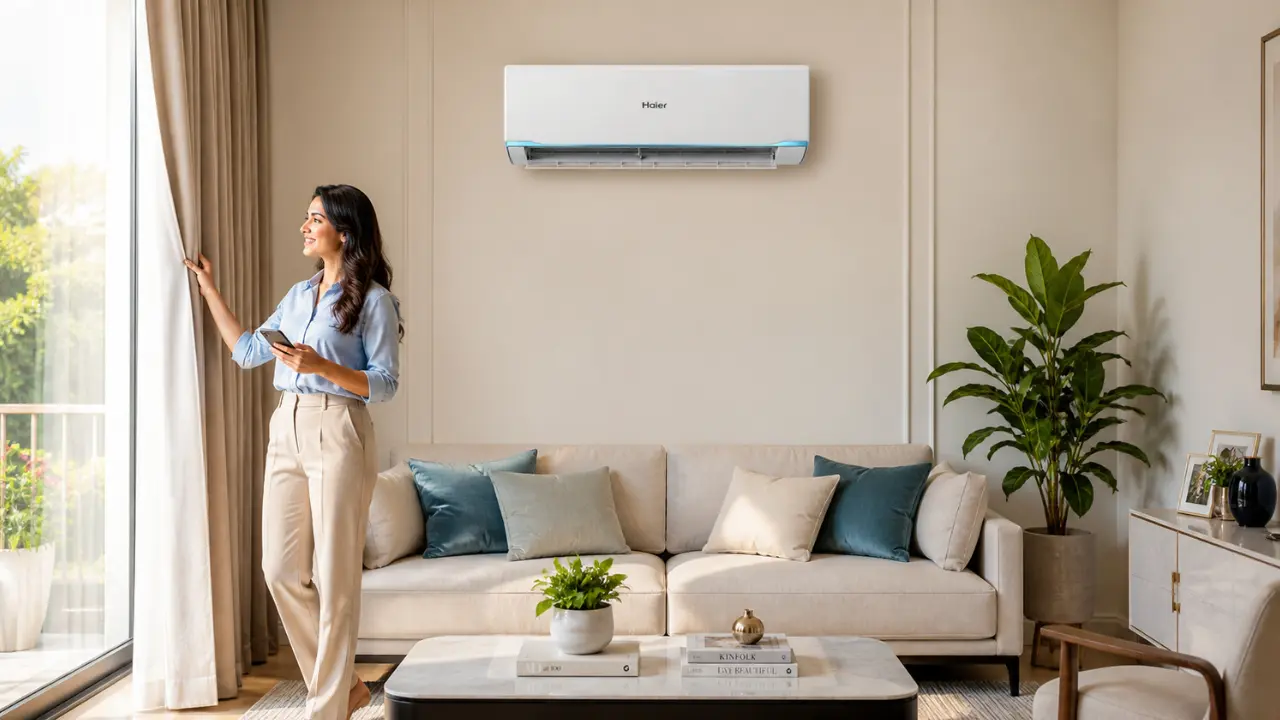

The right AC tonnage is not about buying “more cooling.” It is about buying the right balance.
A small AC struggles and keeps running endlessly. An oversized AC cools quickly but wastes electricity and often leaves rooms feeling damp or uneven. The right AC tonnage depends on room size, sunlight, ceiling height, occupancy, and how your home actually behaves during Indian summers.
Most people discover this too late.
At 2 AM.
When the room still feels warm even though the AC has been running for an hour.
Or worse, when the room feels cold but strangely uncomfortable.
That is the hidden system behind AC tonnage.
Cooling is not just temperature. It is a rhythm.
And Indian homes have rhythms most tonnage calculators ignore.
Why do most people choose the wrong AC tonnage?
Walk into any electronics store and the conversation becomes mechanical.
“How many square feet?”
“Go for 1 ton.”
“Take 1.5 tons.”
“Bigger is better.”
But homes are not spreadsheets.
A 120 sq. ft. bedroom in Bengaluru behaves differently from a 120 sq. ft. bedroom in Delhi’s top-floor summer heat. A west-facing Mumbai apartment absorbs heat differently from a shaded Hyderabad room with cross ventilation.
Same room size.
Different thermal reality.
That is why tonnage decisions fail when people reduce cooling to just dimensions.
An AC cools heat load, not square footage
Heat enters a room from everywhere:
- Sunlight through windows
- Top-floor concrete roofs
- Kitchen heat nearby
- Electronics running all day
- Multiple people inside
- Poor ventilation
- Humidity
The room is not static.
It behaves like a living system.
And the AC tonnage has to match that system.
What Does AC Tonnage Actually Mean?
The word “ton” confuses almost everyone.
It sounds like weight.
It is not.
AC tonnage refers to cooling capacity.
One ton of AC roughly means the system can remove enough heat to cool a standard-sized room under average conditions.
Here is the simplest way to think about it:
- 1 Ton = Smaller rooms
- 1.5 Ton = Medium-sized rooms
- 2 Ton = Large rooms or heavy heat-load spaces
But even this is incomplete.
Because modern Indian homes are changing.
Glass windows are larger.
Ceilings are higher.
Work-from-home setups run longer.
Families spend more time indoors.
The cooling equation has changed.
The Basic AC Tonnage Guide Most Homes Need
For small bedrooms
Usually suitable:
- 1 Ton AC
- Approx room size: up to 110 sq. ft.
Works best when:
- The room gets limited direct sunlight
- Ceiling height is standard
- Occupancy is low
- Usage is mostly nighttime
This is common in compact apartments, studio setups, and guest rooms.
For medium-sized bedrooms and workspaces
Usually suitable:
- 1.5 Ton AC
- Approx room size: 110 to 180 sq. ft.
This is where most Indian households land.
And this is why 1.5 ton ACs dominate the market.
They balance:
- Faster cooling
- Better airflow
- More stable comfort
- Reasonable energy efficiency
Especially during peak summer afternoons.
A good example is the Haier 1.6 Ton 5 Star Gravity AI Air Conditioner (HSA19GHD-WAI5NB-I), designed for medium-sized Indian rooms where cooling demand changes throughout the day.
For large living rooms or high heat-load spaces
Usually suitable:
- 2 Ton AC
- Approx room size: 180+ sq. ft.
Necessary when:
- Rooms face harsh sunlight
- Families gather often
- Ceiling height is high
- Large TVs and appliances generate heat
- Open layouts reduce cooling retention
Living rooms behave differently from bedrooms.
People move constantly.
Doors open frequently.
Heat load changes every hour.
That matters.
Bigger ACs Are Not Always Better
This is where most buying advice breaks.
People assume:
“Higher tonnage means faster cooling, so it must be better.”
Not always.
An oversized AC often creates three problems.
Problem 1: Higher electricity bills
Large compressors consume more power unnecessarily in smaller rooms.
Especially during long overnight usage.
Problem 2: Uneven comfort
Oversized ACs cool rooms too quickly.
Which sounds good until you realise this:
The AC shuts off before properly dehumidifying the room.
Result?
The room feels cold but sticky.
Humidity remains trapped.
Problem 3: More wear-and-tear
Frequent start-stop cycles increase stress on components.
Ironically, the “more powerful” machine sometimes works less efficiently.
A poorly matched AC behaves like wearing a winter jacket in mild rain.
Technically protective.
Practically uncomfortable.
Indian Summers Need Different Cooling Logic
India is not one climate.
It has many climates pretending to be one country.
Hot and dry cities
Cities like:
- Delhi
- Jaipur
- Nagpur
Need strong cooling capacity because ambient temperatures cross 45°C regularly.
Here, slightly higher tonnage often makes sense.
Several Haier Gravity AI Series models are engineered to maintain cooling performance even at 60°C ambient temperatures.
Humid cities
Cities like:
- Mumbai
- Chennai
- Kolkata
Need balanced cooling with strong humidity management.
Because comfort depends on moisture removal as much as temperature.
Moderate climates
Cities like:
- Bengaluru
- Pune
May not require aggressive tonnage upgrades unless sunlight exposure is extreme.
Climate changes the equation.
Always.
The Hidden Factor Most Buyers Ignore: Ceiling Height
A room with a 12-foot ceiling behaves differently from one with an 8-foot ceiling.
More vertical space means:
- More air volume
- More heat retention
- Longer cooling time
Builders increasingly market “spacious” homes.
But spacious rooms need smarter cooling calculations.
The brochure rarely mentions that part.
Why Inverter Technology Changes the Tonnage Conversation
Older ACs worked like switches.
ON.
OFF.
ON.
OFF.
Modern inverter ACs behave differently.
They adjust cooling dynamically.
Which means the system can adapt its output based on room conditions.
That changes efficiency dramatically.
For example, the Haier (1.6) 5 Star Moonstone Grey Gravity AI Series Heavy Duty AC, 5.12kW, 2026 Model (HSA19GHD-SAI5NB-I) uses HEXA Inverter technology designed to optimize cooling while reducing energy consumption.
That matters because modern cooling is shifting from fixed performance to adaptive performance.
A smart AC no longer just cools.
It learns.
Convertible ACs Solve a Problem Most Homes Face
Rooms do not behave the same way all year.
Or even all day.
At noon, the room feels like an oven.
By midnight, only light cooling is needed.
That is where convertible modes become useful.
Systems like the Haier (1.6) 5 Star Morning Mist Gravity AI Series Heavy Duty AC (HSA19GHD-MAI5NB-I) feature 7-in-1 Convertible cooling, allowing users to adjust cooling capacity depending on room conditions and occupancy.
This changes the tonnage discussion completely.
Because flexibility becomes part of the cooling system.
Not just raw power.
One AC Feature Now Matters More Than Tonnage Alone
Energy efficiency.
Because Indian households no longer buy ACs for occasional use.
They use them daily.
Sometimes all night.
Sometimes all summer.
Which means operational cost matters more than purchase price.
Three things to check
- Star rating
- ISEER value
- Inverter efficiency
For example, Haier Gravity AI Series models feature a 5-star rating with an ISEER value of 5.65.
That becomes important over years of ownership.
Because the real cost of an AC is not the invoice.
It is the electricity bill that repeats every month.
“A cheap AC can become an expensive roommate.”
That is the part most buyers miss.
Modern AC Buying Is Becoming More Behaviour-Based
People no longer want appliances that simply function.
They want systems that reduce friction.
An AC that adapts temperature during sleep.
An AC that monitors energy usage.
An AC that cleans itself.
An AC controllable from a phone while returning home from work.
This is why AI-enabled cooling is growing.
For example, the Haier (1.6) 5 Star Galaxy Slate Gravity AI Series Heavy Duty AC (HSA19GHD-DAI5NB-I) integrates AI-ATMOX technology that analyses room conditions and usage habits to optimize cooling automatically.
The interesting shift is this:
Cooling is becoming predictive.
Not reactive.
A Simple Framework to Choose the Right AC Tonnage
Option 1: Choose purely by room size
Fast.
Simple.
Often inaccurate.
Works only for standard rooms with average heat exposure.
Option 2: Choose based on lifestyle and heat load
More accurate.
Consider:
- Sunlight exposure
- Number of people
- Electronics
- Floor height
- Usage duration
- Local climate
- Ceiling height
This creates better long-term comfort.
Option 3: Future-proof your cooling
Useful for:
- New homes
- Hybrid work setups
- Expanding families
- Open layouts
This is where smart inverter and convertible systems create flexibility without forcing oversizing.
The Haier (1.6) 5 Star Midnight Dream Gravity AI Series Heavy Duty AC Model (HSA19GHD-PAI5NB-I) is one example of how modern AC systems now combine heavy-duty cooling, AI optimisation, and energy-efficient operation within a single platform.
What Smart Buyers Actually Optimise For
Not maximum cooling.
Balanced cooling.
That is the difference.
The best AC setup feels invisible.
No constant remote adjustments.
No uneven temperatures.
No noisy airflow.
No anxiety around bills.
Just comfort that quietly works in the background.
That is what modern Indian households increasingly want.
Especially younger buyers setting up homes that need to function across work, rest, entertainment, and family life simultaneously.
The AC is no longer a seasonal appliance.
It has become part of the home’s operating system.
Final Thoughts
The biggest AC buying mistake is treating tonnage like horsepower.
Cooling is more nuanced than that.
A well-chosen AC does not just cool faster.
It cools smarter.
It understands the room.
The climate.
The people inside it.
The way the home lives from morning to midnight.
That is why the future of cooling belongs to systems that adapt, optimise, and respond quietly in the background.
Because the best technology does not constantly remind you it exists.
It simply makes life feel easier.
Frequently Asked Questions
How do I know if a 1-ton AC is enough for my room?
A 1-ton AC is generally suitable for rooms up to 110 sq. ft. with standard ceiling height, limited sunlight exposure, and low occupancy.
My room is 120 sq. ft. Should I buy a 1-ton or 1.5-ton AC?
Room size alone is not enough. Consider sunlight exposure, floor level, ceiling height, climate, and daily usage. Many 120 sq. ft. rooms perform better with a 1.5-ton AC if heat load is high.
Is it safer to buy a bigger AC than I need?
Not necessarily. Oversized ACs can increase electricity consumption, cool unevenly, and leave rooms feeling damp because they don’t run long enough to remove humidity properly.
Why do two rooms with the same size need different AC tonnage?
Factors such as sunlight, ventilation, floor location, occupancy, and local climate create different heat loads even when room dimensions are identical.
What does AC tonnage actually mean?
AC tonnage refers to cooling capacity, not weight. It measures how much heat an air conditioner can remove from a room.
Does AC tonnage depend only on square footage?
No. Tonnage depends on total heat load, including sunlight, roof exposure, appliances, occupants, humidity, and ventilation.
Why does my room still feel warm after the AC has been running for an hour?
The AC may be undersized for the room’s heat load, or the room may have excessive heat gain from sunlight, poor insulation, or high occupancy.