

We lost the remote.
It falls behind the couch. The kid drags it into the next room. Someone accidentally places it on the dining room table. Five minutes later, everyone spends precious time hunting down a small device just to switch channels or launch a streaming app.
Kind of odd when you really think about it.
We have arrived at a place in time where people can book flights, order groceries, and pay bills just by using their voice. Yet millions of TVs around the world still make viewers press buttons over and over again to simply navigate to the content they’re looking for.
That’s where voice control using AI has begun to elevate the television experience.
The smart TVs of today aren’t just screens that sit quietly waiting for someone to throw a remote at them. They listen. They comprehend. They act. Most importantly, they make controlling the little things we do every day easier than ever before. and feel somewhat natural doing it.
If you’re like Indian families who are streaming across multiple services, trying to find something for the whole family to watch, navigating between games and connected smart home devices, AI-powered voice control is quickly going from a nice-to-have to a need-to-have.
And that’s where Haier’s new lineup of AI-powered Google TVs are helping to bridge that gap.
Where’s the Content?
OK, but here’s the honest truth.
The average person doesn’t have trouble finding something to watch because there isn’t any content available.
The problem is the opposite.
There is too much content.
One app has cricket highlights.
Another has movies.
A third platform has web series.
Then there is YouTube. Music apps. Sports apps. Gaming platforms.
Suddenly, finding something becomes harder than watching it.
Traditional navigation systems force users to:
- Scroll endlessly
- Type long search queries
- Jump between apps
- Use multiple menus
- Repeat actions again and again
It feels small at first.
But over weeks and months, those extra steps create friction.
AI-powered voice navigation removes much of that friction.
Instead of searching manually, users simply speak.
The television does the work.
What Makes AI Voice Control Different?
Voice control is not new.
But AI-powered voice control is significantly smarter.
Earlier systems could only recognise basic commands.
Commands like:
- Volume up
- Volume down
- Channel change
Modern AI systems go much further.
They understand context.
They recognise natural language.
They interpret intent.
For example, instead of saying:
“Open Netflix.”
A user can simply say:
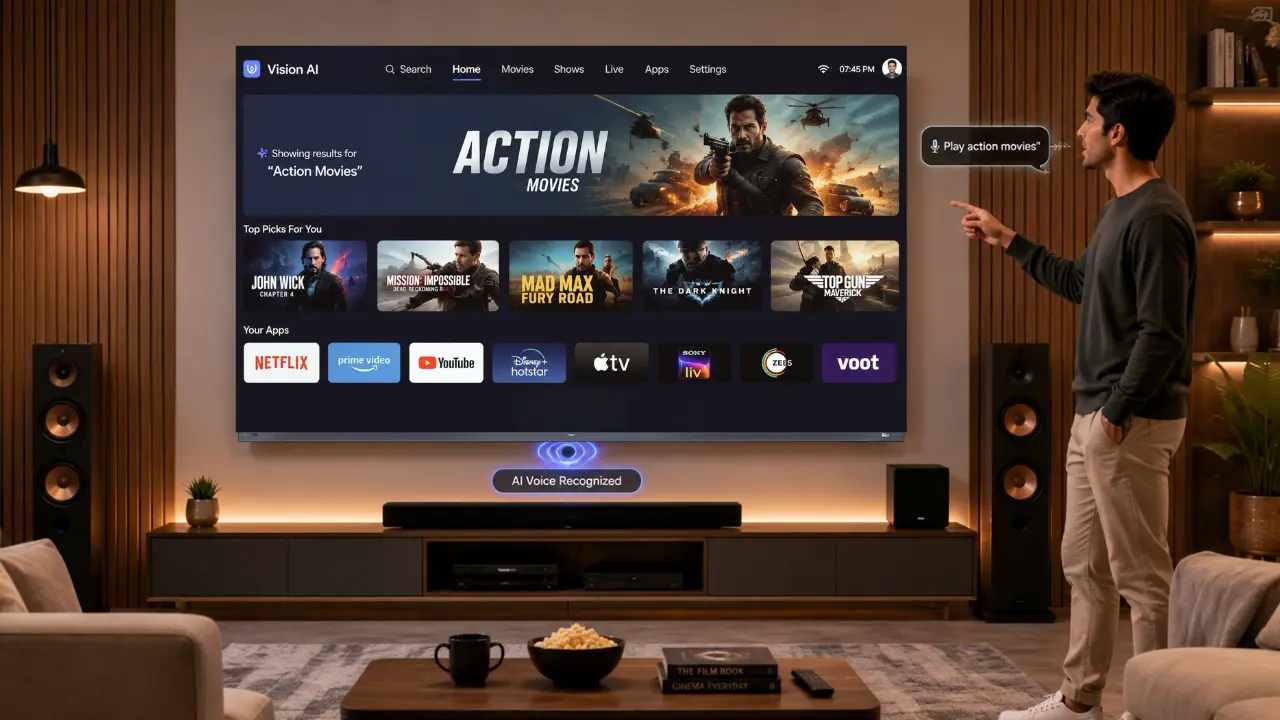
“Show me action movies.”
Or:
“Play cricket highlights.”
Or:
“Find family movies for tonight.”
The television understands the request and navigates accordingly.
That feels less like operating a machine and more like having a conversation.
Why Indian Families Benefit More Than Ever

Indian homes rarely have a single type of viewer.
The television serves multiple people throughout the day.
Morning devotional content.
Afternoon cartoons.
Evening news.
Night-time OTT streaming.
Weekend gaming.
Each viewer has different preferences.
AI voice navigation helps reduce complexity because users do not need to memorise menus or app locations.
For older family members especially, voice control often feels easier than navigating through layers of settings.
A simple spoken command can bring content directly to the screen.
How AI Improves Navigation Behind the Scenes
Here’s something many users never notice.
AI is working even when nobody is speaking.
Modern AI systems continuously optimise navigation by:
Understanding Viewing Behaviour
The system recognises patterns over time.
It learns:
- Preferred genres
- Frequently used apps
- Viewing schedules
- Entertainment habits
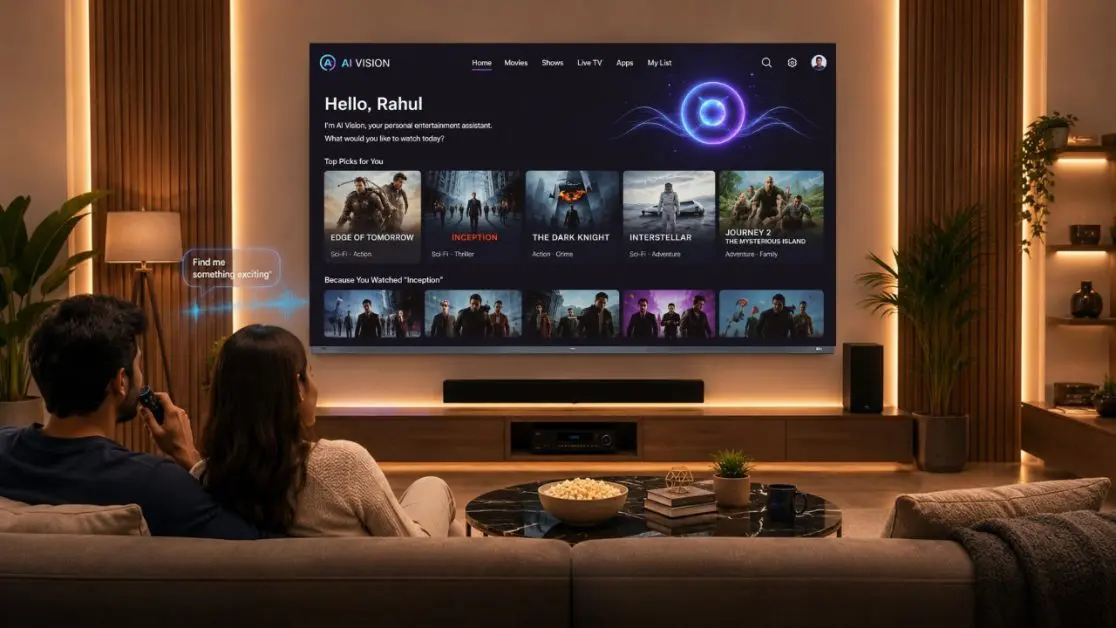
This enables faster recommendations and more relevant content suggestions.
Reducing Search Time
Instead of displaying hundreds of unrelated options, AI prioritises likely matches.
That means fewer clicks.
Less scrolling.
Faster access.
Creating Smarter Recommendations
The best recommendations often feel invisible.
You simply notice that content appears more relevant.
That is AI quietly improving navigation in the background.
The Growing Importance of Hands-Free Control
Now imagine this.
You are cooking.
Your hands are occupied.
A cricket match is playing in the living room.
An important wicket falls.
You want instant highlights.
Instead of washing your hands and searching through menus, you simply ask the TV.
Done.
Or maybe you’re relaxing after work.
The lights are dimmed.
You do not want to hunt for a remote.
A voice command solves the problem immediately.
These small moments are where AI-powered televisions become genuinely useful.
Not flashy.
Useful.
And useful technology tends to stay relevant much longer.
How Haier Integrates AI Into Voice Navigation

AI processing meets smart voice interaction with Haier’s new Mini LED Google TV series.
Experience hands-free voice control with Haier’s New M92 Series 164cm (65) QD- Mini LED AI Smart Google TV (H65M92FUX), Haier New M92 Series 189cm (75) QD- Mini LED Smart AI Google TV (H75M92FUX) and Haier New M96 Series 254cm (100) QD- Mini LED AI Smart Google TV (H100M96FUX) with AI-powered voice commands and Google TV built-in. From searching for your favourite shows to controlling your compatible smart devices, control your TV without reaching for the remote.
Not sure what that means? Basically, you can talk to your TV.
Entertainment becomes easier to access.
Navigation becomes faster.
The overall experience feels more natural.
Features That Strengthen AI Navigation
AI Ultra Sense Processor
Navigation feels better when the television responds quickly.
The AI Ultra Sense Processor supports fast scene recognition and intelligent optimisation for picture processing while helping deliver smoother overall performance.
Google TV Integration
Google TV brings together content recommendations from different apps into a single interface.
Instead of jumping endlessly between platforms, users receive curated recommendations and personalised suggestions tailored to their viewing preferences.
AI Navigation Is About Speed, Not Complexity
Many people assume AI adds complexity.
The opposite is usually true.
Good AI removes complexity.
Think about GPS navigation.
Nobody wants to manually analyse road maps anymore.
Similarly, nobody wants to manually search across dozens of entertainment platforms.
AI shortens the path between intention and action.
You say what you want.
The system helps deliver it.
Simple.
Beyond Entertainment: The Smart Home Connection
Televisions are becoming central control points within connected homes.
The latest Haier AI-powered Google TVs also support HaiSmart ecosystem integration, enabling broader smart-home connectivity capabilities.
This transforms the television from a standalone display into part of a larger connected environment.
The screen becomes more than a screen.
It becomes a digital hub.
What Buyers Should Look For in an AI Voice-Controlled TV
Before choosing any AI-enabled television, consider whether it offers:
| Essential AI Navigation Features |
| Hands-free voice control |
| Intelligent content recommendations |
| Personalised navigation |
| Smart TV platform integration |
| Fast processing capability |
| Smart home connectivity |
| Voice assistant compatibility |
The goal is not simply voice commands.
The goal is reducing effort.
The Future of Television Navigation Has Already Arrived
A few years ago, voice control felt like an interesting feature.
Today, it feels practical.
Tomorrow, it will probably feel essential.
With ever-growing content libraries and households adding more connected devices, AI-guided navigation is going to become critical to avoiding entertainment overwhelm. Case in point: Haier’s new Mini LED AI Smart Google TV lineup shows how AI can help jump past tech specs and into real-world ease.
From searching for content with greater speed, to navigating without a remote in hand, pulling up personalized recommendations or controlling connected entertainment with natural language voice commands, AI is transforming the television experience.
In fact, it may even change how we look at our TVs altogether.
The best technology no longer demands attention.
It quietly removes obstacles.
AI-powered voice control does exactly that.
Frequently Asked Questions
What is AI-powered voice control in a smart TV?
AI-powered voice control allows you to interact with your TV using natural speech instead of buttons or menus. You can search for content, open apps, control settings, and even manage compatible smart home devices through voice commands.
How is AI voice control different from traditional voice commands?
Traditional voice systems typically respond to simple commands like “Volume Up” or “Open Netflix.” AI-powered systems understand natural language, context, and intent, allowing you to speak more conversationally.
Can I talk to my TV like I talk to a person?
Modern AI-powered TVs are designed to understand conversational requests such as “Find family movies for tonight” or “Show me cricket highlights” rather than requiring specific command phrases.
How does AI learn my viewing preferences?
AI analyzes viewing patterns over time, including favorite genres, frequently used apps, watch history, and viewing schedules.
Why do recommendations improve over time?
As the system gathers more information about your habits, it becomes better at suggesting content that matches your interests.
Can AI recommend content for different family members?
AI can adapt to household viewing patterns and provide more relevant recommendations based on usage behavior.