

Every sports fan experiences this moment:
The bowler fires the ball at 145 km/h.
A winger curls in a cross.
A Formula 1 car vanishes around a corner.
Your TV pauses for just a fraction of a second to decide if you’re going to see this moment clearly. or not.
Ok, maybe I’m being a bit overdramatic.
But if you’ve ever watched sports and the ball looked blurry or the players seemed like they were jumping around a slide show during gameplay… You’ve already felt the issue.
The single biggest difference between a mid-range television and a quality sports viewing tv isn’t always size.
It can be motion.
And once you see the difference, you’ll never forget it.
Why Motion Quality Matters More Than Most People Realise
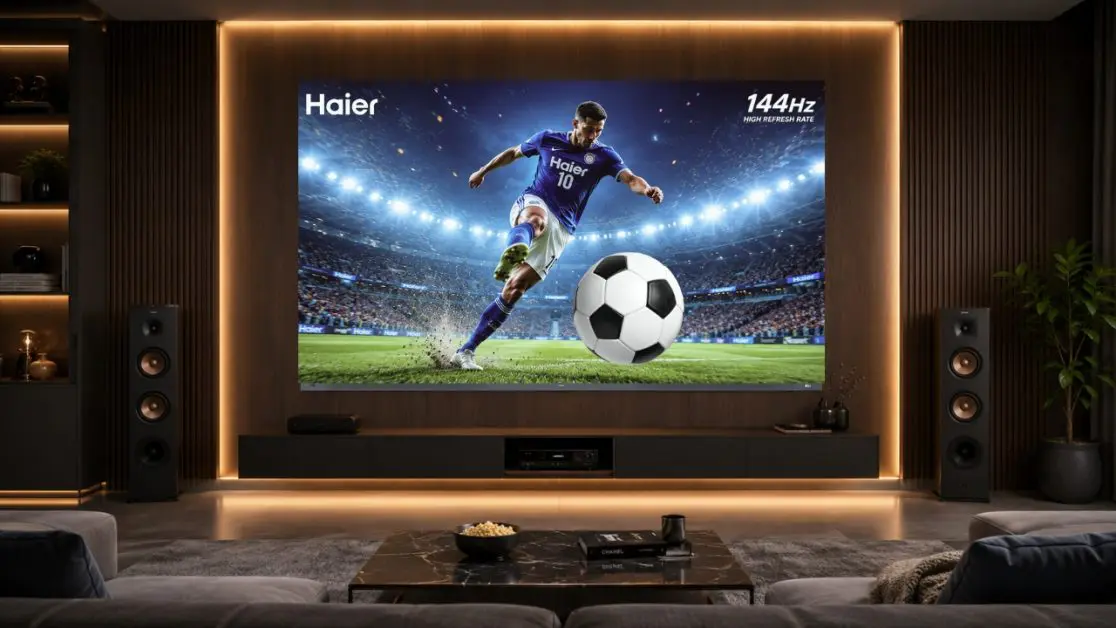
Sports content is different from movies.
A film scene may stay relatively stable for several seconds.
Sports don’t.
Everything moves.
Constantly.
Consider a typical IPL match:
- Fast bowling deliveries
- Quick camera pans
- High catches
- Fielding dives
- Score graphics updating continuously
Your television has to process all of that in real time.
If motion handling is weak, the result becomes:
- Motion blur
- Judder
- Ghosting effects
- Reduced clarity during fast movement
- Eye fatigue during long viewing sessions
The action is still happening.
You simply aren’t seeing it the way it was meant to be seen.
The Problem Isn’t the Broadcast
Many viewers blame streaming platforms.
Others blame their internet connection.
Sometimes that’s true.
But often, the television itself becomes the bottleneck.
A sports broadcast can contain an enormous amount of visual information every second.
A television with advanced motion optimisation is capable of displaying that information smoothly.
A basic TV often struggles to keep up.
The difference becomes obvious during:
Cricket
Tracking the ball after it leaves the bat.
Football
Following player movement across large sections of the pitch.
Tennis
Watching high-speed serves and rallies.
Motorsports
Maintaining detail during rapid camera tracking.
Kabaddi
Capturing sudden directional changes and quick reactions.
These are precisely the situations where smooth motion technology matters most.
What Creates Smooth Motion on Modern Television?
Many people assume motion quality comes from one feature.
It doesn’t. Multiple technologies combine. Refresh Rate Explained Refresh rate is how often, per second, the screen “refreshes” what you see.
The higher this number is the smoother you can render moving objects at a fast pace. When watching sports, you really start to notice this when there are quick cuts and movements of the camera.
The Haier M92 Series and premium flagship Haier M96 Series come with a 144Hz refresh rate which allows you to enjoy smooth motion and less blur during high-speed scenes such as sporting events and action-packed movies.
AI Motion Processing
Raw refresh rate alone isn’t enough.
Modern televisions now use artificial intelligence to analyse scenes frame by frame.
This allows:
- Better object tracking
- Improved motion prediction
- Sharper movement rendering
- Enhanced scene clarity
Haier’s AI Ultra Sense Processor is specifically designed to recognise scenes intelligently while optimising motion, contrast, colour, and depth in real time.
For sports fans, that translates into smoother tracking of players, balls, vehicles, and cameras without constant blur.
Why Large Screens Need Better Motion Processing
Here’s something interesting.
The larger the screen becomes, the more visible motion flaws become.
A small blur on a 43-inch television may go unnoticed.
On a 164 cm (65), 189 cm (75), or 254 cm (100) display?
Not a chance.
That’s one reason premium sports enthusiasts increasingly prefer large-screen televisions with advanced processing capabilities.
The larger canvas exposes every detail.
Good details.
Bad details.
Everything.
Which is why motion technology becomes even more important as screen sizes increase.
Sports Viewing Is No Longer Just About Resolution
A few years ago, consumers focused almost entirely on 4K.
Today, the conversation has shifted.
Resolution matters.
But resolution without motion control creates a limited experience.
Imagine owning a high-performance sports car but driving it on damaged roads.
The potential exists.
The experience doesn’t.
The same applies to televisions.
A truly premium sports viewing experience combines:
- High refresh rates
- Motion optimisation
- HDR performance
- Brightness management
- Colour accuracy
- Sound immersion
Missing one piece weakens the entire experience.
The Role of AI in Modern Sports Viewing
Sports broadcasts today are more complex than ever.
Multiple camera angles.
Real-time graphics.
Instant replays.
Ultra-fast movement.
AI helps televisions process all this information more efficiently.
Haier’s Ultrasense AI integrates AI-driven optimisation across visuals, audio, gaming, and entertainment functions to create a more intelligent viewing environment.
For viewers, the technology works quietly in the background.
No complicated adjustments.
No endless settings menus.
The television simply adapts.
And honestly, that’s how technology should work.
Bright Stadium Lights Require Powerful Display Performance
Let’s be honest.
Most sports aren’t watched in perfectly dark rooms.
Indian households are lively.
Lights are on.
Curtains are open.
Family members are moving around.
This creates viewing challenges.
Premium sports televisions need enough brightness to maintain visibility under varying lighting conditions.
Haier’s QD Mini LED televisions combine HDR performance with high peak brightness capabilities, helping maintain image clarity and visual impact during daytime viewing as well as evening match sessions.
That means:
- Better visibility
- Improved contrast
- More realistic highlights
- Stronger image depth
Even during bright afternoon matches.
Sound Is Part of Motion Perception Too
Interesting fact.
Our brains don’t separate visual motion from audio perception as much as we think.
A cricket ball striking the bat.
The roar of a football crowd.
The engine note of a race car.
Audio reinforces visual movement.
That’s why premium sports experiences require strong sound performance.
The Haier M92 Series features Sound by KEF with a 2.1-channel speaker setup and Dolby Atmos support, while the flagship Haier M96 Series elevates the experience further with Sound by KEF and a 6.2.2-channel speaker configuration designed for a more immersive soundstage.
The result feels bigger.
More engaging.
Closer to being inside the stadium rather than simply watching it.
What Sports Fans Should Look For Before Buying a TV
Instead of focusing only on screen size, evaluate these factors carefully:
Motion Performance Checklist
- High refresh rate support
- Advanced AI picture processing
- HDR optimisation
- Sports viewing modes
- Strong brightness capability
- Dolby Atmos support
- Wide viewing angles
- Premium audio tuning
- Large-screen immersion
- Reliable smart platform
These factors influence real-world sports viewing far more than marketing slogans.
Why Haier’s QD Mini LED TVs Stand Out for Sports Enthusiasts
The reality is simple.
Sports viewing demands more from a television than almost any other type of content.
Fast movement exposes weaknesses immediately.
That’s where Haier’s latest QD Mini LED lineup is designed to make a meaningful difference.
Whether it’s the Haier New M92 Series 164cm (65) QD Mini LED AI Smart Google TV (H65M92FUX), the Haier New M92 Series 189cm (75) QD Mini LED Smart AI Google TV (H75M92FUX), or the flagship Haier New M96 Series 254cm (100) QD Mini LED AI Smart Google TV (H100M96FUX), the focus remains the same:
Deliver smoother motion, intelligent picture optimisation, immersive sound, and a premium sports-viewing experience.
And when the next boundary is hit.
When the winning goal is scored.
When the final over begins.
Those details matter.
Because great sports moments happen in fractions of seconds.
Your television should be ready for every one of them.
Final Thoughts
Sports fans invest emotionally in every match.
The television should not become the weakest link in that experience.
Smooth motion is no longer a luxury feature reserved for enthusiasts. It has become an essential requirement for anyone who wants clearer action, sharper movement, better immersion, and a more realistic viewing experience.
With AI-powered picture processing, 144Hz refresh rate technology, QD Mini LED display innovation, Dolby Vision IQ, Dolby Atmos, and premium KEF-tuned audio, Haier’s M92 and M96 Series televisions are built for viewers who expect every sporting moment to look and feel exactly as exciting as it should.
Frequently Asked Questions
I’m buying a TV mainly for cricket and football. Should I prioritize screen size or motion quality?
Motion quality should be one of your top priorities. A larger screen can make sports feel more immersive, but if motion handling is weak, fast-moving action may appear blurry or less detailed. Ideally, look for a TV that combines a large display with a high refresh rate and advanced motion processing.
Is a 4K TV enough for sports, or do I need additional features?
4K resolution helps with sharpness, but it doesn’t guarantee smooth sports viewing. Features like a high refresh rate, AI motion enhancement, HDR support, and strong brightness levels are equally important for handling fast-moving sports content.
Why do some sports broadcasts look amazing on one TV and average on another?
The difference often comes down to the television’s processing capabilities. Better TVs use advanced motion handling, image processing, and AI optimization to keep fast-moving scenes clear and smooth.
Why does the cricket ball sometimes look blurry after a fast shot?
This is often caused by motion blur. If a TV cannot refresh or process moving objects quickly enough, fast-moving balls and players may appear less defined.
My internet connection is good, but sports still don’t look smooth. Why?
While streaming quality matters, the TV itself can become the bottleneck. Motion processing and refresh rate limitations can affect how clearly movement appears on screen.
What causes players to look like they’re skipping frames during a match?
This effect is commonly called judder. It occurs when a TV struggles to display motion smoothly, especially during rapid camera pans or fast-paced action.
Does motion blur cause eye strain during long matches?
It can. Constant blur, ghosting, and inconsistent motion can make your eyes work harder to track moving objects, which may contribute to fatigue during extended viewing sessions.