
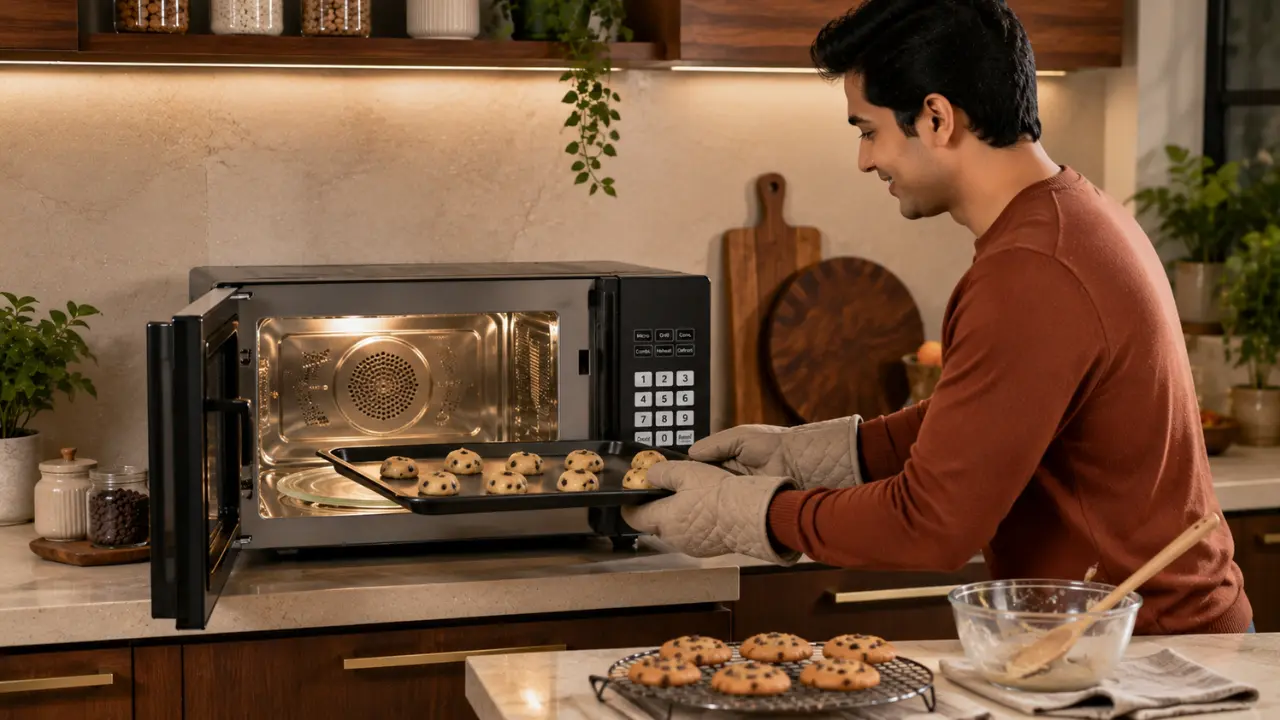

A cake may have the right ingredients, the right-looking batter and the right measurements and it still can come out wrong. However, there is a problem after baking. The centre sinks. More cookies than expected spread. The crust turns colors before the interior is cooked.
The issues start sometimes before the baking tray even enters the oven.
The following are important reasons why preheating should be done during the baking process: it ensures that the cooking cavity is heated to a thermal goal before the food enters the cavity and heats up the cavity in a relatively short period. If you’re baking in a convection microwave, you’ll know when and how to preheat which can make baking much more predictable.
The convection cooking function of Haier convection microwave range allows it to bake by convection cooking. One example is the Haier Convection Microwave Oven, 25L (HIL2501CBSH), which is designed to be used for baking cakes, cookies, muffins and cupcakes in convection mode.
Well, what should you do before clicking Start?
What Does Preheating Actually Do?
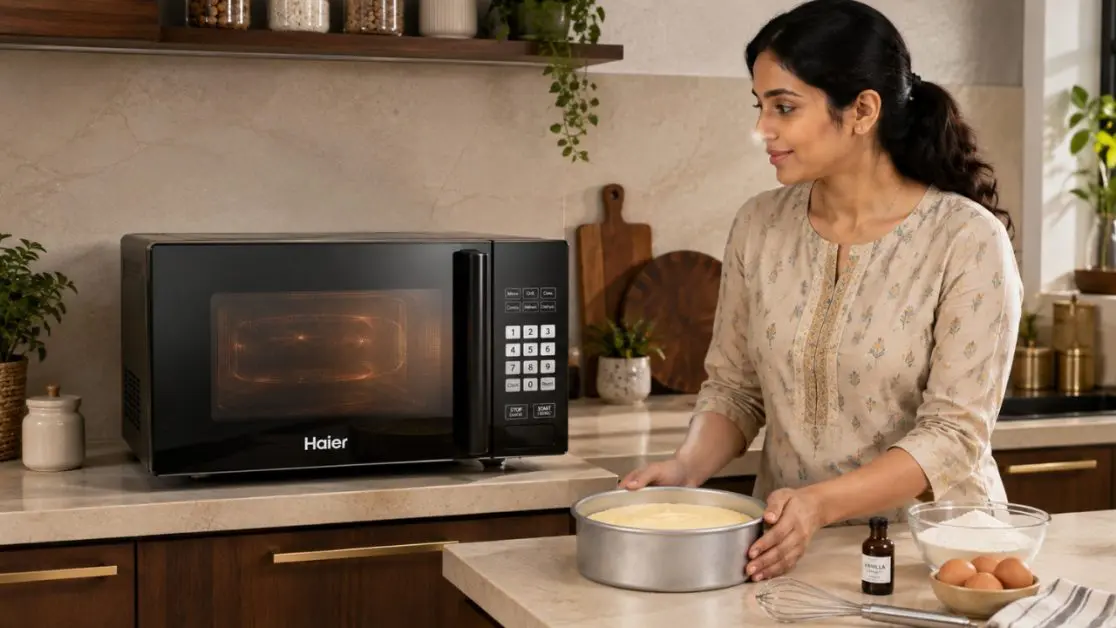
Consider preheating as setting up the cooking area.
If a recipe specifies a baking temperature, the food is normally to be put in a pre-heated cavity. A cold cavity will have the batter or dough waiting in the cavity for some of the cooking time before it starts to cook.
This may impact the rising, setting and browning of the food.
This is important in particular with:
- Cakes and cupcakes
- Cookies and biscuits
- Muffins
- Breads and buns
- Pizzas
- Baked savouries
With a convection microwave, baking relies on convection mode, rather than ordinary microwave heating alone. Haier’s own product guidance specifically instructs users to preheat the microwave in convection mode when baking a cake.
The Preheat-to-Plate Baking Routine
Instead of treating preheating as a separate technical step, it helps to see the entire baking process as one continuous sequence.
1. Read the Recipe Before Switching Anything On
Sounds obvious. It is also surprisingly easy to skip.
Check the recommended temperature, baking duration, pan size and any recipe-specific instructions first. Baking is far less forgiving than reheating yesterday’s dinner; small changes can produce noticeably different results.
And remember that timings are not universal. Haier’s product guidance itself notes that cake cooking times can vary from one microwave model to another.
2. Prepare the Batter Before or While Preheating
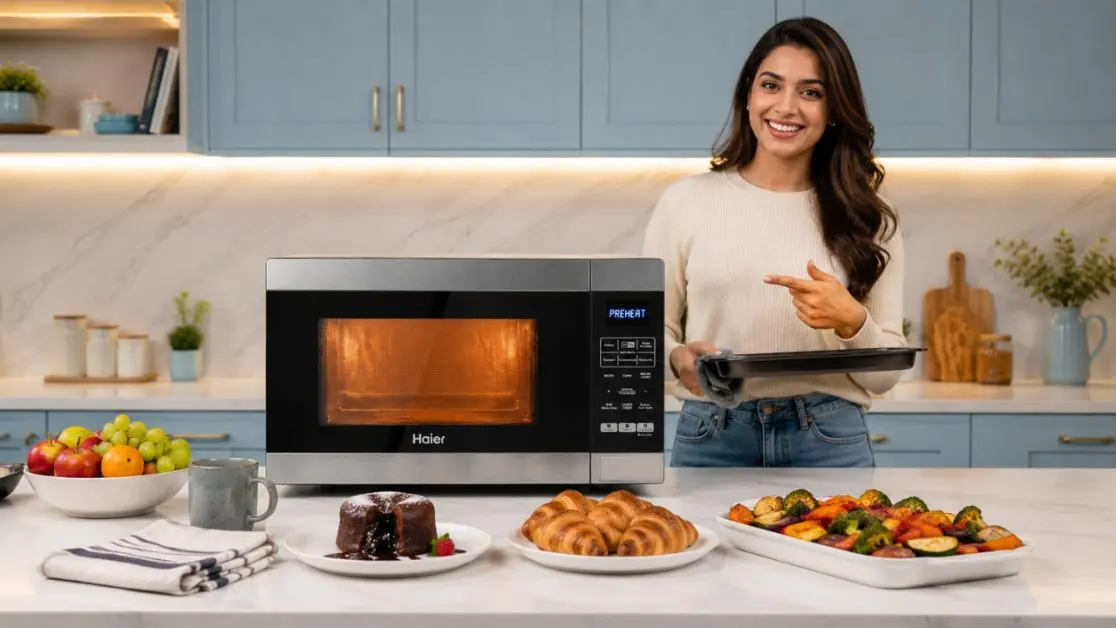
For many recipes, you don’t want a finished batter sitting around indefinitely while the appliance heats.
Have your ingredients measured and the baking tin ready. Depending on the recipe, coordinate the final mixing with the preheating stage so that the prepared batter can go into the appliance without unnecessary delay.
3. Select Convection Mode
This is the crucial bit.
For conventional-style baking in a convection microwave, use the convection setting specified by the appliance instructions and recipe.
Do not assume that regular microwave mode and convection mode perform the same job. Haier’s product information distinguishes microwave cooking from convection baking, while its combination functions bring different modes together for particular cooking requirements.
4. Set the Required Temperature and Allow Preheating to Finish
Set the temperature according to your recipe and appliance instructions.
Resist the temptation to put the cake inside halfway through because the cavity “must be warm enough by now”. Baking likes consistency.
Let the preheat cycle do its job.
5. Put the Food In Without Unnecessary Delay
Once preheating is complete, place the prepared baking dish or tray inside as directed for your model.
Try not to keep the door open longer than necessary. Opening a heated cavity allows heat to escape, which works against the very reason you preheated it.
Then set the baking time required by the recipe.
Five Small Baking Habits That Make a Big Difference
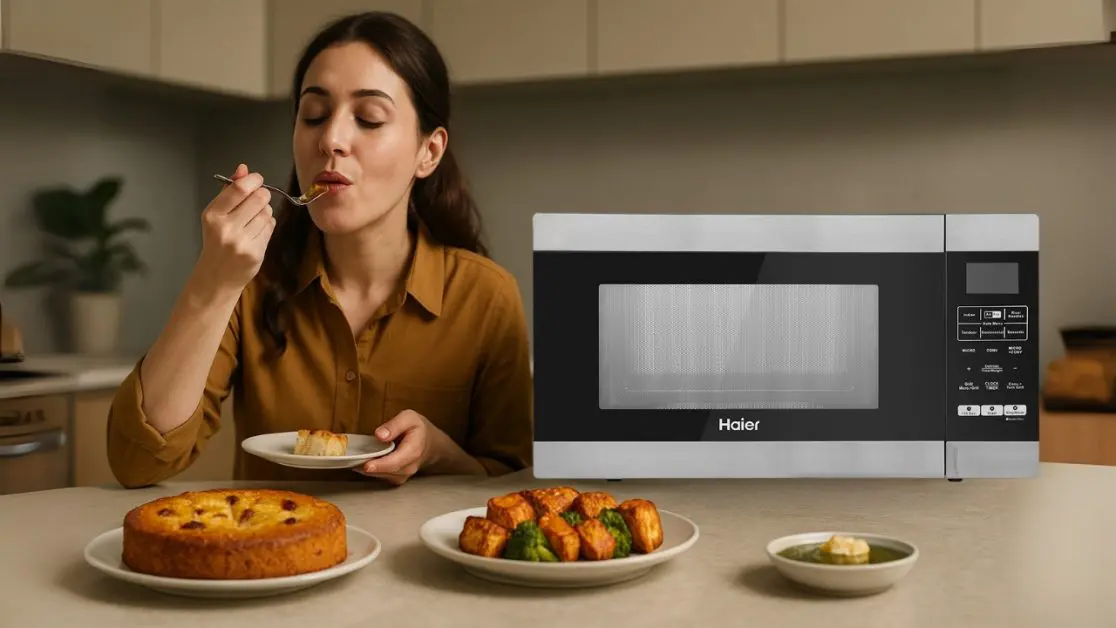
Preheating helps establish the right starting conditions, but it cannot rescue every baking mistake. A few basic habits still matter.
Measure carefully. Baking depends heavily on proportions. A little extra liquid or flour can change texture more than expected.
Choose suitable bakeware. Follow the appliance manual regarding compatible utensils and accessories for the selected cooking mode. Different modes can have different requirements.
Avoid constant checking. Opening the door repeatedly releases heat. Check when the recipe requires it rather than every few minutes.
Allow space where the recipe requires it. Cookies, buns and other items may spread or rise during baking.
Check doneness rather than relying blindly on the clock. Haier’s cake-baking guidance suggests using a toothpick to check whether a cake is done and continuing cooking if required.
That last point is worth remembering. A timer tells you how long something has baked. It does not physically inspect your cake.
Match the Appliance to the Way You Like to Bake
For Indian households, a convection microwave often needs to do considerably more than birthday cakes once or twice a year. It may be used for reheating breakfast, preparing snacks, grilling paneer and then baking in the evening.
That versatility is where Haier’s convection microwave portfolio becomes relevant.
Haier 25L Convection Microwave Oven (HIL2501CBSH)
For households looking for a 25L convection model, the Haier HIL2501CBSH combines convection functionality with features designed around varied everyday cooking.
Its listed capabilities include:
- 305 Auto Cook Menus, with preset power and time combinations
- Bread Basket, designed for Indian breads including naan, paratha, tandoori roti, kulcha and garlic bread
- Oil-Free Cooking
- Memory Function
- Paneer/Ghee/Curd Making function
- Combination cooking
- Stainless-steel cavity
- Deodorizer
The Bread Basket feature is particularly relevant for households interested in moving beyond basic cake baking and experimenting with different bread preparations.
Haier 30L Convection Microwave Oven (HIL3001CBSH)
Need a larger 30L capacity? The Haier HIL3001CBSH expands the cooking possibilities further.
Haier lists 400 Auto Cook Menus, Bread Basket, Oil Free Cooking, Home Fry menus, Ghee/Curd Making and low-temperature cooking. Its specifications also list 2500W convection power for quick cooking, baking and roasting.
Low-temperature cooking operates at approximately 40°C to 110°C over a prolonged cooking period, according to the product information. That gives this model another cooking technique beyond everyday convection use.
Want Baking Plus Air Frying? There Is Another Route
Some kitchens need one appliance to cover an even wider range of jobs.
The Haier 30L Convection Microwave With In-Built Air Fryer (HIL3001ARSB) combines microwave, grill, convection, air-fryer and rotisserie functions in one appliance. Its in-built air fryer includes 36 dedicated air-fryer menus, while the motorised rotisserie automatically rotates food to support uniform grilling.
It also provides:
- 305 Auto Cook Menus
- Five multi-power levels
- Stainless-steel cavity
- Combination cooking
- Air-fry tray
- Crispy plate
- Rotisserie rod and handle
- High rack, turntable and ring
The product’s specifications list a 30L capacity and 2500W convection power.
For someone who wants to bake one day, air fry another and use rotisserie-style grilling on the weekend, that multi-function design can reduce the need for separate countertop appliances.
One Rule Worth Remembering
When a baking recipe calls for preheating, don’t treat it as optional waiting time.
Prepare the recipe correctly, use convection mode as instructed, bring the cavity to the required temperature, minimise unnecessary door opening and judge doneness appropriately.
The process isn’t complicated. But those few minutes before the tray goes inside can influence what comes out.
And with Haier convection microwave options ranging from the 25L HIL2501CBSH and 30L HIL3001CBSH to the multi-functional 30L HIL3001ARSB with In-Built Air Fryer, home bakers can choose a model according to the kind of cooking they actually want to do not merely the occasional cake.
Frequently Asked Questions
Why is preheating important when baking in a convection microwave?
Preheating heats the cooking cavity to the required temperature before the food is placed inside. This helps provide more consistent conditions for baking and can affect how cakes, cookies, muffins and other baked foods rise, set and brown.
Which foods benefit from preheating?
Preheating is particularly relevant when preparing cakes, cupcakes, cookies, biscuits, muffins, breads, buns, pizzas and baked savouries.
Which mode should I use for baking in a convection microwave?
For conventional-style baking, use the convection mode specified by the recipe and appliance instructions. Regular microwave mode and convection mode are not interchangeable for baking.
When should I preheat the convection microwave?
Set the required baking temperature according to the recipe and appliance instructions, then allow the preheating cycle to finish before placing the prepared food inside.
Should I put the cake inside before preheating is complete?
It is better to wait until preheating is complete. Placing the cake into a partially heated cavity can affect the consistency of the baking process.
What should I do after preheating?
Once preheating is complete, place the prepared baking dish or tray inside without unnecessary delay, minimise the time the door remains open and set the baking time according to the recipe.