
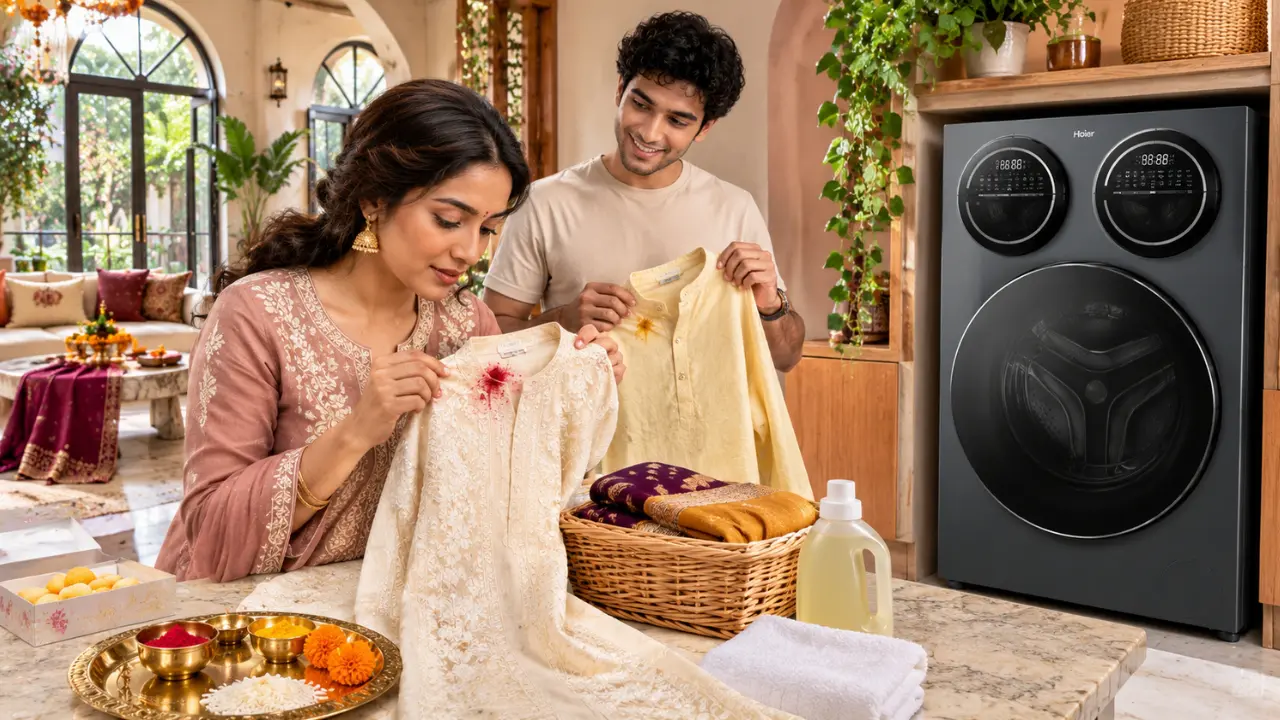

The festival of Bhai Dooj is now over. The sweets are distributed, family photos are taken and everyone is getting ready to get into their holiday attire. It’s in those moments you see something odd.
A shiny red kawashti mark on your favourite kurta. Maybe a yellowish stain on your brother’s white shirt, around the collar. Or a slight orange patch on the dupatta you meticulously picked out for the event.
This is a little bit of a celebration. Sadly, they don’t always go away after a normal wash.
Pigments and other constituents of Kumkum and chandan may attach to the fibre of a cloth especially when combined with oil, water or sweat. If they are washed without preparation, they can be seen as discoloured.
The solution? Know what you’re up against, be gentle with the affected area, and select washing techniques.
Proper maintenance and care of your holiday clothes becomes much easier with the Haier Triple Drum Washing Machine and some care before the holidays.
Why Do Bhai Dooj Tilak Stains on Clothes?

Some holiday stains are not like others.
A little water may evaporate into thin air. But kumkum and chandan can leave behind colour even after the powder or paste has been cleaned from the cloths.
This is because of their composition.
Kumkum: A Small Mark With Strong Colour
Kumkum is commonly used during religious ceremonies as a red tilak. It may contain ingredients derived from turmeric or mineral pigments or synthetic colourants or other additives, depending on the formulation.
These ingredients that produce colours can settle into the fabric fibers.
The stain can be especially problematic if:
- The ceremony involves mixing the Kumkum with oil or ghee.
- This powder is accidentally rubbed into the fabric.
- The colour is transported onto the neck by the perspiration.
- The clothing is left unlaundered for several days.
- Before assessing the fabric, hot water or the wrong cleaning products are applied.
Sometimes a small red mark can spread when rubbed with a wet cloth.
This is why the first few minutes of stain treatment are so important.
Chandan: Gentle on the Skin, Not Always on Fabric
Traditionally prepared chandan paste exists in the form of sandalwood and water but other ingredients in the tilak preparations available in the market might also be used for colouring.
When applied to clothes, the paste can dry and cause a yellowish, beige or brownish stain.
If oil or any added pigments are used in the preparation, the mark made by that preparation may need more attention.
These stains can actually be quite prominent in cotton kurtas, embroidered clothing and light coloured festive shirts.
Discovered a “Tilak Stain”? Don’t Put the Garment Straight Into the Machine
The temptation is understandable.
After a full day of celebrations, nobody wants to spend another half-hour inspecting clothes. You simply want everything washed and ready for the cupboard.
However, putting stained garments directly into a washing machine without checking them can make stain removal more difficult.
Start with these precautions:
- Check the garment’s care label before applying water or detergent.
- Avoid rubbing dry kumkum into the fabric.
- Never use bleach without confirming that the fabric permits it.
- Keep heavily stained garments away from delicate festive clothing.
- Avoid ironing or tumble-drying the affected area until the stain has disappeared.
One more thing. Don’t assume that stronger detergent automatically means better cleaning.
The right treatment depends on the stain and the fabric, not simply the amount of cleaning product used.
Learn How to Spot and Take Out the Stains of Kumkum From Clothes Before Washing Them
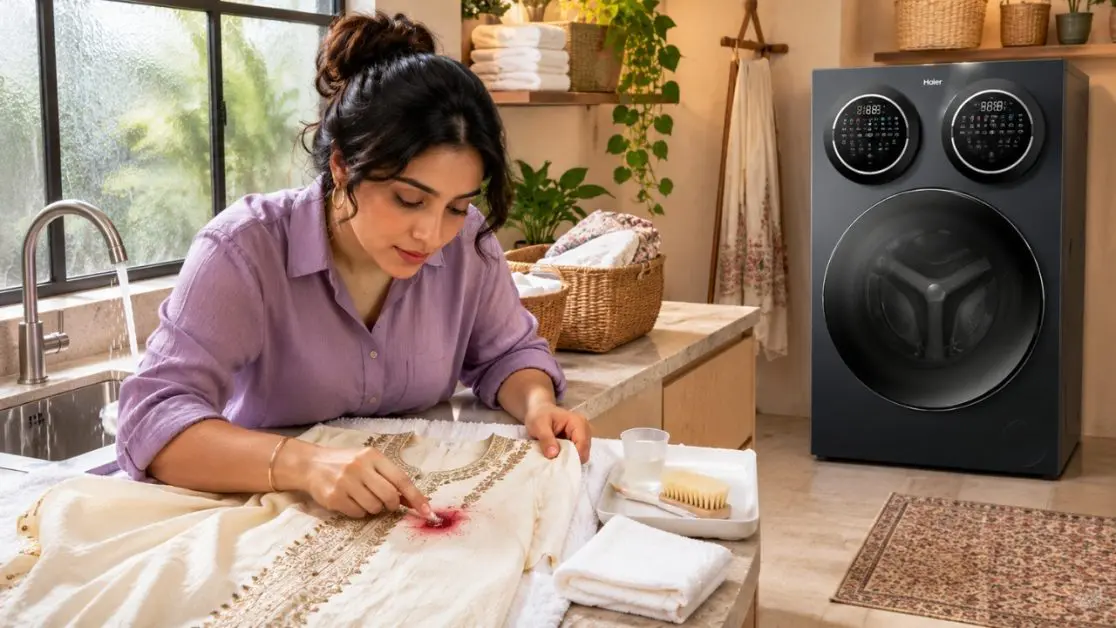
In the case of Kumkum, it is important to take it in small doses, particularly when wearing fancy clothes for a big occasion.
Step 1: Remove Loose Kumkum Carefully
To remove loose kumkum, be sure to handle it carefully to avoid breaking the rope.
If still wet, gently shake off any loose powder.
A soft, dry brush can be used to move the particles on the surface without compacting them deeper into the fabric.
Do not brush strongly on silk, embroidery or loosely woven fabrics.
Step 2: Rinse With Cool Water
If washing the item, position stained material under cold running water.
When possible, wash the back of the garment. This aids in repelling loose colour particles from the fibers instead of pushing them further.
Don’t use hot water at this point.
Certain pigment stains can be more challenging to remove after heat exposure.
Step 3: Use an Appropriate Liquid Detergent
Use a limited amount of liquid laundry detergent which is compatible with fabric on the affected area.
Use your fingertips to lightly buff the stain.
Wait about 5-10 minutes (as long as the directions allow for and the fabric care label states).
Avoid allowing the detergent to dry on the garment.
Test on an inconspicuous spot first with delicate or expensive fabrics.
Step 4: Rinse and Inspect
Rinse thoroughly treated area.
Repeat treatment only if necessary for the fabric if a mark is present.
In some preparations of kumkum there are the highly persistent colourants. These could need a stain remover or professional cleaning.
When the visible residue has been minimized the garment can be machine washed, if the care label indicates.
Removing Stains From Chandan Without Harming the Fabric
When it comes to Chandan stains, it is slightly different as dried paste leaves solid residue as well as discolouration.
The key is the following rule: take the paste out before you try to wash out the colour.
Start With the Dried Residue
If the chandan is dried, carefully remove the superfluous with a spoon or any smooth-edged tool.
Work carefully.
If over-scraped, sensitive threads and embroidery can become damaged.
Treat the Remaining Mark
For machine-washable fabrics:
- Cool with cool water.
- Apply a little of an appropriate liquid detergent.
- Use gentle massage motion on the stained area but be careful not to rub too hard.
- Leave the detergent for the recommended contact time.
- Rinse off before viewing results.
In the event that it has an oily aspect, a laundry detergent which is made to clear up oily stains might help.
Don’t try anything with lemon juice, baking soda or strong household cleaners on costly holiday clothes.
Some dyes and finishes for fabric are sensitive to these ingredients.
What About White Clothes?
Cotton kurta with yellow chandan marks on it can be really frustrating.
But white does not necessarily indicate chlorine bleach is safe.
Review the care label and only apply a suitable stain removal product.
Silk, wool, heavily decorated clothes or clothes that should only be dry cleaned should be professionally cleaned.
Your Washing Machine Matters After Stain Pre-Treatment
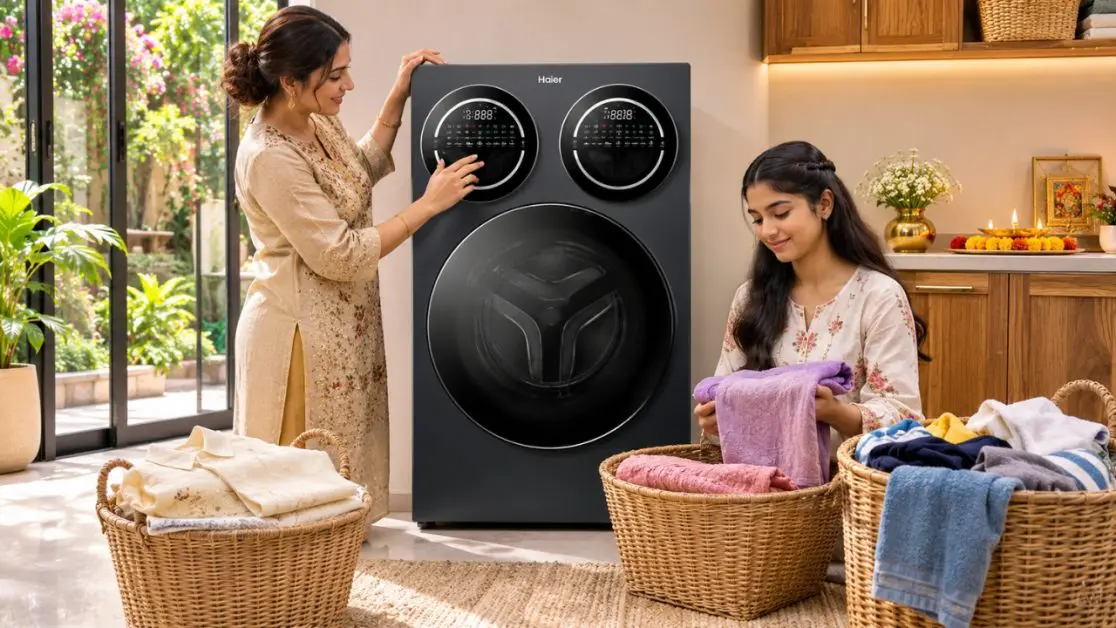
The concentrated mark is treated in pre-treatment. Then, when machine washed, these residues and general dirt are removed.
This is where making the right choice in fabrics, implementing wash programmes and laundry separation come into play.
Take a common laundry basket of Bhai Dooj.
You might have:
- Cotton kurtas that are worn during the puja.
- Everyday shirts that have light tilak lines.
- Delicate clothing that needs to be washed with a special care.
- Food and festive stains on children’s clothes.
- Household laundry, such as towels.
It’s not always the most effective to wash everything together.
Care instructions vary with various garments, and garments may require special washing to prevent colour transfer or damage to the fabric.
In households where mixed laundry is a frequent occurrence, Haier India has introduced an innovative product in the form of Haier Triple Drum Washing Machine (HW120-DM12LC3GNU1).
Haier Triple Drum Washing Machine: The Intelligent Laundry Solution During the Holidays
Holiday laundry doesn’t come packaged.
It’s typically a mix of regular cotton outfits, small delicate pieces and clothes that require special care.
Haier Triple Drum Washing Machine HW120-DM12LC3GNU1 is designed to offer a convenient management of various kinds of laundry by separating them into three drums independently regulated.
The washing machine has a total capacity of up to 12 kg and is equipped with:
- Large laundry load with one 10 kg main drum.
- Two extra 1kg upper drums (for smaller loads).
- Three special Direct Motion Motors.
- Independent controls for customised washing.
All three drums can be used at the same time and each drum may wash independently.
When it comes to separation of clothes based on washing needs, this will offer some flexibility to families who have to complete post Bhai Dooj laundry.
Keep Smaller Loads Separate With Three-Drum Independent Washing
Suppose you have pre-treated some washable festive clothes.
In the meantime, the entire basket of regular household laundry awaits.
The Haier Triple Drum Washing Machine does not merge all the laundry into a single load but could wash different kinds of clothes in one washing machine.
It has two smaller drums at the top, which are especially handy for loads that are the right size but which you don’t want to combine with larger clothing items.
The main drum has a capacity of 10 kg, which can be used for larger day-to-day laundry loads.
Households who often categorize clothes according to fabric or washing requirements will find this independent washing system convenient.
But still, clothing needs to be classified based on their care labels, colourfastness, and washability program.
This Drum Essence Is Designed to Make a Thoughtful Fabric Care
A washing machine should wash clothes, wash clothes.
There is also an important role for detergent distribution in the washing process.
Haier’s Drum Essence Wash technology optimizes the detergent and water mixture to make dense foam before washing.
This method is designed to help in deeper, but gentler cleaning of various fabric types.
This feature can help in the washing process after appropriate pre-treatment with kumkum or chandan stains.
Remember, no washing technology is guaranteed to remove all pigment stains.
Appropriate pre-treatment is still crucial.
Smart Dosing Takes the Guesswork Out of Detergent Dispensing
Too much detergent cannot be a quick way to get the clothes clean.
Using more than necessary can, in fact, leave unwanted residues and rinsing can be a problem.
Haier Triple Drum Washing Machine comes with the Smart Dosing feature to automatically dispense detergent & fabric softener.
The appliance features:
- 1 litre detergent compartment.
- An 800mL fabric softener box.
- Automatic dispensing which is meant to streamline detergent management.
This is especially handy when you have several loads of laundry, especially after a family party.
The machine’s dispensing system allows users to follow the manufacturer’s detergent recommendations and not have to manually measure the detergent repeatedly.
What Wash Programme to Use for Festive Clothes?
The various fabrics have various reactions to washing.
Haier Triple Drum Washing Machine has various washing programs such as Cotton, Silk, Soft, Gentle, Hygiene, Baby Care, Quick and AI Wash.
The right drum to choose will depend on the drum’s care instructions and drum care programmes.
Cotton Kurtas and Everyday Shirts
Generally, machine washable cotton garments will be able to be washed on an appropriate cotton wash programme.
Before washing:
- Pre-treat tilak marks that can be seen.
- Separate whites from coloured clothing.
- Test for colourfastness of the fabric.
- Use detergent and temperature recommended.
Delicate Festive Garments
Festive clothes have thin threads, decorative edges or slim materials blends.
If machine washing is allowed, a suitable gentle wash cycle can be used.
The Silk, Soft and Gentle programme options are flexible, but users should check the availability of the programmes on the selected drum.
Do not machine wash heavy embellishment / dry-clean only outfits as a delicate programme is available.
When Time Is Limited
Celebrations may be behind you, but daily life returns to normal in a few days.
The brand says that its Quick Clean technology can refresh appropriate clothing within a shorter time, down from 1 hour 29 minutes to 46 minutes under its specified ‘programme conditions’.
This can be helpful for clothes that are lightly soiled and can be laundered together.
But very soiled clothes might require a more suitable complete wash cycle following pre-treatment.
Is AI Wash Possible After the Festival?
When it comes to selecting an appropriate wash programme, some may find it confusing, especially if they have to deal with multiple types of laundry.
Haier Triple Drum Washing Machine features Multi-Drum AI Wash Technology.
This feature automatically suggests a washing programme according to the load of laundry, and allows the user to choose from an appropriate washing option.
It also has a touch panel on its door for easier wash controls.
These are effective features for handling laundry tasks easily for busy Indian households.
AI Wash should not be used as a replacement for reading labels or spot testing before putting fabric into the washer.
It is not intended for the identification of all the varieties of residue of kumkum or chandan.
Mistakes That Can Make Tilak Stains More Difficult to Remove
Sometimes the stain is not the problem.
It’s what happens immediately afterwards.
Rubbing the Stain With a Wet Towel
Rubbing may cause free-pigments to be dispersed and pressed deeper into the textile.
Generally, gentle rinsing or blotting is better.
Using Hot Water Immediately
Some stains will require more heat to remove.
Use cool water unless the directions for the stain-treatment product or garment call for otherwise.
Mixing Stained Clothes With Delicate Garments
These are clothes which bleed while in the washing machine.
Carefully sort stained clothes, and test colourfastness as required.
Ironing Before Checking the Stain
Some stains may be more stubborn when exposed to heat.
Check the article of clothing upon washing and prior to ironing.
Using Too Many Cleaning Products
Combining stain removers, bleach and household chemicals can damage clothing and may create safety hazards.
Never mix chlorine bleach with ammonia, acids or other cleaning products.
For one treatment at a time, follow the instructions.
Please Let the Festive Memories Stay and Not the Stains
Bhai Dooj is a festival celebrating the unique brother-sister bond. It should not mean that you do not wear your favourite festive wear just because you have to wear a little kumkum on a kurta or chandan on a shirt.
The secret lies in knowing when to act. Clear away the frizzy bits, treat the affected area with a detergent that is suitable for fabrics and wash the fabric with a suitable programme.
The Haier Triple Drum Washing Machine (HW120-DM12LC3GNU1) combines two separate washing drums with a new Smart Dosing and a new Drum Essence Wash function and AI-assisted program selection in one appliance.
Learn more about Haier Triple Drum Washing Machine from Haier India and find a new solution to handle everyday and post festive laundry.
Frequently Asked Questions
Can kumkum stains be removed completely from clothes?
Many kumkum stains can be reduced or removed through prompt pre-treatment and suitable washing. However, results depend on the pigment formulation, fabric type and how long the stain has remained untreated. Complete removal cannot always be guaranteed.
Does chandan permanently stain white clothes?
Not necessarily. Some chandan marks wash out with appropriate detergent treatment, while formulations containing added colourants or oils may be more persistent. Early treatment improves the chances of successful removal.
Should I use hot or cold water for Bhai Dooj tilak stains?
Cool water is generally a sensible starting point for rinsing fresh kumkum and chandan stains on washable fabrics. Always follow the garment’s care label and the instructions supplied with the stain-treatment product.
Can I wash festive clothes in the Haier Triple Drum Washing Machine?
Yes, provided the garments are suitable for machine washing. The Haier Triple Drum Washing Machine offers independent washing drums and multiple programmes for different laundry requirements. Always select a compatible drum and programme based on the fabric care label
Does the Haier Triple Drum Washing Machine remove kumkum stains automatically?
The machine offers technologies such as Drum Essence Wash, Smart Dosing and Multi-Drum AI Wash to support washing performance and convenience. However, persistent kumkum stains should be pre-treated before machine washing, and complete stain removal is not guaranteed.